
News
TCI: H.E. Governor Nigel Dakin’s Remarks Queen’s Birthday Parade


#TurksandCaicos, June 19, 2021 – “Turks and Caicos and a particular welcome to all on this parade. Let me compliment you on your turnout, your foot and rifle drill and your bearing.
It is the 95th Birthday of Her Majesty Queen Elizabeth II. In our national Anthem we sing “Long to Reign Over Us” and she most certainly has. She is the longest-reigning monarch in English History, surpassing the reign of Queen Victoria six years ago.
In those 95 years of life she has been our Monarch for 69 of them. She has been on the throne during the time in office of 14 British Prime Ministers and 14 US Presidents, the first being Prime Minister Winston Churchill and President Harry S Truman respectively. A remarkable record of Service and of experience.
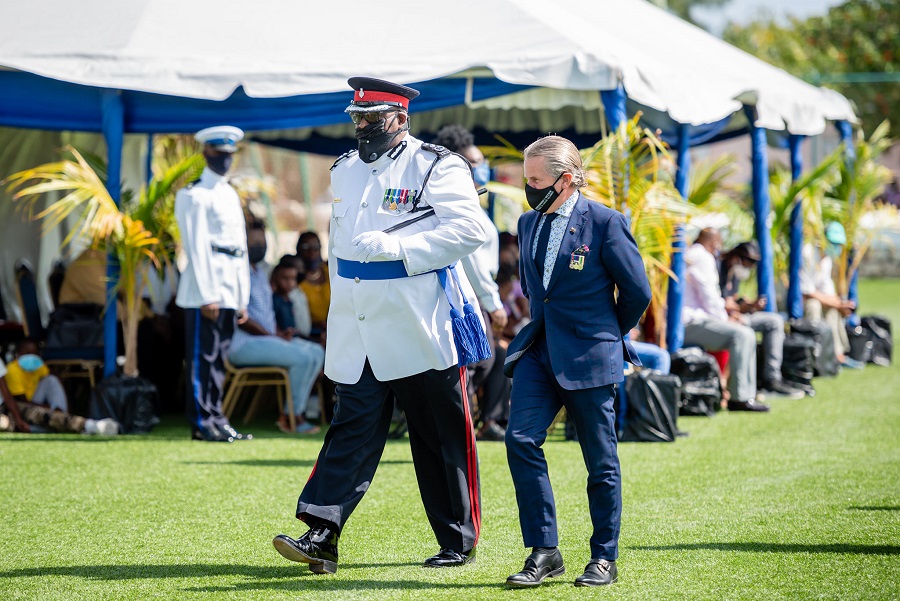
It is therefore entirely appropriate that we link this Parade with the notion of ‘service’, and also longevity of ‘service’. Service as personified by those stood before me today, who I have had the privilege to inspect, and who stand before our nation. As all of us here thank Her Majesty for Her Service to us, I, on Her Majesty’s behalf, and on behalf of the people of this Territory, thank you for your service to the People of the Turks and Caicos Islands.
This year thirteen have 30 years of service, two have 25 years of service and twenty eight have 18 years of service. This year they come from the Royal Turks and Caicos Islands Police Force, Her Majesty’s Prison, the Customs Department and Immigration Department. They of course share in common the concept of ‘enforcement’.
Enforcement takes skill and judgement and of course physical and moral courage. Wield your powers in to draconian a way and in the end there is a loss of public consent. Wield them too lightly, and there is a loss of respect not just for you, as an individual, but for the very law itself and at that point society starts to unravel. You carry a heavier constitutional burden than many understand.
If I may, at this Parade, I wish to particularly offer my thanks and respect to the Prison Service who marched past with pride today. An extraordinary change occurred at the Prison this year and that was due to leadership, teamwork and getting that balance of enforcement in exactly the right place.
To keep you out of the burning sun – and because there was no parade last year so the list is long – I will present medals today only to those Police Officers serving in Grand Turk. For those Police Officers in Providenciales we will present your medals at a Commissioners Parade later in the Summer which will also give the people of Providenciales the opportunity to enjoy the spectacle of the Police Band and your foot and rifle drill.
Moving away from this parade ground for a moment, and on the occasion of Her Majesty’s Birthday, and given the loss she suffered of her consort and most loyal supporter, I would also pay homage to Her late husband, His Royal Highness the Duke of Edinburgh. Throughout his life, he dedicated his time to many issues close to his heart. Two of them are worth dwelling on for a moment.

So first allow me to recognise the young people and their teachers with us today. The late Duke’s mission was to develop and empower young people to realise their potential. There is a moment in every child’s life when that potential is limitless but also their lives require focus and purpose. As a result he founded the Duke of Edinburgh Award. 13 million award journeys; 6 million awards gained; and 120 million hours of voluntary service achieved. One unique international accreditation, reaching 168 countries, over 65 years.
Young people from TCI have received in the past their Silver Awards through regional events and one young woman was presented her Gold Award by the Duke of Edinburgh himself. The Police Cadets, represented here today, and the British West Indies Collegiate, have run program’s to deliver the late Duke’s vision to inspire and invest in our youth, allow them to discover their potential, learn new skills and most important, forge new friendships along the way. This is how self-confidence and self-discipline builds something that our Cadets on parade today exemplify who are a credit to themselves, their parents and the wider community.
The Cadets are not for everyone, I accept, and as the consequences of pandemic subside I hope we might look again at the Duke of Edinburgh Award scheme as one of many approaches to developing the child here in TCI. Our own children participated in the scheme, gained much from it, and myself and Mandy stand ready to support and will be looking to re-energise this program during the coming year.
As a former President of the World Wildlife Fund, the late Duke was also personally engaged in wildlife and environmental issues; a theme that runs throughout the entire Royal family. On the occasion of Her Majesty’s Birthday, her son, His Royal Highness the Prince of Wales has sent out a message to the world drawing attention to the environmental tragedy that is impacting us all.
The protection of our environment against climate change and preserving our natural assets for many generations to come is increasingly seen as a global priority.
Climate change is reaching a tipping point. Humanity’s relationship with our beautiful planet is incredibly precious but endangered. Whilst we retain hope for the future, a degree or two more and we risk losing both our coral reefs and our beaches.

The world organises around a Climate Change Summit this year hosted in the UK. It’s known as COP26. The Overseas Territories have between them extraordinary environments hosting amazing bio-diversity from the Antarctic to the Indian Ocean, to the Mediterranean and the Pacific, and of course closer to home here in the Caribbean.
We in TCI steward, on behalf of the planet, the third largest barrier reef in the world. An extraordinary responsibility and while we are ‘Beautiful by Nature’ we know all too well, that as the seas warm, and as we are at the start of the Hurricane season, we are at the mercy of nature who does not always show us here her ‘beauty’ but also her extraordinary destructive power.
It is entirely in our interests, in TCI, to stop sea temperatures rising, and sea levels rising, and so let us all play our part – small as it may seem – and protect our marine life; our crystal clear waters; our beautiful beaches; and the mangrove and vegetation that surrounds us through local initiatives to reduce waste and fossil fuel energy consumption in our beautiful by nature islands.
Forty Six Thousand people cannot change the world alone, because it will take a global effort, but as a small island state who bears the full brunt of nature’s capriciousness we should provide leadership to the world in all that we do.
I end on welcoming, for the first time, the newest addition of those who serve TCI to this parade ground, if not this parade. You will see members of the Turks and Caicos Islands Regiment stood near to myself and the Premier today. This small contingent, who form the regular nucleus of our Regiment, will be joined next month by our own newly recruited reserve Marines who will undergo basic training run right here in TCI by the British Army, in July.
Next year, the TCI Regiment, seasoned through their first Hurricane Season and having been operational in support of our Maritime Police, and twinned with one of the British Army’s most prestigious Regiment’s ‘The Rifles’, will be stood on this Parade Ground joining you – the remarkable people of TCI who put yourselves before others in service of our Territory. That will be a remarkable Parade and, God willing, I intend to be here, to take that salute.
So may God Bless Her Majesty Queen Elizabeth. May God bless the Turks and Caicos Islands. May God bless all those before me and everything you represent in terms of serving our people, following the example that Her Majesty herself has set over an extraordinary life. ‘Long May She Reign Over us. God Save the Queen’.












March 19, 2026 – March is Colorectal Cancer Awareness Month, a time dedicated to highlighting the importance of prevention and early detection of one of the most common cancers affecting both men and women, according to the CDC.
March is Colorectal Cancer Awareness Month and according to the CDC, colorectal cancer is the third most common cancer for both men and women.
The good news is there are ways to help prevent it, like improving your gut health.
“A healthy gut and a diverse microbiome help decrease inflammation, and chronic inflammation we know can lead to increased risk of cancer, specifically colorectal cancer,” explained Julia Zumpano, RD, registered dietitian at Cleveland Clinic.
Zumpano said we can help improve our gut health by improving our diet.
She recommends eating foods that are high in fiber, such as whole grains, fruits, vegetables, legumes, nuts and seeds.
She also suggests adding fermented and probiotic foods into your diet. Some ideas include yogurt, kefir, kimchi and sauerkraut.
Zumpano notes that it can be overwhelming to eat a bunch of new foods at once, which is why it’s best to make a gradual transition.
“I would first begin by reducing processed foods and incorporating more fiber rich foods. And you’ll see your gut symptoms improve. So, if you have any symptoms like constipation or diarrhea, those things should improve. Now if you’re finding that you’re having gastrointestinal symptoms that aren’t going away despite making positive health changes, that’s when you should seek medical attention,” she advised.
Besides keeping a healthy diet, Zumpano said it’s also important to make sure you’re getting enough physical activity as exercise has been shown to help reduce a person’s risk for colorectal cancer.
By focusing on small sustainable lifestyle changes such as eating a fiber-rich diet, supporting gut health and staying physically active, people can take meaningful steps toward lowering the risk of colorectal cancer and improving their overall health.
How Venezuelan farmers are learning to grow and live with a devastating plant disease
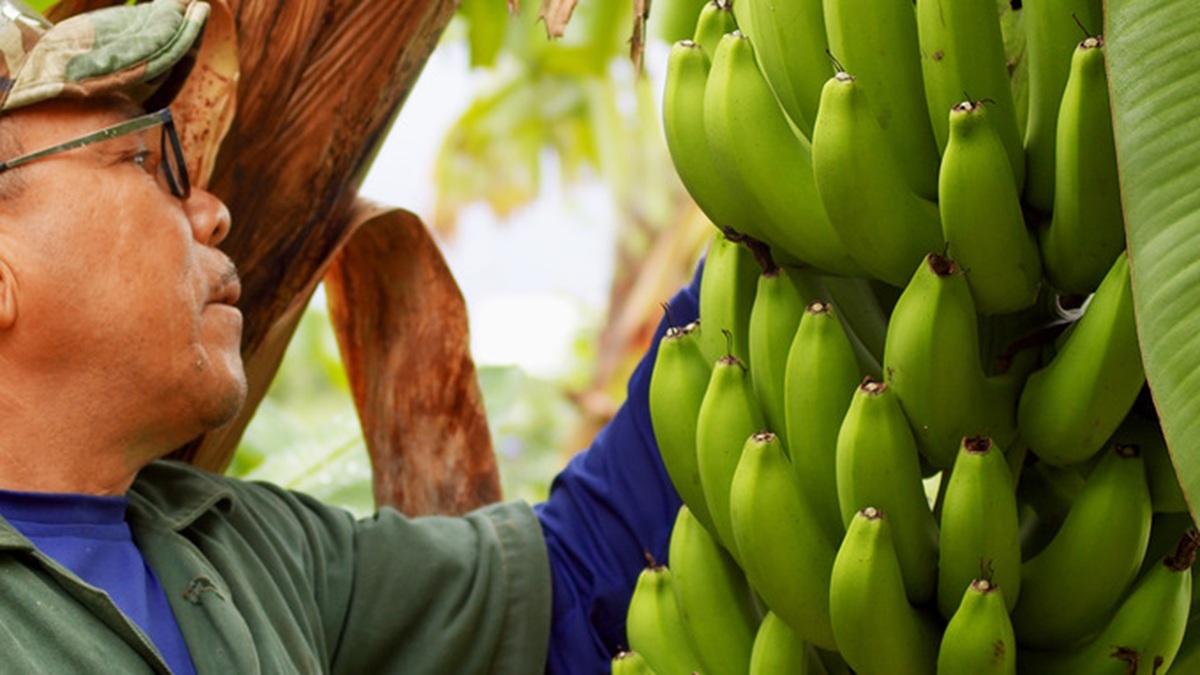
In the fields of Venezuela, where the banana has been for generations a symbol of sustenance and tradition, a shadow fell across the land. In 2023, Venezuela’s National Institute of Integral Agricultural Health (INSAI) declared a phytosanitary emergency: the fungus Fusarium Tropical Race 4 (TR4) (Fusarium oxysporum f. sp. cubense tropical race 4; syn. Fusarium odoratissimum) had arrived in producing areas in the states of Aragua, Carabobo and Cojedes.
This fungus, considered a devastating disease of banana and plantain (Musaceae) trees, can remain in the soil for more than two decades, threatening production and the lives of those who depend on it.
In the state of Aragua in the north of the country, the Renacer community had been growing bananas and plantains on 20 hectares since 2018. Then Fusarium arrived.
“When the disease hit, the entire plantation began to deteriorate. We refused to ‘die’ with the trees because that was our livelihood. The visits of INSAI confirmed that we had to chop down the banana trees. I cried a lot because I had worked with my banana trees for years,” recalls woman farmer, Lesbia Margarita García, with a broken voice.
In response, INSAI implemented measures to eliminate the affected plantations and improve the soil health by changing to other crops that allow agricultural production to recover. The Food and Agriculture Organization of the United Nations (FAO) offered assistance by providing corn seeds, tools, biosecurity inputs and training, with teams of experts helping farmers to start again.
“Planting corn, thanks to the INSAI-FAO programme, gave us a harvest that benefited everyone. We have been improving the soil,” says Lesbia Margarita with a smile. “Now we rotate crops, observe soil health and have learned how to use natural fertilizers. Expert assistance has been key.”
The pilot project works directly with affected producers in high-risk areas, promoting alternative crops such as cereals and vegetables, delivering inputs and tools to mitigate damage and applying biosecurity measures for safe and effective containment.
“Beyond the corn received, we have already planted cassava, chili peppers, beans and pumpkin. We hope that by the end of the year [2025] we will be diversified and that each season we will have something to sell. These lands do not give up,” says Lesbia Margarita with conviction.
The Renacer community is beginning to see fruits. Their products are reaching local markets, generating income and rebuilding their livelihoods.
Key actions to manage Fusarium TR4 are ongoing, including regular monitoring, continuous training, inter‑institutional coordination, updates to the national plan, information campaigns and producer impact assessments. INSAI is sustaining regulatory, surveillance measures and training —with FAO support—as part of a comprehensive long‑term strategy.
At the global level, FAO supports awareness raising, capacity building and international collaboration in the fight against Fusarium TR4 by facilitating the World Banana Forum and its Global Network on TR4.
“The objective is for countries to strengthen their operational and technical capacity, articulating actions between the public sector, the private sector and family farmers,” says Raixa Llauger, FAO Agriculture Officer in Mesoamerica. “FAO and local partners have promoted this approach in Venezuela.”
As an essential part of the activities, a comprehensive training programme was developed with activities that taught farmers how to identify the disease contain it and protect crops. In addition, FAO has distributed laboratory equipment, biosecurity tools and a multispectral drone to INSAI. Drones are an efficient and cost‑effective tool for phytosanitary surveillance, offering rapid, high‑resolution monitoring and early detection of plant pests and diseases.
Overall, the project strengthened biosecurity measures against the Fusarium fungus through the adoption of the National Action Plan and the establishment of partnerships with national and international institutions. In addition, the pilot initiative supporting smallholder farmers in key production areas and a nationwide awareness campaign with broad outreach improved surveillance, diagnosis and phytosanitary response capacities across the country.
News
Statistics Authority Highlights Trade Data as Turks & Caicos Records $227M in Imports for Q4 2025
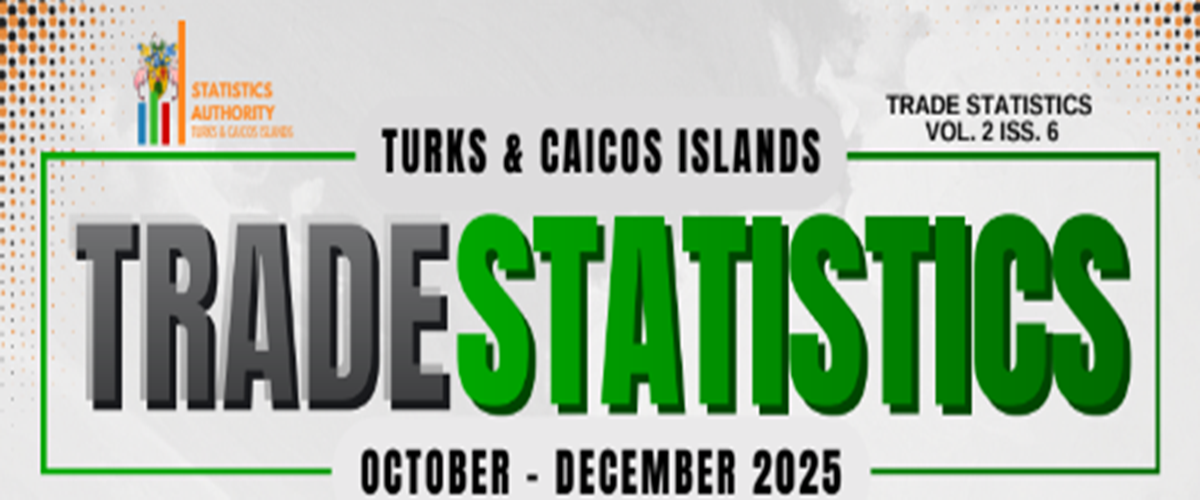
Turks and Caicos, March 18, 2026 – The Turks and Caicos Islands Statistics Authority is highlighting the importance of reliable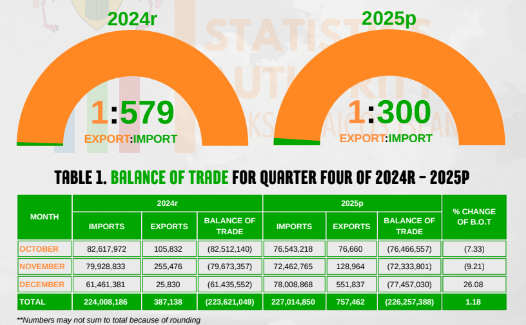 economic data following the release of its latest Trade Statistics Bulletin, which shows the country recorded approximately $227 million in imports during the fourth quarter of 2025.
The detailed report provides a clear breakdown of where goods entering the Turks and Caicos Islands are coming from, the types of products being imported, and the revenue generated from trade-related activity. The figures offer valuable insight into the level of economic activity across the country and the continued demand driven by tourism, construction, and consumer spending.
According to the bulletin, the United States remained by far the largest supplier of goods, accounting for more than $200 million in imports during the quarter. This represents the majority of all goods entering the Turks and Caicos Islands and reflects the territory’s long-standing dependence on U.S. markets for food, fuel, machinery, building materials, and consumer products.
The Dominican Republic was the second largest source of imports, supplying just over $4.1 million in goods, while The Bahamas ranked third, with approximately $1.8 million in imports recorded for the period. The report also noted increasing trade with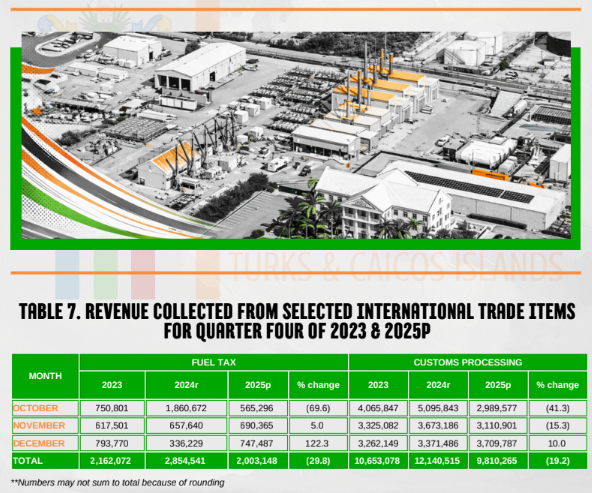 countries such as China, Panama, Switzerland, Poland, and India, showing that businesses continue to expand their supply networks beyond traditional partners.
In terms of the types of goods being imported, the bulletin shows strong activity in categories such as food and live animals, mineral fuels, manufactured goods, machinery and transport equipment, and chemicals, all of which are essential to supporting the tourism industry, infrastructure development, and everyday life in the islands.
The report also tracks revenue collected from international trade, including fuel tax, customs processing fees, and motor vehicle licensing, providing another measure of economic performance during the quarter.
Officials say the quarterly Trade Statistics Bulletin is an important tool for government, businesses, and the public, offering accurate information presented through clear tables, charts, and graphics that make complex data easier to understand.
For a small, import-dependent economy like the Turks and Caicos Islands, access to reliable statistics remains critical. By continuing to publish detailed trade reports, the Statistics Authority helps ensure that decisions about growth, investment, and development are based on sound information.






-

 Bahamas News7 days ago
Economic and Financial Experts Assess US-China Relations; Offer Advice for The Bahamas
-

 Bahamas News7 days ago
Experts Analyze Economic Landscape; Opportunities and Challenges
-
 News7 days ago
Beaches Resorts Announces Grand Opening of Treasure Beach Village at Beaches Turks and Caicos
-

 Caribbean News7 days ago
Widow’s Testimony Recounts Night Haiti President Was Killed
-

 Uncategorized3 days ago
WHERE ARE THE LOCAL ARTISTS?
-

 News7 days ago
North and Middle Caicos Students receive educational material from Sandals Foundation and Beaches Turks and Caicos resort
-

 Health2 days ago
Gut Health Linked to Lower Colorectal Cancer Risk According to Cleveland Clinic Dietitian
-

 News7 days ago
Sandals Foundation Reading Road Trip with Canadian Broadcasters Creates Cultural Mix at Enid Capron Primary School