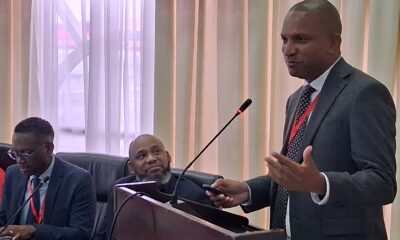
by
THE HONORABLE DR. MICHAEL R. DARVILLE, M.P. MINISTER OF HEALTH & WELLNESS
on FY 2024/2025 MID-TERM BUDGET
House of Assembly Thursday 6th March, 2025 11:00a.m.
MISTER DEPUTY SPEAKER
This morning I rise to give God thanks for allowing me another opportunity to stand to my feet to update this Parliament on what we have been doing in my Ministry over the last seven months. The good thing about this mid-term budget debate is the fact that in a few months we will be right back here again to debate the 2025-2026 Budget where I intend to give a full report on my Ministry’s work, including union agreements, medical training and recruitment, hospital and clinic developments while articulating our transformative agenda for healthcare reform across the country.
During my last budget communication, I foreshadowed my Ministry’s plan to move the Chronic Drug Prescription Plan from the National Insurance Board (NIB) to the Ministry of Health & Wellness. Well I am pleased to report to this honorable House that the management of the Chronic Drug Prescription Plan is now nested within the Ministry of Health & Wellness. Much work has already been done with our partners from NHI and NIB to move this plan to its final destination which is the National Health Insurance Authority (NHIA).
To facilitate this transition, I plan to lay a compendium of bills mainly the new NHI Bill, 2025 that would repeal and replace the current NHI Act, along with amendments to the Pharmacy Act and the NIB Chronic Non-communicable Disease Prescription Drug Plan Act. Once these bills are debated, passed and gazetted my Ministry will finalize the necessary legal adjustments taking us closer to universal healthcare coverage by way of National Health Insurance. This move by our Administration was foreshadowed in the famous Senagest Report which outlined the pathway to universal health coverage, completed under the former Christie Administration and outlined in our Blueprint for Change.
MISTER DEPUTY SPEAKER
NHI is our baby launched in 2016 under a Progressive Liberal Party (PLP) Administration and once again fate would have it that we are left to complete the heavy lifting to ensure this powerful social initiative moves to the second phase of the plan – catastrophic health insurance.
Yesterday, while on his feet the member for East Grand Bahama lambasted our Administration about placing Value Added Tax (VAT) on medication and bread basket items. And for cheap political points he tried to paint a picture that all of us on this side are being insensitive, cold and callus.
MISTER DEPUTY SPEAKER
This is far from the truth and I need to spend a few minutes to correct this misconception because if the truth be told our Administration is heading in the right direction to implement a more robust universal primary health coverage. As it stands the NIB Chronic Drug Prescription Plan now managed by my Ministry is currently providing free prescription drugs for chronic non communicable diseases to just over forty-four thousand (44,000) Bahamians mainly government workers and their families. Once transferred to NHI the one hundred, sixty thousand (160,000) plus registered NHI members who suffer from chronic non communicable diseases like hypertension, diabetes, heart disease, certain types of cancers, renal insufficiency, mental illness and other illnesses will finally have access to lifesaving medications free of charge. This is a huge initiative by our Administration and will change medical outcomes. While the Member of Parliament for East Grand Bahama was referencing about VAT on prescription drugs, our administration will be offering free medication to Bahamian citizens and residents across the country. Yes, under the complete universal primary healthcare package NHI patients would see the doctors free, get the labs and diagnostics free and very soon all medications for chronic non- communicable diseases will be provided free of charge for both private and public patients at healthcare facilities across the country that accept NHI. Yes, you heard it right free medication. This new policy decision by our Administration will not only help the poor and the unemployed, it would not only keep money in the pockets of our constituents but will certainly improve medical compliance, keep patients out of hospital and improve clinical outcomes of thousands of NHI patients across the country.
MISTER DEPUTY SPEAKER
The second powerful social, economic and public health initiative announced in this mid-term budget debate by our Prime Minister is the 50% VAT reduction on food items. This announcement is a powerful social initiative by our Administration and we will not allow members opposite to downplay it. Because if the truth be told they had the opportunity to do so but instead increased VAT on the backs of the poor when they promised not to do so. Polling across the country verified that the majority of Bahamians are grateful for the 50% VAT reduction and are looking forward to benefit from this timely policy starting next month.
A few days ago I meet a constituent in the food store who expressed her gratitude for this 50% VAT reduction on wholesome foods and not just bread basket items which in principle are unhealthy choices.
Finally, patients suffering from hypertension and diabetes and other chronic non-communicable diseases will have healthier affordable choices at the food stores and the public health benefits will go a long way. I support this timely progressive policy reform that is accentuating my Ministry’s health and wellness nutritional programs across the country.
MISTER DEPUTY SPEAKER
That is what real visionary compassionate leadership looks like and we on this side are proud of these new social initiatives. I intend to go into more details about these two life changing initiatives – free medication for patients suffering from chronic non communicable diseases and the 50% VAT reduction on foods at the grocery store in upcoming weeks leading up to the 2025-2026 Budget Debate.
MISTER DEPUTY SPEAKER
Despite the naysayers, healthcare is on the move and our Administration continues to work on behalf of the Bahamian people and position ourselves for a second term in office.
I remain grateful to the wonderful people of Tall Pines for this opportunity to serve and I will continue to do my best to address constituents concerns in this honorable place. I wish to thank both Ministers Bell and Rahming for their efforts and this morning I am pleased to announce that after three (3) years of pushing for a Tall Pines Urban Renewal Center, we finally got it and its located on Faith and Bellot Roads.
MISTER DEPUTY SPEAKER
We all know the positive roll urban renewal is playing in the country and I am confident that this Urban Renewal Center will address many of the complex challenges and social needs affecting families in the Tall Pines constituency.
MISTER DEPUTY SPEAKER
Numbers do not lie, and evidence based information is paramount in shaping public policy. My Ministry’s most recent STEPS Survey done in collaboration with the Pan American Health Organization (PAHO) verified the sobering fact that more that twelve (12) percent of the Bahamian population are living with diabetes and another seven (7) percent are pre-diabetic. Cardiovascular disease remains the number one cause of death in the country and despite our efforts non-communicable diseases have reached pandemic proportions over the last decade.
MISTER DEPUTY SPEAKER
Do you now that eighty (80) percent of non-communicable diseases are preventable? With health education, physical activity, nutrition counseling and lifestyle modification we can achieve better clinical outcomes for patients. The sobering reality is that many of our people are losing their limbs, their vision, their independence and ultimately their lives to chronic diseases that are completely PREVENTABLE. Chronic renal failure is at an all-time high and from the most recent numbers more than six hundred (600) Bahamians both young and old are on the government funded Hemodialysis Program and the scary part is many more are suffering from end stage renal disease and are on a waiting list. This silent epidemic is robbing families of their loved ones, and dialysis centers are overflowing with patients who are running out of options. This is why we are addressing this life threating problem from every direction inclusive of prevention, treatment and yes, live donor kidney transplants.
But, MISTER DEPUTY SPEAKER,
We do not need numbers to tell us this story—we in the Ministry of Health & Wellness see the devastating effects of end stage kidney disease every day. We see it in the long lines at the clinics and the worried faces of patients who fear the cost associated with the management of these life threatening conditions.
MISTER DEPUTY SPEAKER
These are not just statistics; they are our constituents and families from communities across the country. They tell the real story of a nation affected by chronic diseases brought on by lifestyle choices.
MISTER DEPUTY SPEAKER
When the Prime Minister invited me to serve as Minister of Health & Wellness,
I knew the weight of this twenty-four (24) hour job and the great responsibility. I knew there were many fires burning in the Ministry of Health & Wellness and the problems we faced were deep rooted, complex with no quick fix. I knew that in every direction—whether it was our hospitals, our clinics, our manpower challenges, patient access to care, or our ability to manage chronic non communicable diseases—we were facing serious health challenges across the country that could not be solved with small adjustments or temporary fixes. It would take time and planning, serious funding, patient education, legislative reform, recruitment and training as well as infrastructural upgrades to our crumbling hospitals and clinics across the country.
Let me be clear, Mister Deputy Speaker — the crisis in our healthcare system today is not just the result of an overburdened healthcare system and did not happen overnight. It is the direct and shameful consequence of unintentional neglect on both sides of the political divide and in some instances reckless political selfishness by members of the Free National Movement.
MISTER DEPUTY SPEAKER
The former Minister of Health, Dr. Duane Sands, confirmed what we already knew—the Minnis Administration did not prioritize healthcare. In Dr. Sands own words and I quote “I don’t think that under our watch health got the level of funding support that it should have gotten, that it deserved.” And even more damning, he admitted, “I believe there were priorities of the Minnis Cabinet that did not put health near the top of the list, certainly not during the first three years of our Administration.”
MISTER DEPUTY SPEAKER
They should hold their heads down in shame.
While Bahamians were suffering, while people were waiting months for lifesaving treatment, while our healthcare workers were crying out for help, while our doctor and nurses had no signed industrial agreements, Minnis and Sands were locked in a petty power struggle, playing petty politics. Instead of coming together to fix many of the challenges in the healthcare system, they were too busy fighting each other. Instead they opted to settle personal scores. As a result of this infighting little was done at the Princess Margaret Hospital (PMH) and the Department of Public Health (DPH) under their watch. The majority of the clinics in Nassau, Grand Bahama and the Family Islands were left in complete disrepair. The PMH was crumbling with wards gutted and dysfunctional under their watch and because of petty politics they were unable to carry out the people’s mandate clearly articulated in the institution’s vision statement.
MISTER DEPUTY SPEAKER
Days after being named the Minister of Health & Wellness I meet a male patient from Eleuthera who had to be flown out for emergency care because the clinic had no resources. A mother in Nassau who sat for hours in a waiting room, praying her child with COVID-19 would be seen and admitted before it was too late—she paid the price. An elderly dialysis patient in Grand Bahama waiting for surgical intervention for a nonfunctional fistula necessary to receive her life saving treatment and the question was why? Because of egos that resulted in the poor management of many patients. Yes, under their watch Bahamians suffered because two men both doctors, elected Members of Parliament could not put their differences aside long enough to focus on the job they were elected to do. The truth of the matter is the former Free National Movement (FNM) Administration squandered a once in a life time opportunity and what is so ironic now in opposition both Dr. Sands and Dr. Minnis have all the answers for healthcare.
Mister Deputy Speaker that is not what mature leadership looks like.
MISTER DEPUTY SPEAKER
Leadership is not about settling personal scores. It is not about optics. It is not about political revenge. Leadership is about protecting the people you serve. It is about making the tough decisions during great adversity, even when they are unpopular. It is about stepping up when the country needs you most. The former Administration failed the leadership test and did not lead by example.
But, MISTER DEPUTY SPEAKER
What the former Administration saw as a crisis and failed to deliver on our Administration sees as an opportunity for improvement. We can either continue to treat healthcare as a system that reacts when people get sick, or we can build one that works to keep them healthy. We can either watch our hospitals struggle under the weight of chronic diseases, or we can invest in primary and preventative care that gives Bahamians the support they truly need while
illnesses are in the early stages.
MISTER DEPUTY SPEAKER
A strong healthcare system does not exist in isolation. It is built on the foundation of a strong economy. Without economic growth, we cannot invest in new hospitals, expand healthcare services, or recruit the best doctors and nurses. Without financial stability, we cannot ensure that every Bahamian, no matter their background or income, has access to the healthcare they deserve. That is why our Administration is focused on two critical objectives: restoring the economy and rebuilding our healthcare system.
MISTER DEPUTY SPEAKER
Under the leadership of our Prime Minister the Honourable Philip Davis, we have turned the economy around. When we came to office, the country was saddled with debt, government revenues were in crisis, and investor confidence was at an all-time low. We did not run from the tough decisions. We stabilized public finances, restored economic growth, and created the fiscal space necessary to fund essential services including healthcare.
We have seen record levels of foreign direct investment. Unemployment is down. Revenue collection has improved. Investor confidence in The Bahamas is strong again. And because of this economic turnaround, we are now in a position to make the long-overdue investments in our healthcare system that previous administrations failed to deliver.
This is why we are building new hospitals, expanding and modernizing clinics, hiring and training more healthcare workers, and strengthening National Health Insurance. None of this happens without responsible economic management.
That is the difference our Administration is making. That is the reason we are able to invest in healthcare at an unprecedented level.
MISTER DEPUTY SPEAKER
Not long ago, a young mother from Cat Island told me about the long journey she took just to get her child the care he needed. Simple blood works and X-rays should not require plane tickets and a day off work.
This is the reality we inherited. A healthcare system where access depends too much on where you lived and too often, people slipped through the cracks. That is changing across the country as we speak. For three years in the midst of great challenges our Administration has been rebuilding the Ministry of Health & Wellness into something stronger; an institution that does not just react to crises, but plans, builds, and delivers for the people it serves. We have been ensuring that decisions are made faster, that resources go where they are needed most, and that the system works as one—whether you are in New Providence, Grand Bahama, or the Family Islands.
And yes, Mister Deputy Speaker,
A Ministry is only as strong as the professionals who serve in it. That is why we have prioritized the recruitment and training of healthcare workers—because a modern hospital is nothing without skilled, dedicated compassionate healthcare professionals inside it.
This is what transformation looks like.
MISTER DEPUTY SPEAKER
The Ministry of Health & Wellness is no longer simply managing a system it is leading a movement. A movement to make sure no Bahamian is left behind when it comes to healthcare. A movement to build something stronger, fairer, and better than what we met coming to office. A movement that will not stop until every Bahamian, on every island, has access to the care they truly deserve.
MISTER DEPUTY SPEAKER
There is a saying that if you want to understand a government’s priorities, look at where it chooses to invest. Well, Mister Deputy Speaker, look around. For the first time in decades, we are making the investments necessary to modernize and expand our healthcare system, not just in words, but in action, in concrete, in steel, in real change that Bahamians can see and feel.
Not long ago, I met an elderly woman in South Andros at the Miriam Green Clinic who told me about how she had to travel to Nassau just to get routine medical tests done. A man in San Salvador spoke about how the Cockburn Clinic was barely equipped to handle even the most basic emergencies and comply with the Club Med MOU. These are not isolated stories—this was the state of healthcare in The Bahamas for far too long. But we are changing that.
We are making the largest investment in healthcare infrastructure in a generation. Clinics across New Providence, Grand Bahama and the Family
Islands are being upgraded and expanded with labs and diagnostics. In South Andros, renovations are complete, and new medical equipment has been installed. In North Andros, the Mastic Point and Nicholl’s Town Clinics have been modernized. In Eleuthera, the Harbour Island, Spanish Wells, Bogue, James Cistern, and Lower Bogue Clinics have all been upgraded.
And we are not stopping there. We broke ground on new clinics in Mangrove Cay, Andros and Palmetto Point, Eleuthera and I am pleased to report to this honorable House that the new Coconut Grove Clinic in New Providence will make its way to Cabinet this month for final approval and will serve Englerston, St. Barnabas, and surrounding communities. In the Berry Islands, a new clinic will be built in partnership with Royal Caribbean, Via an Inter-American Development Bank (IDB) loan funding clinics in Moore’s Island and Black Point Exuma are in the making ensuring that local residents have access to modern healthcare. In Cat Island, work is underway on the Orange Creek Clinic and the Old Bight Clinic is near completion with final approvals already in place for the New Stevenson Clinic.
MISTER DEPUTY SPEAKER
This is what progress looks like.
And when we talk about capital works, we must talk about our hospitals. At the
Princess Margaret Hospital (PMH), the long-overdue expansion of Accident & Emergency where some areas are operational is now 80% complete and will be finished by May 2025. The tender process will begin soon for the renovations of the Princess Margaret Hospital Legacy Ward, the kitchen and the operating theater flooring. At the Rand Memorial Hospital major renovations are underway, including a new morgue facility and upgraded medical infrastructure. Yesterday the member for Central Grand Bahama showed some pictures of an area used to store medical waste trying to create an impression of neglect and poor management of the Authority. It was distasteful and politically driven. It was an old social media post taken during the transportation of medical waste that was resolved. If the truth be told the medical incinerator is old and emissions proved to be an environmental hazard that is currently being addressed.
MISTER DEPUTY SPEAKER
We are delivering on our promise of a state-of-the-art Freeport Health
Campus—that will transform healthcare in Grand Bahama and the northern Bahamas. In his mid-term communication the member for Cat Island, Rum Cay and San Salvador laid a resolution to borrow 75 million dollars as part of that funding for the Grand Bahama Health Campus, the PHM and very soon we will go out to tender for the second phase of the multistory tower that would complete the new Grand Bahama Hospital. The member of Killarney said it was a pie in the sky and could not be done. But look what the Lord has done for the people of Grand Bahama. Chinese XM Bank funding for the New Providence Hospital is near completion. We remain focused on our transformative agenda in health.
MISTER DEPUTY SPEAKER
None of this happens without vision, without commitment, and without action.
Our Administration came to office with a plan and we are executing that plan. New clinics, modern hospitals, better facilities, training and recruitment of healthcare workers—this is not talk, this is delivery in action.
And if truth be told every Bahamian, no matter where they live, deserves access to modern, well-equipped, and reliable healthcare facilities. And that is exactly what they will get.
MISTER DEPUTY SPEAKER
A healthcare system is only as strong as the people who run it. You can build the finest hospitals, invest in the best technology, and expand services across the country, but without well trained doctors, nurses, and allied healthcare professionals to staff them, the system fails. For years, we have asked our healthcare professionals to do more with less. Understaffed wards, overworked nurses, not enough specialists, and a system that left too many burned out and too many leaving for better opportunities abroad. That is not how you build a modern, world-class healthcare system.
Our Administration understands that if we want better healthcare, we need to invest in the people who provide it. And that is exactly what we have been doing.
We are training and recruiting more nurses and doctors. Over the past year, fifty-eight (58) new intern nurses have joined the workforce, and an additional thirty-five (350 of the sixty (60) registered nurses from Ghana are being processed to help fill critical shortages mainly at our hospitals. In Grand Bahama, fifty (50) student nurses have been enrolled in the Trained Clinical Nursing (TCN) Program, and another cohort will follow in the next budget cycle. The first class of Trained Clinical Nurses from the PHA Academy will sit their exams in May and with successful results strengthen our nursing pipeline.
We are investing in specialist training. More midwives are being trained, ensuring that mothers and newborns receive the care they need. A new Midwifery Program began in January of this year, adding twenty-two (22) more trained professionals to our maternal care services. And we are launching new training programs for Emergency Medical Technicians (EMTs), medical billing specialists, informatics, surgical technicians, and pharmacy technicians—roles that are critical to a fully functioning healthcare system.
We are tackling the long-standing problem of recruitment and retention. We know that if we do not support our healthcare workers, they will leave. That is why we are working to streamline onboarding, accelerate promotions, and ensure that healthcare professionals are paid fairly and on time.
MISTER DEPUTY SPEAKER
This is how you build a strong healthcare system—not just by investing in infrastructure, but by investing in people.
For too long, our healthcare workers were taken for granted. We value them, support them, and are ensuring they have the resources they need to provide the best possible care.
MISTER DEPUTY SPEAKER
Healthcare should be a safety net, not a financial trap. It should protect our most vulnerable, not push them into poverty. This Davis lead Administration will not ignore this issue, and we will not stop working until we create a system where every Bahamian can access life-saving care, regardless of their financial situation.
Over the past three years, I have met with countless Bahamians who have shared their fears, their struggles, and their hopes for a better healthcare system. I have spoken with nurses working double shifts in overcrowded hospitals. I have met with doctors frustrated by outdated equipment. I have held the hands of patients who simply want to get better but do not know how they will afford to do so. And I have listened. I understand the problems.
We have taken real steps to make things better—modernizing our hospitals and clinics, expanding healthcare coverage, investing in digital transformation, strengthening mental health services, and creating opportunities for new medical advancements. We have done the hard work of making the tough decisions, and committing more financial resources.
But, MISTER DEPUTY SPEAKER, we are not done.
It is about making sure that no Bahamian has to suffer in silence, hoping for help that never comes.
MISTER DEPUTY SPEAKER
That is why we will not waiver and we will not stop. We will not stop until every Bahamian—no matter where they live, no matter their socioeconomic status, everyone must have access to quality affordable healthcare. We will not stop until families no longer have to choose between medical treatment and financial security. We will not stop until we have built a healthcare system that truly serves the people of this country.
That is our commitment and that is what we are delivering. More will be said in the upcoming 2025-2026 Budget Debate where I look forward to further informing the people of The Bahamas of the work of the Ministry of Health & Wellness.
Thank you.













 and honor Turks and Caicos men who helped establish and develop the institution in Grand Bahama.
 showcase at the Kendal G. L. Isaacs Gymnasium. Following its inaugural year at the Kendal G. L. Isaacs gym and last year’s event at Loyola Hall, the tournament returned to the Kendal G. L. Isaacs gym this year.
 tournament’s growing impact on the development and advancement of young basketball talent in The Bahamas.