
News
Turks and Caicos Post Cabinet Meeting Statement

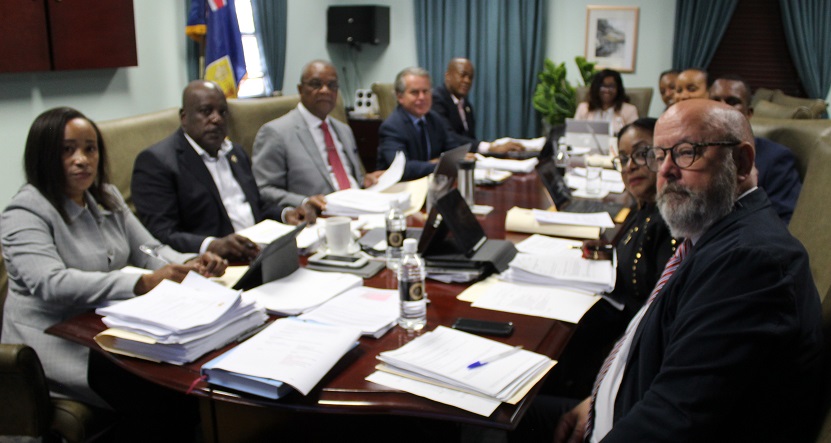
#TurksandCaicos, April 28, 2022 – Her Excellency the Acting Governor, Anya Williams, chaired the 11th meeting of Cabinet on Wednesday 23 March 2022 at the Premier’s Office on Grand Turk.
All Members were present. At this meeting Cabinet:
- Approved the Estimates of expenditure for a Supplementary Appropriation (No. 3) Bill 2022 for submission to the House of Assembly to facilitate: additional funding of the new pensions scheme; repatriation of irregular migrants; legal claims against government; procurement of assets and land acquisition for government.
- Agreed for the approved Provisional Warrant Resolution 2022-23 to withdraw funds from the Consolidated Fund in respect of the recurrent expenditure for part of FY2022-23 to be advanced to the House of Assembly.
- Approved an extension of the timeline for completion from 3 to 4 years and final Development Agreement between the TCI Government and BBF Cooper Jack Ltd. (The Strand) for the development of luxury residences and vacation villas in Cheshire Hall & Richmond Hill, Providenciales.
Was updated on the National Health Insurance Plan (NHIP) of the TCI National Health Insurance Board (NHIB) as at 31st December, 2021. Members approved for the NHIB to go outside of established analogues to recruit and remunerate the Change Manager Operations and Change Manager Finance positions.
- Approved for the TCI Government to host the Caribbean Examination Council (CXC) governance meeting in December 2022.
- Approve the appointment of Trevor Cooke as Chairman of the National Insurance Board for a period of 5 years with effect from 1 April 2022 until 31 March 2027. Members also approved the PS Education or his nominee to represent the Government in the absence of the PS of Finance.


Discussed the provision of official office space for the Leader of the Opposition.
- Approved the exemption of Import Customs Duties for the importation of a vehicle for a named individual similar to an existing policy which applies to Leaders of Churches.
- Approved the exemption of Import Customs Duties for the importation of all-terrain vehicles by Chukka Caribbean Adventures for the provision of excursions to cruise ship passengers on Grand Turk. Members also agreed for a revised policy in support of businesses working in the same sector.
- Approved for the TCI Government to enter into negotiations for the purchase of the following Parcels:
a) 10304/156, Grand Turk for the expansion of the tourism corridor on the island,
b) 10304/139 & 140, Grand Turk for the expansion of the tourism corridor on the island,
c) 51205/18, 43 & 44, North Caicos to construct a Community and Recreation Centre, and
d) 10404/157, Grand Turk for the purpose of developing domestic fire and emergency services on Grand Turk.
e) 60607/79, Providenciales, for the purpose of developing several capital infrastructure projects linked to internal and national security including but, not limited to, a Prison Remand Centre, the RTCIPF Marine Branch Base and an Immigration Detention Centre.
- Approved the applications for Class A Processing and Export Licenses from Caicos Seafood Ltd. (Godet Street, South Caicos); Caicos Fisheries Ltd. (Guagabeen Street, South Caicos); DNA Fishing (Albert Capron) and Provo Seafood (Five Cays, Providenciales) and discussed Class B Processing and Export Licenses for further discussion.
- Approved the extension of existing COVID-19 measures and protocols until 30 April 2022 and the following amendments:


a) Removed the requirement of obtaining written permission from the Chief Medical Officer or Chief Environmental Health Officer and written approval (permit) from the Department of Environment and Coastal Resources for any gathering or social activity (whether private or public), including on public beaches
b) Amend quarantine regulations requiring persons to self-isolate for 5 days if they test is positive.
c) Effective May 1st, 2022 only a negative covid-19 test within 72 hours will be required for visitors entry into the Turks and Caicos Islands and Pre-Travel Authorization will be discontinued.
Members also discussed the need for a Covid-19 strategy covering measures and entry requirements going forward.
Noted a paper on the regional implications of the ongoing war in Ukraine and approved the application of a temporary visa regime for Russian and Ukrainian nationals travelling to the Turks and Caicos Islands.
- Noted recommendations by the Procurement Board on the award of the following contracts:
a) TR 21/43, Consultancy Services for the Providenciales International Airport Redevelopment Project;
b) NHIB 03/2021, TR 21/11, Motor Vehicles for the national Health Insurance Board;
c) TCIFSC 02/2021, TR 21/20, Replacement Vehicle for TCI Financial Services Commission;
d) PN 005225, SSP, Homes for Domestic Violence – Providenciales, Ministry of Home Affairs and Transportation;
e) PN 005575, SSP, water Distribution Pumping Station – Grand Turk, Ministry of Home Affairs and Transportation; and
f) PN 005612, SSP, IT Command and Control System (CAD Radio Upgrade All Islands, Royal Turks and Caicos Islands Police Force.
Re-approved the granting of management responsibility to the Public Works Department over parcel 50206/7 for use as a staging area and an asphalt plant to facilitate the planned road works for North Caicos.
- Was updated on issues related to the Ministries of:
1. Immigration, and
2. Education.


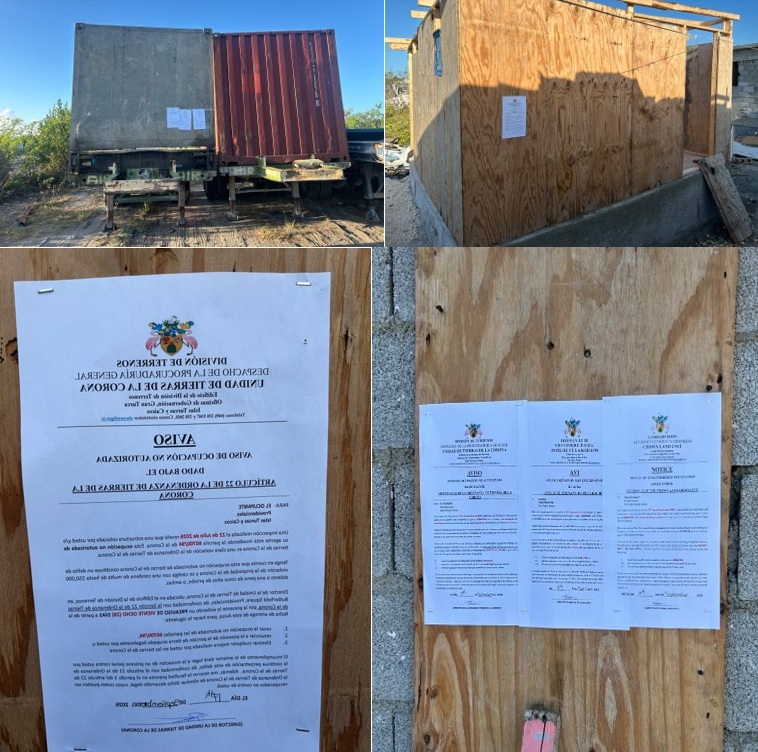
Providenciales, Turks and Caicos Islands: The Crown Land Unit, with coordination and support from the Informal Settlements Unit (ISU), conducted a multi-agency enforcement exercise in the Five Cays area on Thursday, September 17, 2026, as part of ongoing efforts to address the illegal occupation and unauthorised use of Crown land.
The exercise brought together representatives from the Crown Land Unit, ISU and the Turks and Caicos Islands Border Force. Security for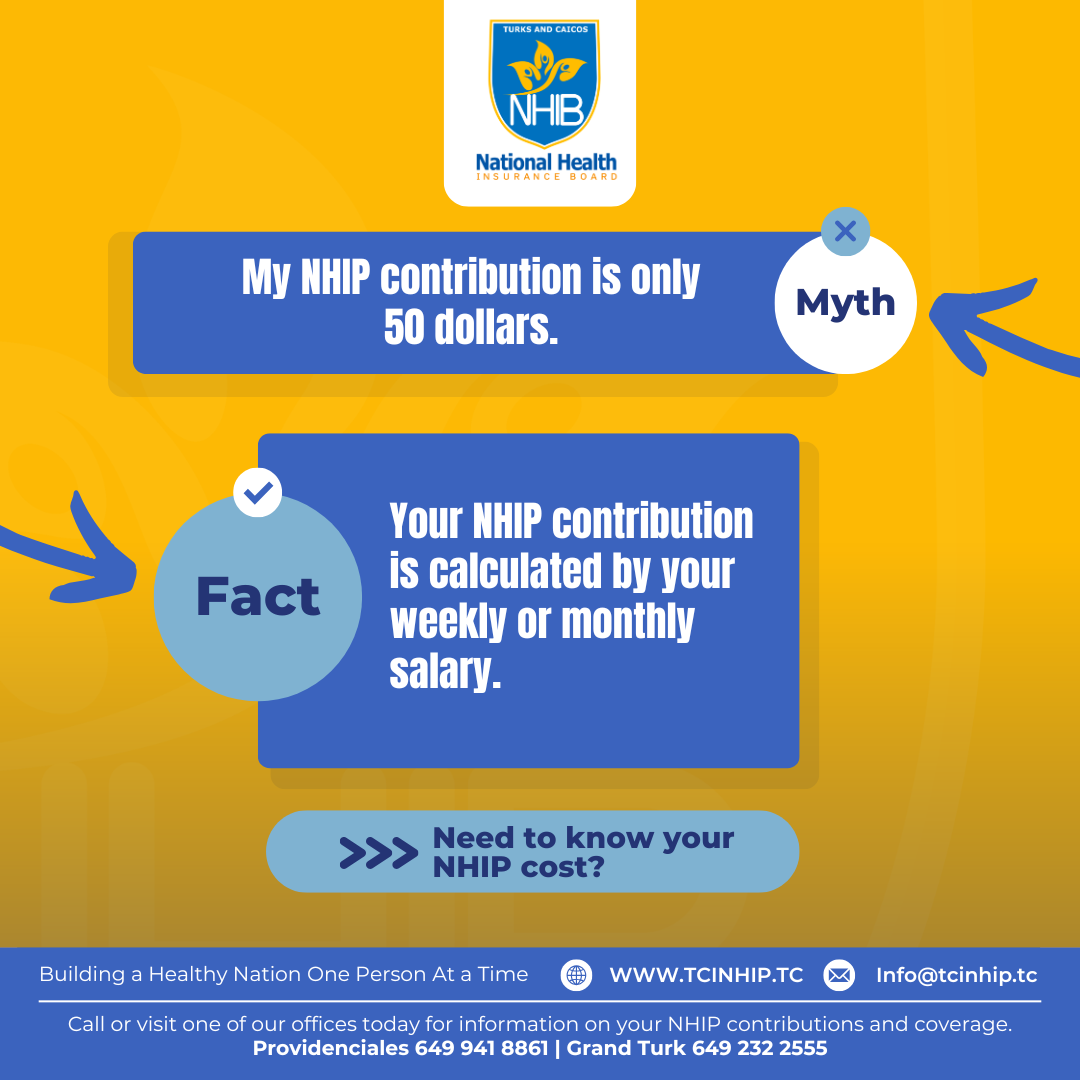 the exercise was provided by the Royal Turks and Caicos Islands Police Force. Inspections were conducted across several parcels of Crown land throughout Five Cays, where instances of illegal occupation and unauthorised use had been identified.
During the exercise, a total of forty (40) Section 22 Notices of Unauthorised Occupation were served in accordance with the provisions of the Crown Land Ordinance. The notices related to various forms of unauthorised occupation and use of Crown land, including incomplete structures, shipping containers, derelict vehicles, trailer chassis, building materials and other items.
Where persons were not present, notices were affixed to the relevant structures or items. The exercise forms part of the Crown Land Unit’s continuing efforts to prevent squatting and encroachment on Crown land and to ensure that identified instances of unauthorised occupation are appropriately addressed.
The Government of the Turks and Caicos Islands reminds the public that Crown land must not be occupied, developed or otherwise used without lawful authority.
The Crown Land Unit, supported by the ISU and its other partner agencies, will continue to identify and address instances of illegal occupation of Crown land across the Turks and Caicos Islands. Persons affected by notices issued during enforcement exercises are encouraged to comply with the requirements outlined and to seek guidance from the relevant authorities where necessary.
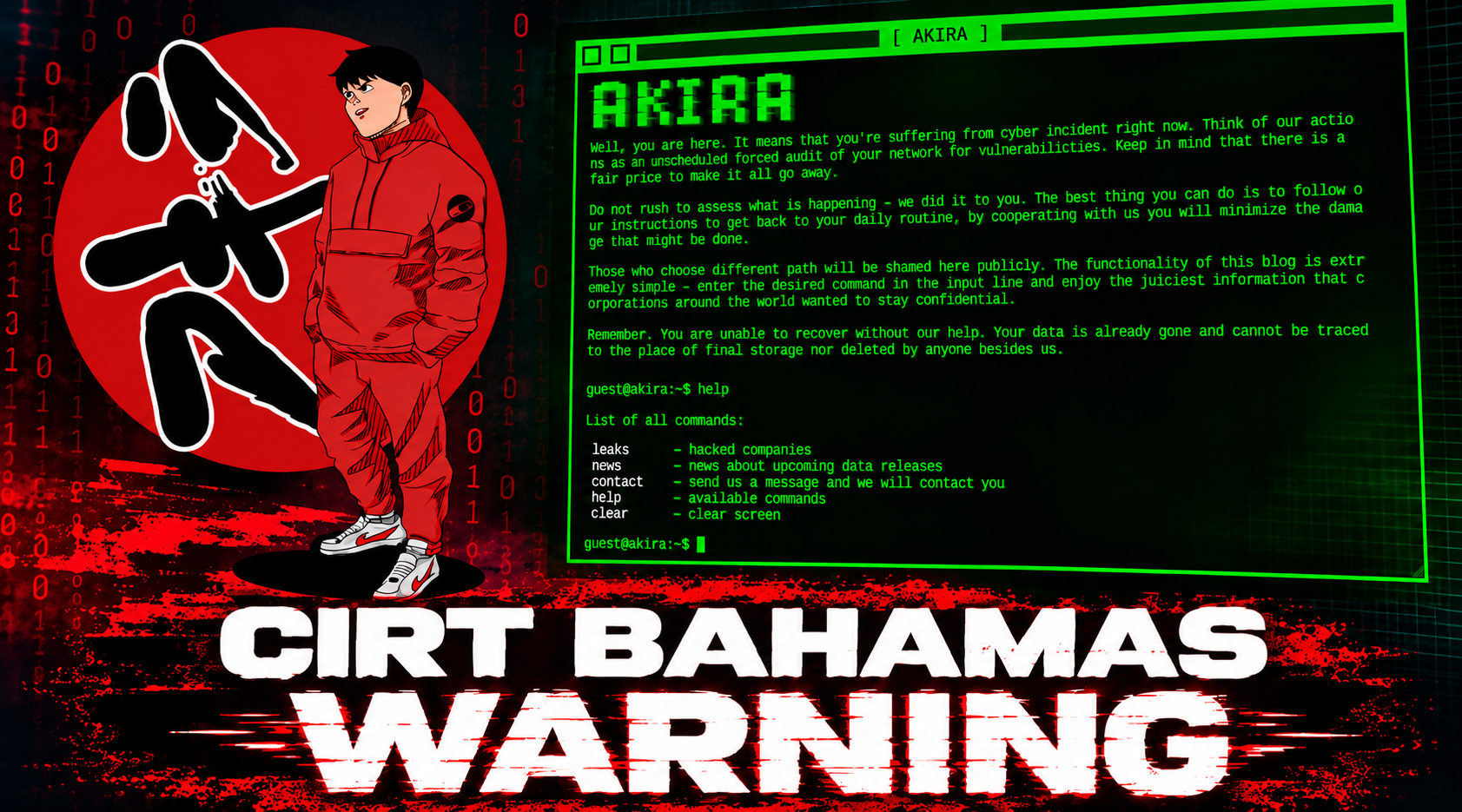
Nassau, The Bahamas, October 22, 2026 — The National Computer Incident Response Team of The Bahamas (CIRT-BS) has issued a cybersecurity advisory warning businesses, government institutions and other organisations about the growing threat posed by Akira ransomware, a cybercriminal operation capable of stealing sensitive information, disrupting networks and demanding ransom payments.
Active since March 2023, Akira operates through a Ransomware-as-a-Service model, with affiliates exploiting weaknesses in computer networks to gain unauthorised access.
Once inside, attackers can steal confidential data, disable recovery systems and encrypt files, preventing organisations from accessing critical information.
Particularly concerning is Akira’s use of double extortion, threatening to publish stolen information unless victims pay. Some attacks involve data theft without encryption.
The October 22 advisory identifies vulnerabilities involving Cisco and SonicWall firewalls, VPN services, Microsoft Remote Desktop Protocol, Veeam backup systems and outdated Windows and Linux operating systems. VMware ESXi and Nutanix AHV environments are also potential targets.
Attackers may exploit unpatched software, stolen login credentials and inadequately secured remote-access applications, including AnyDesk and RustDesk.
Warning signs include unexpected administrator accounts, unusual remote logins, unauthorised software installations, suspicious backup activity, mass file changes and ransom notes.
CIRT-BS recommends immediate security updates, multifactor authentication, restricted remote access, stronger network monitoring and secure backups maintained separately from operational systems.
Organisations should also remove unnecessary internet exposure of remote desktop services, limit administrative privileges and regularly test backup restoration.
The advisory does not identify any confirmed Akira attack against a Bahamian organisation but highlights vulnerabilities that could expose institutions to serious financial and operational disruption.
Cybersecurity incidents can be reported to CIRT-BS at soc@cirt.bs or through its official website.
News
BermudAir Launches Service to the Turks and Caicos Islands on October 26th, Expanding Air Connectivity Ahead of Winter Season

Providenciales, Turks and Caicos Islands (October 22nd, 2026) – The Turks and Caicos Islands welcomes BermudAir as the airline begins its service to the destination on Monday, October 26th, marking the start of a wider expansion that will connect us with additional cities across the United States, Canada and the Caribbean.
BermudAir’s service will begin with a new nonstop service between Fort Lauderdale, Florida, and Providenciales. The flight will depart from the Howard Hamilton International Airport at 8 am on Monday morning and arrives at 7.40 pm. Aboard the inaugural flight will be a delegation from the Turks and Caicos Islands led by Experience Turks and Caicos and the Turks and Caicos Islands Airports Authority (TCIAA), and will include Deputy Governor, Her Excellency Anya Williams, Minister of Tourism, Hon. Zhavargo Jolly, as well s representatives of the Turks and Caicos Hotel and Tourism Association (TCHTA), the board of the Turks and Caicos Islands Tourism Authority, Invest TC and local media.
BermudAir will operate the Fort Lauderdale–Providenciales route three times weekly, on Mondays, Wednesdays and Fridays, through May 3rd, 2027. making it easier for business travellers with the schedule offering the potential for same-day return trips. The airline is also launching nonstop service between Fort Lauderdale and Belize City, Belize, on the same schedule, offering travellers in South Florida direct access to both destinations.
The new service introduces BermudAir’s premium leisure inflight experience to the Turks and Caicos Islands. Flights will operate on Embraer E190 aircraft configured without middle seats, giving every passenger a window or aisle seat, alongside complimentary snacks and beverages.
Minister of Tourism, the Honourable Zhavargo Jolly, welcomed the airline’s arrival, noting the importance of expanding airlift to support the continued development of the destination’s tourism industry.
“Air connectivity remains one of the most important factors in the continued development of our tourism industry. BermudAir’s expansion represents an opportunity to strengthen our connections with key international markets while opening new doors for our sister islands. I am particularly encouraged by the planned direct service between Newark and South Caicos, which speaks directly to our vision of expanding tourism opportunities across the Turks and Caicos Islands. Our objective is to ensure that improved connectivity translates into greater economic activity, stronger local businesses and more opportunities for Turks and Caicos Islanders to participate in and benefit from tourism.” said Minister Jolly.
Commenting on the significance of the new route for the country’s development, the Honourable Arlington Musgrove, Minister of Physical Planning and Infrastructure Development (PPID), stated: “The introduction of BermudAir’s new service is a testament to the continued growth and development of our aviation sector. The Ministry of Physical Planning and Infrastructure Development, alongside the Turks and Caicos Islands Airports Authority, remains dedicated to enhancing our airport infrastructure to accommodate increased airlift. We are committed to working to ensure that our facilities provide a seamless, world-class experience for all incoming passengers and we warmly welcome BermudAir to our shores.”
The Fort Lauderdale launch is the first of several new services BermudAir plans to introduce to the Turks and Caicos Islands for the 2026– 2027 winter season. Additional connections to Providenciales are scheduled from:
- Bermuda to TCI and Grand Cayman: Beginning December 18th, 2026
- Anguilla: Beginning December 19th, 2026
- Boston, Massachusetts: Beginning December 19th, 2026
- Toronto, Canada: Beginning December 19th, 2026
- Raleigh-Durham, North Carolina: Beginning December 20th, 2026
- Newark, New Jersey to South Caicos: Beginning December 20th, 2026
- St. Petersburg/Tampa, Florida: Beginning December 21st, 2026
- Baltimore-Washington: Beginning December 24th, 2026
The expansion will give travellers more options for reaching the destination during the winter travel season, while broadening access from established and developing source markets. The additional routes also create opportunities for tourism stakeholders to reach new audiences and encourage visitors to explore more of the islands.
For flight schedules and bookings, visit www.flybermudair.com.





-

 News4 days ago
Imagine Turks & Caicos Represented in UK Parliament; New Report Favours It
-

 Bahamas News1 week ago
Rosewood Exuma: A precedent-setting case for environmental law and future development in The Bahamas
-

 News6 days ago
Invest TCI Strengthens Regional Investment Connections at Caribbean Investment Forum 2026 in Barbados
-
 Bahamas News3 days ago
Bahamas Issues Cybersecurity Alert Over Akira Ransomware Threat
-
 Bahamas News7 days ago
Energy Minister Delivers Electrifying Keynote Opening Address at CAREC 2026
-

 News4 days ago
Crown Land Unit Leads Multi-Agency Enforcement Exercise in Five Cays
-

 News3 days ago
BermudAir Launches Service to the Turks and Caicos Islands on October 26th, Expanding Air Connectivity Ahead of Winter Season
-

 News4 days ago
DDME Celebrates International Day for Disaster Risk Reduction