Connect with us

News

Job Advertisement – Invest TCI

Published

on

Job Title:                     Corporate Finance Manager (CFM)

Reporting to:              CEO

Location:                     Invest TCI Offices – Providenciales

Job Summary:

The Corporate Finance Manager (CFM) is a key member of the Agency team with primary responsibility for ensuring Invest Turks and Caicos has strong internal financial control structure, along with ensuring proper financial reporting, account reconciliation and budgeting.  The CFM works closely with the Manager-Corporate Services to ensure effective internal operations are maintained.

The CFM’s secondary role will be to support the efforts of the Senior VP – Investor Services in attracting new investment to the country by conducting financial due diligence on investment projects, developing and maintaining a financial assessment model for Investor Services Executives and providing advice and support to the team and business clients related to the Micro-Small Enterprises (MSME) Program.

Key Duties and Responsibilities:

  1. Financial accounting and reporting
    1. Ensures that financial accounting systems, including systems for day to day transactions (general ledger, accounts payable, accounts receivable and payroll) cash flow forecasting and management, credit control, and petty cash are accurately and efficiently maintained. Systems should be maintained in accordance with generally accepted accounting principles (GAAP) and/or IFRS.
    2. Ensures that supporting information for all financial transactions is documented, accurately and properly filed and compliant with all financial provisions of the relevant ordinances and statutory requirements.
    3. Ensure costs and revenue are recorded and reported accurately, timely, and completely in accordance with financial assertions;
    4. Ensure that costs and revenue are incurred and managed in accordance with the terms of the approved budget;
    5. Ensure that Invest Turks and Caicos complies with all financial provisions of the relevant ordinances and statutory requirements particularly the Public Procurement Ordinance and the Public Finance Management Ordinance.
    6. Ensure records, transactions, events, activities and other performance indicators accurately, timely and completely in accordance with performance measure assertions, if any.
    7. Ensures the reconciliation of bank and investment accounts monthly, including monthly supplier reconciliations, review of overdue accounts receivables, updating the accrual and prepayment schedules and calculation and recording of depreciation expense.
    8. Ensure that monthly and quarterly financial reports for management, the Board and TCIG are accurately and timely prepared in accordance with applicable standards.
    9. Make recommendations to the management and the Board on potential areas to reduce expenditure or increase revenue where over run or short falls are noted, respectively.
    10. Ensures the completion and maintenance of the Fixed Assets Register.


  1. Budget Preparation
    1. Collaborate with the CSM to support the preparation of the annual budget using a “Zero Based Budget” approach, in consultation with the CEO, Board of Directors and Invest TCI team.
    2. Ensure alignment of the KPI’s with available resources


  1. Project Analysis
  2. Develop, implement and maintain system for conducting proper financial due diligence on domestic and foreign investors.
  3. Develop/implement a financial model for investment projects that will allow for rapid review of projects and conduct of sensitivity analysis to detect project risk.
  4. Develop templates that can be used by Investor Services Executives (ISE) to compare project costs to socio-economic benefits.
  5. Review financial information contained in complex project proposals assigned by the SVP and comment on the financial viability of the investment as presented by the proponents.


  1. Micro, Small & Medium Enterprises
    1. Monitor compliance of grant agreements with the Center for Entrepreneurial Development (CED) to provide Government funding towards the work of the not for profit entity.
    2. Provide oversight on financial analysis of MSME Business Plans.


  1. Other Related Business
    1. Undertake any related activities required by the Agency as requested by the CEO, SVP.


PERSONAL SPECIFICATIONS

Education and qualifications:

University degree or equivalent in Accounting, Finance, or equivalent


Chartered Accountant, Certified General Accountant, or Certified Management Accountant designation is an asset.

Experience and Knowledge:

  1. Detailed knowledge of generally accepted accounting and internal control principles.
  2. Strong analytical, problem solving and decision-making skills to evaluate alternatives and provide recommendations on business issues.
  3. Minimum five years senior accounting experience in a public or private company environment.
  4. Significant experience in conducting due diligence and financial analysis on development projects and in supporting entrepreneurs.
  5. Proficiency in the use of various computer programs, including: Accounting (Simply Accounting),Word processing (MS Office), Spreadsheets MS Office), Project Management (Visio)


Skills:

  1. Strong track record of competency in current and previous employment.
  2. Excellent Leadership Qualities
  3. Strong Writing and presentational skills.
  4. Excellent Communication and interpersonal skills.
  5. Excellent skills in MS Word, Excel, PowerPoint and Outlook
  6. Ability to work in a team environment and manage time effectively
  7. Commercial awareness.
  8. Ability to maintain confidentiality

Personal Qualities:

  1. Open and engaging demeanor.
  2. Able to generate and share ideas.
  3. Hands-on approach.
  4. Willing to take personal responsibility
  5. Able to win trust and personal credibility
  6. Persistence and personal resilience.
  7. Willingness to personally deliver quality to business clients.
  8. Willingness to understand different cultures, lifestyles, and associated points of view.
  9. Willingness to understand the values associated with small communities.


Other Requirements:

  1. Fluent English
  2. Willingness and ability to travel by air, land, and sea.


Salary and Allowances:

Negotiable in a range from $60,000 to $70,000 depending on education and experience.


Deadline Date for Applications

The deadline date for applications is August 27, 2021, Turks, and Caicos time.


Application Procedure

Interested persons should submit a resume, along with their contact information, cover letter, two letters of reference (one preferably from a former employer), copies of educational certificates, a Police Certificate, and a copy of the Passport photo page.


Applications can be submitted by courier or delivered directly to Invest Turks and Caicos at Unit 2D, Courtyard Plaza, Providenciales, Turks and Caicos Islands, prior to the deadline. The application should be addressed to The CEO (Acting) – Invest Turks and Caicos and envelopes should have the words “Corporate Finance Manager” clearly marked on the front.

Alternatively, applications can be emailed to dastwood@investturksandcaicos.tc .The subject line in the email should read “Corporate Finance Manager


We thank all applicants for their interest. However, only persons selected for an interview will be

Continue Reading

Government

Government Outlines New Healthcare Vision as Interhealth Exit Accelerates Reform  

Published

on

By Magnetic Media Newsroom


PROVIDENCIALES, Turks and Caicos Islands — The Turks and Caicos Islands Government says the breakdown of its relationship with InterHealth Canada presents an opportunity to reshape healthcare delivery, with plans to expand local medical services, strengthen primary care and reduce dependence on overseas treatment.

During a national briefing following InterHealth Canada’s notice terminating its hospital contract, Premier Charles Washington Misick acknowledged publicly for the first time that Government and InterHealth had been negotiating an exit from the arrangement for more than a year after what he described as an “irretrievably broken down” relationship.

Despite the contractual dispute, Misick and Health Minister Kyle Knowles stressed that healthcare services will continue uninterrupted during the transition.

“Allow us to do our job,” Knowles appealed, assuring residents that Government is actively managing the transition and safeguarding patient care.

The Premier outlined what amounts to a broader healthcare transformation built around four connected levels of care: strengthened community-based primary healthcare; expanded polyclinic services; enhanced hospital-based secondary care with greater specialist capacity; and overseas tertiary treatment only for cases that cannot be managed locally.

Among the proposals are the long-discussed establishment of intensive care units, expanded use of currently unfinished hospital space, recruitment of more resident specialist physicians and stronger contract management to oversee future healthcare agreements.

Knowles said the new polyclinic model will broaden services available outside the hospitals, including dentistry, ophthalmology, laboratory services, diagnostic imaging, gynaecology and preventative screening, helping to reduce pressure on emergency departments while improving early intervention.

Misick also acknowledged that while the hospital system significantly improved healthcare access after opening in 2010, Government believes further reform is necessary to improve affordability, sustainability and the range of services available within the Turks and Caicos Islands.

The briefing marked the Government’s most comprehensive explanation to date of its plans beyond the InterHealth contract, signalling that officials now see the transition as an opportunity to redesign healthcare delivery rather than simply replace one operator with another.

Continue Reading

News

Planning for Tomorrow: Why Sustainable Communities Begin with Good Planning

Published

on

Turks and Caicos – Every thriving community tells a story long before the first home is built. The placement of roads, the routing of utilities, the protection of natural resources and the provision of schools, healthcare and emergency services are all the result of decisions made through careful planning. While these elements are often taken for granted, they form the foundation of safe, functional and sustainable communities.

As populations grow and communities evolve, planning becomes increasingly important. It helps ensure that development takes place in locations that can support it, that infrastructure keeps pace with demand, and that public services remain accessible to those who depend on them. Good planning also considers the future, creating communities that can adapt to changing needs while preserving the quality of life enjoyed by current and future generations.

Where development occurs without adequate planning, however, the effects can be felt far beyond the boundaries of a single neighbourhood. Roads may be unable to accommodate emergency vehicles, utilities can become overstretched, and environmental resources may come under increasing pressure. Delivering public services in these circumstances often becomes more difficult and more costly, creating challenges that affect entire communities rather than individual properties alone.

For this reason, sustainable development can only emanate from careful planning. It must be ensured that homes, infrastructure and essential services develop together in a coordinated and responsible way. Every planning decision contributes to the broader picture of how communities function, grow and respond to future demands.

Supporting that process requires reliable information. Accurate data helps planners and policymakers understand where growth is occurring, identify emerging needs and make informed decisions about infrastructure, housing and public services. It also strengthens collaboration among government agencies by providing a shared understanding of the challenges and opportunities facing communities.

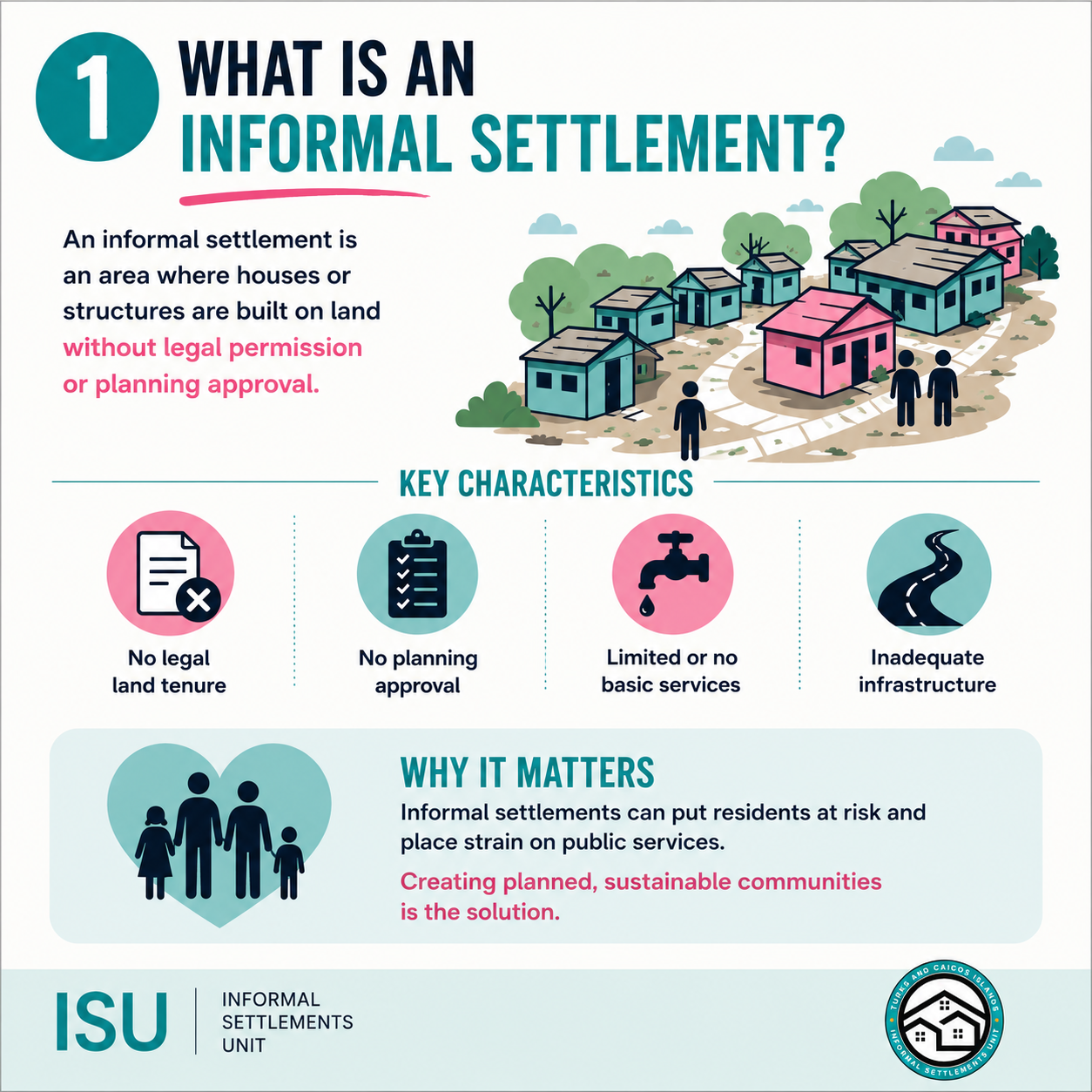
Within the Turks and Caicos Islands, this collaborative approach is reflected in the work of the Informal Settlements Unit (ISU), which supports a range of initiatives aimed at improving the understanding of informal settlement development. Through activities such as GIS mapping, the Social Needs Assessment Survey and collaboration with partner agencies, the ISU contributes valuable information that helps support evidence-based planning and long-term decision-making.

Strong communities are not built overnight. They are shaped through thoughtful planning, informed decisions and cooperation across government and the wider community. As the Turks and Caicos Islands population continues to grow, maintaining that focus will be essential to creating communities that are safe, resilient and equipped to meet the needs of generations to come.

Continue Reading

Bahamas News

Caught in the Net, Not Accused of Wrongdoing

Published

on

What the Attorney General must do now to protect Bahamian exports

Deandrea Hamilton | Editor

NASSAU, Bahamas — The United States’ decision to impose a 12.5 percent tariff on Bahamian exports is about more than higher costs for seafood, rum and other goods entering the American market. It is a warning that The Bahamas must move quickly to strengthen or clarify its legal framework governing forced labour and supply-chain enforcement.

The tariff, which takes effect July 24, is part of a sweeping U.S. trade action affecting 60 economies following a review by the Office of the U.S. Trade Representative (USTR). The review concluded that the listed countries have not adequately prohibited or enforced measures against goods linked to forced labour in global supply chains.

The action follows a recent U.S. Supreme Court ruling that invalidated an earlier series of Trump-era tariffs imposed under emergency powers. In response, the Trump administration shifted to a different legal authority—Section 301 of the Trade Act of 1974—using findings from a U.S. Trade Representative investigation into forced-labour compliance to support a new round of tariffs affecting 60 economies, including The Bahamas.

Importantly, the action does not accuse Bahamian businesses of using forced labour. Instead, it reflects the U.S. view that The Bahamas’ legal or enforcement framework does not yet meet the standard Washington expects.

That distinction matters.

The Attorney General’s Office now has the responsibility to lead the country’s legal response. That begins with determining precisely what concerns the U.S. Trade Representative identified, reviewing whether Bahamian law adequately addresses those concerns and, where necessary, recommending legislative or regulatory changes. If deficiencies exist, legal amendments and stronger enforcement could help position The Bahamas for removal from the tariff list.

The government may also seek formal discussions with U.S. officials while those reforms are undertaken, outlining a clear timetable for compliance and demonstrating that the country is committed to meeting international labour standards.

A Nassau Guardian front-page report on July 24 drew attention to the tariff action, prompting broader questions about why The Bahamas was included among the 60 economies affected by the U.S. trade measure and what steps are now needed to restore full confidence in the country’s trade framework.

For many Bahamians, the immediate concern will be the fisheries sector, one of the country’s largest export industries. Commercial shipments of lobster, conch, fish, crawfish and other products entering the United States could become more expensive because of the additional tariff, potentially affecting exporters’ competitiveness.

The broader lesson is that international trade increasingly depends not only on quality products, but also on strong business relationships and confidence in the legal systems that govern them.

For The Bahamas, this is less a finding of wrongdoing than a reminder that international credibility is earned through modern laws, effective enforcement and trusted partnerships. The challenge now is for the Attorney General’s Office to lead a swift legal review, identify any deficiencies and chart a clear path toward compliance so Bahamian exporters are not burdened any longer than necessary.

Continue Reading

FIND US ON FACEBOOK

TRENDING