Connect with us

News

There will be a greater British presence in the TCI

Published

on

Turks and Caicos, August 3, 2017 – Providenciales – When Colin Roberts, then Director for the Overseas Territories at the Foreign and Commonwealth Office stated that: “There will be a greater British presence in the Turks and Caicos Islands after the Elections”, meaning the 2012 Elections, many persons did not grasp the full gravity of those words or how far-reaching they would be! I would like to put those words in the context of pronouncement, real or imagined; that some nearly two thousand British troops will be descending on Turks and Caicos Islands to clean up the mess of illegal persons living within our borders.

I will start with the ominous words of Sir Robin Auld that there was “high probability of systemic corruption in government and the legislature and among public officers” in the Turks and Caicos Islands and that it must be stemmed from the root and branches. We saw the SIPT investigations and now the trials that have been ongoing for nearly two years of former Government ministers and associates for engaging in alleged acts of corruption, amongst other things. We see custom officers, immigration officials and as of late, police officers and officials being charged with corruption offences. Even though, to my recollection, no one has yet to serve a day in prison resulting from the prosecution of those offences; the mere fact that they are out there, raises the possibility of conviction and imprisonment.

Many of us may not be worried, but after I have laid out this analysis, there should be the need for greater concern in the indigenous Turks and Caicos Islander population – if, these two thousand or so British troops come to our shores. This notion might not be as farfetched as you might presume, because the Governor in his press release of 29th July 2017 has intimated as much by his words “following recent incidents additional and specialised support (including from outside the Islands) is being put in place already”.

Let me start with the words enshrined in our 2011 Constitution which came into force in 2012. In Section 55, Qualifications of electors and entitlement to vote, reads:

“(1) (b) (ii) he or she is resident in the Islands and has been so resident for no less than twelve months, in the aggregate, out of the two years immediately preceding the qualifying date or he or she is a member of Her Majesty’s Forces…

Now, turning to the definition of Turks and Caicos Islander, under “Section 132 (2) An Ordinance shall prescribe the conditions under which a person may be granted the status of a Turks and Caicos Islander, and those conditions shall include, but not be limited to conditions set out in subsection (3). (3) The conditions referred to in subsection (2) are that – (a) an applicant is a British Overseas Territories Citizen by virtue of a connection with the Islands or a British Citizen who either – (ii) has been legally resident in the Islands for a period of at least ten years.”

With this in mind, when a number of public officers are removed by virtue of them being allegedly corrupt or charged with corruption, who better to fill the void than members of Her Majesty’s Forces. These persons would have been stationed or billeted here to clean up the immigration mess and secure our borders. By the time they would have captured and processed the illegal migrants, repatriated them as part of the exercise, a number of vacancies would have been created. The beautiful thing here is that not only will they fill these slots with members of Her Majesty’s Forces; their personnel will not be required to be in possession of work permits to work in the Turks and Caicos Islands. How egregious! More to that, they would be able to vote in the upcoming 2020 Elections! What disruptive a FORCE would these people be when they can vote for a British person who would have come to the Turks and Caicos Islands immediately following the suspension of the 2006 Constitution on 14 August, 2009?

Brexit is certainly a reality now. The British can start the draw-down of its troops responsibility to the EU, and no better place to put them, but here, as part of the resurgence of the real and true British Imperialism.

We have to certainly watch out for what will be on offered as greater ties to the apron-strings of the UK once talks begin in honest as part of the British disentanglement from Europe! What Trojan horse will they offer us in the guise of a better working relationship, when in truth and in fact, the times when we really and truly needed their help, they were absent.

We do not need any further strings to be attached for the British to live up to their Constitutional responsibilities. The current government must exact stringent terms as part of the exit strategy for the deployment of troops here to rid us of the illegal persons in our midst. We do not want to become like Jamaica when they had a snake infestation problem. The Jamaican government introduced the mongoose to eradicate the snakes, but when the snakes were gone the mongoose became an even bigger problem! If we don’t pay attention to the lessons of history – in particular Caribbean history, we are bound to repeat them!

Release: Royal Robinson


Continue Reading

News

Multi-Agency Enforcement Action Conducted at Caicos Lodge

Published

on

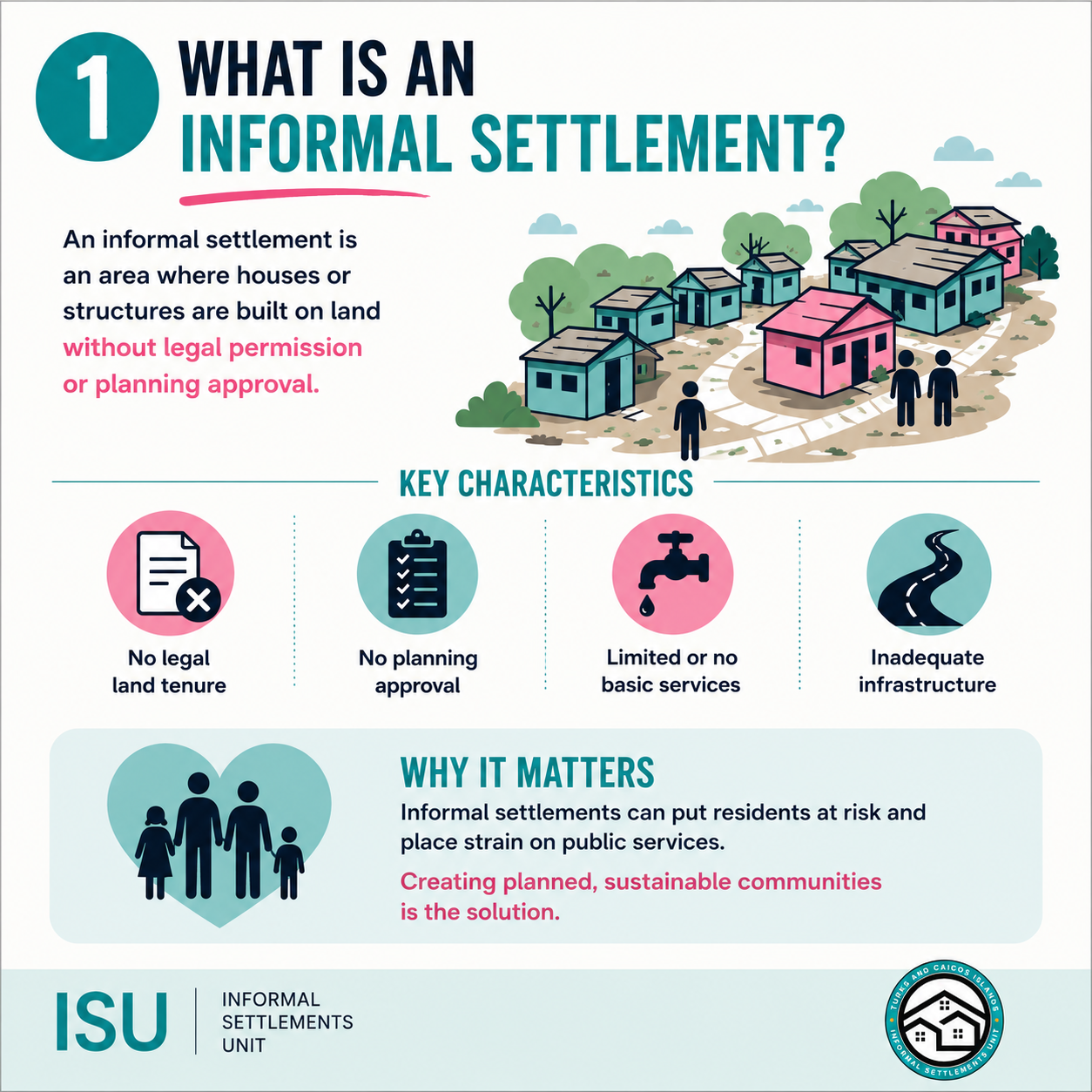
Providenciales, Turks and Caicos Islands, 14 April 2026The Informal Settlements Unit (ISU), in coordination with the Planning Department and key partner agencies, conducted a multi-agency enforcement exercise on Thursday, April 9, 2026, at Block and Parcel 60802/49 and 60802/65, located in the Caicos Lodge area.

The operation was led by the Planning Department, with coordination by the ISU and support from the Royal Turks and Caicos Islands Police Force, the TCI Border Force, Pelican Energy TCI, and DevCon Power Supply. All agencies worked collaboratively to ensure the exercise was carried out in a safe, orderly, and controlled manner.

The enforcement action followed a structured and lawful process in accordance with the Physical Planning framework of the Turks and Caicos Islands. A total of fifty (50) unauthorized structures were removed during the exercise.

Section 45 Enforcement Notices were first issued on the affected parcels on December 11 2024, identifying unauthorized structures in illegal occupation. This was followed by the issuance of Warning Notices on March 26 2026, which clearly advised occupants that they were in breach of planning and land use regulations and provided a 14-day period to remove the structures voluntarily. Despite these notices and the time afforded for compliance, the unauthorized structures remained in place.

The Government wishes to emphasize that the structures removed were unauthorized developments, constructed without the required planning approvals and in breach of established building and land use regulations.

Planning regulations exist to ensure that all developments meet minimum standards for safety and structural integrity. Unauthorized settlements, regardless of appearance, often lack these safeguards and can pose serious risks to occupants and the wider community.

The enforcement of these regulations is therefore not only a legal obligation, but a necessary measure to protect lives, property, and public health.

The Turks and Caicos Islands Government remains fully aware of the housing challenges currently facing the country. However, unlawful development cannot be allowed to proliferate in a manner that compromises safety, undermines planning systems, and infringes on property rights.

All persons undertaking construction or occupation of land must do so in accordance with the law, including obtaining the necessary planning approvals.

The Government will continue to work collaboratively across agencies to:

  •  Uphold planning and development regulations
  •    Protect private and public lands
  •  Prevent the expansion of unsafe and informal settlements
  •  Advance long-term solutions for sustainable community development

This exercise represents part of an ongoing commitment to ensuring that development within the Turks and Caicos Islands is lawful, safe, and aligned with national standards.

Continue Reading

News

What Planning Board Meeting Exposes about Housing Development in Providenciales

Published

on

Turks and Caicos, April 14, 2026 – Planning data from the March 31, 2026 Physical Planning Board meeting points to a clear and consequential trend in Providenciales: a steady rise in approvals for multi-unit residential developments, reflecting growing demand for rental housing on the island.

Applications reviewed at the meeting include apartment buildings ranging from small two-unit structures to larger developments with up to 15 units, along with extensions to existing buildings to add additional floors and living space. The pattern is consistent across multiple submissions—developers are no longer focusing primarily on single-family homes, but instead are maximizing land use to accommodate more residents per parcel.

This shift signals more than just a change in construction style; it reflects mounting pressure within the housing market. Providenciales has been experiencing sustained population growth, driven by economic opportunity, migration and labour demand, all of which are placing strain on available housing stock. As a result, rental inventory has tightened, with many residents facing limited options and rising costs.

In that context, the Planning Board’s approvals suggest that the market is responding—perhaps not through a coordinated housing policy, but through private development adapting to demand. Multi-unit dwellings, apartment complexes and building expansions are emerging as practical solutions to increase housing availability in a setting where land is finite and demand continues to climb.

At the same time, the data reveals that not all proposed developments are moving forward without delay. Several applications, including larger-scale residential projects, were deferred, indicating that regulatory review remains active and that some proposals require further scrutiny or modification before approval. This points to a balancing act between facilitating growth and maintaining planning standards.

What emerges from the meeting is a picture of an island adjusting in real time. Housing development is becoming denser, more vertical and more responsive to immediate needs, as opposed to long-term master planning.

For residents, the implications are significant. Increased rental units could help ease the current shortage, but questions remain about affordability, infrastructure capacity and whether the pace of development can keep up with demand.

In the end, the Planning Board data offers a grounded look at how Providenciales is evolving—not through announcements, but through approvals that reveal where the pressure truly lies.

Beyond housing, the meeting also revealed a mix of supporting and stalled developments shaping the wider growth picture. Among the notable approvals were a warehouse and distribution centre, pointing to expanding commercial and logistics needs, and a boat ramp in Providenciales, signalling continued investment in marine access infrastructure.

At the same time, several applications were deferred, including proposals for solar farms and larger-scale residential developments, suggesting that while demand is strong, not all projects are advancing at the same pace. The combination of approvals and deferrals highlights a development environment that is active but still navigating regulatory checks, infrastructure readiness and planning requirements.

The 786th Ordinary Meeting of the Physical Planning Board was held on March 31, 2026, in Providenciales, with participation both in person and via video conference. Acting Chairman Trent Dickenson presided over the session, joined by members Dondre Brooks and Terrell Gardiner, along with ex-officio members Dainer Lightbourne from Planning and Jamall Blair from the Department of Environment and Coastal Resources. Supporting the Board were key technical staff, including Deputy Director of Planning Toriano Williams, Assistant Director and Secretary Reginald Charles, and Land Use Planner Britney Simmons, reflecting a full complement of planning and environmental oversight at the sitting.

Developed by Deandrea Hamilton • with ChatGPT (AI) • edited by Magnetic Media.

Continue Reading

News

HAITIANS FLEE HOME AS PUSH FACTORS MOUNT; LANDINGS SURGE IN TCI, AGAIN  

Published

on

Turks and Caicos, April 14, 2026 – A worsening security and humanitarian crisis in Haiti—intensifying in April alongside regional enforcement crackdowns and legal uncertainty in the United States—is driving renewed migration pressure across the Caribbean, with the Turks and Caicos Islands now experiencing a sharp spike in illegal boat landings.

Within the first 10 days of April, the United Nations has repeatedly signaled concern about Haiti. On April 1, the UN confirmed full operational support for a Gang Suppression Force, including deployment of helicopters and cross-border logistics to sustain security operations. By April 9 and April 10, the UN was again flagging Haiti for renewed attention, noting that the humanitarian situation “is not heard about enough” and preparing dedicated briefings to refocus global awareness.

These recent updates reinforce a consistent message: Haiti remains deeply unstable, with security conditions severe enough to require sustained international intervention and humanitarian access support.

At the same time, pressure is building in the United States. A legal battle over the termination of Temporary Protected Status (TPS) for Haitians—impacting more than 250,000 people—is unfolding in the courts, with key rulings and challenges playing out in late March and into April. While protections remain in place for now, the uncertainty surrounding their future is widely seen as contributing to heightened anxiety and movement decisions among Haitian nationals.

Regional reporting reinforces the urgency. Coverage from Listín Diario points to sustained deportation operations from the Dominican Republic, with tens of thousands of Haitians returned in recent months. Meanwhile, the Miami Herald continues to document Haiti’s internal collapse, where gang control, displacement and economic breakdown have left large segments of the population without safety or income.

Together, these April developments reflect what observers describe as a tightening regional environment, where Haitians are facing mounting pressure both inside and outside their country.

NEARLY 150 ILLEGALS CAUGHT IN TURKS AND CAICOS LANDINGS

That pressure is now being felt acutely in the Turks and Caicos Islands.

Between April 8 and April 12, law enforcement responded to multiple illegal migrant landings across East Caicos and Providenciales, triggering a coordinated, multi-agency response.

According to the Royal Turks and Caicos Islands Police Force, a vessel incident on April 10 near East Caicos resulted in at least 77 individuals being apprehended, including unaccompanied minors.

Subsequent operations led to additional arrests, with authorities confirming more than 70 individuals detained from that incident alone, along with further apprehensions during follow-up searches.

On April 12, another vessel landed in the Bird Rock area of Providenciales around 3:00 a.m., with 15 migrants detained and ongoing search efforts launched to locate others believed to have dispersed inland.

Authorities have activated a Critical Incident Command Structure and deployed additional personnel across multiple islands, maintaining what officials describe as a heightened operational posture.

Field reports from Eagle Legal News indicate that as many as seven to eight boats may have landed within a single week, with residents in Long Bay and surrounding communities expressing concern over repeated early-morning arrivals, abandoned vessels and migrants moving through residential areas.

A REGION UNDER STRAIN

The situation in Turks and Caicos reflects a broader regional trend emerging this month.

In The Bahamas, enforcement efforts have intensified, with increased interdictions, detentions and prosecutions as immigration becomes a central issue in the current election season.

In the Dominican Republic, deportation operations continue at scale, returning thousands of Haitians to already strained conditions.

These combined pressures are contributing to repeated migration attempts, as individuals returned to Haiti face the same insecurity, displacement and lack of opportunity that prompted their departure.

PUSH FACTORS DRIVING MOVEMENT — NOW, NOT LATER

The convergence of early April developments—from United Nations-backed security escalation and ongoing humanitarian concern, to legal uncertainty in the United States and intensified deportation activity across the region—points to a clear and immediate driver of migration.

At the same time, Haiti remains without elected leadership, governed by a fragile transitional council, with no confirmed date for national elections as insecurity continues to delay any credible path to the polls.

This combination of security collapse, humanitarian strain and political uncertainty is leaving many Haitians with few viable options at home.

This is not a projected surge.

It is a current one.

With instability in Haiti ongoing, enforcement tightening across neighbouring countries and uncertainty growing abroad, migration routes are increasingly shifting toward maritime pathways.

For Turks and Caicos, the impact is already unfolding in real time.

Angle by Deandrea Hamilton. Built with ChatGPT (AI). Magnetic Media — CAPTURING LIFE.

Continue Reading

FIND US ON FACEBOOK

TRENDING