
News
Governor Nigel Dakin gives address on Border Security and the OPBAT Alliance

#TurksandCaicos, December 10, 2021 –
Introduction:
Good afternoon, Turks and Caicos. This is the Governor speaking from the Cabinet room and I’m joined by Minister Arlington Musgrove, the Minister for Immigration, and other colleagues involved in protecting our borders be they Police, Immigration, Regiment or National Security Officials.
- I’m presenting a single narrative on behalf of all of the National Security Council, which I co-Chair with the Premier. Indeed if I were to pinpoint one reason why we are in a better place today, than we were in the past, it is the maturing of these structures. This has been true for both Governments that I have worked with, relationships which I don’t take for granted, but which I do judge is the foundation on which national security has to be built. Increasingly that relationship is grounded in the structures of the NSC rather than based on personality.
 Why is this necessary? I have constitutional responsibilities that I take extremely seriously and responsibilities that extend beyond our borders – and I do bring some experience – but I can neither tax nor spend, nor bring vital legislation in the House, and of course the Commissioner has operational command that neither the Premier nor myself can interfere with, although of course we can influence that through setting wider strategy and context in the NSC of which he is a member.
- The focus for this address is Border Security. I intend it to be both detailed and clear – so the people of TCI know where we are and where we are going. I will not sugar coat and I will take about 30 minutes to present as comprehensive a picture as I can. I will do something similar on internal security and terrestrial, rather than maritime policing, in the New Year when the Commissioner returns following surgery in the UK. There are a set of changes which, as they come to fruition, will be as fundamental to the policing of this Territory as the developments I’m about to describe to you in terms of border protection.
- The Chef Justice I know also wishes to update at some future point on the significant modernisation of the Justice Sector that has started under her inspiring leadership and which of course compliments all matters linked to the security of our people and the observance of law.
Heroes
- However I first want to personalise this and talk about seven heroes who represent the very best in terms of the challenges we face. They are where the ‘strategic rubber’, if you like, ‘hits the operational road’. I met with them today to express my personal thanks. It’s because of seven Police Officers that eighty people are alive. We must praise God for the migrant’s salvation – but we must also thank these officers for what they did. We all want to make a difference in the job we do, but few can say that what they do genuinely makes such a profound difference – a difference between life and death.
- While the events of the last week stand out, it is worth saying that the officers I’m referring to – as well as others who were not on duty that night – deploy every night – while we are asleep to protect our borders, and through that protect our society. In this, I often think of them as the guardians of the dawn, because one of my very first actions on waking up is to pick up my phone and catch up on their activities overnight.
- It’s important to reflect that the type of tragedy that unfolded last week could happen any night. We know that at least seven people perished – it would have been an awful death trapped beneath the hull and out of sight or reach of the officers. There may be more who were lost at sea, time will tell – but that so many survived is a measure of these officers’ extraordinary bravery.
- On the night of Monday 29th November a sloop arrived, from Haiti, off the North West Point of TCI where a Maritime Patrol vessel, vectored in by our radar, sought to take it under control. There was a collision. What I can categorically say – because I’m aware rumour is in the market place – is that the Police vessel did not ‘ram’ the sloop. Images show the police vessel sustained damage mid-ships close to where the skipper sits. The Police vessel was hit rather than visa-versa.
- The full narrative however will become clear because, given the loss of life, and as a matter of necessary routine, the Commissioner has asked the UK’s Marine Accident Investigation Branch to add expert advice to an investigation to determine exactly what happened that night.
- But while that occurs what is already clear is that the four Maritime Police Officers on SEA GUARDIAN were about to make a set of decisions that saw them act in the very highest traditions of those who serve at sea. What they saw unfolding in front of them was the sloop quickly taking on water and chaos and fear gripping those on the sinking vessel amongst dangerous reefs. You can imagine the pitch-black sky and sea only lit up by the Police Vessels lights.
- They were joined by the three crew of SEA PURSUIT – who had quickly deployed – and between them they all delivered an outstanding search and rescue operation. Eighty are alive because of it. I’d therefore ask those in the room here to now join with me in a round of applause for our Maritime Police in general, all who support them on land or at sea, and in particular for the heroism of the crew that night of SEA PURSUIT and SEA GUARDIAN. Last week they were genuinely the ‘magnificent seven’.
The OPBAT Conference: the headline is TCI is moving from defence to offence.
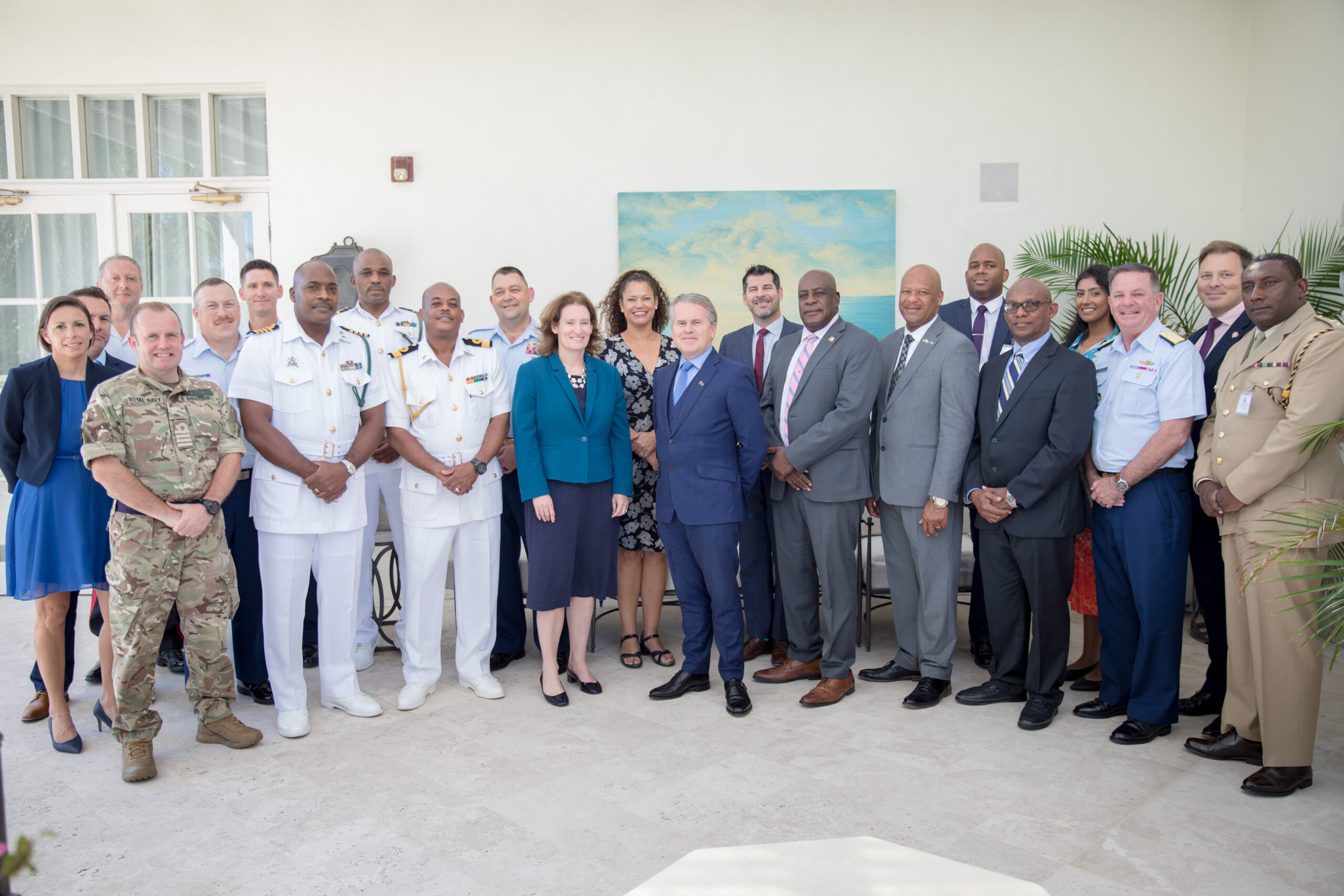
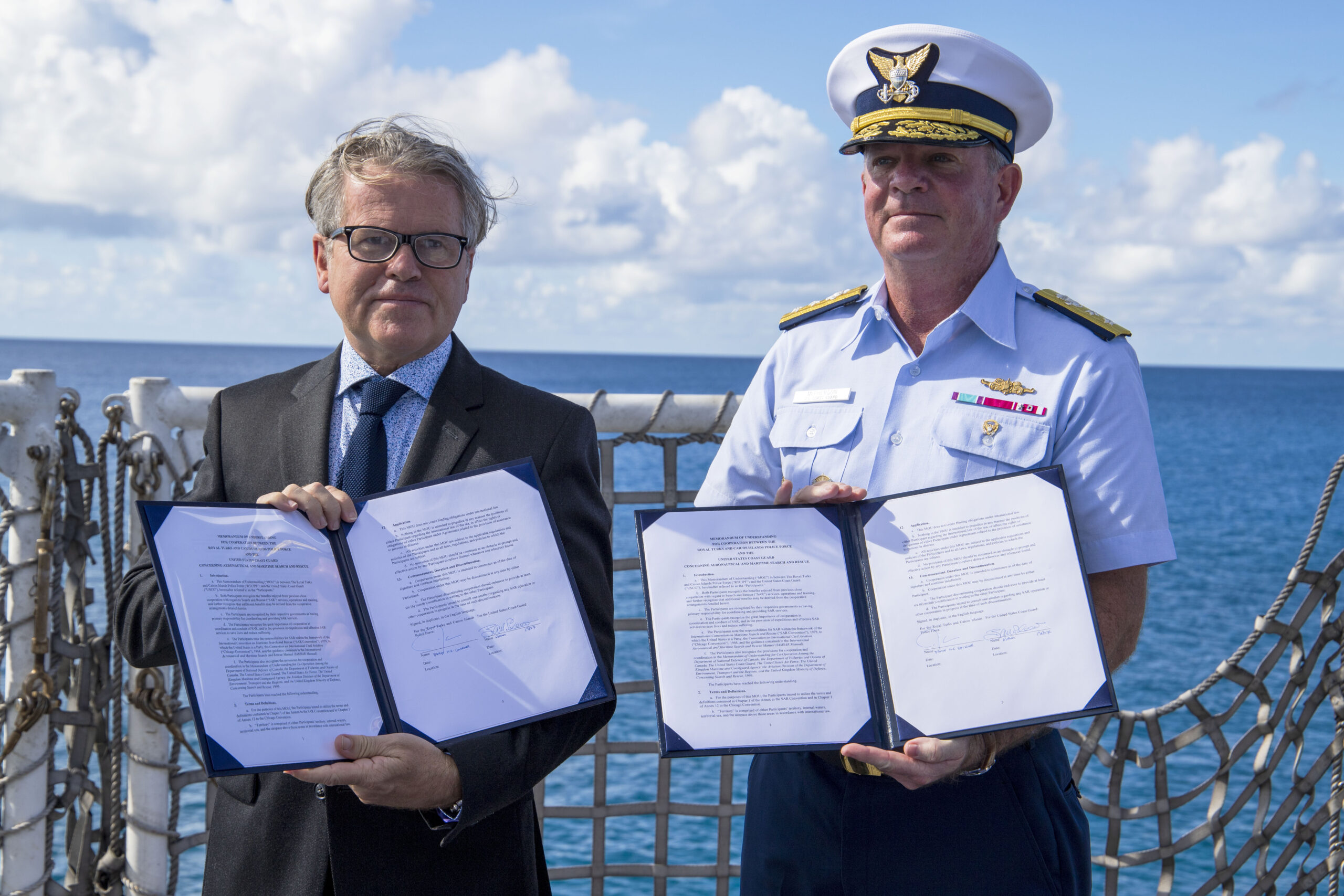
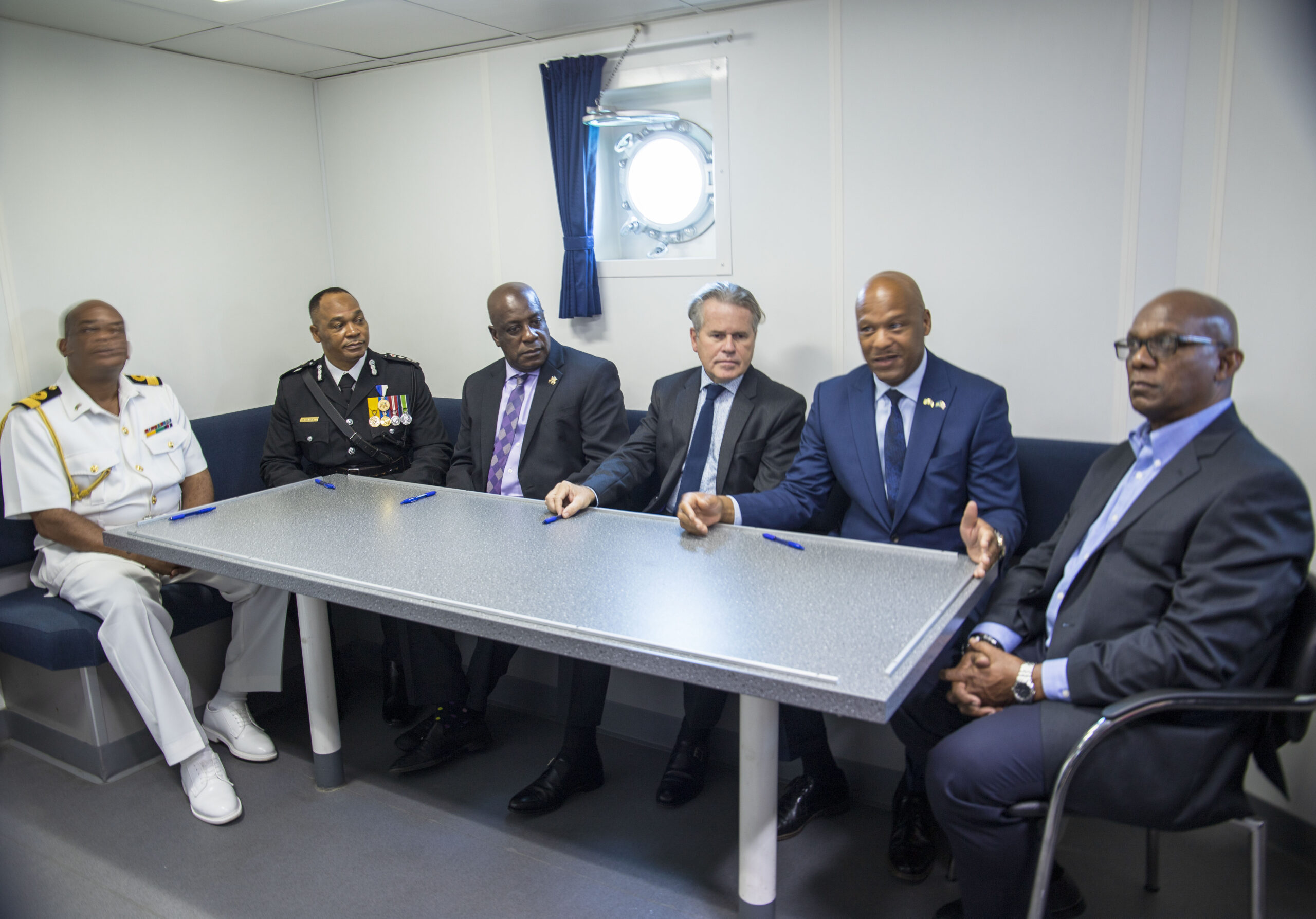
- It was against this highly relevant backdrop that the long planned strategic conference, the first of its kind, took place in TCI. The delegations were led by the Miami based Commander of the US Coast Guard that operates across the Caribbean, Admiral McPherson and by the Bahamas Minister for Immigration, Hon. Keith Bell. I count them both now as friends.
- The Minister and myself led for TCI. We were supported by teams of practioners including Permanent Secretaries for National Security from the Bahamas and TCI, the Admirals Chief of Staff, the Commander of the Bahamas Defence Force, and his opposite numbers from TCI Policing and the TCI Regiment.
- The British High Commissioner from the Bahamas and crucially the US Ambassador – who owns the Treaty on behalf of the US – and her Deputy – also from the Bahamas attended as did a senior British Naval Officer attached to the relevant US Combatant Command and UK Home Office and Border Force Officials.
- They had the confidence to come here – believing it would be worthwhile – because in TCI we have travelled a long way since late 2019 when we announced our National Security Strategy, established a Secretariat, vowed to establish a Regiment and placed the destabilising impacts of illegal migration at the top of the threats we face alongside the devastating impacts of hurricanes.
- Our allies also came here because during the last two years the external environment we are all seeking to manage has not get better – it has got worse – it is a a wicked problem, a problem that is changing, morphing even accelerating away from you as you seek to solve it. As has been evident in international media the push factors out of Haiti have got worse, not better over the last two years. Recent natural disaster and political shocks has meant Haiti is in no position, at present, to stop the problems on its Northern shore that we face – the problem set if faces is unfortunately huge.
- This, I’m afraid, sits within a much wider global context that the world is now on the move – mainly from the South to the North and from the East to the West. Populations that were once static now have just sufficient funds to travel and through the internet and global communications cannot only see a better life but have someone already there they can reach out to that can facilitate their travel and manage their arrival. This is a long-term global trend and we are on the wrong end of it.
- Being an archipelago of Islands just over 100 nautical miles, from a country whose population is 240 times our size, and who is experiencing the lawlessness evident in that country, is frankly not a comfortable place to be – particularly when any long-term solution to Haiti will take decades and require much more international support than is seemingly available. TCI can’t wait for that, welcome as it will be when it comes, but I assure the Government of Haiti that no place in the world wants a more stable, more secure and more prosperous neighbour to our South, more than we do.
- If the situation is getting worse another reason our allies came is because they now know we are serious because we have shown that seriousness. I said two years ago – when I first travelled to Miami and Nassau – that our allies should not underestimate my ambition, and they should not underestimate TCI’s ambition, and that was because it was hard for us in TCI – to overstate the threat illegal migration was to us.
- Despite the deteriorating situation in Haiti – and despite the complications that slowed us down during the pandemic – we are in a much stronger place today than we were in 2019. We are now building from a position of increasing strength. There has been many significant successes. Many sloops are now turned around at sea before they reach our waters and for that we can thank our allies with whom we are now in much closer communication. Over the last two years this has genuinely started to become, if you like, a team sport.
- I don’t say this as often as I should because I fear fate – I fear hubris – but for those that do get past these outer rings of defence we in TCI have become predictably good – almost metronomically good – at intercepting the large wooden sloops that used to be a regular sight washed up on our beaches having successfully landed their human cargo.
- We have become more effective, in the short term, mainly through the better co-ordination of our efforts and through the brilliance of the work done, 365 days a year, by those who are at sea or who monitor our borders from land. They have grown in determination and purpose over the last two years and that isn’t a commodity that can be bought, but instead fostered. I commend the leadership of those in roles where this strong morale and determination to succeed has been developed and I particularly call out the leadership of the Maritime Branch, the Radar, the Immigration Task Force and the Regiment.
- What the TCI public are not seeing, is those abandoned wooden hulls left on the beaches to rot covered in discarded clothing. We don’t believe a large vessel such as this has got past us in close to 2 years. Instead the public are seeing the pictures of the victims of people smugglers arrested and being landed at South Dock for rapid repatriation to Haiti. These images still enrage, I know, and there are costs involved in this which I will come onto later – but the costs are frankly manageable when compared to the damage inflicted on our society when we miss one of these large vessels and on the overall common good if we ever return to the position we were once in, when hundreds were arriving in each vessel we failed to stop.
- While some large sloops do – pathetically – continue to attempt to breach our defences we have now seen a noticeable shift in our opponent’s behaviours. As we get better, Darwinian like, so do they. Our main challenge now is fast boats, or far smaller boats, and as a result we have to shift and develop our own operations and build different types of capability. Some of those boats, and crucially fuel for them, are being stolen from our marinas and coastline and we have to both put an end to that while recognising – that rather like a chess game – we are forcing our opponents now into errors in that when they commit crime here in TCI – and we arrest them here in TCI – which we will – they start to illuminate the wider network of facilitators who live here amongst us and are in Haiti presently beyond our reach.
- There is therefore a strategy that is now being built – and the conference was part of us confirming our future maritime strategy – that can tackle shifts in their future methodology. It’s less about ‘how they come at us’ but who is facilitating the trade. It’s less about the soldiers and more about the Generals. What we need is a way to seriously degrade the smuggler’s ability to do damage to us. We need a ‘network’, if you like, to take down a ‘network’ and as I will come onto the people of TCI are part of this solution. You are not victims and you are not passive observers.
- This requires us, as an individual Territory and as an alliance, to do four things really well:
- to increasingly build sophisticated concentric circles of defence that allow the alliance the maximum opportunity to intercept vessels before they make landfall;
- to have a far better understanding – through surveillance and intelligence – of incoming vessels long before they reach our waters so we have time and space to interdict them at a point of our choosing, but crucially to understand who is profiting from this trade;
- to then lift our sights from just intercepting sloops or fast boats, to taking down the networks particularly here in TCI who facilitate this trade and;
- to do all we can to reduce the pull factors that bring irregular migrants to our shores. On this last point the Haitian Community that are here lawfully, the TCI business community and the wider public have a significant role to play and I will come to that.
So let me first update you – in detail – on how we in TCI are going to do those four things really well.
- The Maritime Police: are truly on the front line of our Territory’s defences and they are doing a magnificent job. We must invest in success. Under Mr WARRICAN’s leadership their numbers will close to double next year and two new Maritime Patrol Boats will be ordered this coming year for delivery in 2023. The Regiment will also provide them with a further reserve of well-trained manpower to draw on, as they need.
- The Radar: As previously announced the radar coverage is about to triple. The equipment has been procured and will shortly be operational – locking Providenciales down through 360 degrees. The staff at the Radar have, in the interim, seriously professionalised. We made an early decision to double their numbers and that has paid dividends. I commend the leadership of that team in particular. These are now some of the most effective public servants we have.
- A Coastguard: We are scoping out how all our Maritime assets can be brought together into a Coast Guard to bring greater efficiencies. A preliminary report was presented at last week’s National Security Council and work will continue on its feasibility. For the moment one large law-enforcement agency that can cover the protection of our borders from all threats – be they smuggling, environment or illegal fishing of our waters – has logic to it but what none of us want to do is disrupt the success the Maritime Police presently enjoy. Change needs to be carefully managed.
- So as an interim step, the Government has committed to building a new Marine Base and within that there will be a Maritime Operations Control Facility that will fuse all activity working in support of this mission. As part of the journey, a decision was made by the NSC last week that the Radar Operation – that now does so much more than just irregular migration – will move from the Ministry of Immigration to the Maritime Police bringing two first class, but separate units together, to ensure maximum collaboration. That will happen on 1 April.
- As our radar becomes ever more comprehensive, we risk becoming a victim of our own success and we may have many more sightings of suspicious craft. How we best resolve if these are ‘friend or foe’ depends on the increase in numbers that the radar see – we don’t necessarily want the Maritime Police having to intercept each one which would be inefficient. So the NSC has not ruled out investing in fixed wing drone technology to complement our radar activity if that becomes necessary, and the NSC has received some preparatory briefing on this.
- The TCI Regiment. As promised the Regiment has been formed and was stood up during the pandemic. It has a presence in both Grand Turk and Providenciales. It’s already operational and gaining plaudits for its support to counter-migration work from the Minister of Immigration. It’s staffed by brilliant committed people, regular and reserve alike, and it will grow year-on-year over the next two years to be around 100 Marines. Given how new it is, it’s already operating well beyond our early expectations but by 2023 it will be operating on land and sea to a very high standard indeed.
- The site for a regimental barracks has been acquired and is being developed. Fast boats will be procured that can both work in support of counter smuggling and post disaster relief operations. It will be equipped and armed to the highest of standards. The Regiment’s officers will be trained at the Royal Military Academy Sandhurst and plans are already underway for a British Army Training Team to be with us again next year to train what will be further recruits. A Non-Commissioned Officer cadre will be run to develop the leadership of our people probably in conjunction with other Overseas Territories. We have permanent on-island support from one, if not to my mind the best line Regiment the British Army has – ‘The Riles’ – and as an OT we are unique in securing this type of day-to-day support. My thanks to my good friend, General Sir Patrick Sanders, for being so forward leaning on this.
- A Border Force: Led by the Minister, stood here with me, and his new Permanent Secretary, and championed by the Premier, next year should see profound changes to the way we organise our defences at our ports of entry. Those entering our country illegally, or overstaying, come as much by air as by sea. The first step will be to combine the enforcement arms of Customs and Immigration to form a Border Force. That decision has now been taken. As I speak a top team from our Immigration Ministry is in UK looking at their digitised airport security features including pre-registration and e-gates. If we get this right, and I believe UK Border Force and Home Office will support us, in what is intelligence led border protection, those we know will do us ‘no harm’ – such as locals returning home and those arriving from our main markets – should have a seamless arrival and departure at our ports while our Border Force officers focus properly on those who bring the greatest risk.
- Wider Immigration Ministry: This move to a Border Force will be a very public manifestation of much deeper changes that will be occurring at the Ministry of Immigration, led by the Minister, and to support him we have appointed a new top team who will be in place by the New Year under PS Althea Been that includes, for the first time, a Deputy Secretary drawn from Policing to ensure there is an operational and enforcement mind-set at the top of the Ministry and alongside him a further new Deputy Secretary who, as a then Head of Department, cut his teeth on improving customer service.
- This top team is a team charged with delivering ‘change’. An Immigration Ministry focussed on serious enforcement against those that break the law, while giving excellent service to those who work inside the law, underpinned by the roll out of e-government to standardise and give transparency to process. That is the destination the Cabinet and NSC believe is not only in reach, but one that must be achieved. If our colleagues get this right this should feel – over the next couple of years – like a once in a generation change.
- And now to Sentencing: there has to be far greater consequences for those who facilitate this trade. They are not just smuggling people, they are undermining our society and there are the aggravating factors we saw last week where they put those they take money from, in genuine peril. We are expecting a Cabinet paper in the very near future but my understanding – and it is for the Legislature in the end to decide – is that the proposed minimum tariff for facilitating this trade will be a suggested 7 years in prison and an unlimited fine. That legislation is particularly important as we turn our attention to going after the networks that facilitate this trade.
- Moving away from our territorial waters – I mentioned reducing the costs of repatriation. Once overloaded, unseaworthy craft, are in – or close to – our territorial waters we cannot turn them around. There are maritime conventions linked to safety of life at sea – known as ‘SOLAS’ – that prevent this, that no Sea Captain anywhere in the world can ignore, and frankly we are not in the business of facilitating the potential mass drowning of migrants. We in TCI are bigger than that.
- However, the closer the Sloops can be identified to the Haitian shore the better, and therefore in conjunction with our allies we need to know what is happening well beyond our horizon. The deployment of a Royal Navy Wildcat Helicopter last year started to show us how valuable it was if we could extend our reach and therefore our and our allies warning. The more recent basing in TCI of US Coast Guard and Department of Homeland Security airframes has built on this and will continue. It was also good having the Royal Navy and its helicopter in our waters in October exercising with our Regiment and then patrolling.
- We generally expect a significant uptick in migrant boats at this time of year and as a result the Helicopter from the Cayman Islands is with us for periods over December and January – paid for by the UK – fulfilling this role – pushing our understanding out well beyond our horizon.
- But we know this is short term and we know we need something more persistent than that. In the recent meetings the Premier, Deputy Premier and myself had in London the UK Minister committed to support us with a long term maritime surveillance asset. While not yet confirmed I expect that to be a fixed wing specialist aircraft with long term persistence – able to observe for hours – and equipped with the relevant surveillance capabilities. That will not only support our own interdiction operations but also work in collaboration with our allies so more vessels can be returned to Haiti before entering our waters.
- We are also starting to develop a partnership with the UK that will give us access to the product of satellites that will provide surveillance of the waters we must protect – not least from illegal fishing. There are also long-term boundary disputes with our neighbours that alongside this need to be settled. The Premier raised this in particular with the UK Minister, and the FCDO’s International Treaty Team in London know that we must make headway on these issues so – as far as the global work they undergo – this will be re-prioritized in our favour.
- There is then our relationship with Haiti. Haiti is not our enemy. Haiti has always been our neighbour and always will be our neighbour. We are bound together, for better or for worse, for the rest of time. As a result I was speaking regularly to the then Haitian Minister of Foreign Affairs – Claude Joseph – including when he was Prime Minister – and myself and the Premier had hoped for a visit from him next year.
- He is no longer in office and so I hope to speak to the interim Foreign Minister this week. The new Haitian Consul, who is a professional serious diplomat, and who I have been impressed by since her arrival – has been instrumental in helping build this relationship and the Haitian Government and Haitian Consul works with us collaboratively on repatriation – and for that I am grateful in that not all countries – including the United States – had such a straightforward arrangement with Haiti, during the height of the pandemic, as we did. They were accepting flights from us when they were not accepting flights from others.
- I and the NSC have to live in the real world, not the world we would wish it to be, and we have to be realistic that the push factors out of Haiti are not going to reduce any time soon. The trend is the opposite way. We in TCI have to be in charge of our destiny, not the victim of others. What is entirely within our personal gift is we can reduce the pull factors that bring irregular migrants to our shores.
- As digital government rolls out in TCI – and I applaud the Governments determination to digitise – it will become increasingly clear who is, and who is not, on the island legally. We must stop employing those in TCI who have no right to be here. It’s simply no good us complaining about irregular migration and then employing someone here illegally to do the garden, work on a building site, look after a child or work in a store or bar. If we are to succeed that must be completely socially unacceptable. We should be ashamed if we do it.
- There is also a serious responsibility on the Haitian Community here in TCI to support the islands that they now call their home. If you send money to Haiti to facilitate this trade you are damaging the society you live in. If you harbour or support a person who entered the Territory illegally you deserve the Islands condemnation. You are not part of TCI’s amazing future, you are damaging and hurting it. I know there are leaders in the Haitian community pushing this message and they are right to do so.
- If this is what we are doing on our own – what are our allies doing.
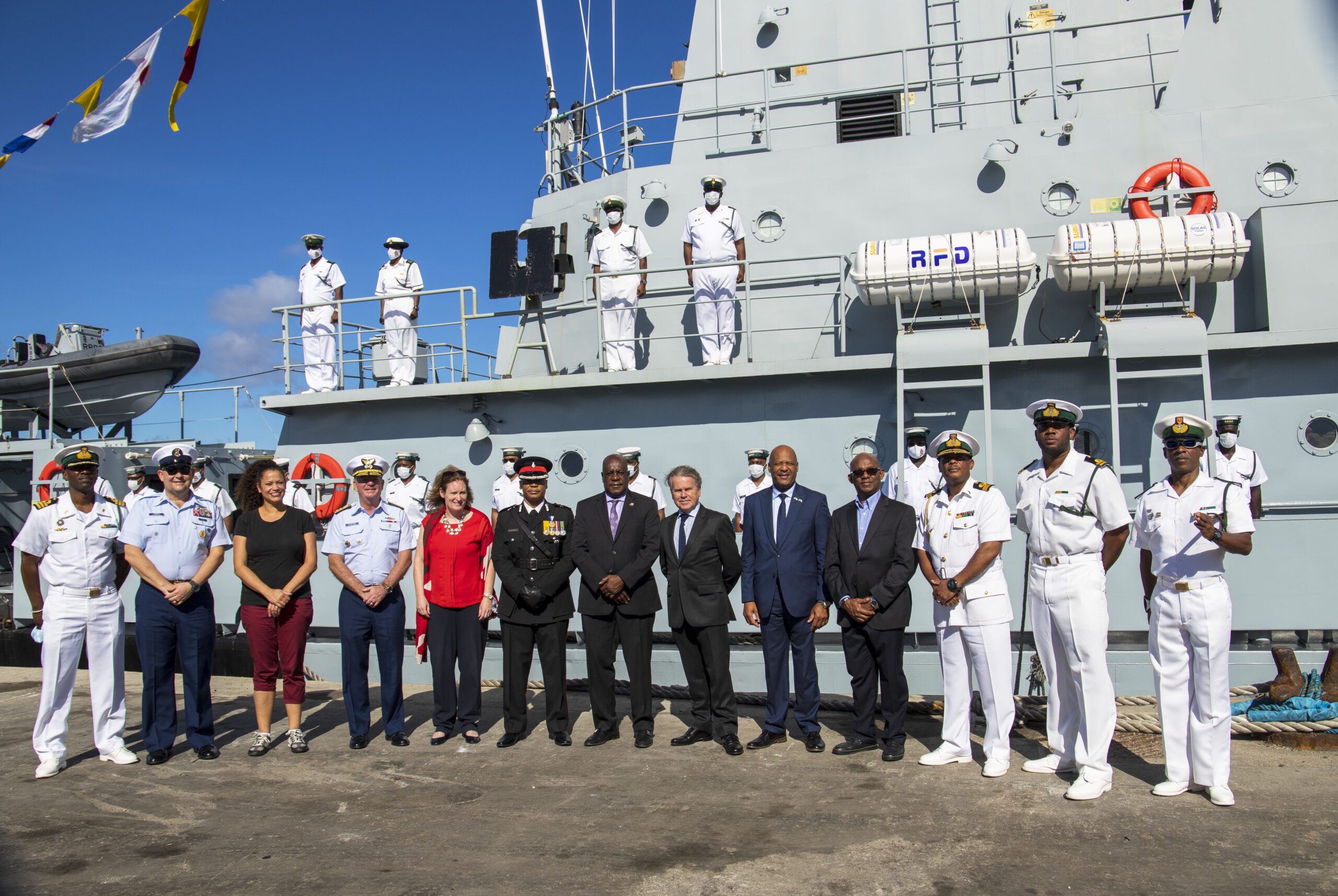
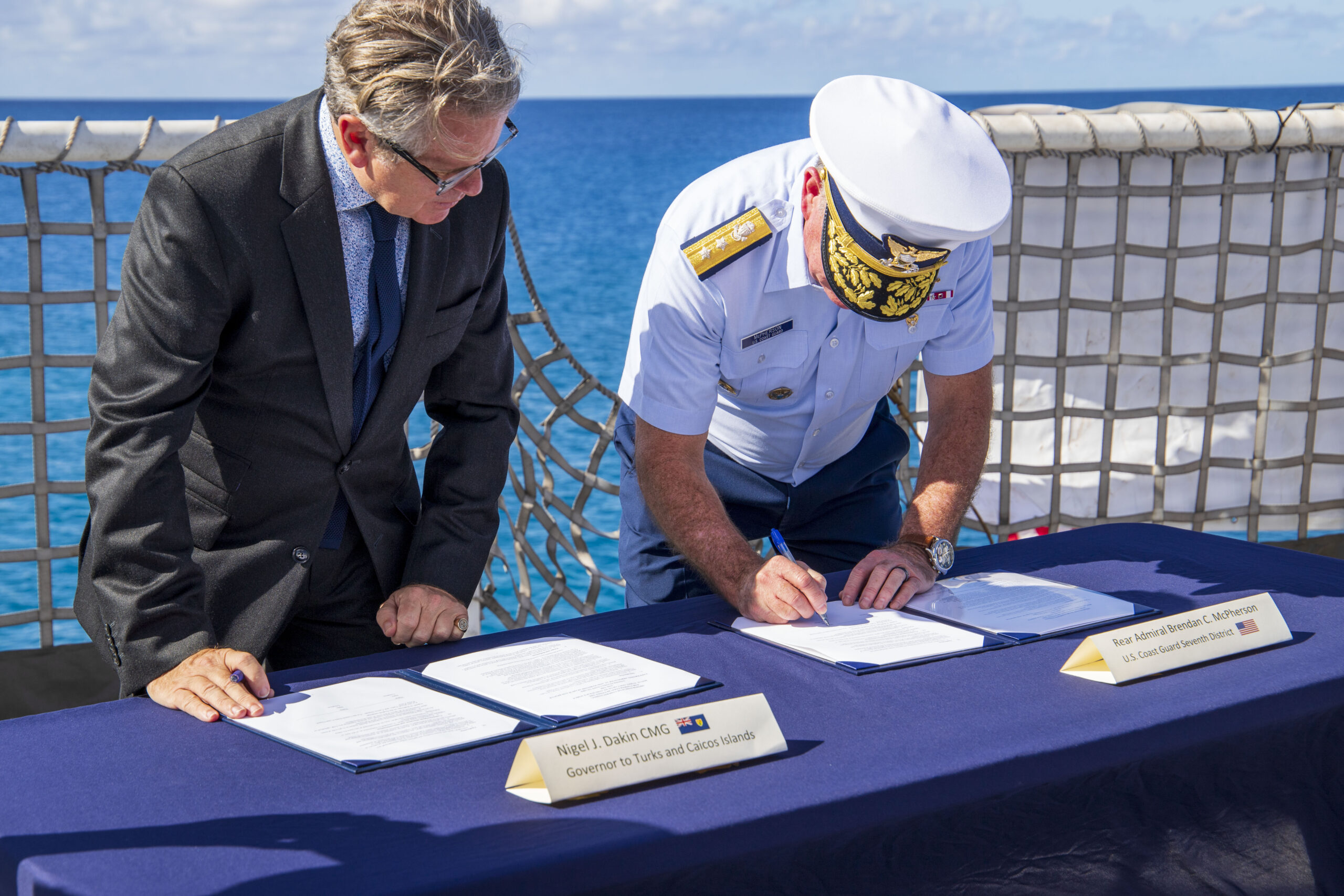
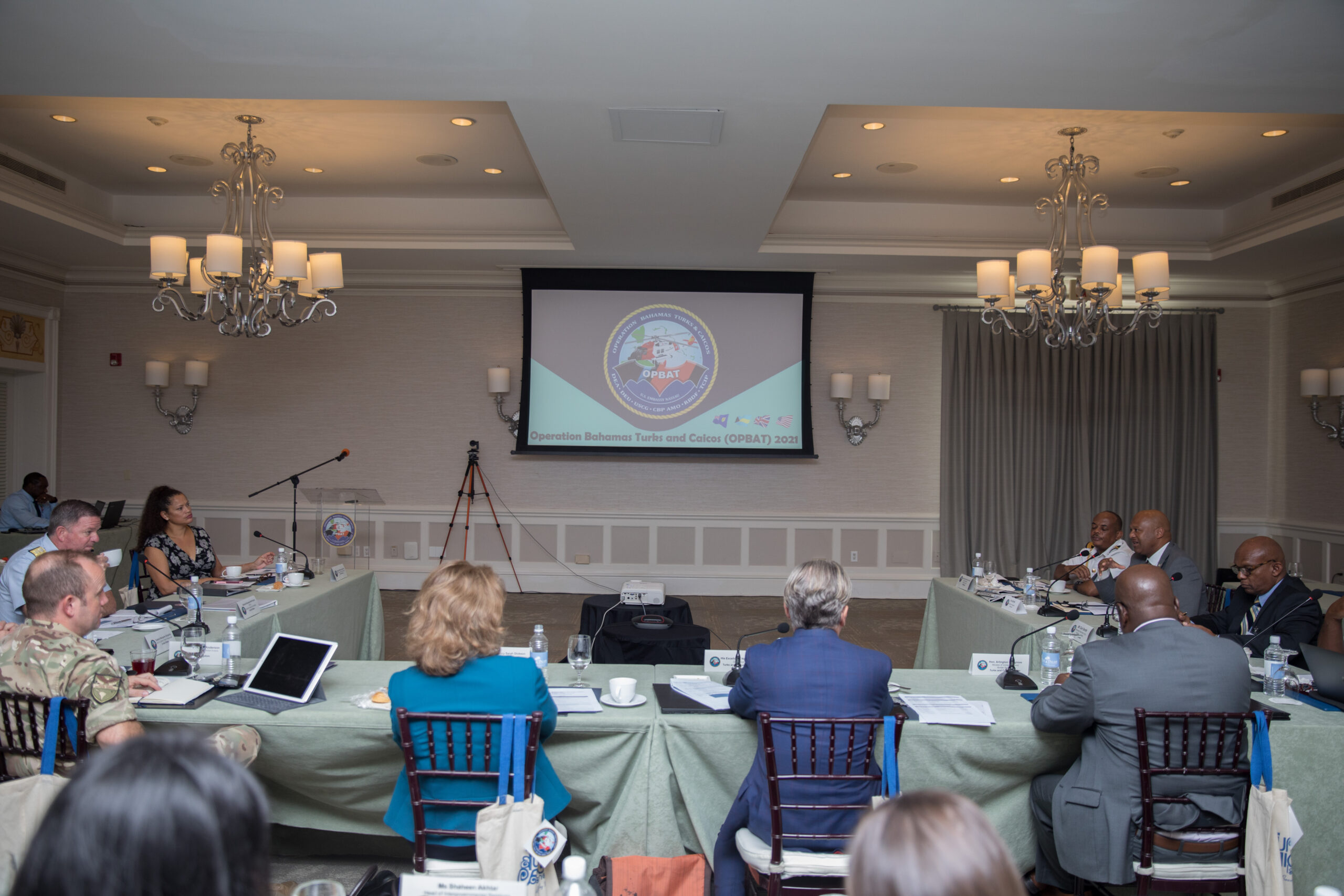
- The Bahamas – who have suffered worse than we have in recent years – are in the process of seriously building their defences. Ten times our size their own naval assets are growing. The signing of what is known as a ‘Shiprider’ agreement on board Her Majesty’s Bahamas Ship NASSAU last week will allow the Commodore who commands the Bahamas Defence Forces to station a vessel far closer to our waters and it can operate in the passage between Haiti and ourselves. That goes for ratification to our House of Assembly next week. We will then have our people on board and in support of our and their priorities.
- That immediately compliments the US Coast Guard deployment that works along the coastline of Haiti and that starts to open up the opportunities for a ‘Task Force’ to deploy – not just individual vessels. That brings into play aerial assets – including our own future surveillance platform. As we collectively do this we are quickly starting to make the passage from Haiti far harder because our combined defences overlap. An action point from the conference was for the Bahamas to take the lead to develop far more ambitious tri-lateral joint operational plans in this area on behalf of us all. I have every confidence they will.
- Our people are everything and investing in their training and development is essential. If we get this right we become not only interoperable in a practical sense but also relationships and trust further develop across national boundaries. Its trust above all that make alliances work. A very practical output from the conference was the US taking on the overall training brief and we expect, in reasonably short order, world class training being delivered to those who serve at sea delivered by those we work alongside. The UK has some specific training expertise that can also be sown into this trilateral effort, for the good of all.
- What is fundamental to going after the networks and using our scarce resource wisely is information and intelligence. As an alliance we have become very good recently at what might be called tactical tip-offs – indeed many successes start as we react to real time sharing between ourselves – but what we have yet to do is properly develop that intelligence to do long term damage to our opponents extended network. The UK – through its Policing and serious crime expertise, its defence intelligence and its intelligence led immigration work – are well placed to support this and TCI, supported by the UK, was asked by our partners at the
 conference to take the lead on this.
- That sits well for TCI because beyond UK support – which we will get – we are increasingly going to have, for ourselves, a sophisticated intelligence collection operation that we need in TCI to provide exactly those sort of leads to take down networks here, be they linked to the smuggling of people, guns, drugs or the murder of our citizens.
- Some of that preparatory work is already well underway. It will however require legislation to come to the House of Assembly, legislation that will be best in breed in the Caribbean, world class in terms of providing Judicial – rather than Executive – over-watch to ensure proportionality and necessity – while also ensuring those that can really do us harm, and make fortunes from the misery of others, don’t have the freedom to communicate locally or regionally as they work against the interests of the law-abiding citizens of these Islands.
- Put succinctly – we can’t possibly close them down in a network in physical space if we give them complete freedom of movement and communication in digital space. More on that in the New Year, once the legislation is in draft and there is time for proper considered consultation. Rather like building a Regiment for TCI, this is one to get right.
- Finally, a word on atmospherics at the conference that I think says something to TCI’s growing place in the region. Friendship, already established through joint work at the practitioner level, quickly turned into fellowship at the leadership level. We liked each other, a lot. I’ve done a lot of this type of engagement in the past and rarely have I seen three delegations lean in so completely towards each other wanting to find solutions to problems too large for even the largest of us to handle alone.
- The National Security Team that organised this presented TCI as a professional, serious partner and more than ready to carry our own weight while contributing to the security of the alliance. And it sat comfortably with the way the Premier, Deputy Premier and other team members presented at the JMC in London. Let nobody doubt, TCI is a serious player with serious ambition and we have reached the point where we are taken seriously by those whose opinion we respect and whose partnership we are grateful for.
- So thank you United States, thank you Bahamas, thank you UK and, I end as I started, by saying a huge thank you – to the men and women who guard our borders, by day and by night, at sea and on the land. Behind the scenes we will do everything we can to provide you with the ability to be as good as I know you can be – and want to be – because you show us that every night. You are indeed the guardians of our dawn and we all thank you for it.
- And so may God bless these Turks and Caicos Islands.

By Magnetic Media Newsroom
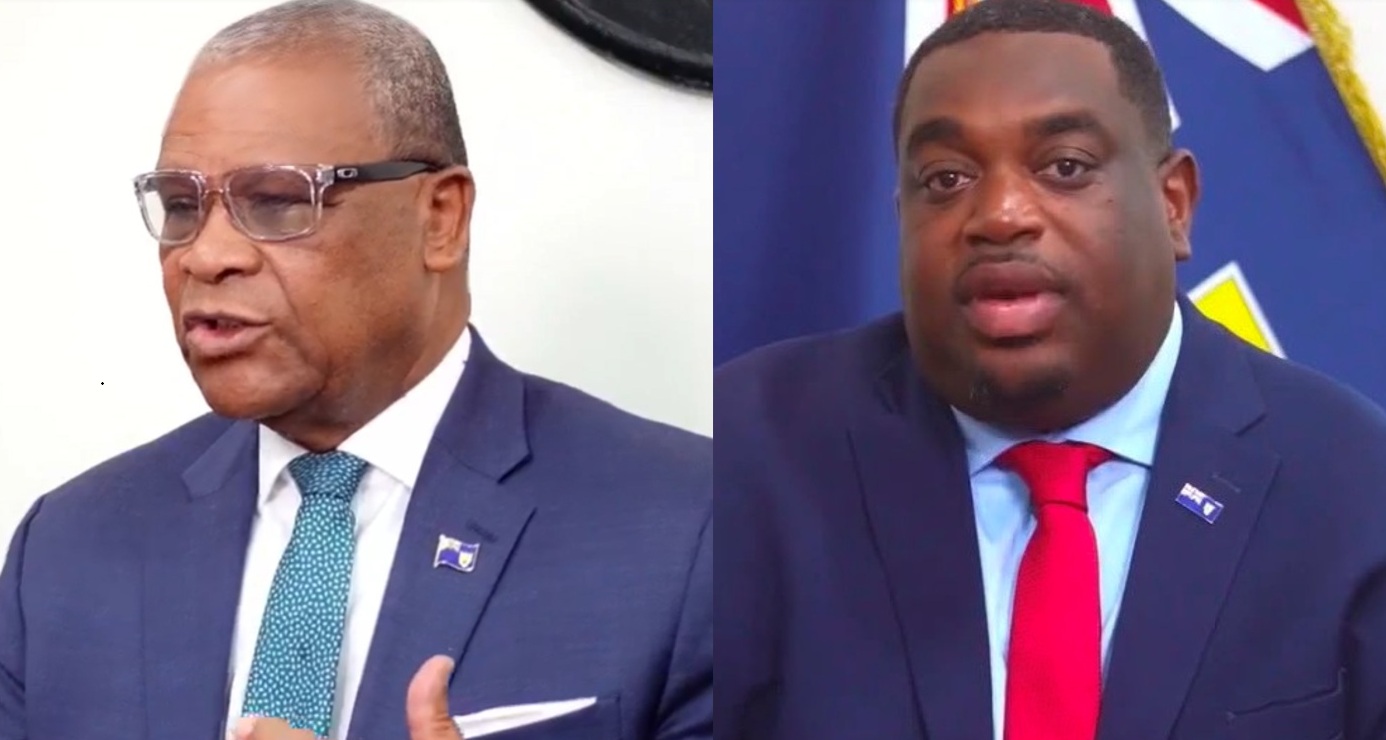
PROVIDENCIALES, Turks and Caicos Islands — The Turks and Caicos Islands Government says the breakdown of its relationship with InterHealth Canada presents an opportunity to reshape healthcare delivery, with plans to expand local medical services, strengthen primary care and reduce dependence on overseas treatment.
During a national briefing following InterHealth Canada’s notice terminating its hospital contract, Premier Charles Washington Misick acknowledged publicly for the first time that Government and InterHealth had been negotiating an exit from the arrangement for more than a year after what he described as an “irretrievably broken down” relationship.
Despite the contractual dispute, Misick and Health Minister Kyle Knowles stressed that healthcare services will continue uninterrupted during the transition.
“Allow us to do our job,” Knowles appealed, assuring residents that Government is actively managing the transition and safeguarding patient care.
The Premier outlined what amounts to a broader healthcare transformation built around four connected levels of care: strengthened community-based primary healthcare; expanded polyclinic services; enhanced hospital-based secondary care with greater specialist capacity; and overseas tertiary treatment only for cases that cannot be managed locally.
Among the proposals are the long-discussed establishment of intensive care units, expanded use of currently unfinished hospital space, recruitment of more resident specialist physicians and stronger contract management to oversee future healthcare agreements.
Knowles said the new polyclinic model will broaden services available outside the hospitals, including dentistry, ophthalmology, laboratory services, diagnostic imaging, gynaecology and preventative screening, helping to reduce pressure on emergency departments while improving early intervention.
Misick also acknowledged that while the hospital system significantly improved healthcare access after opening in 2010, Government believes further reform is necessary to improve affordability, sustainability and the range of services available within the Turks and Caicos Islands.
The briefing marked the Government’s most comprehensive explanation to date of its plans beyond the InterHealth contract, signalling that officials now see the transition as an opportunity to redesign healthcare delivery rather than simply replace one operator with another.
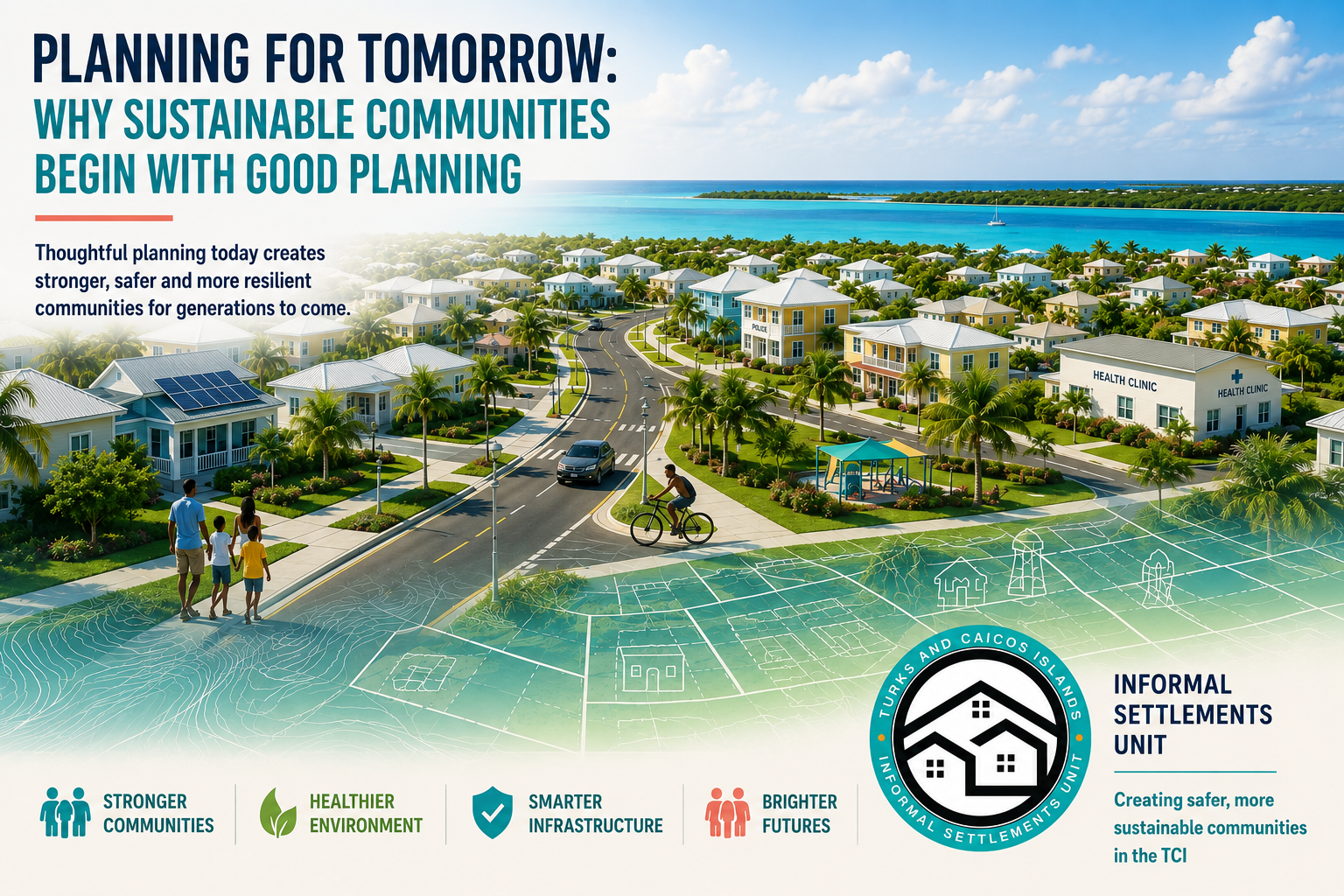
Turks and Caicos – Every thriving community tells a story long before the first home is built. The placement of roads, the routing of utilities, the protection of natural resources and the provision of schools, healthcare and emergency services are all the result of decisions made through careful planning. While these elements are often taken for granted, they form the foundation of safe, functional and sustainable communities.
As populations grow and communities evolve, planning becomes increasingly important. It helps ensure that development takes place in locations that can support it, that infrastructure keeps pace with demand, and that public services remain accessible to those who depend on them. Good planning also considers the future, creating communities that can adapt to changing needs while preserving the quality of life enjoyed by current and future generations.
Where development occurs without adequate planning, however, the effects can be felt far beyond the boundaries of a single neighbourhood. Roads may be unable to accommodate emergency vehicles, utilities can become overstretched, and environmental resources may come under increasing pressure. Delivering public services in these circumstances often becomes more difficult and more costly, creating challenges that affect entire communities rather than individual properties alone.
For this reason, sustainable development can only emanate from careful planning. It must be ensured that homes, infrastructure and essential services develop together in a coordinated and responsible way. Every planning decision contributes to the broader picture of how communities function, grow and respond to future demands.
Supporting that process requires reliable information. Accurate data helps planners and policymakers understand where growth is occurring, identify emerging needs and make informed decisions about infrastructure, housing and public services. It also strengthens collaboration among government agencies by providing a shared understanding of the challenges and opportunities facing communities.
Within the Turks and Caicos Islands, this collaborative approach is reflected in the work of the Informal Settlements Unit (ISU), which supports a range of initiatives aimed at improving the understanding of informal settlement development. Through activities such as GIS mapping, the Social Needs Assessment Survey and collaboration with partner agencies, the ISU contributes valuable information that helps support evidence-based planning and long-term decision-making.
Strong communities are not built overnight. They are shaped through thoughtful planning, informed decisions and cooperation across government and the wider community. As the Turks and Caicos Islands population continues to grow, maintaining that focus will be essential to creating communities that are safe, resilient and equipped to meet the needs of generations to come.
What the Attorney General must do now to protect Bahamian exports
Deandrea Hamilton | Editor
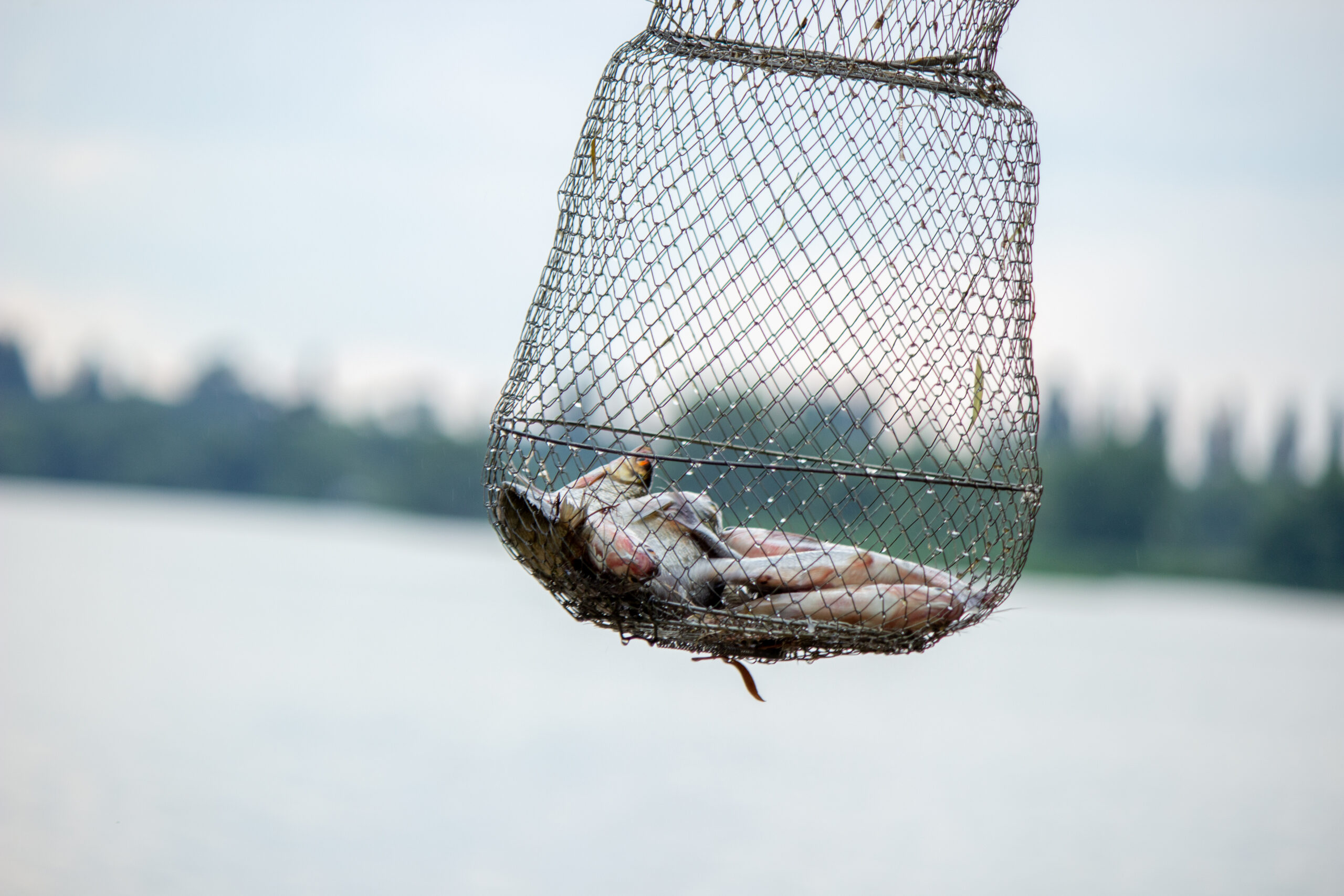
NASSAU, Bahamas — The United States’ decision to impose a 12.5 percent tariff on Bahamian exports is about more than higher costs for seafood, rum and other goods entering the American market. It is a warning that The Bahamas must move quickly to strengthen or clarify its legal framework governing forced labour and supply-chain enforcement.
The tariff, which takes effect July 24, is part of a sweeping U.S. trade action affecting 60 economies following a review by the Office of the U.S. Trade Representative (USTR). The review concluded that the listed countries have not adequately prohibited or enforced measures against goods linked to forced labour in global supply chains.
The action follows a recent U.S. Supreme Court ruling that invalidated an earlier series of Trump-era tariffs imposed under emergency powers. In response, the Trump administration shifted to a different legal authority—Section 301 of the Trade Act of 1974—using findings from a U.S. Trade Representative investigation into forced-labour compliance to support a new round of tariffs affecting 60 economies, including The Bahamas.
Importantly, the action does not accuse Bahamian businesses of using forced labour. Instead, it reflects the U.S. view that The Bahamas’ legal or enforcement framework does not yet meet the standard Washington expects.
That distinction matters.
The Attorney General’s Office now has the responsibility to lead the country’s legal response. That begins with determining precisely what concerns the U.S. Trade Representative identified, reviewing whether Bahamian law adequately addresses those concerns and, where necessary, recommending legislative or regulatory changes. If deficiencies exist, legal amendments and stronger enforcement could help position The Bahamas for removal from the tariff list.
The government may also seek formal discussions with U.S. officials while those reforms are undertaken, outlining a clear timetable for compliance and demonstrating that the country is committed to meeting international labour standards.
A Nassau Guardian front-page report on July 24 drew attention to the tariff action, prompting broader questions about why The Bahamas was included among the 60 economies affected by the U.S. trade measure and what steps are now needed to restore full confidence in the country’s trade framework.
For many Bahamians, the immediate concern will be the fisheries sector, one of the country’s largest export industries. Commercial shipments of lobster, conch, fish, crawfish and other products entering the United States could become more expensive because of the additional tariff, potentially affecting exporters’ competitiveness.
The broader lesson is that international trade increasingly depends not only on quality products, but also on strong business relationships and confidence in the legal systems that govern them.
For The Bahamas, this is less a finding of wrongdoing than a reminder that international credibility is earned through modern laws, effective enforcement and trusted partnerships. The challenge now is for the Attorney General’s Office to lead a swift legal review, identify any deficiencies and chart a clear path toward compliance so Bahamian exporters are not burdened any longer than necessary.





-
 Education4 days ago
Turks and Caicos Islands Students Excel at Cycle 13 WizdomCRM Regional AI Game National Awards Ceremony
-
 News1 week ago
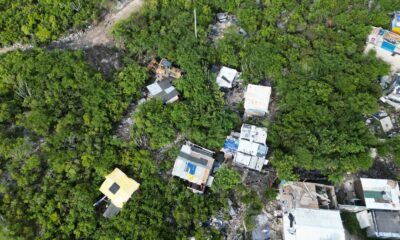
Six Unauthorised Structures Demolished During Multi-Agency Planning Enforcement Operation
-
 Caribbean News6 days ago
Pres Ali declares three days of national mourning following MV Barima tragedy July 21, 2026
-
 News5 days ago
ANDY BURNHAM, NEW UK PM’S FIRST ORDER: LOWER THE COST OF LIVING
-
 Government4 days ago
Parnell Urges Premier to Step Aside, Proposes Bipartisan Board to Guide Healthcare Transition
-
 Government3 days ago
Government Outlines New Healthcare Vision as Interhealth Exit Accelerates Reform
-

 News3 days ago
Planning for Tomorrow: Why Sustainable Communities Begin with Good Planning
-
 Bahamas News3 days ago
Caught in the Net, Not Accused of Wrongdoing