Connect with us

News

Government ‘jumped the gun’ over Rubis leak risks

Published

on

Nassau, 01 Aug 2015 – The government displayed poor judgment and risked giving false hope to Marathon residents by releasing incomplete findings on the health risks associated with the Rubis fuel spill on Robinson Road, Vanessa Haley-Benjamin said.

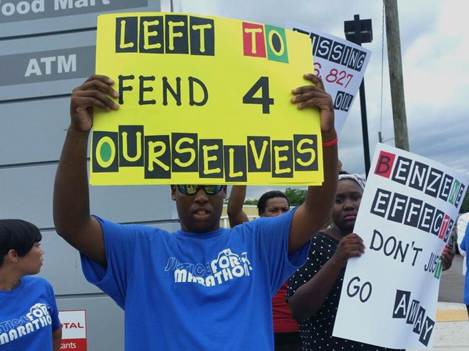
Lending her support to last week’s protest by Marathon residents outside the station, Haley-Benjamin, CEO of fast-growing social and environmental movement Save The Bays (STB), said authorities were wrong to tell residents they have nothing to fear from the toxic chemicals to which they were exposed for upwards of two years, as medical tests are far from complete – and likely to be less than conclusive when they are.

“The release of these premature results is unfortunate,” she said. “The government clearly jumped the gun. In reality, there is no satisfactory way in the short term to verify conclusively whether a person has been exposed to low levels of certain chemicals, for example benzene.”

Haley-Benjamin noted that according to Dr. van de Weerdt, toxicologist and consultant with the Pan-American Health Organization (PAHO), while the preliminary results may be encouraging, it remains important to establish a complete picture of the situation – both in terms of completing the health risk assessments and being in a position to reassure concerned citizens.

“The government should not be in the business of communicating simplified versions of this very serious situation to the public,” she said.

“With regard to the 223 persons tested, more information is required to understand the extent of the evaluations and if those tested are representative of both the original and possibly any newly impacted areas. To date, we know that 17,000 gallons of fuel have yet to be recovered from the ground. Over time, the impacted area will grow as the benzene spreads with the natural flow of groundwater.

“Residents of this area are very concerned for their safety – and rightfully so considering the known link between aggressive cancer and benzene exposure; and in light of the more than 20 recent cancer-related deaths in the area,” said Haley-Benjamin. “Exposure to low levels of benzene can result in chronic health effects and take a longer period of time to manifest. This underscores the need for long-term medical surveillance by a medical practitioner to detect abnormalities during early onset.”

Haley-Benjamin called for a full report of the investigation by the Department of Environmental Health (DEHS) and PAHO to be compiled and released to the public, and said officials should refrain from making any sweeping statements until such time.

She went on to stress STB’s full support for Justice for Marathon, the grassroots community group that organized last week’s protest, citing the lack of proper response to the leak by both government and Rubis, and the ongoing failure to fully address the concerns of residents.

Haley-Benjamin said STB’s call for stronger environmental legislation is also an effort to protect human health by either through prevention of hazardous pollution, or mitigation of the effects if such situations do arise. To that end, she called for the implementation of an effective response and public warning system for hydrocarbon leaks, and a comprehensive monitoring program for all fuel stations, in line with the recommendations in the report by consultants Black & Veatch, who were contracted by the government to evaluate the response to the Marathon spill more than a year ago.

Save The Bays CEO Vanessa Haley-Benjamin participates in last week’s protest, pointing out 20 recent cancer-related deaths in the area of the fuel leak.

In January 2013, it came to the attention of Rubis and the government that the Robinson Road station had leaked around 24,000 gallons of gasoline into the ground.

The resultant presence of strong hydrocarbon vapors and discovery of large pools of underground gasoline forced the station’s immediate neighbor, Cable Bahamas to evacuate its Customer Service Building (CSB) amid fears of health and safety issues for customers and staff. Eventually, more than 40 staff members had to be treated for exposure.
It has been confirmed that the leak led to the contamination of a wide area of groundwater, including the water supply to several homes and residents have reported a range of health problems.

For two years, Rubis and government officials were aware of the leak and the associated dangers, but failed to make any public announcements, sparking widespread outrage.

Since then, two further possible leaks at Rubis stations in New Providence have come to light. In the wake of the fallout from the Marathon case, both Rubis and the government appeared to take swift action. However yet again, they only broke their silence in response to concerns raised by members of the public.

Magnetic Media is a Telly Award winning multi-media company specializing in creating compelling and socially uplifting TV and Radio broadcast programming as a means for advertising and public relations exposure for its clients.

Caribbean News

Migration Is No Longer Just About Borders

Published

on

What Caribbean migration dialogues reveal about the region’s future


By Patrice Quesada, Coordinator, IOM Caribbean

Migration has become one of the defining issues shaping the Caribbean’s future—not simply because people are moving, but because our economies, labour markets, populations and climate realities are changing.

Over the past several weeks, I have participated in migration discussions at the global, regional and national levels. While each conversation was different, they all pointed to the same conclusion: the Caribbean is beginning to recognize migration not only as a border issue, but as a development issue.

The challenge now is moving from dialogue to action.

From Global Commitments to Caribbean Solutions

That shift was evident during the International Migration Review Forum held at the United Nations in New York, where Caribbean participation was particularly strong. Delegations from ten Caribbean countries, including ministerial representatives from Barbados and Belize, reinforced the region’s growing commitment to shaping international migration policy.

Two messages emerged clearly.

First, migration governance must be grounded in each country’s realities and supported by concrete national commitments. Second, migration cannot be viewed in isolation. It is closely linked to labour markets, demographic change, climate vulnerability and long-term development planning.

Every Caribbean Country Has Its Own Story

Across the region, governments are approaching migration through different lenses.

In Saint Lucia, the launch of the country’s draft migration policy reflected concerns about declining birth rates, labour shortages and continued emigration. The discussions recognised that labour needs, diaspora engagement, remittances, return migration and protection must all work together within one national strategy.

Jamaica demonstrated how migration planning can begin at the local level, with Clarendon becoming the country’s first parish to integrate migration considerations into its long-term development strategy.

Guyana, meanwhile, is managing migration in the context of rapid economic growth, balancing increased labour demand with worker protections and orderly migration systems.

Barbados has also begun incorporating migration into broader population planning as it addresses demographic decline and an ageing population.

The Bahamas has focused on disaster preparedness, bringing together government agencies to strengthen national plans for managing inter-island and cross-border movement during emergencies while safeguarding the rights and dignity of displaced people.

Different countries face different challenges—but all are recognising migration as an essential part of national planning.

The Caribbean’s Greatest Untapped Asset

One message resurfaced repeatedly throughout these discussions.

The Caribbean diaspora should no longer be viewed simply as a source of remittances.

Across the region, citizens living abroad continue to contribute through investment, entrepreneurship, professional expertise, advocacy and, in many cases, by returning home with new skills and experience.

The opportunity now is to engage the diaspora more deliberately as a strategic development partner.

Turning Dialogue into Action

Technical discussions held throughout May demonstrated that governments are beginning to move beyond policy conversations.

CARICOM, supported by the International Labour Organization and the Inter-American Development Bank, convened regional labour migration specialists to explore how migration can help address workforce shortages while ensuring fair recruitment and decent working conditions.

Together, these initiatives suggest the Caribbean is entering a new phase—one where migration is no longer viewed simply as movement across borders, but as a tool for economic resilience, demographic planning and sustainable development.

The conversations have begun.

The next challenge is ensuring they lead to meaningful action.

Continue Reading

Health

Cleveland Clinic Completes Its First Robotic Lung Transplant in US

Published

on

Cleveland Clinic staff performing their first U.S. robotic lung transplant surgery

Health system is one of only a handful in the world able to perform the complex robotic procedure

In May 2026, surgeons at Cleveland Clinic successfully completed the health system’s first robotic lung transplant in the United States, marking a significant advancement in minimally invasive organ transplants. Cleveland Clinic is among only a small number of centers worldwide offering this surgical approach and was the first in Ohio to complete this type of procedure. Robotic lung transplants have rarely been performed because they require advanced robotic capabilities and a skilled surgical team.

Gregory Jones, MD, a thoracic surgeon at Cleveland Clinic’s Heart Vascular and Thoracic Institute, led the surgical team for the single lung transplant procedure, which also included Kenneth McCurry, MD, a cardiothoracic surgeon and surgical director of lung transplantation and enterprise director of transplantation.

“This achievement reflects the collaboration and innovation across our transplant and surgical teams,” said Dr McCurry. “As these technologies continue to evolve, they will play an increasingly important role in improving patient outcomes and advancing the future of transplantation. Indeed, our kidney and liver transplant programs in Ohio have also been at the forefront of robotic organ transplantation with great success.”

In a traditional lung transplant, surgeons commonly gain access to the chest by dividing the breastbone or ribs to access the lungs. This is often associated with significant pain, which can prolong recovery. In a robotic lung transplant, surgeons use small incisions and robotic instruments and 3D visualisation to perform the procedure with a less invasive approach. This approach is designed to help reduce postoperative pain, shorten hospital stays, and accelerate recovery.

“This milestone reflects an important step forward in how we approach lung transplantation,” said Dr Jones. “It builds on our experience with both robotic surgery and transplant care and adds another option for some patients who may benefit from a minimally invasive approach.”

Robotic surgery has transformed many types of cardio-thoracic procedures over the past decade. By bringing this technology to lung transplantation, Cleveland Clinic is expanding access to advanced, minimally invasive transplant care.

The surgery was performed on a man in his 70s with pulmonary fibrosis, a progressive lung disease that causes scarring of the lungs and can make breathing increasingly difficult. Following the transplant, he was discharged from the hospital and is recovering well.

Cleveland Clinic’s Lung Transplant Program is a national leader in advanced lung transplant care, having performed more than 2,500 transplants since 1990. In 2025, Cleveland Clinic performed 146 lung transplants in the U.S. The program is known for its expertise in caring for complex transplant patients, many of whom have been turned down elsewhere, and for advancing new approaches in transplant care.

In addition to the US, Cleveland Clinic is also a leader globally in transplantation. A team at Cleveland Clinic Abu Dhabi performed the enterprise’s first robotic lung transplant last year. It was also the first procedure of its kind performed in the Gulf region.

Continue Reading

Caribbean News

Caribbean Urged to Rethink Tourism as Travel Patterns Shift

Published

on

Deandrea Hamilton | Editor

The Caribbean’s tourism industry has mastered the busy season. Now, a new report says the region’s biggest opportunity lies in transforming the months it has long considered its slowest.

The latest Amadeus Travel Insights Report, produced in partnership with the Caribbean Hotel and Tourism Association (CHTA), urges Caribbean destinations to strengthen marketing efforts and forge closer partnerships with airlines to stimulate demand during the traditionally quieter months of September and October.

The report comes despite a strong performance by the region, with international visitor arrivals climbing by approximately 30 percent over recent years. Researchers caution, however, that continued growth cannot be taken for granted simply because demand remains strong during peak travel periods.

Instead, the study points to a persistent seasonal challenge.

While Caribbean destinations continue to attract robust visitor numbers during the winter travel season, arrivals typically flatten once the calendar turns to late summer and early autumn. Those months coincide with the height of the Atlantic hurricane season—a reality that has long influenced travel decisions and presents a challenge largely beyond the control of tourism-dependent economies.

The report suggests the solution lies in changing traveller behaviour rather than simply waiting for demand to return.

That means targeted promotions, strategic airline partnerships, expanded route development and marketing campaigns designed specifically to encourage off-season travel.

There is another encouraging finding for the Caribbean.

According to the report, airfares to Caribbean destinations remain broadly competitive with those to South America, giving the region a valuable advantage as travellers continue searching for affordable international getaways.

For tourism leaders, that pricing competitiveness provides an opportunity to attract visitors who increasingly weigh value alongside destination appeal when planning holidays.

The challenge now is convincing travellers that the Caribbean offers compelling experiences beyond its traditional high season.

Whatever strategy emerges, the report suggests success will depend on balancing innovation with reality. September and October will always bring heightened weather risks, but with stronger airline partnerships, creative marketing and attractive pricing, the region could unlock new opportunities during months that have historically been among its quietest.

For a tourism industry built on resilience, the next frontier may not be attracting more visitors—but attracting them at a different time of year.

Continue Reading

FIND US ON FACEBOOK

TRENDING