
Bahamas News
House of Assembly Covid-19 Communication by Bahamas Prime Minister, Dr. Hon Hubert Minnis – April 27, 2020

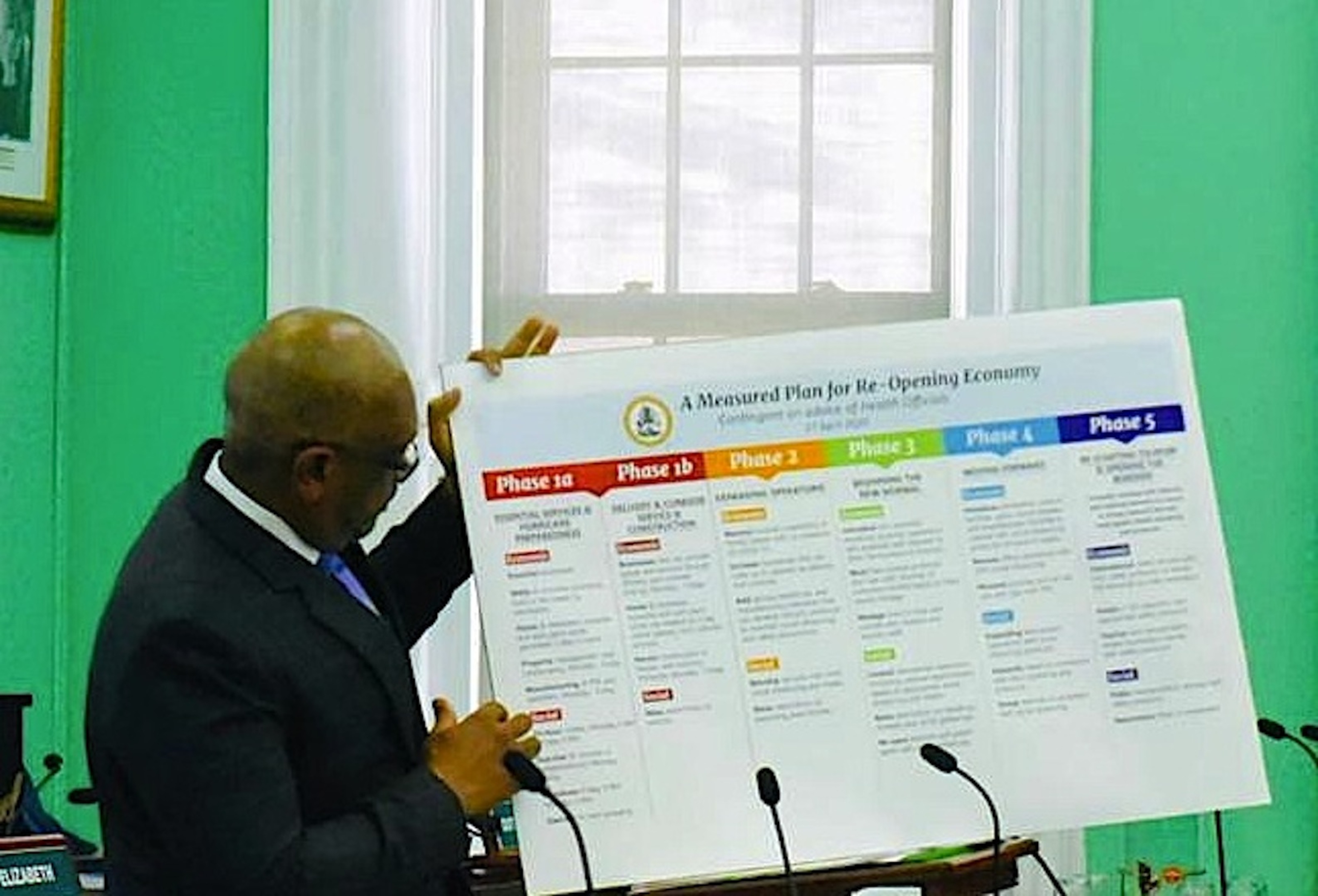
Mr. Speaker:
The House meets today to approve a
Resolution extending emergency powers in
The Bahamas because of the COVID-19
global pandemic.
I also wish to provide the House and the
Bahamian people with an update on a range of matters in my Government’s ongoing, full
and comprehensive response to the
pandemic.
Mr. Speaker:
The House meets today to approve a
Resolution extending emergency powers in
The Bahamas because of the COVID-19
global pandemic.
I wish at the outset to offer the
condolences of the country and my personal
condolences to those who have lost loved
ones to this deadly virus.
They remain in our hearts and prayers.
Mr. Speaker:
The Resolution before the House: (a.) approves the continuance of the
Proclamation made on the 17th day of
March, 2020 until the 30th day of May, 2020;
(b.) affirms the continuance in effect of
the Emergency Powers (Covid 19)
Regulations, 2020 made on the 17th day of
March, 2020 until the 30th day of May, 2020;
(c.) affirms the continuance in effect of
the Emergency Powers (Covid 19) (No. 2)
Order, 2020 made on the 23rd day of March,
2020 until the 30th day of May, 2020;
(d) affirms the continuance in effect of
the Emergency Powers (Covid 19) (Special
Provisions) Order, 2020 made on the 30th
day of March, 2020 until the 30th day of 2020
Mr. Speaker:
I know that some will be disappointed by
the extension of the Emergency Orders,
including workers and businesses who are
hurting.
But I assure them, and I assure all
Bahamians and residents, that this short
term sacrifice and pain is absolutely needed:
- to reduce the spread of the virus;
- to protect the health and safety of those
- we love; and
- to revive our economy as quickly as
possible.
Mr. Speaker:
We must always be people of gratitude
because therein lies a source of spiritual
strength and generosity.
On behalf of the people and the
Government, and on my own behalf, we will
never cease nor tire, from expressing our
profound gratitude to the health care
professionals at every level who battle daily
against this virus.
These men and women place
themselves at risk day after day to save lives
and to heal their fellow citizens and
residents.
They are heroes who never expected to
be called to such a duty, but who are
nonetheless serving us all in one of our
greatest hours of need.
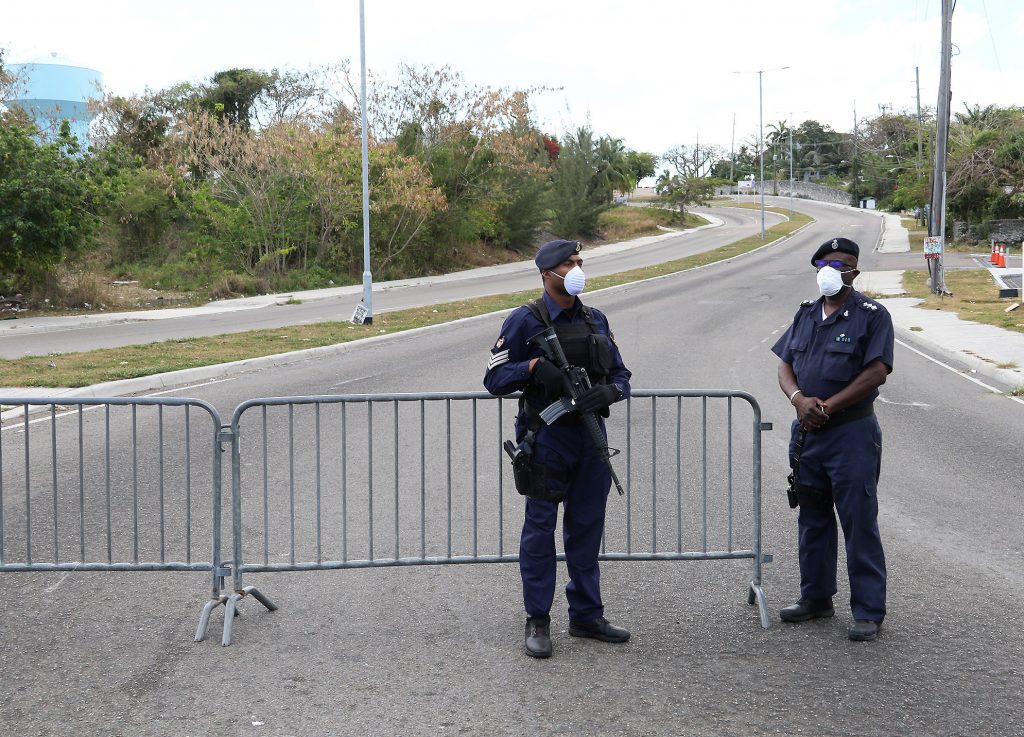
We owe gratitude also to all the men and
women in our law enforcement branches,
who help to ensure law and order, especially
during these challenging times.
I salute all public officers who continue to
perform their duties in every government
ministry and agency.
I salute also private citizens, and those
businesses who have demonstrated
generosity of spirit and an unwavering
commitment to the common good.
This includes those business enterprises
that continue to sustain and to support staff
members and workers during this terrible
and devastating economic downturn.
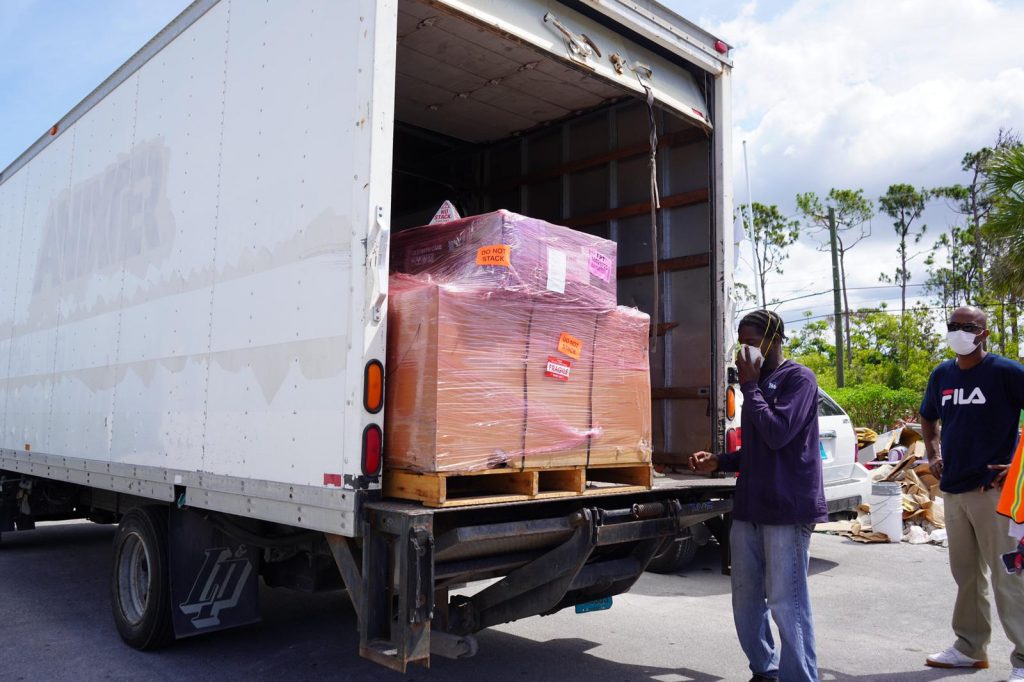
I appeal once again to those businesses
and citizens with a capacity to do so, to
continue to support their workers and
employees. This is a time for national solidarity!
Mr. Speaker:
As we said at the beginning of the spread
of COVID-19 in The Bahamas, among our
best measures for fighting this outbreak are
measures such as: staying at home, physical
distancing, and other vital measures such as
curfews and lockdowns.
Contact tracing, and the temporary
quarantine and isolation of those exposed to
the virus are also vital measures to arrest the
spread of the virus and to save and to protect
lives.
I join the Minister of Health in recognizing
the outstanding and valiant work of the
Surveillance officers at the Ministry of
Health.
In our fight against COVID-19 we should
not only praise our health care professionals
and law enforcement officers.
As a sign of our gratitude, we join them in
the fight against the virus by staying at home
and by wearing our masks and practicing
discipline and social distancing.
We must all do our part.
This is a time for solidarity.
I wish to remind Bahamians and
residents that the shopping schedule of the
last two weeks remains.
The weekday curfews and weekend
lock downs will continue until health officials
advise otherwise.
I thank those businesses, employees and
all who have complied with the regulations.

Mr. Speaker:
As of 25th April 2020, there are almost
800 individuals in quarantine.
To optimize the intent of the quarantine
and isolation period, and to simultaneously
enhance the support and monitoring of those
in quarantine, the Ministry of Health has
undertaken the exploration of a number of
solutions that are fit-for-purpose.
It is envisaged that through the simple
action of downloading an App, quarantined
and isolated individuals could use their
cellphones in a manner similar to a walkie
talkie.
With the touch of a single button they
may:
With the touch of a single button they
may:
- Connect instantly with care agents
- Send an emergency assist alert for rapid response and
- Talk to Family and Friends in a secured space.
This App will be designed to help
individuals in home quarantine and isolation
to stay within the boundaries prescribed by
the Surveillance team.
This may further empower these
individuals to do their part to protect their
mother, father, sister, brother, neighbor and
fellow citizens, and reduce the risk of
exposure to and spread of COVID-19 within
the country.
I underscore that this App will collect
anonymous data to ensure that the privacy
of those using the App is respected.
Health officials have repeatedly noted
that a number of those who should remain in
quarantine or isolation at home are not doing
so, which could result in greater spread of
the virus.
I note that the Emergency Orders have
been amended to enforce strict fines for
those who break quarantine protocols.
Those who break quarantine will fined up
to $20,000 or five years imprisonment or
both.
Mr. Speaker:
We know from other jurisdictions how
rapidly COVID-19 spread in other countries
or locales because individuals who were
COVID-19 positive returned to their home
countries without being quarantined.
We cannot risk doing this in The
Bahamas because this could lead to a wider
outbreak of the virus.
I know that this has placed a burden on
some Bahamians overseas.
I understand the frustration and worry of
their families here at home.
We are working to try to resolve this
matter in the best interest of all concerned
and the best interest of the country.
In keeping with the protocols of other
countries, the Government is finalizing plans
to secure a mandatory quarantine facility to
accommodate the return of a number of
Bahamians in the United States to New
Providence.
At present there are 200 Bahamians who
want to return home.
Mr. Speaker:
To emphasize the need to reduce
community spread of this deadly virus I wish
to share with the House the Assessment by
health officials of the Analysis of confirmed
COVID-19 cases by Dr. Danny Davis, an
Associate Professor at the University of the
Bahamas.
The Government’s COVID-19 Coordinator
Dr. Dahl-Regis provided notes
regarding the impact of the restrictive
measures put in place to mitigate the spread
of Coronavirus 19 throughout the islands of
The Bahamas.
She noted: The Ministry of Health tested all symptomatic and suspect cases of Covid-19 as recommended by the World Health Organization.
“During the period prior to the curfew restrictions, the country recorded increase number of cases every other day, then daily. Following the first lock down period there was a decrease in new cases. According to the exponential curve, at least 23 cases were averted with the imposition of the restrictive measures. Additionally, lives were saved.
Dr. Dahl-Regis forwarded the Report
from Dr. Davis, noting that: “Models were developed with his support and a team from PAHO, the Ministry of Health and other international statisticians and mathematicians, Dr. Davis’ report notes:
“Building on the assertion that the
difference between the predicted curve and
the actual value is attributed to social
distancing measures, it follows that social
distancing resulted in an estimated reduction
to 23 new cases by Day 27 (April 9, 2020). This is a 36% reduction in the number of new COVID-19 cases. The aforementioned estimated the reduction of 23 translates into an
estimated reduction of four deaths over this
past week. This death reduction estimate is based on the country’s fatality record of eight (8) deaths per 41 confirmed cases. Without the social distancing measures, we estimate the country would have recorded 12 deaths by Day 27. These unrealized deaths represent a 33% reduction in the case load for the doctors and hospital resources, and demand for beds. Mr. Speaker:
My Government will do all that we can to
protect the vulnerable in our society.
This is a time for national solidarity.
As previously announced, the
Government is appointing a National Food
Committee, which will consult widely with
many stakeholders in numerous fields.
The major objective of the National Food
Committee is to steer the coordination and
collaboration of the public sector, private
sector and NGOs to increase food
distribution nationally and fairly.
This includes, in the immediate term,
distribution of food for vulnerable individuals
and communities.
We must ensure that the poor and those
struggling through the current economic
downturn because of the pandemic have
suffecient nutritious food.
We must also ensure that those affected
by Hurricane Dorian also continue to have
food.
I wish to emphasize that many more
Bahamians are vulnerable to food insecurity
as a result of COVID-19.
This includes, but is not limited to:
- the newly unemployed;
- self-employed individuals whose
businesses are adversely affected; - senior citizens unable to leave their
homes because of the virus; - school children who do not have
sufficient food; - some patients and those who provide
them with care at home;
Mr. Speaker:
The National Food Committee will
coordinate with various food sector agencies
and groups for the distribution of food to the
vulnerable.
These agencies and groups include, but
are not limited to: the Ministry and
Department of Social Services, the Ministry
of Health, the Ministry of Education, the
National Emergency Management Agency,
the Disaster Recovery Authority, domestic
and international NGOS, civil society groups,
philanthropic organizations, and private
citizens and businesses.
The National Food Committee will help to
determine the need for engagement of food
workers, both formally and informally, to help
with the preparation and distribution of food.
The Committee will make
recommendations on the delivery of food for
vulnerable individuals.
This will be done in consultation with the
Ministry of Health and the Head of the
COVID-19 Health Taskforce.
Mr. Speaker:
The Committee will communicate with
wholesalers and retailers to confirm the
status of food supply chains to the country,
and make recommendations on how to keep
these supply chains viable.
The Committee will put together a digital
food distribution plan to make sure that every
Bahamian in need is provided with food.
Let me add that the Government will
promote and strengthen industries in pork,
poultry and beef, and is committed to
protecting local industries.
Further, the Food Committee will also
make recommendations on the
enhancement of delivery services and the
kinds of digital platforms required to boost
home delivery.
Mr. Speaker:
I am pleased that Mrs. Susan Holowesko
Larson, M.B.E., has agreed to serve as
Coordinator of the Committtee. Mrs.
Holowesko Larson has an impressive record
of public service.
She is a Co-Founder of Ride for Hope
Bahamas and the Bahamas Hope
Foundation, which raises hope and
resources for Bahamians fighting cancer.
She is also a Co-Founder of Bahamas
Strong, which was established last year in
response to the unprecedented destruction
caused by Hurricane Dorian. She helped to spearhead the country’s
private sector response to Dorian as well as
the initial coordination of the international
NGO community.
With her longstanding business
experience and commitment to public
service, I am pleased that she has agreed to
serve in this new capacity.
The members and stakeholders
represented on the Committee will soon be
announced.
Mr. Speaker:
Last week, I advised that the
Government would implement a program to
assist individuals who have rental
obligations but whose income has been
impacted by the ongoing COVID-19
pandemic.
Today, I wish to announce the details of
this program and how it is to be
administered.
This program is limited to residential
rentals.
It is only for those whose employment or
income has been affected by COVID-19.
Individuals will have to provide
documentation to their landlord to qualify for
this program.
Those who qualify for this program will be able to defer ± or in other words to postpone ± a portion of their rent payment for the next
three months.
Landlords will be required to defer 40
percent of rent due per month for this three
month period, beginning with the month of
April, 2020.
Landlords will not for the three-month
period be able to evict tenants who were in
good standing prior to April.
Landlords will not be able to disconnect
the electricity or water for tenants who were
in good standing prior to April.
This means for example, that if an individual’s rent is $800 per month, they will be required to pay $480 per month over the next three months. The remainder will be deferred or postponed.
At the end of the three-month period,
individuals will have 12 months to pay back
the deferred amount.
This means that individuals will have to
pay the unpaid rent back to the landlord, but
will have a full calendar year to do so.
I note again, that landlords will not be
able to evict any tenant who was in good
standing as of March of this year.
That means that there should be no
evictions between now and the end of June
unless the tenant had been already legally
eligible for eviction before April.
I want to be very clear:
This is not permission for individuals not
to pay their rent.
I advise those who are still able to pay
their full rent to do so.
Mr. Speaker:
It is important to recognize also that
landlords depend on rental payments for
their own income and often, to pay off their
bank mortgages on the rental properties.
This is why those rental payments can be
deferred but they cannot be eliminated.
I am pleased to advise that the
commercial banks have indicated they are
open to deferring the mortgage payments on
rental properties to the extent that landlords
are affected by this program.
To qualify for this program, a renter must
meet the following criteria:
-‐ They must be renting residential property
inside The Bahamas;
-‐ They must be paying a monthly rent of
$2,000 per month or less;
-‐ They must be no more than one month in
arrears with rent;
-‐ They must be a Bahamian citizen or legal
resident;
-‐ They must be able to demonstrate that
their employment or income stream has
been affected by the COVID-19
pandemic.
Renters will have to provide the evidence
necessary to show that their income has
been impacted by COVID-19 and they will
have to sign an agreement to repay the
amount deferred.
This will be mandatory for all landlords for
their qualifying renters.
In due course, I will present the revised
order to give effect to this program.
Mr. Speaker:
It is my hope that renters and landlords
can work together through this
unprecedented time to implement this
program with full cooperation by both sides.
Landlords may with the agreement of the
renter decide to provide a bigger deferment
amount. Qualifying renters can decide that they
want a smaller deferment, or no deferment
at all.
I am asking landlords and renters to
approach this with understanding and with
patience. Many renters are on unemployment
assistance and will not have the means to
pay full rent. Many landlords have mortgage
obligations to meet with the banks for these
rental properties.
They and other landlords also depend on
rental income to take care of themselves and
their families.
The government’s policy is intended to recognize that all parties ± including the banks which hold mortgages ± have a stake
in this matter
I am asking for a sense of national
solidarity, personal and collective
responsibility and goodwill by all.
Neither renters nor landlords should seek
to take any advantages at this time.
The details of the program will be
communicated in the coming days.
Mr. Speaker:
Our primary focus right now are:
-‐ dealing with the health challenges
because of COVID-19;
-‐ food distribution for the most vulnerable;
-‐ social and economic assistance; and
-‐ the maintenance of law and order.
But, we are also planning and preparing for
the way forward and the very next steps so
that we can begin to reopen our economy
and our society more broadly.
Let me emphasize that those who may
have criminal intent in their mind, will be
dealt with swiftly and vigorously.
We will maintain law and order and we are
monitoring gangs and others who are known
to the Police for criminal behavior.
Mr. Speaker:
The House will recall that I formed a broad
based National COVID-19 Coordinating
Committee, comprised of a broad range of
stakeholders.
They have been meeting regularly and
they have been providing advice and
recommendations on a full range of matters
related to the pandemic.
They have been working with medical
professionals and other experts in their
respective areas to develop the draft plans
for what comes next, especially to gradually
re-open the economy in phases.
Mr. Speaker:
The reality is that COVID-19 will be with
us for the foreseeable future even as our number of cases ± and those around the world ± begin to stabilize and even decline.
For the immediate term at least, we will
need protocols and a strategy that will allow
us to re-open our society and our economy
in a way that protects the health and well
being of Bahamians and residents.
The Coordinating Committee has
recommended protocols and a strategy that
we will announce in due course.
We must establish and adhere to a way
of doing things that will allow us to open back
up in a responsible manner.
Such re-opening will be gradual and
deliberate. At each step, proper health and physical
distancing protocols will be mandatory and
will be enforced.
Even as we look and plan to open back up ± we will not and cannot establish a fixed
timetable that says we will do this particular
thing on one date and another on another
date. While the Government establishes plans,
the general timing of the phased reopening
recommended by the Coordination
Committee, will be predicated upon metrics
and guidelines by health officials.
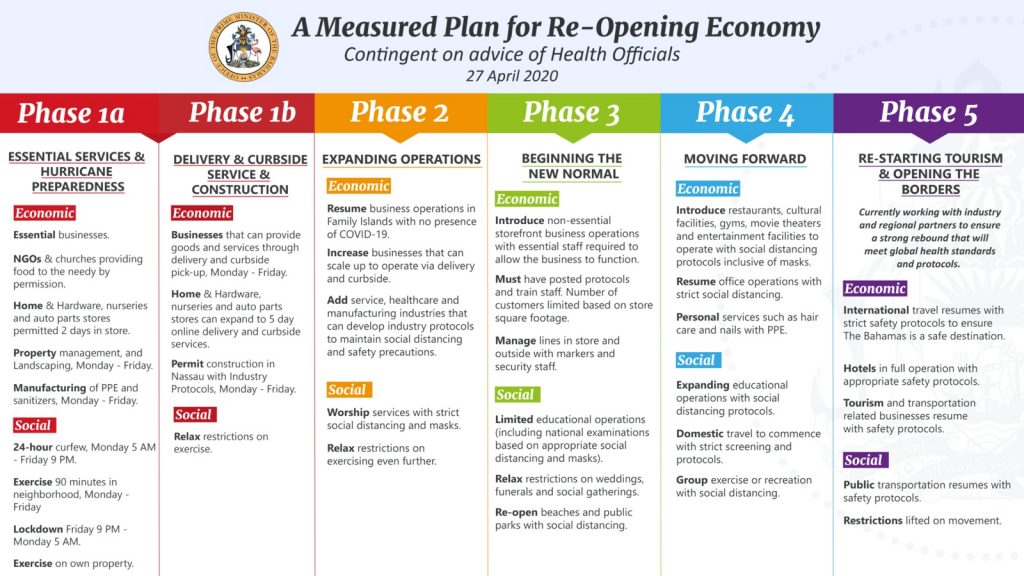
As in other jurisdictions, we must also
have the flexibility to make changes quickly
and to tighten restrictions if the numbers do
not move in the right direction.
Mr. Speaker: Our airport and seaport partners ± as well as the hospitality industry ± are themselves
working with their counterparts around the
world to develop international and regional
standards for the transportation and lodging
of individuals in the COVID-19 landscape.
We will review these standards and
accept those that we feel are appropriate for
The Bahamas.
We will also as necessary implement our
own specific standards where we feel
various regional or international standards
do not match our reality.
We have started to reopen small parts of
the economy to allow Bahamians and
residents to access hardware and auto
parts, among other items.
Any further reopening will be guided by
the advice of our health professionals.
Mr. Speaker:
Yesterday, the Cabinet Office
announced the Economic Recovery
Committee.
The National Coordinating Committee is
a committee representing various national
stakeholders to advise the government
generally.
The Economic Recovery Committee is a
group convened to draft a medium- and
long-term strategic vision for recovery along
with proposed implementation plans.
The Co-Chairs of the Committee are
Acting Financial Secretary Mr. Marlon
Johnson and businessman Mr. Ken Kerr,
CEO, Providence Advisors.
The Economic Recovery group is made
up of individuals with noted expertise and
experience from the private and public
sector.
This group will consult widely, at home
and abroad, with representation from myriad
industries.
This public-private Committee will make
recommendations to the Cabinet on: the
long-term economic recovery of The
Bahamas economy, including job-creation
and stimulating small business recovery and
development in response to COVID-19.
The Committee will focus on restoring the
macroeconomy; restarting a competitive
business environment; economic
diversification; tourism and transport;
financial services and labour.
Public-Private partnerships will be
essential in restoring and rebuilding our
economy.
I have charged the Economic Committee
with thinking boldly and creatively in its
deliberations.
We are in a new era, so we must think in
new ways and think outside of the narrow
confines of what is necessary or possible.
Mr. Speaker:
The COVID-19 pandemic has caused
the worst economic crisis for our country in
living memory.
Due to international borders being
closed, our tourism sector has shut down.
Tourism is the heart of our economy.
The virus and its effects make it difficult
to predict when tourists will return.
We have the most dynamic tourism
economy in the region.
We will do all we can to be ready to
receive and host visitors when they can
travel again.
However, in the interim while travel has
stopped we must explore what else we can
do to make it through in these difficult times.
The purpose of this economic advisory
group is to give practical, innovative and
doable policy recommendations for the way
forward.
We need the minds and hearts of this
committee to contribute ideas that Cabinet
and the Parliament can consider to boost our
economic circumstance.
This is not the time to be timid.
What are needed are ideas that can
generate economic activity and trade, and a
pathway to those ideas that is doable.
This Committee must think quickly, as we
are in the crisis now.
Ideas from all existing sectors should be
reviewed.
Ideas in sectors we are not yet in must
also be pursued.
We must use our individual and collective
Bahamian imagination for greater self
reliance.
We will continue to promote and to
encourage the manufacturing of local
products.
The new face mask industry is doing well,
and by some estimates may be valued
between six to nine million dollars a year.
Mr. Speaker:
I thank Bahamians and residents for their
suggestions and ideas.
As of Sunday, April, 26, we have
received more than 1,700 suggestions that
have been submitted ideas through the
opm.gov.bs Suggestions platform.
We are in the process of sorting these
suggestions, which have poured in from New
Providence, Grand Bahama and the Family
Islands.
The suggestions cover topics ranging
from ideas on how to diversify our economy,
how to address critical issues like food
security, how best to re-open our economy,
how to improve government services, and
many, many more.
We may not be able to reply to every
suggestion, but we will carefully read every
submission and ensure that it reaches the
right agency for consideration.
I encourage Bahamians and residents to
continue to send in suggestions.
We welcome the ideas.
I thank the Bahamian people and
residents for the solidarity they are
demonstrating at this time.
Mr. Speaker:
Most Bahamians are playing their part in
the fight against this virus.
Many are staying at home and following
the guidelines and Emergency Orders.
Many students are learning at home
while their parents are working from home.
Some Bahamians are discovering new
talents and hobbies.
Bahamians and residents are wearing
their masks and practicing physical
distancing.
There are countless acts of love and
kindness and generosity.
We must all continue to play our part to
stem this outbreak and to return, over time,
to a greater sense of normalcy.
Please continue to stay at home.
Go out only when absolutely necessary.
Go out by yourself, not as a group.
As another world leader said: ³Remember: it is not just about adhering to
the letter of the law.
The spirit of the guidelines is to reduce
movement to a minimum, and to avoid being
out and about in the community. This is the
way to protect yourself, your family and everyone else.´
Mr. Speaker:
In all things and at all times let us pray
unceasingly to the God who gives us life and
who is able to give new life and life
abundantly.
I wish to close with the words of a well
known hymn, which may be our shared
prayer and hope.
To the God of New Beginnings we pray: ³Abide with me; fast falls the eventide; ³The darkness deepens; Lord, with me
abide;
When other helpers fail and comforts flee,
Help of the helpless, oh, abide with me. Swift to its close, ebbs out life’s little day; Earth’s joys grow dim, its glories pass away; Change and decay in all around I see²
O Thou who changest not, abide with me. I need Thy presence every passing hour; What but thy grace can foil the tempter’s pow’r? Who like Thyself, my guide and stay can be?
Through cloud and sunshine, Lord, abide
with me. ³I fear no foe, with Thee at hand to bless;
Ills have no weight, and tears no bitterness;
Where is death’s sting? Where, grave, thy
victory?
I triumph still, if Thou abide with me. ³Hold Thou Thy cross before my closing
eyes;
Shine through the gloom and point me to
the skies; Heaven’s morning breaks and earth’s vain shadows flee; In life, in death, O Lord, abide with me.
Thank you, Mr. Speaker.
May God bless and guide our Bahamas.










Bahamas News
Two Months On, The Bahamas Academy of Sciences Turns Fifty Years of Research into Action

First peer-reviewed paper published, policy brief delivered to Minister Lightbourne, a seat at Climate Week, and a growing public audience for Bahamian science
NASSAU, The Bahamas, 7 October 2026 — Two months after putting fifty years of research on The Bahamas “on the record” at its first public event in July, The Bahamas Academy of Sciences (BAS) has been turning that evidence into action.
Since July, the Academy has published its first peer-reviewed paper, presented its findings to Government through a policy brief, taken Bahamian science to Climate Week in Nassau and New York, and launched a growing public conversation in which Bahamians can ask scientists questions and get answers. The Academy’s new policy brief, “Prioritising National Research Needs for The Bahamas,” is attached to this release.
“In July we said the record was open. Since then, we have been working to put it to use,” said BAS President Dr. Krista Sherman. “Fifty years of research revealed where The Bahamas is strong and where the gaps are: water, food, energy, long-term monitoring. Our job as the national academy is to share that evidence with the decision-makers and the public they serve, and to build the Bahamian research capacity to fill those gaps.”
THE RECORD, NOW PEER-REVIEWED AND PUBLIC
The Academy’s first publication, “Fifty Years of Research in The Commonwealth of The Bahamas: A Quantitative Thematic Analysis of Scholarly Output,” is now published in the international journal Gulf and Caribbean Research. Led by Dr. Amina Moss (University of Stirling) with BAS members Dr.
Krista Sherman, Dr. Williamson Gustave, Dr. Kathleen Sullivan Sealey, Dr. Charlotte Dunn, Dr. Nicola Smith, Lindy Knowles and Dr. Christy Gibson, the study analyses 12,113 scholarly records published about The Bahamas between 1975 and 2025.
It shows a rich scientific legacy, particularly in geology, fisheries, oceanography and conservation, while also highlighting persistent gaps in areas of direct national importance: groundwater resources, food systems, renewable energy, social-ecological governance and locally led, long-term monitoring. The full paper is free to read at https://doi.org/10.18785/gcr.3701.15.
FROM THE RECORD TO POLICY
Building on this research, BAS has prepared a policy brief, “Prioritising National Research Needs for The Bahamas,” which translates the findings into a set of ten strategic priorities.
The policy brief calls for greater investment in locally led, policy-aligned and climate-ready research, including:
- a national research agenda aligned with Vision 2040;
- stronger local scientific capacity, laboratories and field stations;
- rebuilt long-term monitoring of reefs, fisheries, coasts and mangroves;
- targeted research on groundwater, food systems and renewable energy;
- a national environmental and health data repository; and public health research on the risks facing small island states.
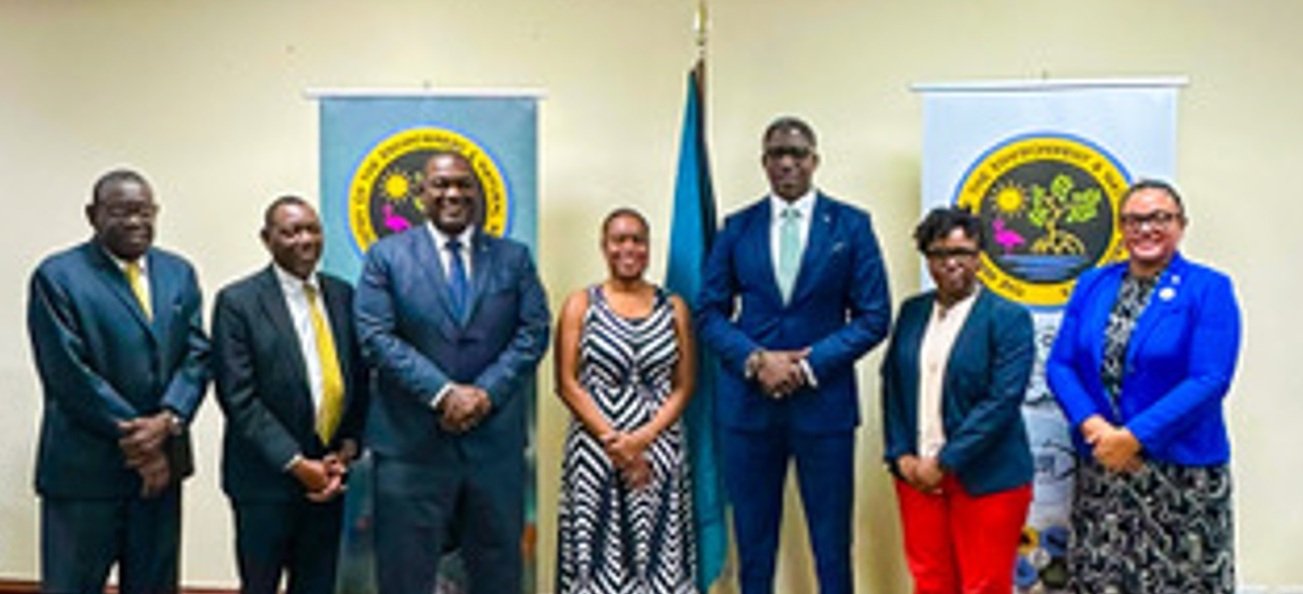
In September, Dr. Sherman presented the brief to the Hon. Zane Lightbourne, Minister of the Environment and Natural Resources, during a courtesy call. The visit is the first in a series of introductory meetings with Government ministries over the coming months. Through these meetings, the Academy will introduce its work and explore opportunities for collaboration in science, the environment, sustainability, conservation and climate resilience. The policy brief also maps research priorities to relevant national legislation and policies, from the Environmental Planning and Protection Act to the National Health Strategy 2026–2030.
BAHAMIAN SCIENCE AT CLIMATE WEEK, FROM NASSAU TO NEW YORK
BAS also brought Bahamian scientific expertise to Climate Week 2026.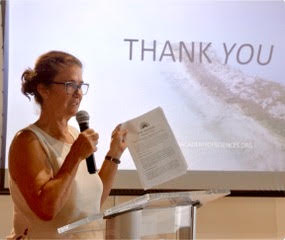
On Monday, 21 September, BAS Board member Dr. Kathleen Sullivan Sealey, Professor Emerita at the University of Miami, presented “Coasts and Climate Change” at the opening day of Climate Week in The Bahamas, hosted by the Baha Mar Resort Foundation at ECCHO, under the theme “At the Edge of the Water.” Dr. Sullivan Sealey explained why The Bahamas’ low-lying carbonate islands face growing risk from sea-level rise and storms, and how historical losses of coral reefs, seagrass, mangroves and dunes have weakened the islands’ natural defences. More importantly, she highlighted actions communities can take to reduce these risks.
During Climate Week, the Academy also released a science statement, “Climate Change and Ocean Warming Impacts on The Bahamas: What Does the Science Tell Us?”, a synthesis of the environmental, ecological, social and economic impacts facing the archipelago.
In New York, BAS Vice President Dr. Adelle Thomas, Vice-Chair of Working Group II of the Intergovernmental Panel on Climate Change (IPCC), brought the realities of vulnerable small island states to Climate Week NYC.
A GROWING PUBLIC AUDIENCE FOR BAHAMIAN SCIENCE
The Academy’s public campaign, 242 #ForTheRecord, has also been building a presence across its five platforms since launching in mid-July. Its most successful format has been the simplest: Bahamians ask a question and a BAS scientist answers it. So far, the “You Ask/Science Responds” series has tackled questions on how climate change will affect Bahamian farming (Dr. Williamson Gustave) and the science of blue holes (Dr. Krista Sherman). An upcoming episode will examine the effects of high temperatures on public health. Question-led content is reaching roughly twice the audience of the Academy’s institutional posts. During its first month, the campaign generated more than 18,500 views and over 200 shares across its platforms.
To extend the conversations to more Bahamians, beyond the traditional science-curious audiences,
BAS has also formalised collaborations with two local content creators, Kaché Knowles (“I is a Bahamian Bey”) and Stephen Hanna (“Schin Nguyen”). Their first joint pieces will appear before the campaign closes on 30 November.
WHAT COMES NEXT
For BAS, putting the record to work is only the beginning. Over the coming months, the Academy will:
- continue introductory meetings with Government ministries and agencies;
- host its Future Scientists classroom event with Bahamian students in early November;
- launch its YouTube channel with a video-podcast series on Bahamian scientists in November;
- begin work on its second peer-reviewed publication, “A Horizon Scan on Emerging Environmental Issues in The Bahamas Over the Next Decade”; and
- offer “Introduction to Statistics using Excel,” a short, practical course in early 2027 that will give early-career scientists and resource managers in The Bahamas hands-on skills in organising, analysing and summarising their own data.
“Research is most valuable when it can be used,” said Dr. Sherman. “The Bahamas has an extraordinary scientific record. Now we need to ensure that record informs the questions we ask, the decisions we make, and the science we build here at home.”
See BAS Climate Statement and BAS Policy Briefing 50 Years of Bahamian Research here: BAS Climate Statement,
BAS Policy Briefing_50 Years of Bahamian Research
PHOTO CAPTIONS:
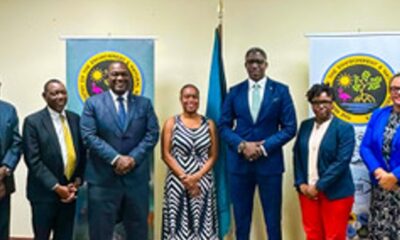
Header: BAS President Dr. Krista Sherman met the Minister of the Environment and Natural Resources and his team on 17 September 2026. L–R: Mr. David Davis, Permanent Secretary; Mr. Ricardo Deveaux, Acting Under Secretary; The Hon. S. Obie Roberts, Parliamentary Secretary; Dr. Krista Sherman, BAS President; The Hon. Zane Lightbourne, Minister; Dr. Rhianna Neely-Murphy, Director, Department of Environmental Planning and Protection; Ms. Danielle Hanek, Acting Director, Forestry Unit.
Credit: Ministry of Environment and Natural Resources.
Insert: Kathleen Sullivan Sealey, BAS Board member, presents the Academy’s science statement at Climate Week in The Bahamas, ECCHO, 21 September 2026.
Credit: Amaeleo Carey.
PRESS RELEASE: BAS

Nassau, Bahamas, 1 October 2026 – Every Saturday this month, communities across The Bahamas will take steps in support of cancer patients and survivors as CIBC Caribbean’s Walk for the Cure returns to New Providence, Abaco, Eleuthera, and Grand Bahama.
CIBC Caribbean Head of Country, Terrance Gibson, said, “Each Saturday in October represents another community coming together,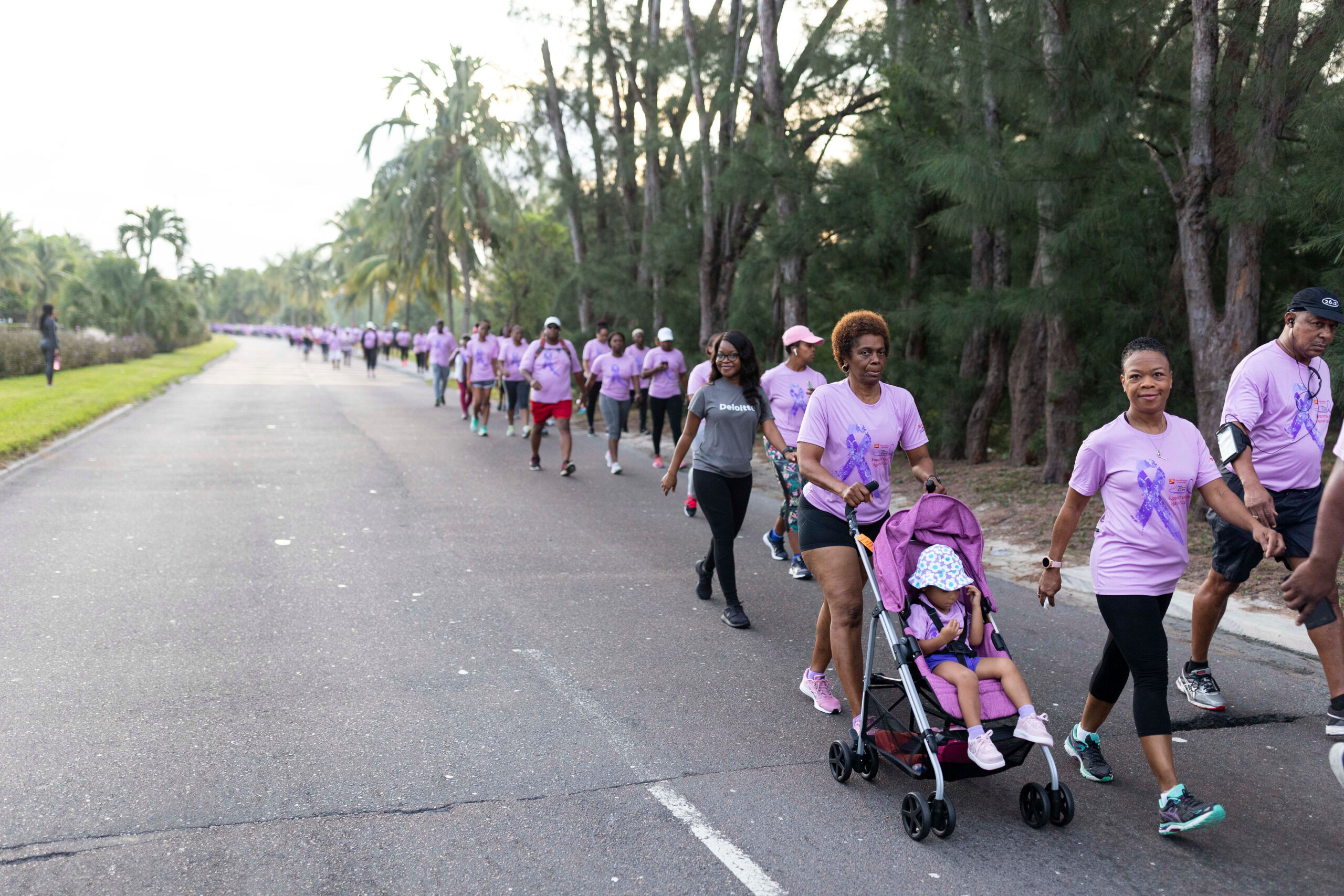 another opportunity to raise awareness and, most importantly, more support for the organizations that are doing this work every day.”
The month of activities begins this Saturday, October 3, in New Providence, with participants gathering at the Goodman’s Bay Corporate Centre for a 6:30am start.
CIBC Caribbean Walk Champion, Antionette Fox, said the series of walks gives communities across the country an opportunity to contribute to a cause that directly supports Bahamian cancer organizations.
“Every Saturday for the month of October, there will be a walk that you can participate in to contribute towards this worthy cause,” Fox said.
In New Providence, the morning will extend beyond the walk itself, with Zumba, wellness activities, informational vendors, and opportunities for participants to connect with organizations working directly with cancer patients and survivors.
Gennie Dean Caring and Sharing Cancer Support Group President Duquesa Dean said participants do not have to complete the full route to be part of the morning.
“Just come out…there is something for everyone, come for the community,” Dean said. “There’s a survivor ceremony, so come and participate and celebrate the people who have gone through cancer and are here as evidence that you could live after a cancer diagnosis.”
The Gennie Dean Caring and Sharing Cancer Support Group is one of eight cancer organizations in The Bahamas that benefit from funds raised through Walk for the Cure. The others are the Sister Sister Breast Cancer Support Groups of New Providence and Grand Bahama, Cancer Society of The Bahamas, the Cancer Societies of Abaco, Eleuthera, and Grand Bahama, and the Cancer Association of Grand Bahama.
Dean explained that CIBC Caribbean covers the cost of staging WFTC, allowing donations raised to support the work of beneficiary organizations.
For her organization, that assistance translates into tangible support for people navigating cancer, including food assistance, financial aid, prosthetic breasts, and mastectomy bras, as well as programs such as Step Into Wellness, which promotes movement and healthy living among cancer patients and survivors.
Corporate partners are also helping to strengthen this year’s effort. Bamboo Shack has joined the initiative as a gold sponsor, with representative Ghandi Pinder sharing that the cause has a personal significance for her.
Pinder recalled shaving her hair in solidarity with her sister after she was diagnosed with an aggressive form of breast cancer and began losing her hair during chemotherapy.
“We see you, we’re here with you, we’re in it with you,” Pinder said of Bamboo Shack’s message to those affected by cancer.
She also encouraged more of Corporate Bahamas to support initiatives that directly impact the communities they serve.
“At Bamboo Shack, we always say a better Bahamas begins with you… Together, we can make a difference,” she said.
Registration for Walk for the Cure is $30 for adults and $15 for children and can be completed at any CIBC Caribbean branch. CIBC Caribbean clients can also donate through online banking.
The New Providence Walk begins promptly at 6:30am on Saturday, October 3, at the Goodman’s Bay Corporate Centre, followed by Walk for the Cure events in other islands each Saturday throughout October. The Grand Bahama WFTC event will be held on October 10 and the Abaco and Eleuthera WFTC events will occur on October 17 and October 24 respectively.
Gibson added, “Some will walk for themselves, some in celebration of a survivor, and others in memory of someone they have lost. Whatever brings you to Walk for the Cure, every person who shows up becomes part of a much bigger expression of support for those affected by cancer.”
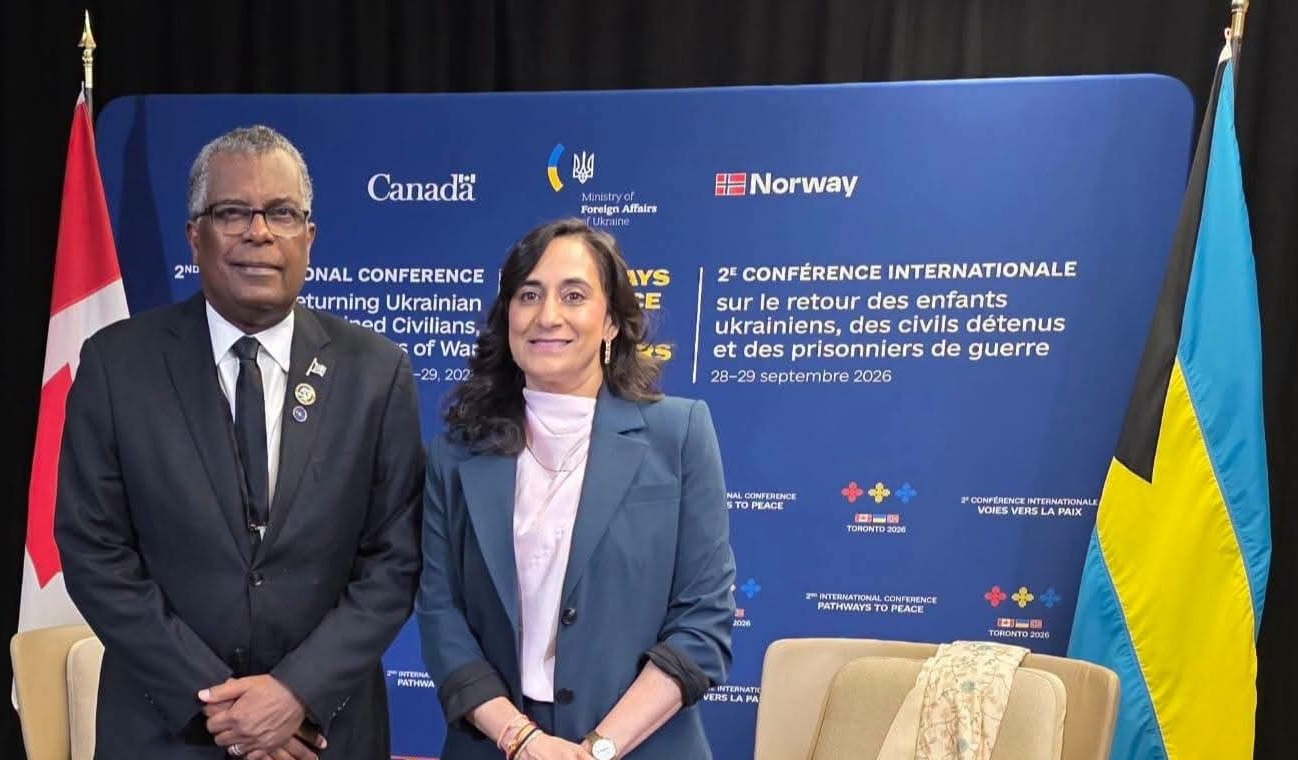
TORONTO, Canada —Minister of Foreign Affairs and Immigration Fred Mitchell has reaffirmed The Bahamas’ support for Ukraine’s territorial integrity and the international effort to secure the return of Ukrainian children, detained civilians and prisoners of war.
Speaking at the two-day Second International Conference on Returning Ukrainian Children, Detained Civilians, and Prisoners of War, held in Toronto on September 28 and 29, Minister Mitchell thanked Canada, Norway and Ukraine for convening the conference and said The Bahamas was honoured to participate.
“I first want to add my thanks to Canada, Norway and Ukraine for convening this important conference,” Minister Mitchell said. “We are honoured to have been invited and to be here.”
Minister Mitchell said The Bahamas supported the position expressed by Antigua and Barbuda from the CARICOM Region, while also drawing on remarks delivered by Prime Minister Philip Davis at them United Nations.
He said The Bahamas’ own history made it impossible for the country to remain silent when them territorial integrity of another state is under attack.
“Just a couple of days ago, our Prime Minister spoke at the United Nations about a people with a history of struggle for identity, arising out of the struggle against slavery, and how we cannot be silent in the face of the attack on the territorial integrity of another state,” Minister Mitchell said.
He noted that Canada and other countries have stood alongside Caribbean nations as they confront their own regional challenges, including the situation in Haiti and difficulties facing Cuba.
“We are a region which is far away from Ukraine, but we identify with the struggle,” he said. “In this case, we want to be sure that our voices are heard in support of the defence of the territorial integrity and the people of Ukraine.”
Minister Mitchell said the principle of territorial integrity carries lessons well beyond the current conflict and deserves particular attention from smaller states.
“We think that the question of territorial integrity is a lesson for all to inwardly digest,” he said, adding that The Bahamas particularly appreciated Canada’s approach to its role as a “middle power” in international affairs.
The minister also reflected on the broader historical context surrounding Russia and Ukraine. Referring to a recent interview with Russian President Vladimir Putin that he encountered on social media, Mitchell described the discussion as an example of historical revisionism.
He recalled the days of writings and experiences of Soviet-era dissidents including Aleksandr Solzhenitsyn and Andrei Sakharov, as well as the struggles that took place during the Soviet period and the eventual collapse of the Soviet Union.
Minister Mitchell said the historical interpretation presented in Putin’s remarks offered a markedly different account of those developments and placed responsibility for the situation in Ukraine on what Putin described as Western intellectual elites and their actions.
“That was very interesting,” he noted.
Drawing on the work of political scientist Samuel Huntington, Minister Mitchell suggested that political systems can retain characteristics of their predecessors even after major upheavals or revolutions.
“The Czar has been replaced, but what do we have today?” he asked. “A kind of pre-emptory, antidemocratic, autocratic behaviour attacking another state?”
Minister Mitchell concluded by reaffirming The Bahamas’ support for the objectives of the Toronto conference and calling for practical opportunities for the country to contribute.
“So I am, on behalf of The Bahamas, supporting the aims of this important conference,” he said. “Please assure us, or let us know, what practical ways we can help.”
He said The Bahamas’ participation itself was an important first step.
“We hope that, in this instance, the fact that we are here and that our voice has been added to this cause is at least a good start.”





-

 News1 week ago
Invest Turks and Caicos Officially Opened Caya Hico Collective, Grand Turk MSME Storefront
-
 Health6 days ago
Cleveland Clinic First in Ohio to Perform Robotic Nipple-Sparing Mastectomy
-

 News3 days ago
Beaches Turks & Caicos strengthens year-round commitment with local craft vendors and transport operators
-
 News1 day ago
Beaches Turks & Caicos gives Enid Capron Primary a pre-term facelift
-
 Bahamas News4 days ago
Two Months On, The Bahamas Academy of Sciences Turns Fifty Years of Research into Action