
Africa
South Africa plans Military Exercises on the Anniversary of the Russian invasion of Ukraine; not sitting well with some

By Dana Malcolm
Staff Writer
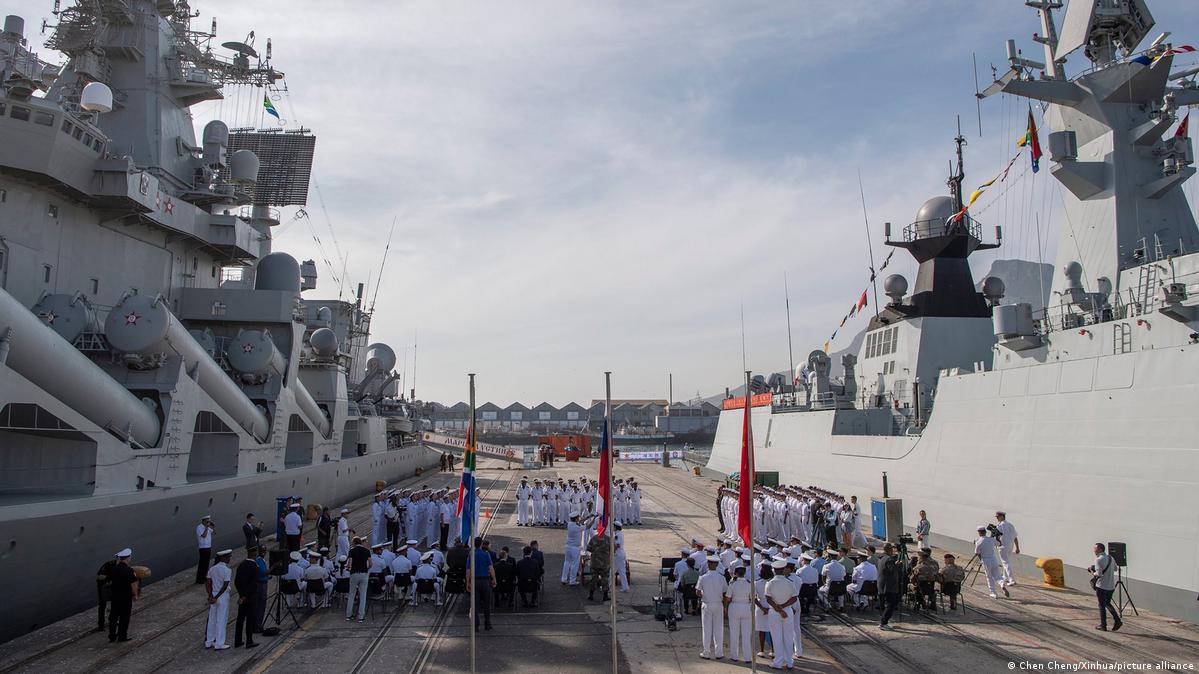
#Africa, February 2, 2023 – South Africa has announced it is planning a joint naval exercise with Russia and China during the anniversary of the Ukrainian invasion but says there is no sinister intent.
According to the South African National Defense Force, more than 350 South African soldiers will join Chinese and Russian soldiers in Exercise MOSI II.
In a statement posted to its Twitter, the South African National Defense Force has rejected any insinuation that the move is a political one, emphasizing that it was a continuation of exercises planned years prior. 
“Ex MOSI II is a scheduled nine-day military marrying up exercise, one of several that the SANDF conducts with militaries around the world on a regular basis, to ensure that it can learn from and benchmark its own operating capability. The first edition of this particular exercise was held in 2019 and involved Brazil and India, as well as Russia and China. The follow-up exercise, MOSI II, was postponed due to the COVID-19 pandemic.”
It further maintained that it was on neutral terms with both the US and Russia.
“South Africa is continually home to military cooperation events, not all of which are formal exercises. The USAF is currently using Cape Town as a landing base — Last year, South Africa participated in Exercise SHARED ACCORD, the US military’s annual African military exercise.”
They maintained that over the last year, they had participated in events with the French, Indians and Brazilians.
“None of this is sinister, nor suggests any agenda over and above the ongoing improvement of the SANDF’s capabilities in executing its constitutional mandate of safeguarding the territorial integrity of this country.”
Exercise MOSI II will last for nine days from February 17th to 27 and will be held in the Indian Ocean.

By Deandrea Hamilton | Editor
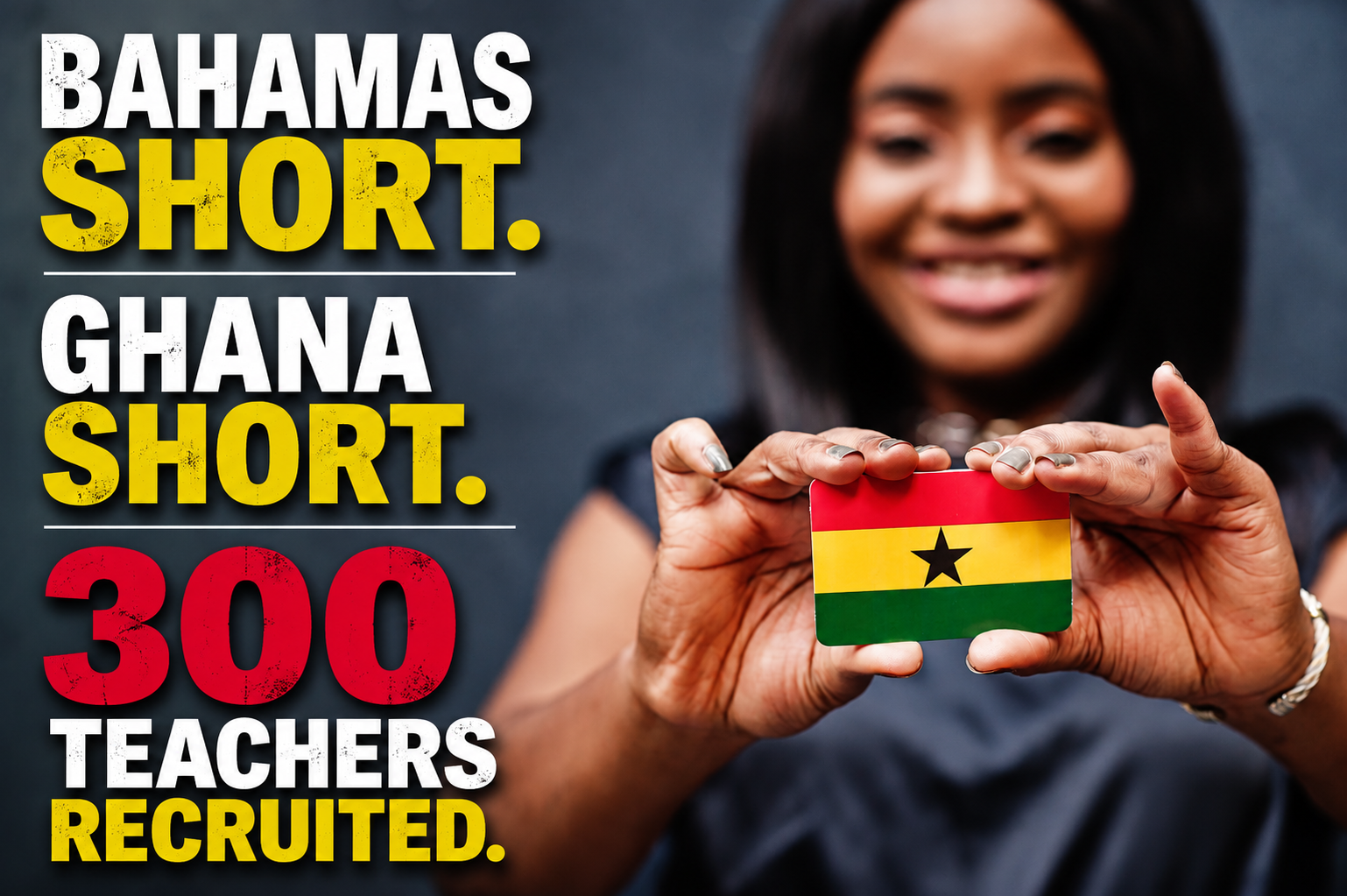
NASSAU, Bahamas (July 14, 2026) — The Bahamas Government says it needs the 300 teachers being sourced from Ghana to help close a critical staffing gap, even as criticism mounts over unresolved employment matters reportedly affecting approximately 2,000 Bahamas Union of Teachers members and as Ghana itself struggles with a massive shortage in the profession.
Deputy Prime Minister and Minister of Education, Science and Technology Chester Cooper said the shortage has been worsened by retirements, expiring contracts and the expansion of specialized subjects, including special education, technology, financial literacy, digital literacy and entrepreneurship.
Cooper said the Government has established a multi-agency task force and is attempting to attract recently retired teachers, new graduates and educators who previously left the profession.
“In keeping with government policy, Bahamians will be given first priority to fill all vacancies,” Cooper said.
However, the optics surrounding the decision are sketchy at best, with the BUT pressing the Government to settle long-standing matters affecting its members while Ghana grapples with a teacher shortage estimated at no fewer than 50,000 educators.
Ghana’s Minister of Education, Haruna Iddrisu, recently disclosed that the country needs between 50,000 and 90,000 additional teachers to adequately staff its schools.
UNICEF’s 2026 Teachers for All: Ghana report confirms that Ghana is not only experiencing an overall teacher shortage but also serious inequalities in how available teachers are distributed. It found that rural and underserved schools are particularly affected, while Ghana’s primary teacher workforce fell by more than 25 percent—from 131,094 in 2019–2020 to 93,818 in 2022–2023—as student enrolment increased.
The report stated:
“Not only is there a teacher shortage in Ghana, but inefficiencies also exist in the current distribution of available teachers.”
That finding raises questions about why a country with such a significant domestic deficit is prepared to facilitate the overseas recruitment of hundreds of educators.
Meanwhile, BUT President Belinda Wilson has argued that the Bahamian Government has substantial unfinished business with the teachers already serving in the public system.
According to Wilson, approximately 2,000 educators are awaiting the conclusion of salary negotiations, while hundreds reportedly have unresolved matters involving confirmations, salary reassessments, promotions, rental allowances, examination marking fees, disturbance allowances, hardship payments and coaching allowances.
The union has also complained that it was not properly consulted before the proposed recruitment became public and has demanded details about the qualifications, subjects, deployment locations and employment conditions being considered for the Ghanaian teachers.
The debate is also unfolding as the University of The Bahamas has produced approximately 219 education graduates over the past three years—76 in 2024, more than 60 in 2025 and 73 in 2026.
Cooper maintains that overseas recruitment is intended only to fill positions that cannot immediately be occupied by qualified Bahamians.
“For decades, we have benefitted from strategic international recruitment of educators from partner nations,” he said. “We emphasize that such recruitment is intended only to address vacancies that cannot be immediately filled by qualified Bahamians.”
Still, the questions remain: why are outstanding matters affecting thousands of Bahamian teachers unresolved, and why is The Bahamas sourcing educators from a country that acknowledges it is tens of thousands of teachers short itself?

By Deandrea Hamilton | Editor
For years, Caribbean families have endured relentless increases in the cost of food, fuel, housing and everyday essentials. Now, one of Africa’s leading financial institutions says the worst of those inflationary pressures may finally be easing.
The African Trade Report 2026, published by the African Export-Import Bank (Afreximbank), shows inflation across Latin America and the Caribbean fell sharply from 16.6 percent in 2024 to 7.6 percent in 2025. The report compares economic performance across the world’s major regions, placing Latin America and the Caribbean alongside Africa, Asia, Europe and advanced economies.
The figures suggest regional price pressures have moderated considerably after several years of high inflation driven by supply chain disruptions, rising energy costs and global economic uncertainty.
Consumers, however, should not expect prices to suddenly return to pre-pandemic levels.
Economists note that lower inflation does not mean goods and services become cheaper. Rather, it means prices are continuing to rise, but at a much slower pace than before. That distinction helps explain why many Caribbean households may still feel the strain at the supermarket, petrol station and on utility bills despite improving economic indicators.
The report also points to a relatively stable regional economy. Gross domestic product growth for Latin America and the Caribbean held steady at 2.4 percent in both 2024 and 2025, suggesting economic expansion continues, albeit at a modest pace.
For Caribbean governments, the findings provide cautious encouragement. Lower inflation can reduce pressure on household budgets, improve consumer confidence and give central banks greater flexibility as they balance economic growth with price stability.
Perhaps most intriguing is the source of the analysis.
Rather than coming from a traditional Western financial institution, the assessment comes from Africa’s premier trade finance bank. The report treats Latin America and the Caribbean as an important global economic region and repeatedly highlights the growing importance of ties between Africa and its diaspora, including the Caribbean. It argues that stronger economic, trade and investment relationships across what it calls “Global Africa” could become a powerful driver of shared prosperity in the years ahead.
For Caribbean readers, the report offers more than encouraging inflation figures.
It provides an outside perspective on the region’s economic performance and serves as a reminder that the Caribbean is increasingly being viewed not only as a tourism destination, but also as an emerging partner in trade, investment and global development conversations.
As governments continue searching for ways to ease the cost of living, Africa’s latest economic report suggests there is at least one reason for cautious optimism: the pace of price increases across the Caribbean is finally beginning to slow.

By Deandrea Hamilton | Editor
What would happen if the Caribbean started spending more with Africa?
That question is no longer hypothetical. It’s the vision behind a growing movement that sees the Caribbean not just as a neighbor of the Americas, but as a key partner in the rise of a “Global Africa.” With shared history, deep cultural ties, and emerging trade frameworks, experts say the potential is enormous—if the will to act finally matches the passion of the speeches.
Billions on the Table
Today, trade between Africa and the Caribbean sits at just over US $729 million annually. But the International Trade Centre (ITC) and Afreximbank project that number could balloon to US $1.8 billion per year by 2028—more than doubling in just a few years.
This boost is expected to come not just from commodities, but increasingly from services, particularly in transport, travel, food exports, and creative industries. Two-thirds of that growth, according to analysts, could come from services alone—sectors where the Caribbean is eager to expand. (afreximbank.com).
Meanwhile, Africa’s consumer and business spending is forecasted to skyrocket to US $6.66 trillion by 2030, driven by a population boom and rising middle class.
The Case for a New Trade Axis
The Caribbean imports 80% of its food, but many of those goods can be sourced from African markets. What we offer in return? World-class logistics, tourism know-how, financial services, and proximity to the U.S. market. It’s a natural fit—one that is currently underdeveloped.
The recent call by Grenadian Prime Minister Dickon Mitchell for a “Global Africa Commission” underscores this urgency. He urged stakeholders at the Afreximbank Trade Expo to stop the cycle of empty talk and get to work: building shipping routes, finalizing trade agreements, and boosting knowledge of what each region actually has to offer.
“We will not leave here with another communiqué,” Mitchell continued. “We will leave here with a commitment to act, to build together, to trade together, to succeed together and rise together.” The statement underscored a central theme of the summit — that both Africa and the Caribbean can no longer afford to admire the idea of unity; they must operationalize it.Pilot platforms like the Pan-African Payment and Settlement System (PAPSS) are already simplifying how cross-border payments work between African countries—and could extend to Caribbean partners. The system removes the need for U.S. dollars in trade between African nations, creating space for sovereign empowerment.
What’s the Hold-Up?
Let’s be blunt: political will, slow bureaucracies, and lack of coordination are stalling real action. Despite a decade of “Africa–Caribbean unity” talk, less than 3% of CARICOM trade currently involves the African continent. That fact continues to undermine these brave speeches and ambitious notions.
Where Caribbean Consumers Fit In
Caribbean consumers—especially the younger, tech-savvy generation—are already looking for affordable, ethical, and culturally relevant goods. African markets offer exactly that. Redirecting even a fraction of spending toward African-made clothing, beauty products, tech tools, or agro-processed foods could start a real trade revolution.
Bottom Line
If the political leaders won’t build the bridge fast enough, maybe Caribbean consumers will. The money is there. The interest is rising. Now it’s time to turn the “Global Africa” vision into a real economic shift—one shopping cart at a time.





-

 Independent writer1 week ago
Born Here, Raised Here, but Still Unable to Vote: Is this a Conundrum for TCI Electorate?
-

 Bahamas News2 days ago
Rosewood Exuma: A precedent-setting case for environmental law and future development in The Bahamas
-

 Bahamas News6 days ago
Monument Supports Hands for Hunger With Paradise Plates Debut
-

 Bahamas News7 days ago
Schweppes ‘the Art of Mixology’ Dazzles at Paradise Plates with Nemiroff Vodka
-
 Bahamas News1 day ago
Energy Minister Delivers Electrifying Keynote Opening Address at CAREC 2026