
Caribbean News
TCI: Governor’s Address – First Covid Anniversary


#TurksandCaicos, March 24, 2021 – Good afternoon. I have been invited to provide some personal reflections from the last year so I hope to explain what I think my long-term memories will be when, perhaps, I look back on this period in five years’ time. In other words the bigger picture.
I’ll start with what I believe will be my strongest positive and my strongest negative memory of the last twelve months, then talk about some of the big lessons I think I’ll remember, and end with my darkest potential fear and greatest possible hope for the year ahead.
The strongest positive will be about our people. Everyone in the Islands ended up on the front-line during COVID and the vast majority were magnificent throughout, and continue to be so. True – a very small number – failed the integrity test I described at the very start of the pandemic, putting others at risk while they sought either profit or momentary gratification – but compared to the rest of the world these individuals were a very small percentage of our number. I’m immensely proud of the people of TCI.

Beyond the population there are people who we have all relied on, many in front of me today, and many of us owe you more than we will ever know, such as Desiree Lewis (the Permanent Secretary of Health) and Denise Braithwaite (the CEO of the Hospitals) and those in support or alongside them, who have spent the full year working relentlessly – 15 hour days or more – often seven days a week.
I include in this list, because I saw it close up, the last Premier whose work ethic over the last year, and the attention to detail she paid to health, should be recognised today as we reflect back on where we were and where we got to. Health is after all a devolved issue. I should say I see all the same characteristics in the new Government who will now steward us towards the second anniversary next year. If the last 12 months was about a successful defence, the next 12 months is all about our counter-attack and how completely we all throw ourselves into regaining the initiative and retaking control of our future. More on this later.
When I think about the people who got us through this I include people across every profession and with any, and every, job title, in both the public and private sector, who adjusted and innovated and delivered in a way that has not only kept these Islands safe, but also kept us functioning in relative normality, compared to the rest of the region and indeed the world. You know who you are – so if you recognise in yourself the contribution you made – I can only thank you on behalf of us all.
And so to the overpowering negative. There is one thought that overshadows and that is the loss of our people to this wretched virus with – perversely-numbers of deaths now increasing, even as the vaccine is available on the Islands for those that wish it; a theme I will return to at the end.
Those lives shortened, and the sorrow it brings to those left behind, will be the abiding memory of this year. Attending a young Police Officers funeral service to mourn a further Police Officer, struck down not in the direct line of duty but through the impact of COVID, are memories that I will hold, but wish I didn’t have to.
Having lost my own father to Covid my family isn’t left untouched by this year’s events and when all other memories have gone, this is the one that will of course abide. There will be others listening who know exactly how this feels, and will also know that none of us want others memory of this period to be attached to this type of direct personal grief.
There are of course other consequences of this year that have hit families in other ways. For some this will have been the toughest year of their lives economically. When tourism stops the economy here stops. The obvious lesson from this year must be about diversification but it surely must also be about starting on the journey of having a proper safety net in place, that can catch the most vulnerable and most deserving, quickly, when unexpected calamity occurs.
And on that point, another memory I will hold is the magnificent NGO’s, in these Islands, who managed to achieve so much with so little. While we didn’t say so at the time Mandy – my wife – spent time working alongside them, regularly packing up food parcels – so our family had a very good and very regular insight into just how much good, these very good people in the TCI did, on behalf of the poorest of our Residents.
Quite probably the longest term consequence is that, as we acknowledge a year of COVID, we must also acknowledge a year that the schools have been closed. I’m personally delighted they are now on a planned course to full reopening. Education has been disrupted globally this year and what the longer term impact of that will be, no one yet knows, but there has to be an impact and every Government must plan for it, which I know ours is.
So as I think about this year I will think about the children of these Islands, what they were asked to sacrifice and how they managed, brilliantly, the challenges that none of us would have wished to face, at their age, particularly the disruption to friendships, fun and childhood freedoms as well as lessons.
Looking back, I will recall we started the pandemic without the means to fight it. We had little high dependency care capability, we had no Intensive Care Unit. We had little PPE. We had no testing capacity on the Islands. We had no closed ventilators. We had modern hospitals, but with very limited bed capacity, and those risked being overwhelmed extremely quickly. We had insufficient staff in our hospital. We had, and we continue to have, a health system built on treatment of our most serious cases outside our shores and when we were most in need, the region was closing down to us. All this, underpinned by a National Health Insurance Program that going forward cannot sustain, over the long term, the sort of costs that the pandemic has imposed but also modern medicine will bring.
The extremely tough and well observed lockdown – the use of emergency powers – the closure of the international borders and the stopping of our economy – not least because the rest of the world stopped travelling – saved us from the first wave of the pandemic and gave us just enough breathing space to build up capacity to give ourselves a fighting chance, although that capacity has recently been sorely tested.
So, in the future, I will reflect that at the end of the first year we were in an immeasurably better place than when this pandemic started. The extraordinary amount of hard work and grind by so many people who made that possible is a memory I will also hold of this year, for some time.
Another positive memory I will hold is the role the UK played. They stepped up. Facing a crisis alone is not a place you want to be – particularly when you were as ill-prepared as we were, and while it’s probably more appropriate for others to talk of the UK’s practical, comprehensive and rapid delivery of the stores, equipment and expertise we needed, I will personally remember a group of UK colleagues, here and in London, who fought for TCI as if their very lives depended on it.
If I believe we made the right decision locking the country down quickly, another memory will be the belief that the elected Government took a brave decision – and I use that word in its most positive sense – to open our international borders in July, and then keep them open. I pay tribute to the then Government for having the courage to do this, and then hold that position. That decision has positioned us in the region as, presently, the standout tourism destination.
What we and the industry have learned over the last eight months, while others have stayed shut or oscillated in their position, is how to deliver a safe tourism experience and our top end visitors know it, admire it, and will remember it as will the wider industry.
We also now have the data – because of testing prior to departure of our visitors – to tell us that not only are tourists not bringing the virus with them (because of our pre-testing model) they are also staying extremely safe while here – and I attribute much of that to the protocols the hotels and villas are observing, but also the excellent take up of vaccine we have seen in their front-line staff. Our main industry has done an excellent job.
There is a good dictum that you should never let a good crisis go to waste and beyond burnishing our tourism reputation I believe in the future we will look back on this period and see it as the moment that a consensus emerged amongst politicians, senior officials and across the medical profession, that Healthcare on the Islands requires a root and branch review. I know the Premier has this in his sights.
The pandemic put Heath under just the right amount of strain that it hasn’t (yet anyway) been broken but it has given us a forensic insight into its weaknesses. Our hospitals need greater capacity and capability. Our partnerships across public and private medicine have to be strengthened. The affordability of our treatment abroad programme has to be examined. Our past lack of investment in public health and mental health provision needs to be questioned.
And the good news is that necessity, being the mother of invention, means progress is already underway. Our overall health system and the relationships between medical practitioners and officials are immeasurably stronger in March 2021 than they were in March 2020; that is a welcome foundation on which to build. While there is ongoing and complex arbitration between the Government and the Hospital, the working relationships between the CEO and the PS are outstanding. Public Health England, who have been magnificent partners to us throughout this year, stand ready to help if and when that help is needed but there is a huge amount of experience and local knowledge now accumulating that can be released when required.
But now we turn to the most important points I wish to make, my greatest fear and greatest hope, because these look to the 2021 rather than reflecting on 2020. We cannot change the past but we can all influence the future and what I’m about to say places exactly the same amount of power, to influence that future, in each and every residents hands. It is the great equaliser of this year. Rich or poor, old or young, whatever your ethnicity, you, the population, not the Government, through your own personal decisions will decide whether 2021 is an opportunity seized or an opportunity squandered.
I believe the end of this first year does start to mark a hinge moment, a moment when we have to start to look towards individual responsibility for our protection rather than government imposed restrictions to govern our collective behaviours around our personal health. The later got us through the last year but the former will not only get us through 2021, but reignite our economy and return our personal liberties.
What all of us here in this hospital know, but what we need the whole Territory to understand, is that the COVID virus is not going to give up and go away. Quite the opposite, it is mutating, it is getting stronger, it is becoming more deadly, it is being transmitted at a faster rate. We don’t need epidemiologists or the World Health Organisation to tell us this, we can see it with our own eyes here in TCI. People are getting sicker, faster and getting sicker with more deadly results. If we include residents we have sent overseas for treatment in just the last 7 days, four from TCI have died. All of these deaths occurred after the vaccine was available – which would have prevented their death.
I confidently predict more deaths, there is no reason to think any other way. The restrictive measures we have in place clearly are reducing contagion, but not eliminating it, and those catching the virus are becoming more likely to die. Sat behind this, the Hospital has on several occasions’ risked being overwhelmed. The Government could of course return us – on a regular cycle – to a lockdown and stop the Islands economy, or keep ramping up and down restrictions, forever, but why should we now need to do that? There is no action Government can now take – in terms of restricting your behaviours or closing down parts of the economy that offers the protection that an individual can now take, themselves, by taking the vaccine.

I promised to be straight and clear in my inauguration speech. The issue for me, as Governor, is that rather than the uptake of the vaccine increasing week-on-week, as more and more evidence accumulates that this is the life-saving remedy, the uptake of the vaccine is starting to flatten off. We had an extraordinary roll out – efficiently delivered and administered – but momentum is seemingly cooling.
This coincides with news that the Pfizer vaccine may well become in short supply in the UK and while the UK will send us as much vaccine as the TCI population can use – in terms of full transparency – we cannot in all conscious ask for more to be sent if the clinicians and medical officials on the Islands are uncertain if future deliveries will be used before their expiry date. We cannot have vaccines being thrown away here when there are those in the UK who want the vaccine but have yet to receive it.
Having attended a forum with Premiers and Ministers from across the Caribbean last week, where a cry from the independent Caribbean was for easy access to vaccines as they look enviously on at us, the one memory I do not want to hold from this anniversary is that this month marks the moment the vaccine program to TCI started to falter because the demand for it was not there.
For TCI to miss this opportunity, the opportunity to prevent loss of life, the opportunity to prevent our hospitals being overwhelmed, for us to choose to rely on curfews and restrictions and masks – indefinitely – when the door to normality has been opened and the route clearly signposted would, along with the deaths already mentioned, be the darkest of memories for me – a once in a century opportunity offered and then missed.
So on this anniversary what we must do in Team Health and Government is redouble our collective efforts at public education, answer the publics concerns respectfully and diligently, continue to deliver the vaccine – as we all have – efficiently and safely to all those who want it. As of 21 March – 12,935 persons have been vaccinated, without any incident, which is 34% of our population. That’s a good start, but only a start.
So we must also explain to those who have yet to be vaccinated that at some future point the program – as constructed – will be closed, the supply will have halted, and the country will have to move on – indeed the world will have to move on – with some – hopefully most of the population safe – and some of it at risk – and at risk through personal choice.
I use this opportunity again to say, when you take the vaccine you are taking it for yourself, your family, all those you come into contact with, for their health, for their future prosperity and for their future liberty. You are doing it – literally – for your country and your TCI brothers and sisters.
In strong contrast the memory I want to hold – the memory I believe I will hold – is that together we all created the safest destination and home in the Caribbean for ourselves and our visitors alike, and that our reputation for this secured us an unbelievably positive future for these Turks and Caicos Islands as a world and regional leader.
This future is ours to have if we have the collective courage to seize it. Please (please) register for the vaccine and more than that encourage those you care about to do so to. This is a moment for all of us to be leaders and recognise that the power of one, the power of individual decision making, has the power to change these Islands future.
And with that, may God Bless these Turks and Caicos Islands.









By Deandrea Hamilton | Editor
September 28, 2026 – Wall Street initially flinched at the $3-billion handshake. But in a matter of days, it was smoother sailing.
Perhaps the bigger Caribbean business story is not what Sandals Resorts International is getting from the deal. It is who is writing the cheque — and what that says about what Gordon “Butch” Stewart built.
As reports of Royal Caribbean Group’s Sandals deal circulated Tuesday, RCL shares plunged 6.14 percent from Monday’s $250.25 close to $234.89, on sharply elevated trading.
When the agreement became official Wednesday — approximately $3 billion for a 50 percent equity interest in Sandals and Beaches Resorts — shares slipped another 1.95 percent to $230.30 and touched $222.22 intraday. Investors were digesting both the size of the investment and committed debt financing secured through Morgan Stanley.
But by Thursday, RCL rebounded 3.77 percent, with shares continuing their recovery Friday to finish the week around $243. Analysts were also looking ahead: JPMorgan reportedly raised its RCL price target from $345 to $394, while Citi placed the company on a 90-day positive catalyst watch.
And just who is RCL?
Royal Caribbean Group is a global vacation giant, publicly traded on the New York Stock Exchange with a market value of roughly $65 billion. Its portfolio includes Royal Caribbean International, Celebrity Cruises and Silversea, alongside private destinations and an expanding vacation platform.
So when a company of that scale commits $3 billion for only half of Sandals and Beaches Resorts, the transaction puts a striking financial marker on one of the Caribbean’s greatest home-grown hospitality success stories.
The deal, expected to close in early 2027, creates a 50-50 partnership with the Stewart family and takes Royal Caribbean deeper into the all-inclusive resort business.
Butch Stewart started Sandals in Jamaica in 1981 believing a Caribbean company could compete with the world’s best.
Forty-five years later, one of the world’s biggest vacation companies is prepared to pay $3 billion just to own half of what he built.
Now that’s the handshake that does more than seal a deal — it cements a legacy.
Caribbean News
Royal Caribbean Group and Sandals Resorts Announce Landmark Partnership to Accelerate Their Leading Vacation Experiences
Royal Caribbean Group Investment to Advance Sandals and Beaches’ Growth and Broaden the Group’s Vacation Portfolio
Montego Bay, Jamaica and Miami, September 24, 2026 – Royal Caribbean Group (NYSE: RCL) and Sandals Resorts today announced the signing of an agreement to form a partnership in the all-inclusive resort space with a 50% investment from Royal Caribbean Group. Building on Sandals and Beaches Resorts’ more than four decades of leadership in Caribbean hospitality, the joint venture will create new opportunities for continued resort growth while broadening the experiences across Royal Caribbean Group’s vacation platform.
The partnership brings together two of the travel industry’s most celebrated vacation companies, pairing Sandals and Beaches’ all-inclusive resort expertise with Royal Caribbean Group’s vacation platform, including industry-leading brands – Royal Caribbean, Celebrity Cruises and Silversea – a portfolio of private destinations, new river cruising offering, and an industry-first loyalty program. United in a shared history in the Caribbean and connected by a love for their communities, the companies will offer travelers an unparalleled collection of cruise, private destination and resort experiences, serving guests across more vacation occasions and establishing their undisputed leadership in Caribbean vacations.
The joint venture expands Royal Caribbean Group into an adjacent vacation category, growing its participation in the approximately $2 trillion global vacation market, and meets the growing global demand for Sandals and Beaches Resorts by accelerating their expansion. The partnership will include Sandals and Beaches’ collection of premier all-inclusive properties across the Caribbean, and the companies will explore opportunities to broaden distribution, deepen guest engagement, and make it easier for travelers to discover vacation experiences offered across both portfolios.
“For nearly 60 years, we’ve reimagined what a vacation can be, constantly expanding the ways we inspire our guests to explore, connect and create lifelong memories,” said Jason Liberty, Chairman and CEO, Royal Caribbean Group. “We have been building a vacation platform that brings joy to millions of people around the world and creates meaningful relationships that last with our guests. Our partnership with Sandals and Beaches Resorts is an important next step on that journey – bringing together two iconic leading vacation companies to further strengthen and grow one of the most admired resort portfolios in the world. The Stewart family has created powerful and beloved brands, and we are honored to build on that legacy. Together, we see tremendous opportunity to expand the reach of Sandals and Beaches Resorts and continue turning the vacation of a lifetime into a lifetime of vacations.”
“My father, Gordon ‘Butch’ Stewart, founded Sandals Resorts with the belief that a company built in the Caribbean could stand on the world stage alongside the most respected names in hospitality. Today is proof of how far that vision can go,” said Adam Stewart, Executive Chairman of Sandals Resorts and Beaches Resorts. “This partnership is the natural next step in building on that conviction. It gives us the ability to grow faster with a partner that shares our values of exceptional hospitality, long-term investment, and the power of enduring brands. Together, we will introduce more guests to Sandals and Beaches Resorts while creating even more extraordinary experiences for those who have made our resorts part of their lives for decades.” Stewart added, “As we continue to grow, we will remain true to what has always defined us: delivering authentic vacations that exceed expectations while creating opportunities for our team members, travel advisor partners and the communities we call home. The future has never been brighter, and I know this moment would make my father incredibly proud.”
The joint venture will be governed by a board under the shared leadership of Stewart and Liberty. Stewart will maintain a leadership role in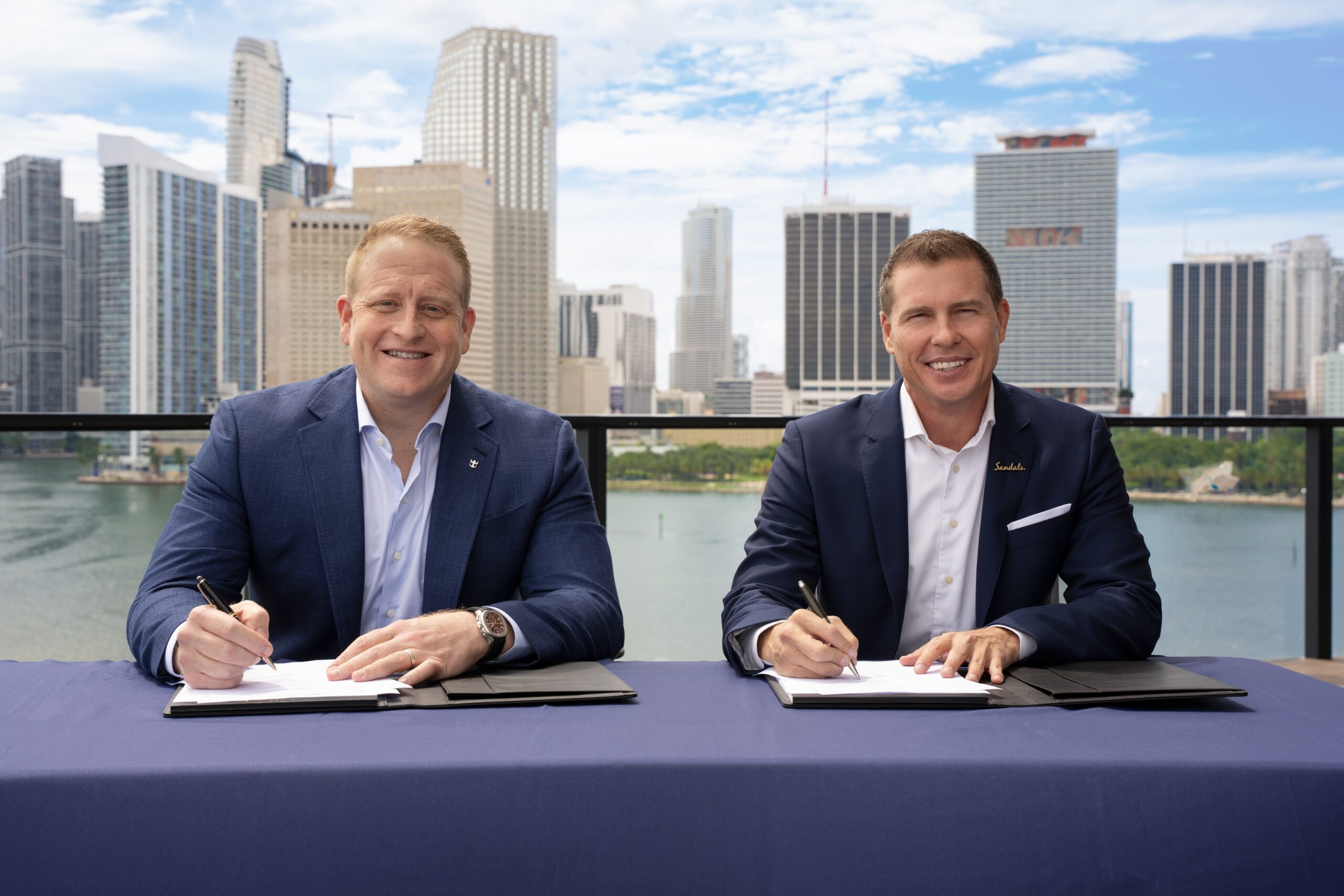 guiding the company’s long-term strategic growth as Executive Chairman of Sandals and Beaches Resorts. Existing reservations, loyalty programs, resort operations and cruise operations will continue as usual, with the partnership bringing additional resources to support future opportunities.
Under the terms of the agreement, Royal Caribbean Group will acquire a 50% equity interest in Sandals and Beaches Resorts for approximately $3 billion, representing a forward EBITDA multiple of approximately 10x. Royal Caribbean Group has secured committed debt financing from Morgan Stanley to fund the investment. The transaction is expected to close in early 2027, subject to customary approvals and closing conditions, and is expected to be accretive to earnings next year.
BofA Securities and PJT Partners acted as financial advisors, and Latham & Watkins and Jones Day acted as legal advisors to the Sandals Group. Perella Weinberg Partners and Morgan Stanley acted as financial advisors and Kirkland & Ellis LLP acted as legal advisor to Royal Caribbean Group.
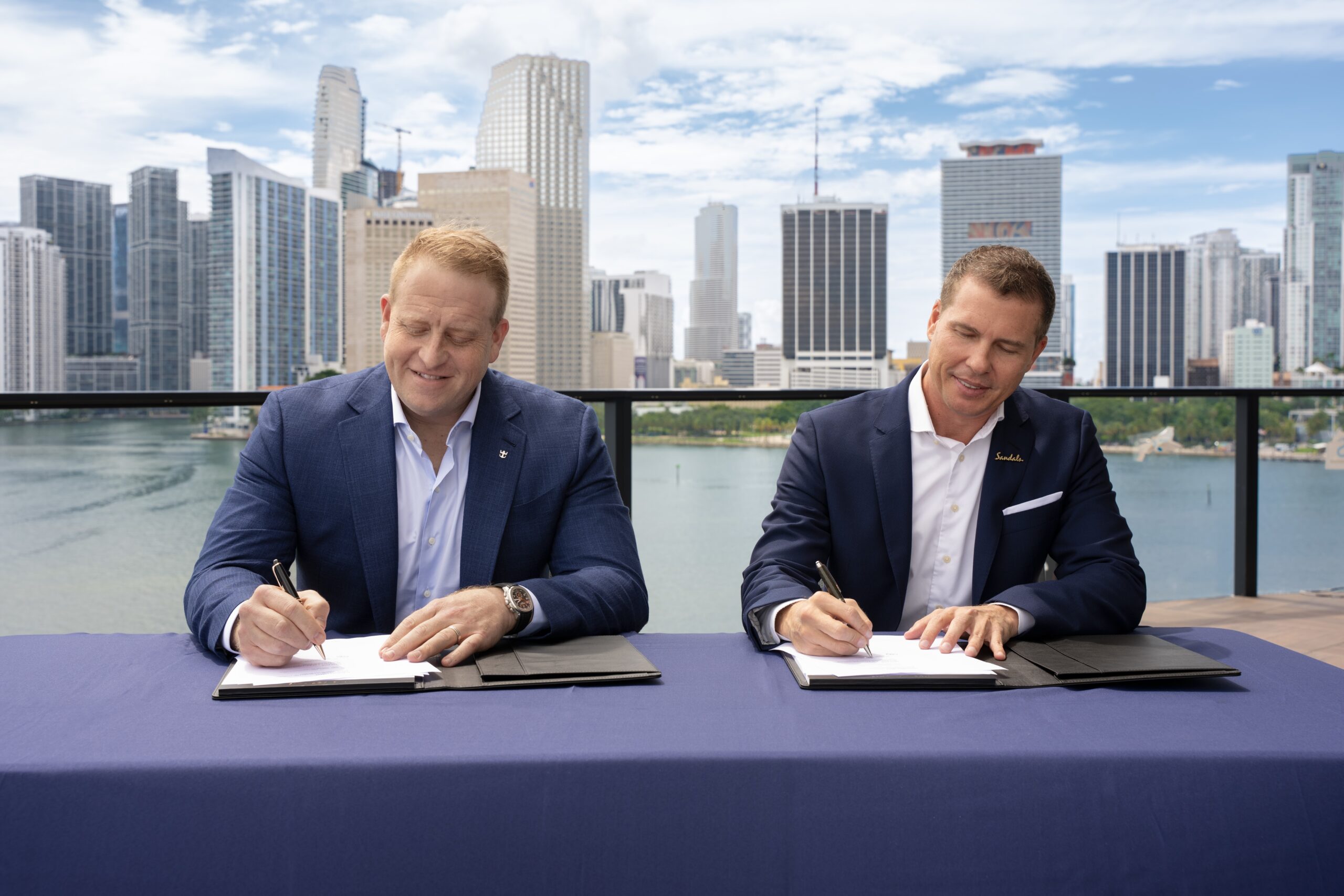
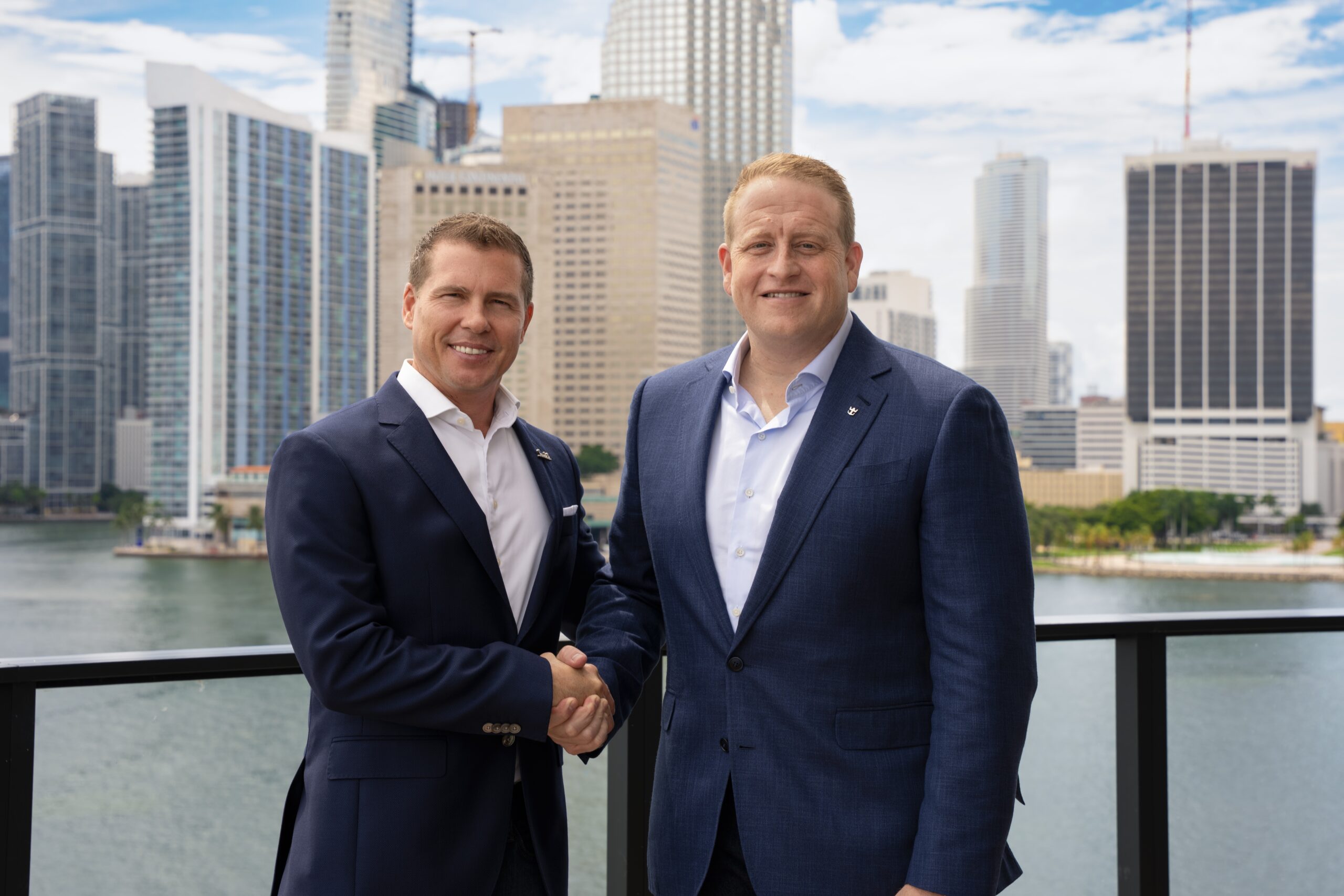
PHOTO CAPTION: Jason Liberty, Chairman and CEO of Royal Caribbean Group, and Adam Stewart, Executive Chairman of Sandals Resorts, mark the signing of an agreement to form a landmark partnership that expands Royal Caribbean Group into the all-inclusive resort space and supports the future growth of Sandals and Beaches Resorts. The signing took place at Royal Caribbean Group’s new headquarters in Miami, with the city’s skyline in the background.
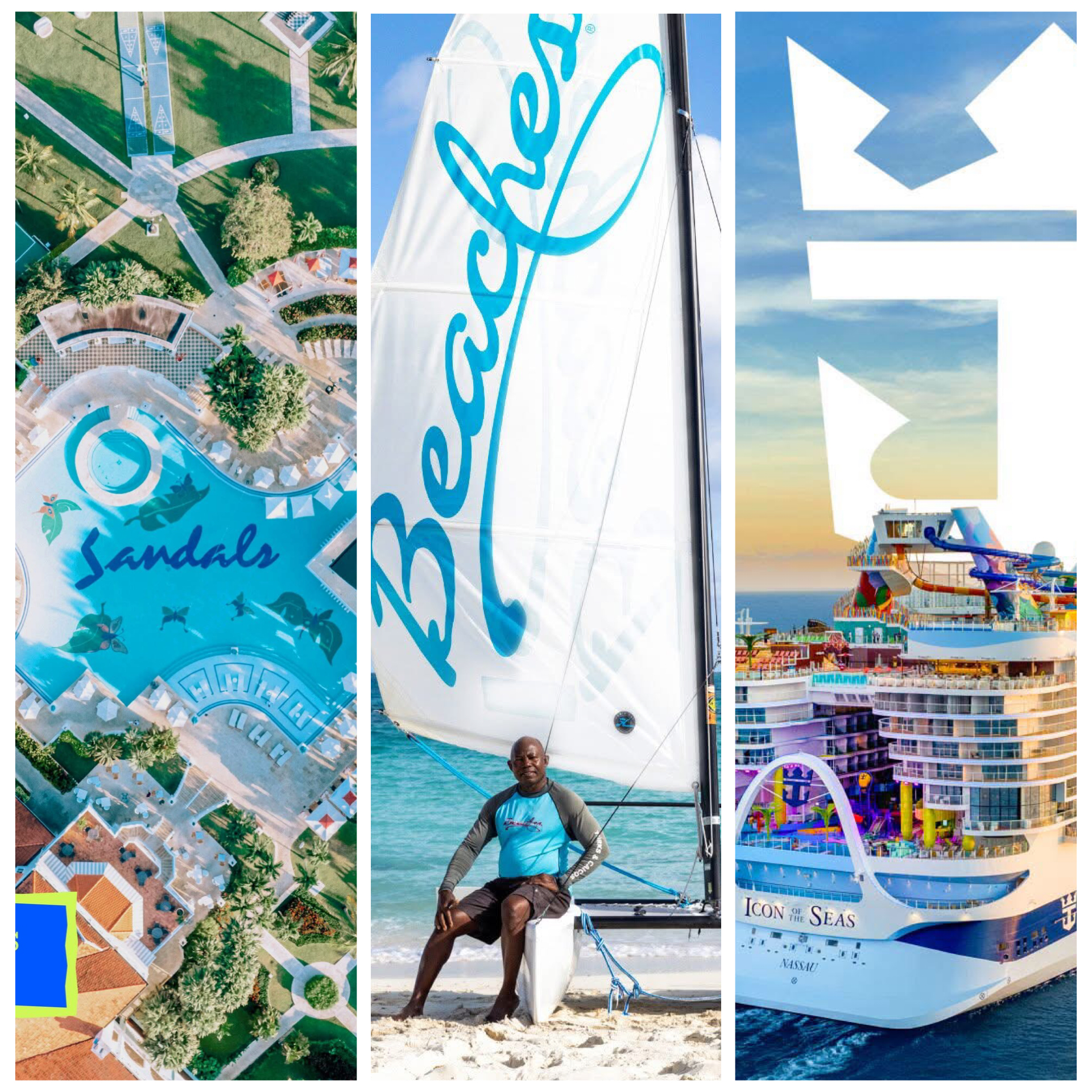
The Caribbean tourism deal first reported as a possibility on Tuesday is now a signed agreement. Royal Caribbean Group plans to pay approximately US$3 billion for a 50% stake in Sandals and Beaches Resorts, putting the value of the business at about US$6 billion. The purchase is expected to close in early 2027, subject to approvals.
Founded in Jamaica by the late Gordon “Butch” Stewart in 1981, the resort business has a presence across nine Caribbean destinations, including Jamaica, The Bahamas and Turks and Caicos. Sandals has described its workforce as nearly 20,000 people, most of them Caribbean nationals.
“My father, Gordon ‘Butch’ Stewart, founded Sandals Resorts with the belief that a company built in the Caribbean could stand on the world stage alongside the most respected names in hospitality,” said Adam Stewart in the announcement carried by PR Newswire. He will remain executive chairman, while the Stewart family retains a stake. The companies say existing reservations and resort operations will continue as usual.





-
 Independent writer1 week ago
Born Here, Raised Here, but Still Unable to Vote: Is this a Conundrum for TCI Electorate?
-
 Bahamas News5 days ago
Rosewood Exuma: A precedent-setting case for environmental law and future development in The Bahamas
-
 News4 days ago
Invest TCI Strengthens Regional Investment Connections at Caribbean Investment Forum 2026 in Barbados
-
 Bahamas News1 week ago
Monument Supports Hands for Hunger With Paradise Plates Debut
-
 Bahamas News4 days ago
Energy Minister Delivers Electrifying Keynote Opening Address at CAREC 2026
-
 Bahamas News1 week ago
Schweppes ‘the Art of Mixology’ Dazzles at Paradise Plates with Nemiroff Vodka
-
 Bahamas News11 hours ago
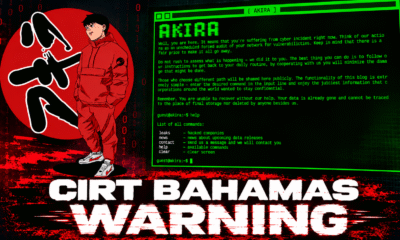
Bahamas Issues Cybersecurity Alert Over Akira Ransomware Threat
-

 News2 days ago
Crown Land Unit Leads Multi-Agency Enforcement Exercise in Five Cays