Connect with us

Bahamas News

Bahamas Minister of Youth, Sports and Culture Lauds Junkanoo Commandos

Published

on

#Bahamas, November 3, 2017 – Nassau – Minister of Youth, Sports and Culture the Hon. Michael Pintard recently commended the Junkanoo Commandos for the work they have done in helping to promote and enhance the Bahamian cultural art form of Junkanoo and for the recognition and awards they accumulated while doing so.

“One of our goals is to assist Junkanooers in making sure that Junkanoo is a ongoing concern, that it is able to generate employment and income,” Minister Pintard said during a courtesy call with the award-winning group.   “In order to accomplish that, we need to work with organisations that are able to stage events, create places where Bahamians and visitors can enjoy a part of our culture – Junkanoo being the most popular expression of Bahamian culture – and we need organisations who are able to internatonalise aspects of our culture.

“The Junkanoo Commandos is one of the best possible examples of an organisation that is doing that.”

The Junkanoo Commandos is an organisation comprised of young Bahamian men and women from various New Providence Junkanoo groups, and its members have traveled nationally and internationally, showcasing the various expressions of Junkanoo and Bahamian culture for at least a decade.

CEO and Founder Angelique McKay said that one of the many things that makes her proud of the Junkanoo Commandos is that its members destroy the myth of the “tribalism” amongst the various Junkanoo groups.

“That myth is dispelled by the cohesion in our organisation because are made up of members from Valley Boys, Saxons, Roots, One Family and Genesis; and you do not tend to see the tribalism that people in the general population speaks about,” Ms. McKay said.   “Everyone moves as one unit to showcase Junkanoo, with one common goal; so I’m proud of the fact that they are in the position to dispel that myth that Junkanoo has become totally ‘tribal’ amongst the groups.”

Ms. McKay pointed out that she wanted to put the Junkanoo Commandos forth for consideration as “cultural ambassadors for The Bahamas – when it comes to cultural exchange programmes because it was something that the organisation had been doing for years.   She wanted to familiarise Minister Pintard with what the Junkanoo Commandos has done in terms of teaching the creative arts of Junkanoo, highlighting Junkanoo as a cultural expression of the people of The Bahamas.

Locally, the Junkanoo Commandos organisation has conducted national workshops throughout The Bahamas, since 2007, designed and built lead costumes for stage plays produced by Shakespeare in Paradise, introduced and judged the off-the-shoulder category in Junior Junkanoo, raised funds for various relief efforts, appeared in music videos and even donated 500 books to Stephen Dillet Primary School when the school won the primary school Junior Junkanoo Division.

Internationally, the Junkanoo Commandos lists in its accomplishments the honour of conducting Junkanoo workshops on the Isle of Wight, UK; performing at the Grand Opening of The Carnival Learning Centre there, as well as being included as part of the first-ever Junkanoo Backline National Tour of the United Kingdom, in 2008.   From there, they conducted workshops and performed in festivals throughout the United States, the United Kingdom and Europe – including the Edinburgh Jazz Festival, the Nice (France) Carnival, the Broughhaha Festival in Liverpool, and the Virginia Carib Fest.

One of the highlights of the Junkanoo Commandos history was performing on the steps of the Lincoln Memorial in Washington, D.C., for the 50th Anniversary Celebrations of the “I Have A Dream” Speech by Dr. Martin Luther King, Jr.

“The fact that the Junkanoo Commandos was the only international act that performed at that venue, at that historic event – in the presence of three U.S.   Presidents and we performed immediately after the (then) Prime Minister of Commonwealth of The Bahamas spoke; and the fact that that was the widest broadcast, to date of Junkanoo globally – I would say that that is the proudest moment that we would have had,” Ms. McKay said.   “We were actually a part of history and with the importance of what Dr. Martin Luther King, Jr., did, it makes us even prouder to have been an instrumental part in the 50th Anniversary.

Among the accolades and awards that the Junkanoo Commandos have attained, two of particular note were received this year – the U.S.-based International IndigoLife Black Life Treasure Award and, closer to home, the Cacique Award in the Creative Arts from the Ministry of Tourism.

“The Cacique Awards recognises the best in our preeminent industries, and for them to have achieved that is an outstanding accomplishment and is a testimony to the power of Junkanoo and the discipline and teamwork of the Commandos,” Minister Pintard said.

Ms. McKay said that she wanted Minister Pintard to see that the Junkanoo Commandos takes the creative arts very seriously, in that they had created a business from it, and its members move as artists.

“We are self-sustaining,” Ms. McKay pointed out. “We have created our line of products that we generate revenue from for the organisation, and (utilise) the best practices for a cultural entity, taking advantage of the fact that the ‘orange economy’ is growing.

“We are an example of the success of Junkanoo, being able to be exported as a creative art.”

“We are proud of the work that they are are doing,” Minister Pintard said. “We are honoured to be partnering with them and we encourage other groups to look at this successful programme, and model themselves after them or adopt portions of their programme.”

By: Eric Rose (BIS)

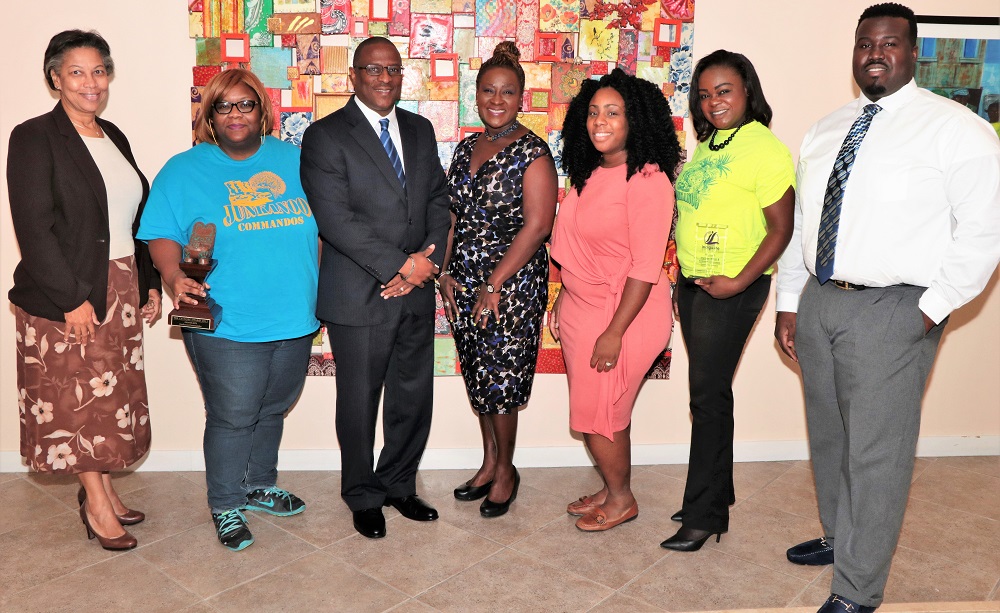
Photo caption: Minister of Youth, Sports and Culture the Hon. Michael Pintard pictured with senior Ministry officials and representatives of the Cacique-Award-Winning Junkanoo Commandos (JC), during a recent courtesy at his Ministry.   Shown (from left) are Permanent Secretary Nicole Campbell, JC Strategic Analyst and founding member Dr. Erecia Hepburn, Minister Pintard, JC CEO and Founder Angelique McKay, Director of Culture Rowena Sutherland, JC Administrative Coordinator Shereka Pinder, and JC Project Manager Jamal Riley.

(BIS Photo/Eric Rose)


Continue Reading

Bahamas News

Where to Draw the Line? TCI and Bahamas Advance Maritime Boundary Talks

Published

on

June 16, 2026 – Thirty-four years after formal negotiations began, Turks and Caicos Islands and The Bahamas are still working to define an agreed maritime boundary between the neighbouring archipelagos, a revelation emerging from a recent Turks and Caicos Cabinet summary which has brought renewed attention to a largely overlooked diplomatic and security issue.

A May 2026 Turks and Caicos Cabinet update suggests the long-running negotiations are continuing to advance.  In August 2023, Bahamas Foreign Affairs Minister Fred Mitchell said efforts to draw an exact maritime boundary had been slowed by the challenge of gathering the mapping and locational data required for the exercise.  The United Kingdom, which represents Turks and Caicos in the negotiations, has offered few details beyond confirming that both sides remain committed to maritime boundary delimitation talks.

The negotiations are not centred on a territorial dispute but rather on establishing a legally recognized maritime boundary under international law.  Such agreements help determine jurisdiction over fisheries, maritime resources, law enforcement activities, environmental protection and migration control in the waters between neighbouring countries.

While the discussions focus on the boundary between The Bahamas and Turks and Caicos, the exercise is part of a wider maritime delimitation effort — the process of formally marking and agreeing upon where one country’s waters end and another’s begin.  In comments to The Tribune in August 2023, Mitchell referenced similar boundary considerations involving the United States and Haiti, underscoring the broader regional importance of defining maritime jurisdictions in accordance with international law.

According to public statements from The Bahamas, formal negotiations between the two sides began in 1992 and were followed by technical discussions in 1996.  After years of little public activity, talks resumed in 2023 and have continued through a series of engagements involving legal, maritime, security and geographic information specialists.

The importance of maritime boundaries was underscored by former Bahamas Foreign Affairs Minister Brent Symonette during maritime boundary discussions between The Bahamas and the United States in 2009.  At the time, Symonette described clearly defined maritime borders as essential to national sovereignty, law enforcement, fisheries management, environmental protection and efforts to combat illegal migration.  He also argued that agreed boundaries provide legal certainty and strengthen cooperation between neighbouring countries.

The United Kingdom, which represents Turks and Caicos in the negotiations, has offered few public details beyond confirming its commitment to the process.  However, officials from the Foreign, Commonwealth and Development Office participated alongside TCI representatives during talks held in Nassau in August 2023.  The Turks and Caicos delegation included then Permanent Secretary Wesley Clerveaux, whose responsibilities included Marine Affairs.

At this stage, the TCI Cabinet has only publicly identified the area under discussion as being south of “Point 1.”  Information released by The Bahamas following a 2023 meeting indicates the negotiations concern waters between the southeastern Bahamas and the Turks and Caicos Islands.  While no map has been made public, the available information places the discussions south of Bahamian islands including Mayaguana and Great Inagua.  Exactly where the proposed boundary would meet the Turks and Caicos archipelago remains unclear from public records.

The latest Cabinet update offers no indication of when the negotiations may conclude.  However, after more than three decades of intermittent discussions, recent references by both governments suggest efforts to finally draw the line between the two jurisdictions are continuing.

Continue Reading

Bahamas News

CDB Leadership Passes to Belize as Region Eyes New Financing Partnerships  

Published

on

By Deandrea Hamilton


The Bahamas, June 9, 2026 – The Caribbean Development Bank’s annual gathering may have concluded in The Bahamas, but attention is already turning to Belize as leadership of the institution’s Board of Governors officially changed hands.

At the close of the 56th Annual Meeting in Nassau, outgoing Chairman and CDB Governor for The Bahamas, Michael Halkitis, formally transferred the chairmanship to Belize’s Dr. Hon. Osmond Martinez, continuing the Bank’s tradition of rotating leadership among its regional shareholders.

The handover capped a week of discussions focused on financing development in an increasingly uncertain global environment and strengthening the Caribbean’s ability to withstand economic and climate-related shocks.

One of the meeting’s most closely watched conversations centered on how multilateral development banks can better support vulnerable Small Island Developing States.

During the President’s Chat, titled Financing the Future: MDB Strategies for Uncertain Times, CDB President Daniel Best joined leaders from the OPEC Fund, the Central American Bank for Economic Integration and the Fund for Responding to Loss and Damage to discuss expanding development finance and building resilience.

OPEC Fund President Dr. Abdulhamid Alkhalifa emphasized that development institutions must move beyond responding to crises and instead help countries prepare for them.

“The real test is whether we can help countries move from strategy to implementation, and from implementation to results,” Alkhalifa said.

The discussions reflected a growing regional push for innovative financing solutions as Caribbean nations continue to confront climate vulnerability, infrastructure demands and economic uncertainty.

Beyond discussions on financing and resilience, the Annual Meeting also featured youth engagement activities, including the Youth FIRE Forum, where young Caribbean leaders participated in conversations about innovation, entrepreneurship, leadership and the future of regional development. Senior government officials, development professionals and youth delegates exchanged ideas on the challenges and opportunities facing the next generation, reinforcing a recurring message throughout the conference: that investments made today must ultimately improve opportunities for Caribbean youth tomorrow.

That theme was echoed by Bahamas Prime Minister Philip Davis, who used the opening ceremony to challenge regional leaders to invest in future generations.

“We must invest in the one asset that no agency can ever downgrade, and that no storm can ever wash away: the mind of a Caribbean child,” Davis told delegates.

With Belize now assuming the chairmanship, regional leaders say the focus remains on transforming ideas discussed in Nassau into tangible results for Caribbean people.

Angle by Deandrea Hamilton. Built with ChatGPT (AI). Magnetic Media — CAPTURING LIFE.

Continue Reading

Bahamas News

New GPS Evidence Prompts Fresh Search for Missing American Woman in Abaco

Published

on

ABACO, BAHAMAS — Nearly two months after American sailor Lynette Hooker vanished in waters off Abaco, investigators are preparing to conduct a new search based on GPS and navigation data that reportedly challenges the account originally provided by her husband.

The case, which first drew international attention in early April, began when Brian Hooker told authorities that his wife was swept away after falling from an inflatable dinghy during rough conditions in waters near Elbow Cay.

Initial search efforts involving Bahamian and U.S. authorities covered extensive areas of the Sea of Abaco but failed to locate the missing Michigan woman.

Now, according to multiple U.S. media reports, investigators have obtained electronic navigation and GPS data that appears to place the couple’s dinghy in a different location from where searchers initially concentrated their efforts.

The new information has prompted authorities to reopen search operations and seek permission for divers to examine a more targeted area of the Sea of Abaco.

Unlike the broad search that followed Hooker’s disappearance, the renewed effort is expected to focus on a relatively shallow section of water, reportedly about 25 feet deep. Investigators believe the location may offer a better opportunity to recover evidence and potentially answer lingering questions surrounding the disappearance.

The latest development marks a significant shift in the investigation.

What began as a maritime search-and-rescue operation has evolved into a complex multinational investigation involving Bahamian authorities, the United States Coast Guard and the Federal Bureau of Investigation.

Brian Hooker was detained and questioned by Bahamian authorities following his wife’s disappearance but was later released without charges. While investigators have never publicly accused him of a crime, reports indicate he remains a person of interest as authorities continue to examine the circumstances surrounding the case.

Hooker has repeatedly denied any wrongdoing and has maintained that his wife accidentally fell overboard.

The investigation has intensified in recent weeks. U.S. authorities have reportedly seized the couple’s sailboat, Soulmate, transporting the vessel to Florida for forensic examination. Investigators are said to be reviewing onboard electronics, digital records and other potential evidence as part of the ongoing inquiry.

The case has also attracted attention from Lynette Hooker’s family, who have continued to press for answers and support efforts to locate her.

The renewed search comes after Brian Hooker returned to the United States following the disappearance. Reports indicate he cited family reasons, including concerns about his mother’s health, for leaving The Bahamas.

For investigators, however, the focus now appears fixed on the newly identified search area and the electronic evidence that led them there.

Whether the latest operation produces answers remains to be seen. But nearly eight weeks after Lynette Hooker disappeared in the waters of Abaco, authorities believe new technology and new information may finally provide a clearer picture of what happened that night.

Continue Reading

FIND US ON FACEBOOK

TRENDING