
News
Building a Stronger Royal Turks and Caicos Islands Police Force through Change and Capacity Building


Turks and Caicos, September 4, 2026 – As the world continues to advance, the nature of policing continues to evolve. Criminals are becoming more sophisticated, technology is changing rapidly, and the expectations placed upon law enforcement agencies have never been greater. If we are to remain effective in protecting our communities, we must be prepared to evolve alongside these changes.
It is against this backdrop that the Royal Turks and Caicos Islands Police Force has embarked on a journey of organizational transformation and modernization. Change is not always comfortable, nor is it easy. It requires us to challenge old ways of thinking, review longstanding practices, and sometimes make difficult decisions in pursuit of a better future.
We recognize that change often brings uncertainty and resistance. However, strong institutions cannot remain static. They must continuously adapt to changing circumstances while remaining true to their core mission and values. Our responsibility as a Police Force is to build structures, systems, policies, and capabilities that will endure long after any individual officer leaves the organization.
This transformation is not simply about responding to today’s challenges. It is about building an institution that is resilient, sustainable, and capable of serving future generations.
Central to this transformation is capacity building.
For too long, discussions about organizational effectiveness in policing have focused primarily on equipment and infrastructure. While these remain critical, true organizational strength comes from knowledge, competence, leadership, and institutional capability. Our objective is not merely to fill positions but to develop professionals who possess the expertise, confidence, and leadership skills necessary to navigate increasingly complex policing environments.
The Royal Turks ans Caicos Islands Police Force have made substantial investments in training, leadership development, specialist expertise, and knowledge transfer across the Force. ACP Dr. Terrance Bent, drawing on more than 30 years of policing experience and professional knowledge, will play a pivotal role in driving this organizational transformation. These investments are intended not only to enhance individual capability and performance, but also to strengthen the institutional resilience and effectiveness of the Force. Every officer who undertakes advanced training becomes a valuable source of expertise, mentorship, and leadership, creating a lasting ripple effect that benefits colleagues, teams, and the wider organization.
In this way, capacity building becomes far more than professional development. It becomes the foundation upon which long-term organizational success is built.
Between October 2025 and August 2026, the RTCIPF delivered 63 training courses and programmes, recording 1,289 participant attendances across a broad range of professional development initiatives.
The Junior Command Programme, our flagship leadership development initiative, continues to strengthen supervisory and leadership capacity and offers certification and accreditation for further learning opportunities. Four(4) cohorts have successfully completed the programme since its reintroduction, with the fifth cohort scheduled to conclude on 11 September 2026. To date, fifteen (15) persons from the RTCIPF and the Turks and Caicos Islands Border Force have completed the programme, while six participants are currently undergoing training. An additional 32 personnel remain engaged in ongoing professional development activities.
These investments in our people are already producing measurable results. We are building stronger leaders, enhancing operational capability, improving investigative capacity, and creating a more professional and adaptable workforce. These improvements are helping us create a police service that is better equipped to meet today’s challenges while preparing for those that lie ahead.
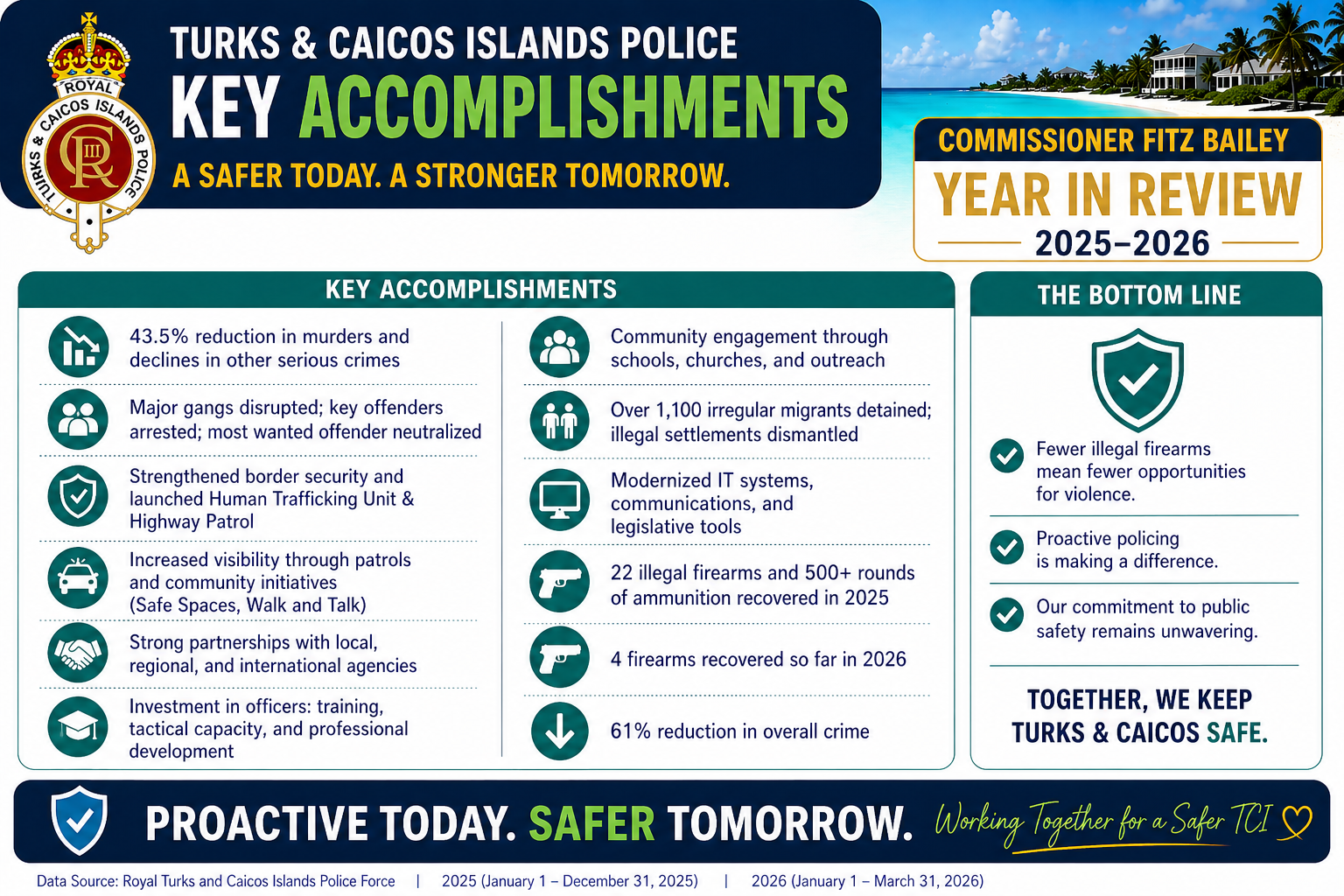
Encouragingly, these efforts are being reflected in our operational outcomes. Over the past year, the Royal Turks and Caicos Islands Police Force has recorded a steady decline in serious reported crime, including significant reductions in violent offences and homicides. Murders have fallen from a record high of 48 in 2024 to 27 in 2025, and to just three(3) recorded murders by the end of August 2026. This represents a reduction of 43.8% in 2025 and 93.8% in 2026 when measured against the 2024 baseline. Collectively, this equates to approximately 66 fewer homicides recorded over the period compared to what would have occurred had the 2024 murder rate continued.
Serious crime has also continued on a downward trajectory, decreasing from 551 offences in 2024 to 502 in 2025, with 210 offences recorded by the end of August 2026. Based on current trends, serious crime is projected to end 2026 at approximately 315 offences, representing a reduction of 42.8% compared with 2024.
These achievements are a testament to the dedication of our officers, the support of our partners and the cooperation of the communities we serve. The results demonstrate the positive impact of sustained investment in our people, targeted enforcement initiatives, intelligence-led policing and strong community partnerships.
While we are encouraged by this progress, it would be disingenuous not to acknowledge the challenges that remain.
Our officers continue to operate under demanding circumstances. There are genuine concerns regarding facilities, technology, equipment, uniform supplies and other resources necessary to support effective policing. These are not mere inconveniences; they are operational realities that can affect our ability to deliver services at the standard both the public and our officers deserve.
We acknowledge these concerns and are committed to addressing them. To support this effort, the Force has engaged Mr. Rohan Richards as Chief Operations Officer. Drawing on his extensive expertise and operational experience, Mr. Richards will provide strategic guidance and oversight to identify areas for improvement, strengthen organizational efficiency, and help drive the changes necessary to enhance the effectiveness, resilience, and capability of the Force.
The acquisition of modern technology, fit-for-purpose workspaces, specialized equipment and adequate operational resources remains essential to achieving our modernization objectives. Budgetary constraints continue to present challenges, and we will continue to advocate strongly for the investments required to equip the Force for the future.
However, while we pursue the resources we need, we cannot allow the absence of resources to define who we are. Our identity is shaped not by the equipment we possess, but by the professionalism, dedication, and resilience of the people who serve.
Every success achieved by this Force has been made possible through the determination, commitment, and sacrifice of the men and women who serve this organization and by extension, the people of the Turks and Caicos Islands.
Too often, the public sees the uniform but not the person behind it. They do not always see the long hours, the missed family occasions, the difficult decisions, or the emotional burden that policing can impose. Yet every day, our officers continue to answer the call of duty with professionalism, courage, and unwavering commitment.
As an organization, we have a responsibility to support our people by investing in their development, recognizing their contributions and creating opportunities for growth. Morale is strengthened when individuals feel valued, respected and empowered to succeed.
That is why our modernization programme places people at its heart. Every course completed, every skill acquired, every leadership opportunity created, and every improvement in working conditions is an investment in the people who make this organization successful.
While building capability and reducing crime remain essential priorities, public trust and police legitimacy are equally important.
The appointment of an Inspector General Alison Woods reinforces our commitment to ensuring that accountability is not merely an aspiration but a reality. It provides an independent mechanism through which allegations of police misconduct can be examined fairly, impartially, and transparently. This oversight role strengthens public confidence while supporting the professionalism and integrity of the overwhelming majority of officers who serve honourably each day.
At the same time, it is important to recognize the dangers that officers continue to face in the execution of their duties. Criminals remain willing to confront law enforcement, particularly during responses to firearms-related incidents.
A recent shooting involving several underage males serves as a stark reminder of this reality. Incidents such as these highlight the complex environment in which officers must operate, balancing accountability and transparency while confronting individuals who are often armed and prepared to engage in serious criminal activity.
For this reason, our focus has increasingly shifted from short-term gains to long-term sustainability. The true measure of success is not whether crime falls during my tenure as Commissioner. Rather, it is whether the systems, structures, and capabilities we are building today are strong enough to sustain that success long after my tenure has ended.
Building institutional resilience also means investing in the next generation of police officers. While developing our existing workforce remains a priority, we continue to focus on attracting talented individuals from within our own communities. Recruitment remains an important part of this effort, and we continue to encourage suitably qualified Turks and Caicos Islanders, Permanent Residency Certificate holders and British Overseas Territories citizens to consider a career in policing.
The future of this organization depends on our ability to identify, develop and retain individuals who are committed to public service, professionalism and integrity. By bringing new talent into the organization while continuing to develop those already serving, we are creating a sustainable foundation for long-term success and ensuring that the progress we achieve today can be maintained well into the future.
My goal is clear: not simply to reduce crime today, but to create the conditions that will keep crime low, communities safe, and public confidence strong for years to come.
Change does not happen overnight. It requires patience, discipline, commitment and collective effort. It requires the support of our officers, our partners, our Government and the communities we serve.
As we prepare for the reopening of schools, the Royal Turks and Caicos Islands Police Force will maintain an increased presence on the nation’s roads to help ensure the safety of students, parents and all road users. Motorists are urged to comply with all traffic laws and exercise patience during peak travel periods. Drivers who create unnecessary congestion or are found in violation of traffic regulations may face enforcement action and prosecution where appropriate.
Together, we are building more than a modern police service. We are strengthening an institution, safeguarding our progress, creating opportunities for our young people, and laying the foundation for a safer and more secure Turks and Caicos Islands for generations to come.
The men and women of the Royal Turks and Caicos Islands Police Force are our greatest asset. They remain the driving force behind every success we achieve today and every success this organization will achieve in the future.
Stronger Together, serving the citizens, residents and visitors of these Beautiful by Nature Turks and Caicos Islands.






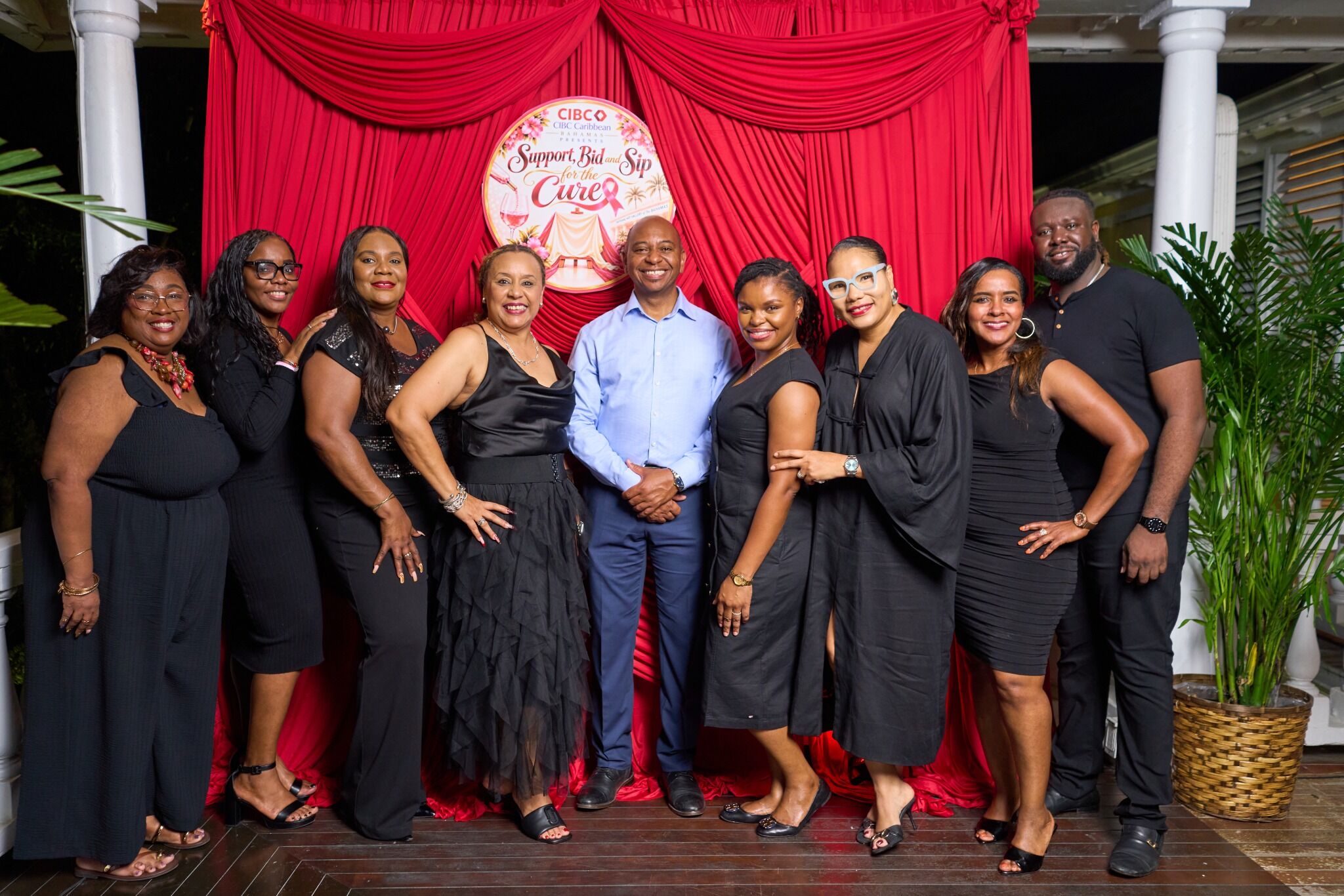
Nassau, Bahamas, 23 November 2026 – With 15 years of Walk for the Cure now successfully concluded, CIBC Caribbean is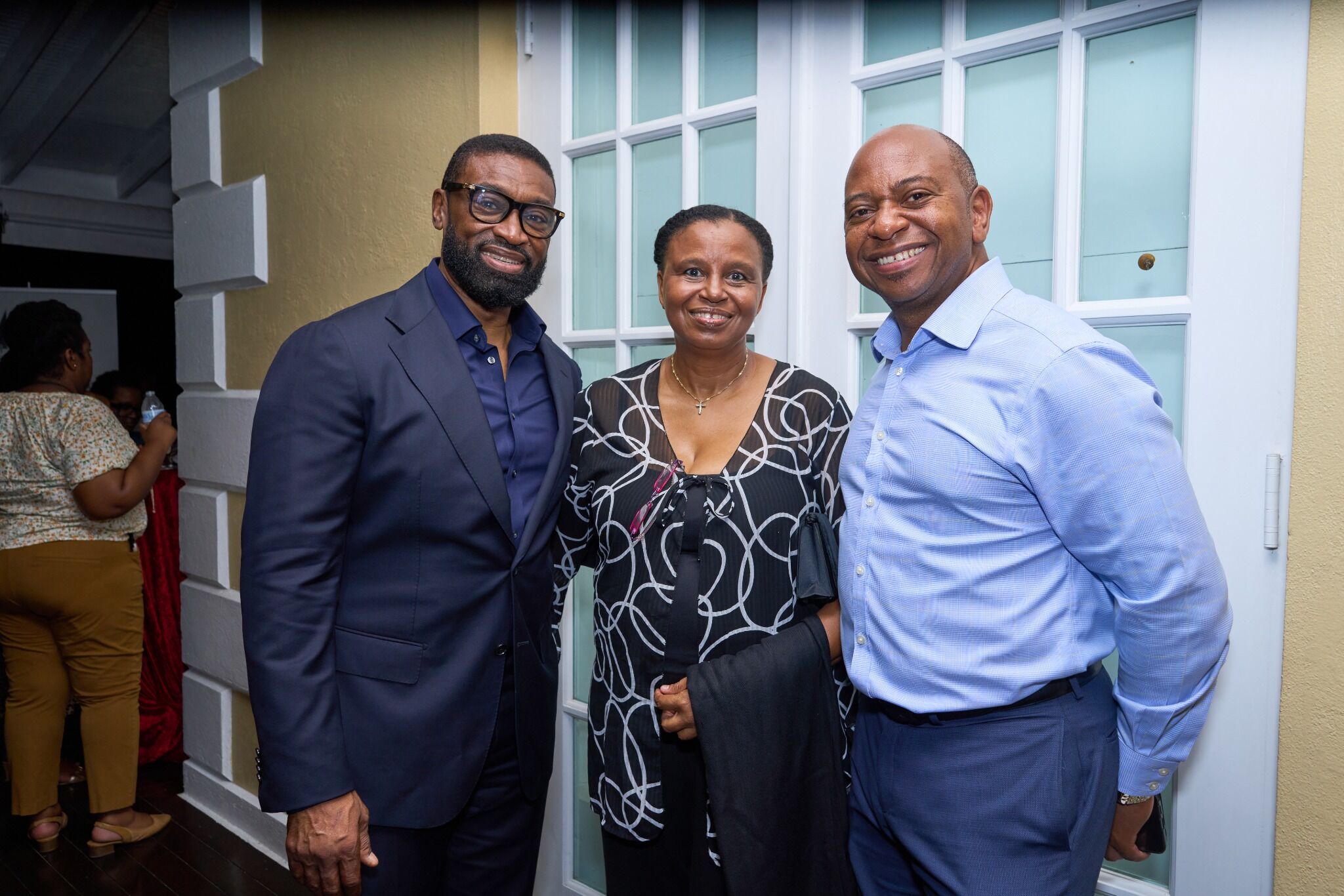 introducing new ways to build on its fundraising efforts in support of a worthy cause.
The latest addition is Sip for the Cure, which brings together art, culture and philanthropy to raise additional funds for cancer organizations across The Bahamas. Hosted by Das Quay, the recent event featured a silent auction, including an exclusive piece by renowned Bahamian artist His Excellency Jamaal Rolle, along with performances by the R.M. Bailey Senior High School Junkanoo Group and Rhythm in Motion Studios.
CIBC Caribbean Head of Country Terrance Gibson said the new initiative reflects the bank’s commitment to finding meaningful ways to engage supporters beyond the traditional walks.
“Walk for the Cure has shown us what is possible when people come together with a shared purpose. Sip for the Cure is an extension of that commitment, creating another opportunity for people to give and help make a difference in the lives of those affected by cancer,” Gibson said.
“While this event marks the close of another fundraising season, the need for support continues long after the last walk. Our hope is that Sip for the Cure will grow into an annual tradition, allowing us to build on what we have achieved and extend the reach of the support we provide.”
Held at the National Art Gallery of The Bahamas, the event followed four Walk for the Cure events hosted in New Providence, Grand Bahama, Abaco and Eleuthera throughout October. The event also provided an opportunity for CIBC Caribbean to recognize the individuals, businesses and community partners whose contributions have supported the flagship fundraiser over its 15-year history.


Photo Captions:
1st insert: From left are Charles Sealy II, Cheyvonne Bethell, and CIBC Caribbean Head of Country Terrance Gibson.
2nd insert: Pictured beside CIBC Marketing Manager F. Leann Albury-Mitchell are student artists Ayira Roache, left, and Chloe Sawyer, right.
3rd insert: Standing beside an exclusive piece by his Excellency Jamaal Rolle, left, is CIBC Caribbean Head of International Corporate Banking Tonia Cartwright, right.
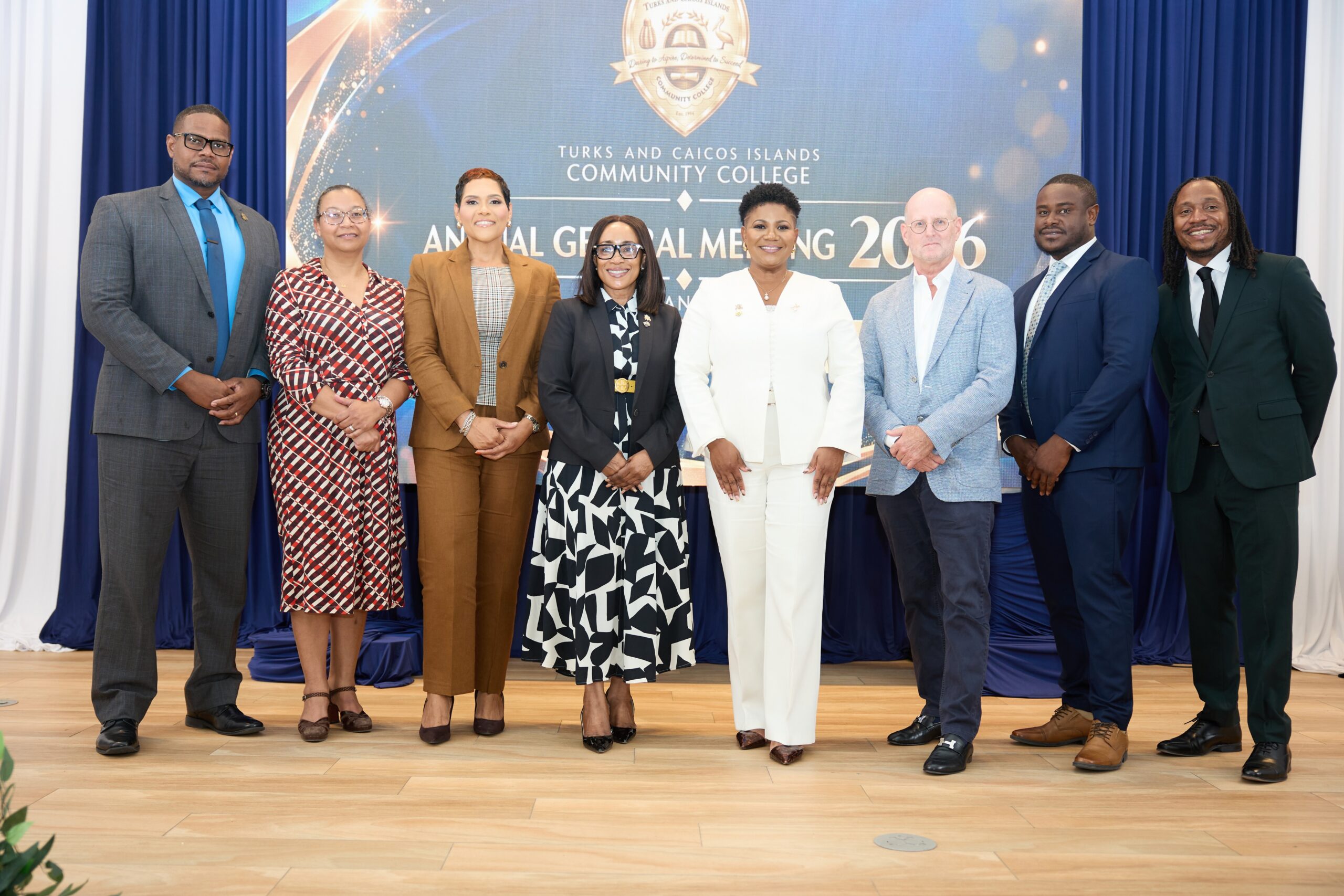
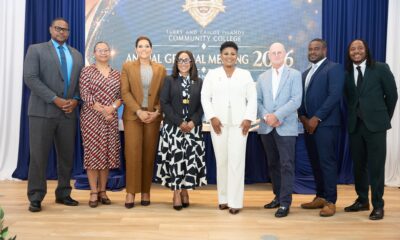
Turks and Caicos, November 23, 2026 – The Turks and Caicos Islands Community College (TCICC) officially launched the TCICC Foundation and Endowment at its Board of Governors’ second Annual General Meeting on Thursday, October 22, 2026, in Providenciales.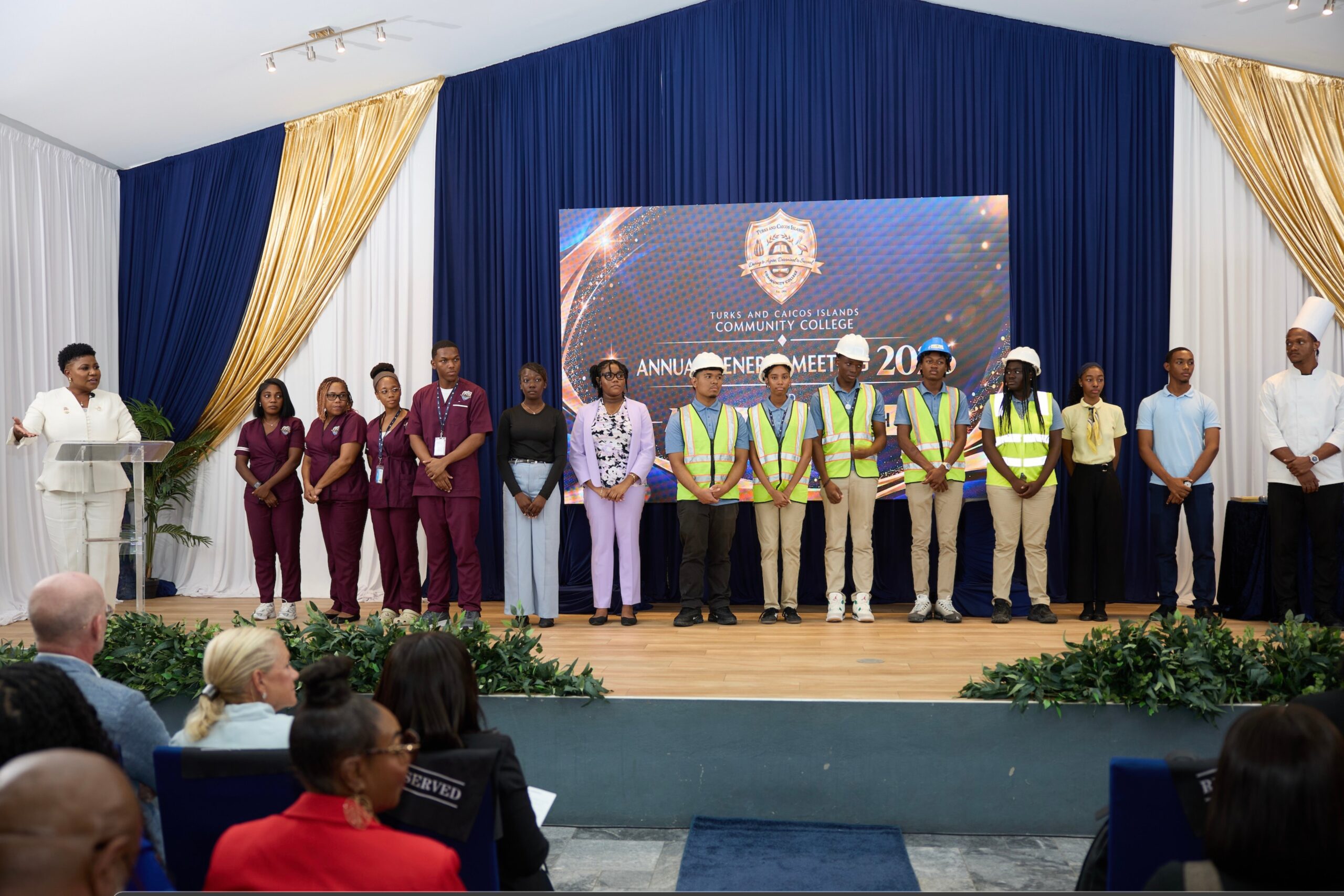
Held under the theme “Together We Advance: Strengthening Partnerships, Expanding Possibilities,” the event introduced an initiative to strengthen the College’s financial sustainability through philanthropy, student support and educational investment.
Mr. Leonardo Patrick emphasized the need for sustainable funding as enrollment and academic offerings expand.
President and CEO Dr. Candice Williams reported a 32 percent enrollment increase, from 469 students in Fall 2024 to 619 in Fall 2025, alongside a record 144 graduates and ISO 9001:2015 certification.
“TCICC is not the same institution it was a year ago. We are larger. We are stronger. We are more accountable. And we are moving forward with intention,” she affirmed.
Board Chair Sheba Wilson described the Foundation as a significant step toward institutional sustainability.
Keynote speaker Dr. Stan Hartling urged businesses to invest through mentorship, internships, apprenticeships and career opportunities.
Education Minister Hon. Rachel Marshall Taylor welcomed the initiative, highlighting opportunities for scholarships and stronger academic programs.
Dr. Williams closed by inviting students from TCICC’s seven faculties onto the stage, emphasizing the Foundation’s student-centered mission.
Annual memberships range from US$45 for students to US$18,000 for corporations, with additional categories available.
For membership, donations or Board participation, contact TCICC at (649) 339-3900.
Bahamas News
Nearly 1,500 UK Parliamentarians to Weigh In on Bahamas–Turks and Caicos Maritime Boundary Treaty
By Deandrea Hamilton | Editor
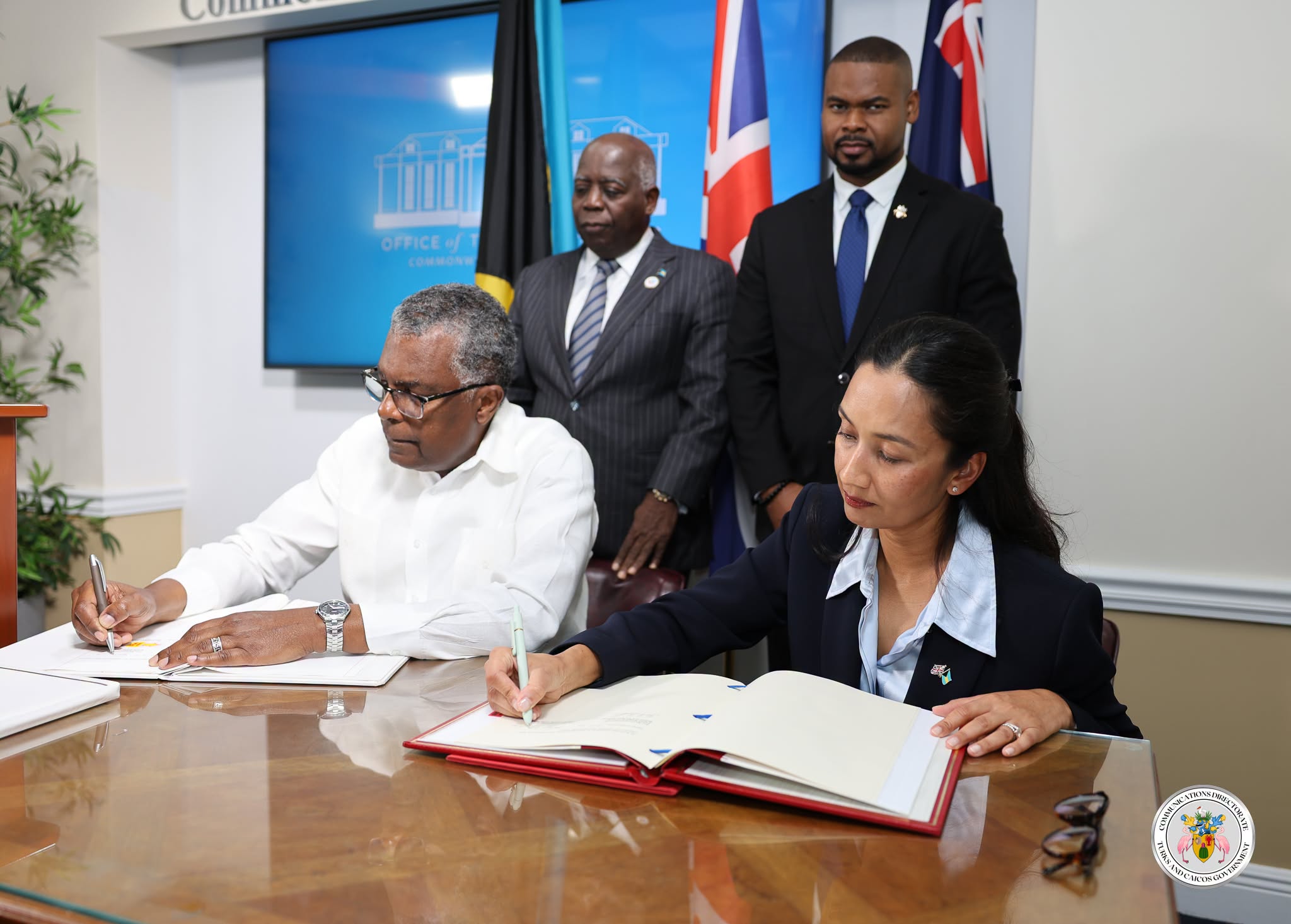
A historic maritime boundary treaty between The Bahamas and the Turks and Caicos Islands is heading for scrutiny by 650 elected members of the United Kingdom’s House of Commons and approximately 796 members of the House of Lords before it can become legally binding.
The agreement was signed in Nassau on Monday, November 16, 2026, by Bahamian Foreign Affairs and Immigration Minister Frederick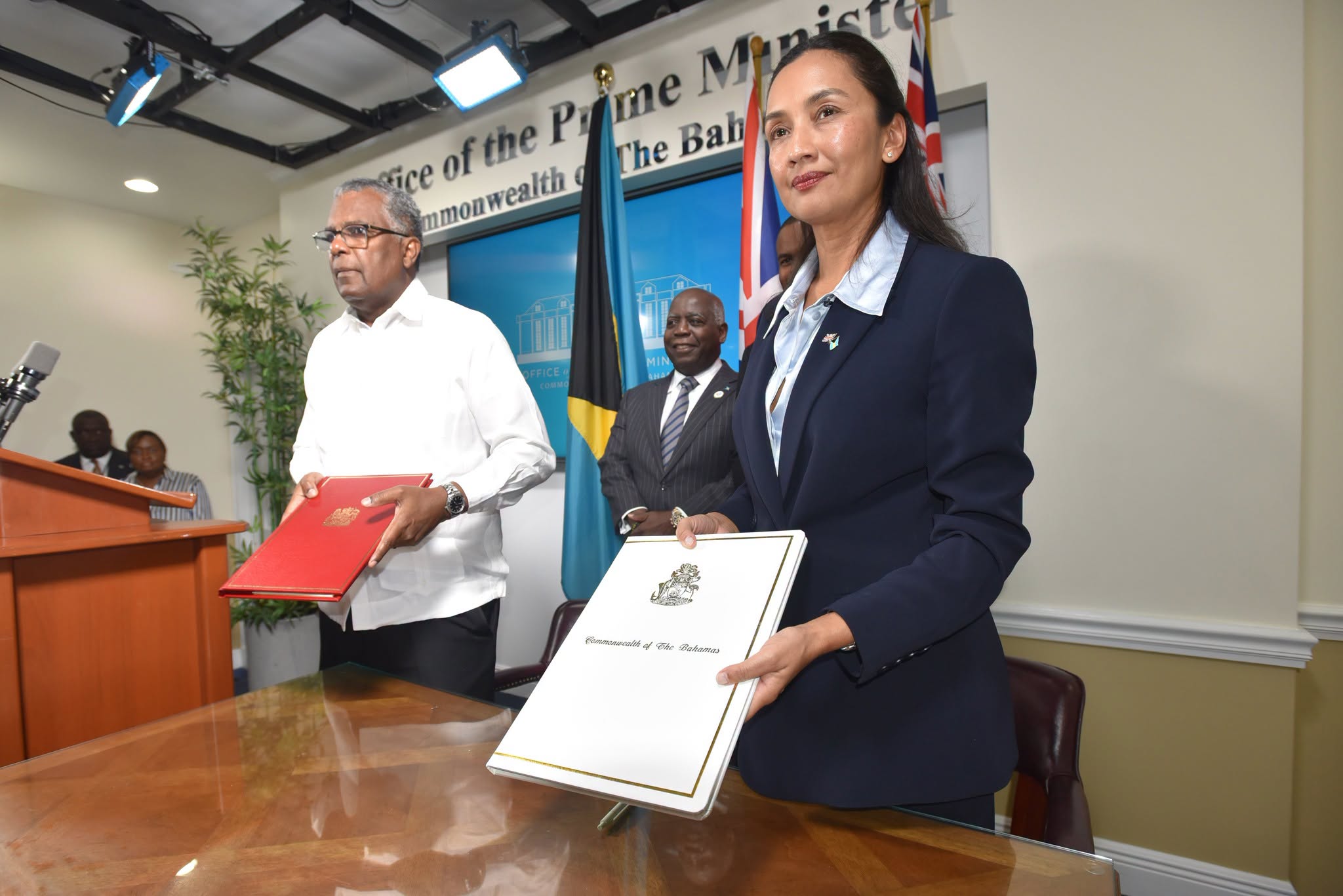 Mitchell and British High Commissioner Smita Rossetti, representing the United Kingdom. Looking on were Bahamian Prime Minister Philip Davis and Turks and Caicos Deputy Premier Jamel Robinson.
Although the treaty draws a delimitation line across the Atlantic Ocean, that line runs much deeper than the surface.
It establishes a boundary through the water column, across the seabed and into the subsoil beneath it, defining maritime rights and jurisdiction involving fisheries, underwater resources and security operations.
The boundary separates maritime areas between Mayaguana and Inagua in The Bahamas and the Caicos Islands.
But the signatures do not make the treaty immediately enforceable.
Under British parliamentary procedures, the agreement must be presented to both Houses for 21 sitting days, allowing parliamentarians to scrutinize its provisions and potentially object to ratification.
A parliamentary vote is not automatically required. However, the House of Commons can formally delay ratification, while the House of Lords may register objections.
The process reflects the Turks and Caicos Islands’ constitutional relationship with Britain, which retains responsibility for its international treaty arrangements.
Deputy Premier Jamel Robinson emphasized the territory’s involvement in the negotiations.
“Our Government has been actively engaged in the negotiations, ensuring that the interests of our people and our maritime communities were represented throughout the process.”
He added that the agreement strengthens the foundation for maritime security, responsible fisheries management and cooperation between the neighboring jurisdictions.
Negotiations began in 1992, with a technical agreement reached in 1996 that was never ratified. Talks resumed in 2023, following changes to The Bahamas’ archipelagic baselines in 2008.
Prime Minister Philip Davis welcomed the conclusion of negotiations spanning more than three decades.
“It gives fishermen and law enforcement officers on both sides an agreed line, and it will strengthen the close cooperation between our security services.”
Davis also acknowledged the longstanding friendship between the two island communities.
“Our peoples have been friends for generations, and today’s Agreement builds on that friendship.”
Once both governments complete their domestic procedures, the treaty will enter into force on the 30th day following the final notification.
For two Caribbean neighbors, the agreement settles a 34-year-old boundary question, but its final legal journey now passes through Westminster.





-
 Bahamas News1 week ago
Sunset and friendship as guests join Governor General at 700ft table for inaugural The Longest Table event in The Bahamas
-

 Bahamas News3 days ago
CIBC Caribbean Introduces Sip for the Cure
-
 Bahamas News4 days ago
Nearly 1,500 UK Parliamentarians to Weigh In on Bahamas–Turks and Caicos Maritime Boundary Treaty
-
 Education3 days ago
TCICC Foundation Officially Launched at Board of Governors’ Second Annual General Meeting
-

 Independent writer4 days ago
Golf Cart Restrictions: What Happens to Grand Turk’s Tourism Economy?