
News
InterHealth Canada awarded $17.1 Million; former Health Ministers explain why

Deandrea Hamilton
Editor
Turks and Caicos, March 28, 2025 – Five ministers of health have served while a lingering legal matter got dusty and went unrectified; now the Turks and Caicos Islands Government will pay InterHealth Canada $17.1 million; a negotiated settlement engineered by the Washington Misick Administration.
The dispute escalated to litigation in the Sharlene Cartwright-Robinson Administration, when Edwin Astwood was the Minister of Health and Human Services.
Former minister Astwood, now the Leader of the Opposition, explained to Magnetic Media, the government of that day believed there was a contractual quandary. On the one hand, the TCIG had signed on to incrementally increase its clinical services payment to InterHealth Canada to the tune of $1.5 million per month. On the other hand, the government then believed full services in the management of hospital were never delivered by IHC.
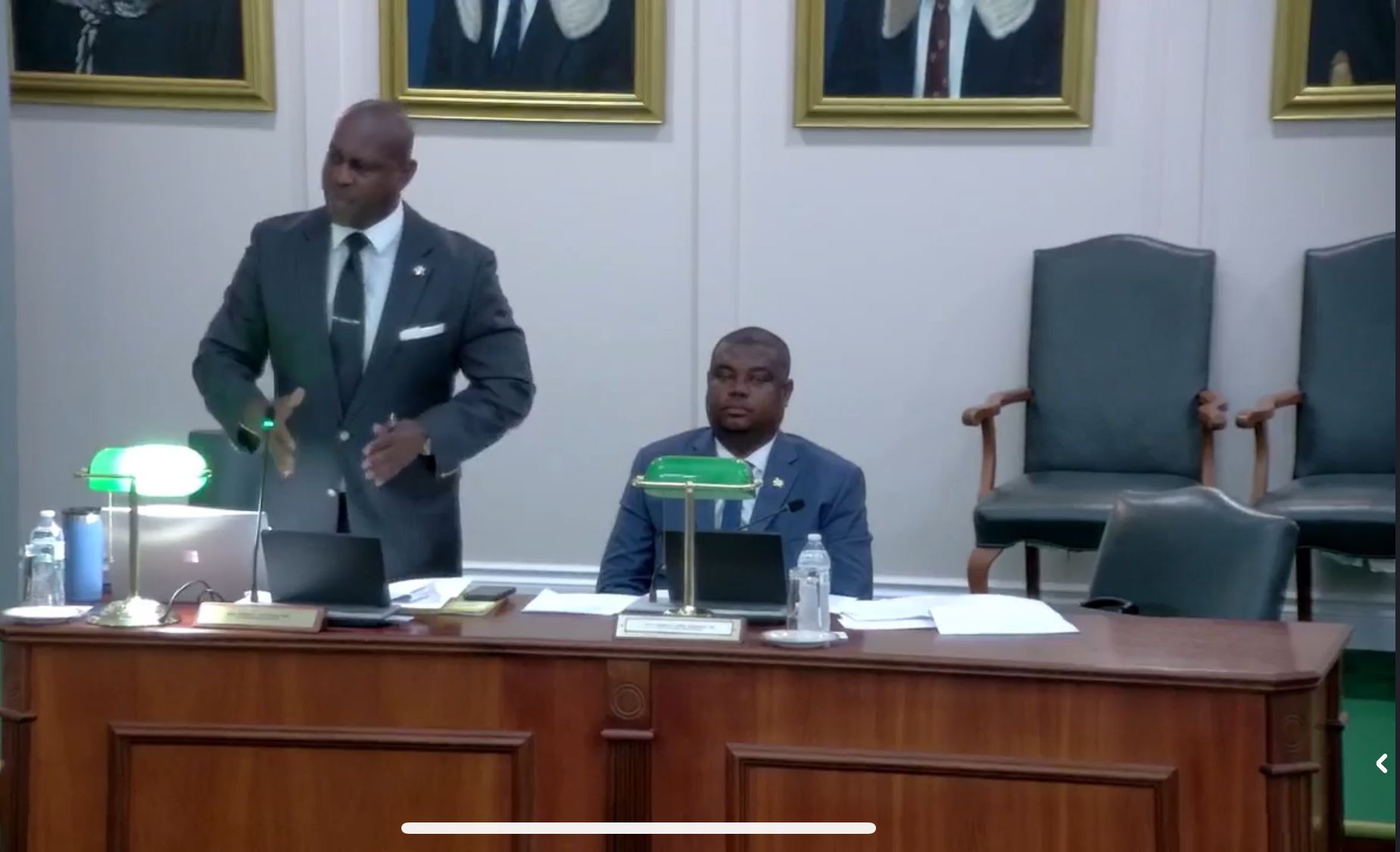
“Mr. Speaker if we feel that InterHealth Canada wasn’t doing something right by the people of the Turks and Caicos Islands, why shouldn’t we go and question what they’re doing legally,” explained Edwin Astwood, Leader of the Opposition, after being chastised for the litigation started under the PDM Administration.
“I don’t know what happened in the four years, why we lost that case. I wasn’t there for the last four, five years so maybe why did we lose the case, why didn’t we win that? It was a clear shut case that we had.”
Former Minister of Health, Shaun Malcolm had earlier expressed outrage at the question related to the payout; chiding Astwood for feigning ignorance of the matter.
Malcolm explained how the government arrived at the payout sum.
“One of his questions, in relation to the $17.1million claim against government; he asked a question: what is this about? So, Mr. Speaker, I think its important to clarify for the public, those who are listening in the public …. The leader of the opposition was a member of that very same committee (Public Accounts Committee), Mr. Speaker and I recall having the Ministry of Health before that committee and the Ministry of Health was being questioned about the relationship of the Hospital and its contractual agreement.
Mr. Speaker, it came forward that the Ministry of Health could not answer many of our questions at that time because there was an arbitration, that we learned at that time, was in-train. And what was the reason? The TCIG was in a dispute with the InterHealth Canada.
Mr. Speaker, people of the Turks and Caicos Islands, because under the former minister of health, which was on the committee, that happened to be the Leader of the Opposition, there was no reconciliation for a number of years, under him and because there was no reconciliation done and they couldn’t come to a resolution on how much needed to be paid, Interhealth Canada took the government to court on his watch,” said Shaun Malcolm, now the Minister of Home Affairs.
“Thank God for the prudency of this government and our actions we took in our last term, it would have been much more!
We worked diligently, we recruited experts to navigate the very complicated contract and because of the move we made, we have saved this country – this good progressive PNP government – has saved this country a colossal amount of money.”
Minister Malcolm called it the price of “bad management” of the PDM.
“The prudent action to take is to bring expertise, people in, so that we could right the institution.”
The Opposition Leader corrected a point, that it was the PDM which brought the matter to arbitration and not the other way around. He also believes the Turks and Caicos Islands Government should have won the matter, not agreed to the enormous settlement.
“What happened in the last four years and four ministers of health that brought us to this point and I do believe they need to address that,” said Astwood. In a November statement from the Government, the public got a glimpse into the protracted case, where the PNP Administration expressed similar reasons for discontent with the InterHealth Canada contract.
From the TCIG Statement: “… TCIG believes it has established areas of non-compliance that could result in TCIG being able to pursue various remedies under the contract. Whilst IHC have disputed this, the last few months have seen greater dialogue in which a settlement of outstanding issues was sought. However, IHC has been unable to provide adequate assurances to the Cabinet of future performance and we have not been able to reach a satisfactory agreement.
As a result, the Cabinet has decided to continue to enforce TCIG’s contractual rights and invoke the appropriate remedies available to TCI which would include the levy of financial deductions, the ability to require service improvement plans, the ability for TCI to step in to provide the services, and/ or the termination of the contract entirely.”
The spat over the $17.1 million settlement erupted in a March 18, 2025 meeting of the House of Assembly, where a fourth Budget Supplementary of $40.5 million was passed.










Turks and Caicos, April 06, 2026 – Technical excellence early in their jumps became the defining factor for two Turks and Caicos athletes, as David Hall soared to gold in a nail-biting Under-20 high jump final at the 53rd CARIFTA Games in Grenada. Herwens Guerrier added to the country’s success with a 1.90 metre clearance to secure silver in the Under-17 division, finishing in a tightly contested field where all three medalists cleared the same height.
Both events were decided on countback — meaning the medals were determined not just by height cleared, but by which athlete did so with fewer failed attempts, highlighting the importance of precision and composure under pressure.
A wave of national pride followed the results, with congratulatory messages pouring in for the athletes who delivered under pressure on the regional stage. In a statement, Dileeni Daniel-Selvaratnam praised both competitors, saying their “hard work, discipline and determination have made the entire nation proud,” while encouraging the wider team to continue striving as competition unfolded at the Kirani James National Stadium in Grenada.
Team Turks and Caicos finished just outside of the top ten among 28 competing nations, and anticipation is already building for what is expected to be a spirited homecoming for the standout athletes, whose performances have ignited pride across the islands.
The 53rd staging of the CARIFTA Games, held at the Kirani James National Stadium in Grenada, unfolded under warm, at times testing conditions, with intermittent showers and shifting winds challenging athletes across disciplines.
Jamaica once again asserted its dominance, capturing its 40th consecutive CARIFTA title, continuing an unmatched run in regional athletics. Among the standout performers was Shanoya Douglas, whose electrifying run in the Under-20 200 metres earned her the prestigious Austin Sealy Award — the Games’ highest individual honour — after she shattered the long-standing record of Bahamian Shaunae Miller-Uibo, who went on to become an Olympic gold medalist in the 400 metres. Douglas clocked an impressive 22.11 seconds to rewrite the CARIFTA record books.
For Turks and Caicos, however, the spotlight remained firmly on the field, where two high jumpers delivered performances defined by discipline and growth. Hall’s gold medal-winning clearance of 2.00 metres marked a significant step forward in his development, improving on his 1.89 metre silver medal performance at the 2025 Inter-High Championships. Guerrier’s 1.90 metre effort in the Under-17 division similarly places him among the country’s top emerging talents, signalling a strong future for the event locally.
Angle by Deandrea Hamilton. Built with ChatGPT (AI). Magnetic Media — CAPTURING LIFE.

NASSAU, Bahamas — What should be a simple five-minute drive is fast becoming an expensive, hour-long ordeal, as rising fuel prices collide with worsening traffic congestion across New Providence.
As of early April 2026, gasoline prices across The Bahamas have climbed sharply, with motorists now paying an estimated $5.50 to over $6.50 per gallon, depending on the station and grade. The increases, seen at major retailers including Esso, Rubis and Shell, reflect a volatile global oil market driven by escalating geopolitical tensions.
The latest spike — in some cases jumping more than 50 cents per gallon within days — is being driven by uncertainty surrounding escalating tensions involving Iran. U.S. President Donald Trump has issued a direct ultimatum, warning that the United States could launch aggressive strikes on Iranian infrastructure, including power plants and key facilities, if demands are not met. While he has also expressed hope for a swift resolution, the threat of rapid escalation is already rattling global oil markets — and The Bahamas, heavily dependent on imported fuel, is feeling the impact almost immediately.
At the pumps, the frustration is real.
Drivers are now paying significantly more just to sit in traffic. Commutes that once took minutes are stretching into hour-long crawls, burning fuel with little movement and compounding the financial strain. For many residents, the issue isn’t just the price per gallon — it’s how quickly that gallon disappears.
Industry players are also bracing for impact. Higher diesel prices are expected to ripple across key sectors, including trucking, construction, and shipping — all of which ultimately feed into the cost of goods and services. In short, this is not just a fuel story; it’s an inflation story in the making.
Despite the surge, the Bahamas Petroleum Retailers Association has moved to calm fears, confirming that there is no fuel shortage. Supply remains stable, but consumers are being urged to adjust behavior — from maintaining proper tyre pressure to considering carpooling — small measures that could stretch every dollar a bit further.
Retailers, however, are not offering much comfort on price relief. While fluctuations are expected, insiders say the days of sudden price drops are unlikely in the immediate term. The “shock” increases may level off, but a meaningful decline hinges on global stability — something that currently feels out of reach.
For Bahamians, the reality is tightening: higher fuel costs, longer commutes, and a growing sense that relief isn’t coming anytime soon.
Angle by Deandrea Hamilton. Built with ChatGPT (AI). Magnetic Media — CAPTURING LIFE.

PROVIDENCIALES, Turks and Caicos Islands — It’s that time again — a period of compliance, accountability and transparency for those entrusted with public office and captured under the category of “Specified Persons in Public Life.”
The Integrity Commission is reminding all individuals who fall within this category that they are legally required to file their Declarations of Income, Assets and Liabilities, in accordance with Section 39 of the Integrity Commission Ordinance.
The declaration window is now officially open, running from April 1 to June 30, 2026, and applies to a wide cross-section of senior public officials, statutory board members and others operating within the machinery of government.
This is not a routine administrative exercise. It is a cornerstone of good governance — designed to ensure that those in positions of power are transparent about their financial interests, and to guard against corruption, conflicts of interest and illicit enrichment.
Who Must File
The Commission outlines several categories of individuals required to submit declarations this cycle.
They include:
- Persons who last filed on or before June 30, 2024
- Individuals newly appointed to statutory boards or government positions from April 1, 2026 onward
- Those who have demitted office, resigned or whose contracts have ended — who must file within 90 days of leaving their post
- Individuals who may not have previously realized they fall under the legal requirement
The net is wide — and intentionally so.
“Specified Persons in Public Life” includes elected officials, senior civil servants, financial officers, law enforcement leadership, members of statutory bodies, and other key decision-makers whose roles carry influence over public resources and policy.
Among them are Members of the House of Assembly, Cabinet Ministers, Permanent Secretaries, Heads of Department, senior police officers, and individuals serving on public boards and commissions.
The Commission notes that the full schedule of designated roles is extensive, and persons are encouraged to consult the official list available through its office or website to confirm whether they are captured under the law.
How to File
Unlike many modern reporting systems, this process remains deliberately controlled.
All declarations must be:
- Submitted in person
- Delivered by appointment only
- Accompanied by supporting documentation
Declarants will be contacted directly with their assigned appointment details, including date, time and location. The Commission has made it clear — submissions through third parties, email or mail will not be accepted.
This approach reinforces the seriousness of the process and ensures the integrity of submissions.
Declaration forms are available via the Commission’s website, and assistance is accessible through its Providenciales office for those needing clarification.
Penalties for Non-Compliance
The warning from the Commission is unambiguous.
Failure to file a declaration without reasonable cause is a criminal offence.
Penalties include:
- Up to one year imprisonment
- A fine of up to $15,000
- Or both
Additionally, the Commission is mandated to publish the names of non-compliant individuals in the official Gazette — a move that carries both legal and reputational consequences.
Confidential but Critical
While the process is strict, the Commission emphasizes that all declarations are confidential documents, handled with discretion.
Still, the purpose is clear: transparency does not always mean public disclosure — but it does mean accountability to an independent oversight body.
In a region where public trust can be fragile, these filings serve as a quiet but powerful mechanism to reinforce confidence in governance.
For Turks and Caicos, this annual exercise is more than paperwork — it is a test of integrity at the highest levels.
And for those required to file, the message is simple: comply, disclose, and do it on time.
For more information or to confirm filing obligations, individuals are encouraged to contact the Integrity Commission directly.
Angle by Deandrea Hamilton. Built with ChatGPT (AI). Magnetic Media — CAPTURING LIFE.





-

 News3 days ago
GOLD & SILVER – Hall & Guerrier Fly High for Turks and Caicos at CARIFTA 2026
-

 Bahamas News1 week ago
Mother’s Pride Headlines Bahamian Takeover at Sixers-Heat Clash in Miami
-

 Independent writer2 days ago
The Rise of Right-Wing Populism and What It Could Mean for the Turks and Caicos Islands
-

 News4 days ago
Beaches Turks & Caicos, FIU train next generation of hospitality leaders in Providenciales
-

 News3 days ago
CALL 649-338-4008 OR 649-338-2684 IF A CHILD IS AT RISK: TCI Confronts Alarming Reality During Child Abuse Prevention Month
-

 Bahamas News3 days ago
Fuel Pain at The Pump: Global Tensions Drive Prices Up as Bahamians Feel the Squeeze
-

 Bahamas News4 days ago
FNM’S $200 CHILD SUPPORT PLAN SPARKS DEBATE AS PLP QUESTIONS FUNDING AND SCOPE
-
 News4 days ago
COMING SOON: BORROWING TO MODERNISE