
Caribbean News
2024 UK and Overseas Territories Joint Ministerial Council communiqué


December 3, 2024
Introduction
- We, the Minister for the Overseas Territories and elected Leaders and Representatives of the Overseas Territories, met as the Joint Ministerial Council (JMC) on 19 to 21 November 2024. We were delighted to be joined at our meeting by the Prime Minister and the Foreign Secretary. Ministers and representatives from across the UK Government, including the Home Office, Department for Environment, Food & Rural Affairs, UK Export Finance, Department of Health and Social Care, Department for Education, Department for Energy Security and Net Zero, and the Joint Maritime Security Centre joined. We also welcome the newly elected
 Leader of Montserrat.
 - We value the visits by the Minister for the Overseas Territories: to Gibraltar in September 2024, and to Anguilla, the British Virgin Islands, and the Turks and Caicos Islands in November 2024. Gibraltar and the Falkland Islands also welcome the visits from the Minister for the Armed Forces in August and November 2024 respectively.
- The elected Leaders of the Overseas Territories welcome the UK Government’s five principles to guide the UK’s relationship with the elected Governments of the Overseas Territories:
- devolution and democratic autonomy for the Overseas Territories, and consistency on the principles of partnership and engagement
- listening to the Overseas Territories, following the principle of “nothing about you without you”
- partnership with the Overseas Territories based on mutual respect and inclusion, applying to all UK Government departments – rights come with responsibilities, including the responsibility to uphold our common values
- good governance and ensuring proper democratic accountability and regulation
- defending the Overseas Territories’ security, autonomy and rights, including the right of self-determination
- The relationship will be guided by the principles of a modern, respectful and engaged partnership.
- We reflect on the opportunities that this new approach to the relationship presents to the UK and the Overseas Territories. We also reflect on successes of the year such as: the Overseas Territories event in the UK Pavilion at COP29, showcasing innovations and initiatives being delivered in the Territories to address climate change, and the President of UK Overseas Territories Association joining the UK delegation at the Commonwealth Heads of Government Meeting in October 2024. The partnership between the UK and the Overseas Territories helps us deliver these successes.

Partnership and principles
- The UK affirms that the Overseas Territories are vital members of our global British family. We reflect on the deep, historic and enduring partnership between the UK and the Overseas Territories. We celebrate the diversity of our communities and cultures. We are united by shared values and proud of a relationship that delivers for our peoples. We are a family working together to overcome shared challenges.
- The JMC was established as the highest political form of political dialogue and consultation between the UK and the Overseas Territories. We welcome the mission-led UK Government and dialogue on promoting cooperation in shared areas of interest and celebrating the relationship.

- We share an ambition to transform the relationship between the UK and the Overseas Territories including the function, frequency and facilitation of our meetings. We recognise: the opportunities of economic diversification; the role of human development in the relevant Territories natural environments; the threat of the climate and nature crisis and the importance of the Territories’ environments; the issues faced by Official Development Assistance recipient Territories; irregular migration and security threats; and the importance of tackling illicit finance.
- The Overseas Territories welcome that each UK Government department has an assigned minister with responsibility for their department’s relationship with the Territories. The Minister for the Overseas Territories convenes and chairs the group. We welcome the opportunity for the elected governments to contribute to the agenda and to be informed of the outcomes. We reflect on how we can work together to transform the relationship between the UK and the Overseas Territories to further strengthen the bonds between us. This fresh approach, based on closer working and mutual respect, will seek to deliver greater security and prosperity, deliver high standards of governance and transparency, and address the dual climate and nature crisis.
- We share a commitment to investing in public sector capability. We welcome the extension of access to the Leadership College for Government for permanent secretaries (or equivalents) of the Overseas Territories to build expertise and help develop senior peer relationships between the Overseas Territories and the UK.
- The principle of equal rights and self-determination of peoples, as enshrined in the UN Charter, applies to the peoples of these Overseas Territories. The UK and Overseas Territories reaffirm the importance of promoting the right of self-determination which is a collective responsibility of all parts of the UK government. We will continue to explore ways in which the Overseas Territories can maintain international support in countering hostile sovereignty claims. For those Territories with permanent populations who wish it, the UK will continue to support requests for the removal of the Territory from the United Nations list of non-self-governing Territories.
- The UK will engage closely and proactively with each Overseas Territory where the democratically elected Territory Government seeks engagement on reviewing their constitution. The UK continues to support the constitutional right of the Overseas Territories to sustainably develop their own natural resources, mindful of our international and domestic obligations.

- The UK will support closer links between the UK Overseas Territories and the Commonwealth, and we will work together to explore opportunities for the greater participation of the Territory Governments and peoples in its organisations.
Security and irregular migration
- The Overseas Territories are part of the British family and we recognise threats to the Overseas Territories are threats to the UK. We welcome the ongoing work by the UK Government through the UK Integrated Security Fund, Justice, and Border Security Programmes to help build Overseas Territories’ resilience. This includes enhancing border control capabilities across the Territories. We recognise the importance of taking a holistic approach to crime prevention and border security.
- Responsibilities for the security, safety and wellbeing of our citizens are shared across the UK Government and Overseas Territories. The Home Office and Foreign, Commonwealth and Development Office will continue to work in partnership to identify and address the key security challenges in the Overseas Territories from the ground up, drawing on specific areas of competence and expertise across the UK Government and the Overseas Territories. We note the Ministry of Defence plays a critical role in defending the OTs, including through its forward military presence, and providing support through capacity building and consideration of requests for assistance.
- The Council understands that the challenges facing each Overseas Territory are complex and varied. We commit to strengthening the co-operation between local government services such as police and social services in the Overseas Territories to tackle challenges using a multi-agency approach.
- The UK remains committed to supporting the Territories to enhance their security and law enforcement, including through preventative measures and strategies to respond to security threats. This includes strengthening maritime capabilities in the
 Territories and the need for investment.
 - The UK remains fully committed to defending the sovereignty of each of its Overseas Territories against external threats, including working together on hybrid and cyber threats.
- We recognise the impact of irregular-migration challenges on the communities of the Overseas Territories, facing multiple security threats, which, in some cases, include drug trafficking, human trafficking and gang violence. The UK commits to work in partnership with the Overseas Territories to support the capability and capacity required for impacted Territories to tackle the complex irregular migration challenges, and seek to ensure the stability of the Overseas Territories.

- The UK and the Overseas Territories’ Governments expressed their solidarity with the Government and people of the Turks and Caicos Islands in respect of the security challenges they currently face and will commit to working together across the British family to urgently assist where possible.
Environment and climate change
- We welcome the Foreign Secretary’s commitment that action on the climate and nature crisis will be central to the Foreign, Commonwealth and Development Office’s work, which builds on the Prime Minister’s commitment that climate and nature will be at the centre of the cross-UK Government missions. We recognise the Overseas Territories’ stewardship for internationally important and unique environments and ecosystems. As part of our global British family, the Overseas Territories are responsible for protecting 94% of unique British biodiversity. Together, the UK and the Overseas Territories oversee one fifth of our globe’s marine estate, stretching across the seven major oceans. It is these precious marine and terrestrial environments that the Overseas Territories and their communities are dependent upon for their livelihoods. The UK Government continues to work in partnership with the Overseas Territories to support the protection of their environments and help address biodiversity loss.
- We acknowledge that the Overseas Territories are on the frontline of the climate crisis and are vulnerable to its impacts such as from extended hurricane seasons in the Caribbean and water security issues in the Atlantic. We recognise the unique contribution the Overseas Territories make to the UK’s ambitions on climate. We acknowledge concerns regarding Territories’ access to climate funding and will continue dialogue on climate-change support for adaption, mitigation and to build climate resilience. We acknowledge the need for the Overseas Territories to have access to the right resources to effectively respond to climate change and enhance climate resilience. We recognise the Integrated Security Fund’s Climate Security Programme work to identify issues impacting climate security, risks, resilience and stability in the Overseas Territories, and to realise key climate priorities and how they might be addressed.
- We welcome the UK Government’s commitment to expand the Blue Belt Programme to enhance marine protection and sustainable management of their marine environments. We note that the Cayman Islands have most recently joined Blue Belt in September 2023. Whilst future funding for Darwin Plus remains subject to business planning and spending review processes, we note strong support from the Overseas Territories for its continuation. We welcome the Department for Environment, Food and Rural Affairs (Defra) resuming work on development of the new Overseas Territories Biodiversity Strategy and we will strive for its publication in early 2025, working in partnership to implement our collective goals and local priorities thereafter.
- We affirm the importance of the Overseas Territories’ participation in international fora alongside the UK to promote our collective interests. We welcome the Overseas Territories’ attendance at the United Nations Climate Change Conference (COP29) and the sixteenth meeting of the Convention on Biological Diversity (COP16) as part of the UK delegations.
- We affirm the UK Government’s commitment to restoring the UK’s global leadership on climate at the World Leaders Summit at COP29 on 12 November, where the Prime Minister announced the UK’s ambitious and credible NDC target to reduce all greenhouse gas emissions by at least 81% by 2035, compared to 1990 levels, excluding international aviation and shipping emissions. To date, the UK has extended its ratification of the Paris Agreement to the Overseas Territory of Gibraltar (2022). We note Cayman Island’s
 interest in requesting an extension of the Paris Agreement and are working together on this. The UK is committed to working with all eligible Overseas Territories who request an extension. While recognising the efforts of all Overseas Territories in reducing emissions, the UK Government will continue to support Overseas Territories with appropriate technical input.

Economic Diversification and Resilience
- Economic growth is key to building prosperity and wellbeing for the peoples of the UK and Overseas Territories. While the Overseas Territories are particularly vulnerable to external shocks and natural disasters, there remain opportunities to build resilience through diversification. We are working together to identify common solutions and share expertise to ensure that the benefits of economic growth are felt by all.
- We acknowledge the challenges posed by rising global inflation, particularly for the most vulnerable in our societies. Interested Territories will explore UK Export Finance’s offer to provide targeted support to increase trade and investment between Territories and the UK. We resolve to promote and encourage trade and investment in partnership, as both are key engines of prosperity. The UK will continue to work with the Overseas Territories to explore opportunities for diversification of economies and building economic resilience. We note the Territories’ interest in replacing those funding streams which were previously accessible as part of the EU.
Tackling Illicit Finance and Sanctions
- We welcome the launch of the Foreign Secretary’s campaign to prevent the use of the international financial system for illicit finance and kleptocracy; and we commit to working together as partners to continue to tackle and curtail attempts to use the international financial system for illicit finance and kleptocracy. We uphold and continue to strive to meet the highest international financial standards, including those set by the Financial Action Task Force and the Organisation for Economic Co-operation and Development.
- The Overseas Territories and the UK will continue to cooperate, including through technical forums on anti-money laundering, sanctions enforcement, counter-terrorist financing and foreign bribery.
- We commit to improving our corporate transparency by completing plans to implement Accessible Registers of Beneficial Ownership, with some Territories implementing registers with legitimate interest access and others implementing fully publicly accessible registers. We note the UK Government’s ambition that Publicly Accessible Registers of Beneficial Ownership (PARBOs) become a global norm and its expectation that Overseas Territories and Crown Dependencies implement full PARBOs.
- We note the full PARBOs already in place in Montserrat and Gibraltar, and the commitments to implementing these by the Falkland Islands and Saint Helena by April 2025.
- We note commitments by Anguilla, Bermuda, the British Virgin Islands, the Cayman Islands and the Turks and Caicos Islands to implement Legitimate Interest Access Registers of Beneficial Ownership with the maximum possible degree of access and transparency, whilst containing the necessary safeguards to protect the right to privacy in line with respective constitutions. Where not already in place, Anguilla, Bermuda, the British Virgin Islands, the Cayman Islands and the Turks and Caicos Islands will have legislation on registers of beneficial ownership approved through their respective legislatures by April 2025, with implementation by June 2025 or earlier.
- We reflect on the Overseas Territories and the UK’s partnership to tackle illicit finance over 2024. In March, we held a Ministerial Illicit Finance Dialogue and in October we convened in Miami a Senior Officials level dialogue, which enabled a deep level of knowledge sharing to take place between technical experts. We will continue to deepen this partnership with further Ministerial level dialogues and technical forums in 2025 and beyond.
- The UK and the Overseas Territories confirm their commitment to effective implementation and robust enforcement of UK sanctions; to urgently building additional sanctions enforcement capability and addressing the sanctions vulnerabilities across the Overseas Territories; and to improving sanctions cooperation between the UK and the Overseas Territories. We recognise the concerted efforts to implement the Russia and other sanctions regimes by the Overseas Territories. The Cayman Islands’ ‘Operation Hektor’ approach is an example of an effective OT initiative. The Overseas Territories have frozen accounts and assets worth over £7 billion GBP ($9 billion USD).
Official development assistance recipient Territories
- The UK remains committed to meeting the reasonable needs of Territories where financial self-sufficiency is not possible, as the Overseas Territories continue to have the first call on the aid budget to facilitate sustainable economic growth and development. The UK and Overseas Territories will work in partnership to develop and deliver long term sustainable programmes in the Territories, with a renewed focus on the priorities and needs of Territory peoples.
- The UK is committed to supporting Official Development Assistance-recipient Territories as they graduate from eligibility, ensuring the UK meets its responsibilities while Territories transition to economic independence recognising their unique vulnerabilities. The UK will seek to ensure that funds allocated to regional organisations do not exclude those Overseas Territories that are members of these organisations. We welcome the commitment from the UK Government to develop critical national infrastructure in the aided Overseas Territories.
Human development
- We note the integrated approach to human development which brings together education, healthcare and public health to break down barriers to opportunity, as evidenced by work led by the UK Health Security Agency in Anguilla to prevent violence. We recognise the crucial role for coordinated health and education support, particularly in the first 1,000 days of life. We will continue to co-operate and share experience on education and health including early years and elder care. We welcome commitment to discuss shared procurement and supply chain opportunities for pharmaceutical and vaccines.
- We note the Overseas Territories’ interest in exploring increased access to healthcare, including mental health services, and the Global Health Insurance Card. The Territories welcome the offer of discussions with the UK Government on the specific needs and requirements of individual Territories to assess what support is available.
- The Territories also note the UK’s continued commitment to pandemic preparedness throughout the UK family.
- The Council affirms the importance of education and skills, particularly as a contribution to adaptation and resilience to climate change. We welcome the UK Government’s offer of advice and support in this area. We also note the international Declaration on a Common Agenda for Education and Climate Change made at COP28 and undertake to consider endorsing the Declaration.
- The Overseas Territories welcome the UK Government’s commitment to resolving delays with the issuance of visas for students with British Overseas Territories Citizenship to study in the UK.
- We note that students from the Overseas Territories do not currently have access to maintenance loans but recognise that this is a devolved responsibility within the UK as well as in the Overseas Territories. We will continue discussions on this topic.
- We acknowledge a concern raised by some Overseas Territories on the inconsistencies with the uprating of State Pensions for residents who worked in the UK and then return to their Territory on retirement. The UK will assess the implications of change and update the Territories at the earliest opportunity.
Closing remarks
- The UK Government and the Overseas Territories welcome the opportunity to come together as a Joint Ministerial Council. We reiterate our joint commitment to deepening our unique and modern partnership.

By Deandrea Hamilton | Editor
September 28, 2026 – Wall Street initially flinched at the $3-billion handshake. But in a matter of days, it was smoother sailing.
Perhaps the bigger Caribbean business story is not what Sandals Resorts International is getting from the deal. It is who is writing the cheque — and what that says about what Gordon “Butch” Stewart built.
As reports of Royal Caribbean Group’s Sandals deal circulated Tuesday, RCL shares plunged 6.14 percent from Monday’s $250.25 close to $234.89, on sharply elevated trading.
When the agreement became official Wednesday — approximately $3 billion for a 50 percent equity interest in Sandals and Beaches Resorts — shares slipped another 1.95 percent to $230.30 and touched $222.22 intraday. Investors were digesting both the size of the investment and committed debt financing secured through Morgan Stanley.
But by Thursday, RCL rebounded 3.77 percent, with shares continuing their recovery Friday to finish the week around $243. Analysts were also looking ahead: JPMorgan reportedly raised its RCL price target from $345 to $394, while Citi placed the company on a 90-day positive catalyst watch.
And just who is RCL?
Royal Caribbean Group is a global vacation giant, publicly traded on the New York Stock Exchange with a market value of roughly $65 billion. Its portfolio includes Royal Caribbean International, Celebrity Cruises and Silversea, alongside private destinations and an expanding vacation platform.
So when a company of that scale commits $3 billion for only half of Sandals and Beaches Resorts, the transaction puts a striking financial marker on one of the Caribbean’s greatest home-grown hospitality success stories.
The deal, expected to close in early 2027, creates a 50-50 partnership with the Stewart family and takes Royal Caribbean deeper into the all-inclusive resort business.
Butch Stewart started Sandals in Jamaica in 1981 believing a Caribbean company could compete with the world’s best.
Forty-five years later, one of the world’s biggest vacation companies is prepared to pay $3 billion just to own half of what he built.
Now that’s the handshake that does more than seal a deal — it cements a legacy.
Caribbean News
Royal Caribbean Group and Sandals Resorts Announce Landmark Partnership to Accelerate Their Leading Vacation Experiences
Royal Caribbean Group Investment to Advance Sandals and Beaches’ Growth and Broaden the Group’s Vacation Portfolio
Montego Bay, Jamaica and Miami, September 24, 2026 – Royal Caribbean Group (NYSE: RCL) and Sandals Resorts today announced the signing of an agreement to form a partnership in the all-inclusive resort space with a 50% investment from Royal Caribbean Group. Building on Sandals and Beaches Resorts’ more than four decades of leadership in Caribbean hospitality, the joint venture will create new opportunities for continued resort growth while broadening the experiences across Royal Caribbean Group’s vacation platform.
The partnership brings together two of the travel industry’s most celebrated vacation companies, pairing Sandals and Beaches’ all-inclusive resort expertise with Royal Caribbean Group’s vacation platform, including industry-leading brands – Royal Caribbean, Celebrity Cruises and Silversea – a portfolio of private destinations, new river cruising offering, and an industry-first loyalty program. United in a shared history in the Caribbean and connected by a love for their communities, the companies will offer travelers an unparalleled collection of cruise, private destination and resort experiences, serving guests across more vacation occasions and establishing their undisputed leadership in Caribbean vacations.
The joint venture expands Royal Caribbean Group into an adjacent vacation category, growing its participation in the approximately $2 trillion global vacation market, and meets the growing global demand for Sandals and Beaches Resorts by accelerating their expansion. The partnership will include Sandals and Beaches’ collection of premier all-inclusive properties across the Caribbean, and the companies will explore opportunities to broaden distribution, deepen guest engagement, and make it easier for travelers to discover vacation experiences offered across both portfolios.
“For nearly 60 years, we’ve reimagined what a vacation can be, constantly expanding the ways we inspire our guests to explore, connect and create lifelong memories,” said Jason Liberty, Chairman and CEO, Royal Caribbean Group. “We have been building a vacation platform that brings joy to millions of people around the world and creates meaningful relationships that last with our guests. Our partnership with Sandals and Beaches Resorts is an important next step on that journey – bringing together two iconic leading vacation companies to further strengthen and grow one of the most admired resort portfolios in the world. The Stewart family has created powerful and beloved brands, and we are honored to build on that legacy. Together, we see tremendous opportunity to expand the reach of Sandals and Beaches Resorts and continue turning the vacation of a lifetime into a lifetime of vacations.”
“My father, Gordon ‘Butch’ Stewart, founded Sandals Resorts with the belief that a company built in the Caribbean could stand on the world stage alongside the most respected names in hospitality. Today is proof of how far that vision can go,” said Adam Stewart, Executive Chairman of Sandals Resorts and Beaches Resorts. “This partnership is the natural next step in building on that conviction. It gives us the ability to grow faster with a partner that shares our values of exceptional hospitality, long-term investment, and the power of enduring brands. Together, we will introduce more guests to Sandals and Beaches Resorts while creating even more extraordinary experiences for those who have made our resorts part of their lives for decades.” Stewart added, “As we continue to grow, we will remain true to what has always defined us: delivering authentic vacations that exceed expectations while creating opportunities for our team members, travel advisor partners and the communities we call home. The future has never been brighter, and I know this moment would make my father incredibly proud.”
The joint venture will be governed by a board under the shared leadership of Stewart and Liberty. Stewart will maintain a leadership role in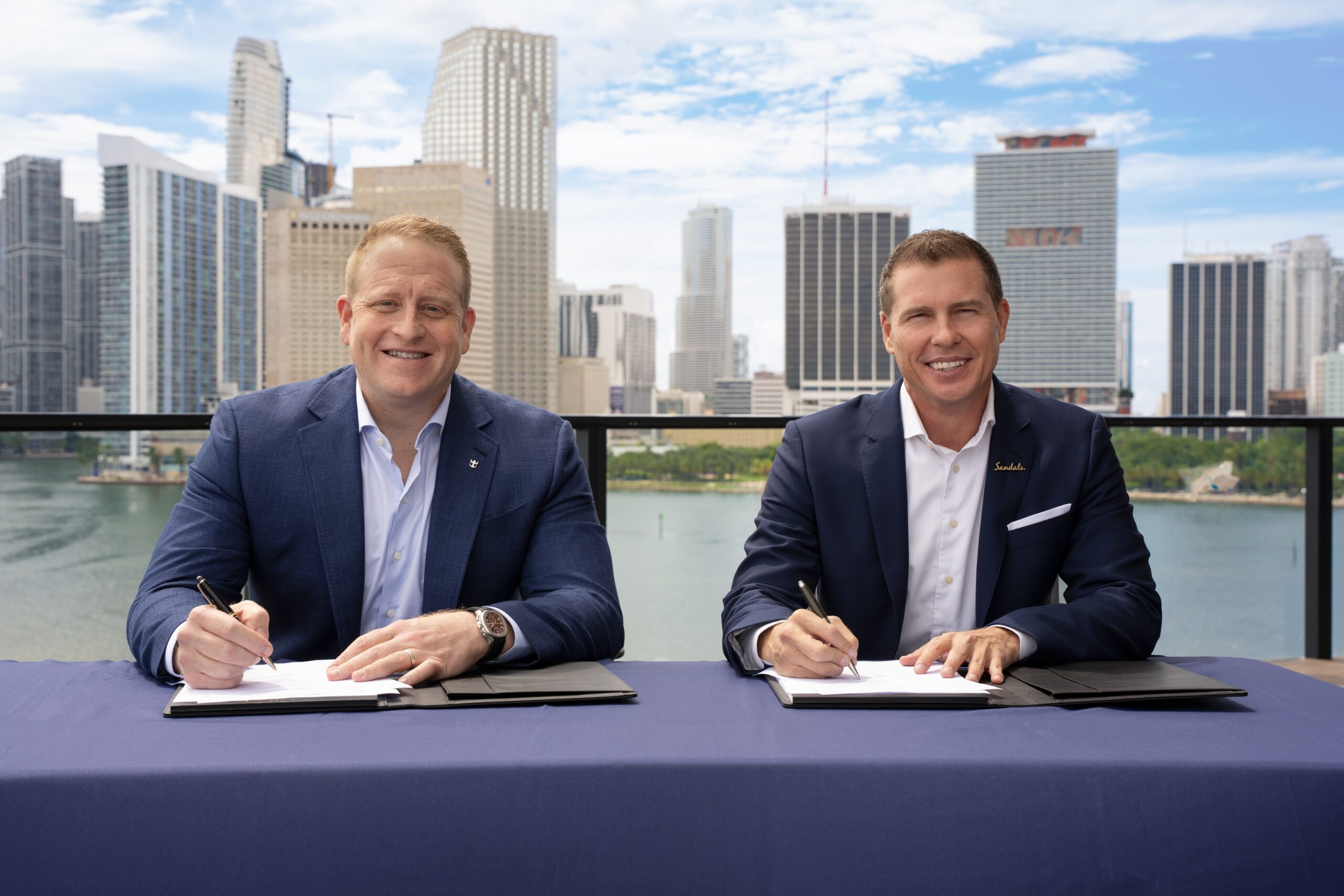 guiding the company’s long-term strategic growth as Executive Chairman of Sandals and Beaches Resorts. Existing reservations, loyalty programs, resort operations and cruise operations will continue as usual, with the partnership bringing additional resources to support future opportunities.
Under the terms of the agreement, Royal Caribbean Group will acquire a 50% equity interest in Sandals and Beaches Resorts for approximately $3 billion, representing a forward EBITDA multiple of approximately 10x. Royal Caribbean Group has secured committed debt financing from Morgan Stanley to fund the investment. The transaction is expected to close in early 2027, subject to customary approvals and closing conditions, and is expected to be accretive to earnings next year.
BofA Securities and PJT Partners acted as financial advisors, and Latham & Watkins and Jones Day acted as legal advisors to the Sandals Group. Perella Weinberg Partners and Morgan Stanley acted as financial advisors and Kirkland & Ellis LLP acted as legal advisor to Royal Caribbean Group.
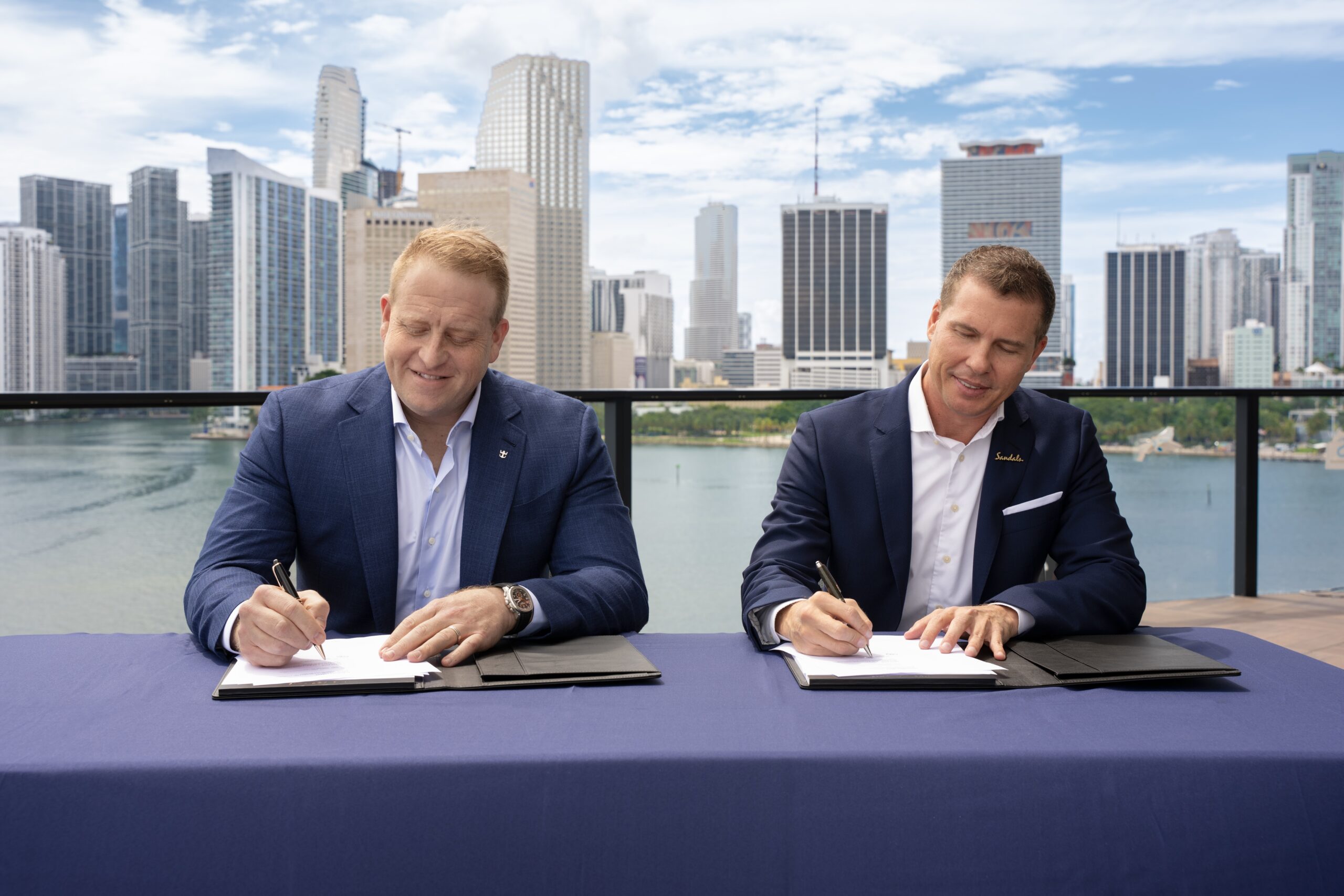
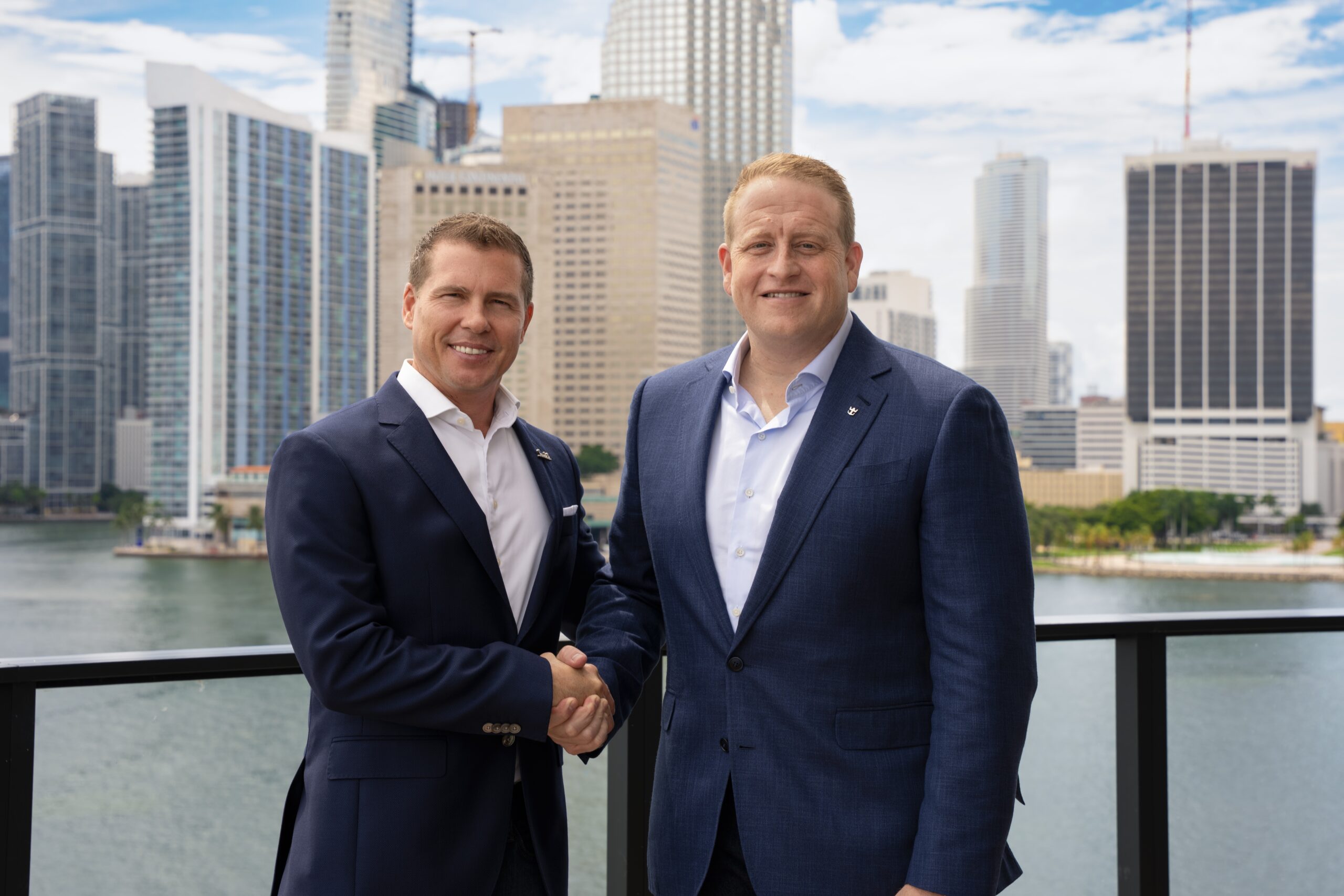
PHOTO CAPTION: Jason Liberty, Chairman and CEO of Royal Caribbean Group, and Adam Stewart, Executive Chairman of Sandals Resorts, mark the signing of an agreement to form a landmark partnership that expands Royal Caribbean Group into the all-inclusive resort space and supports the future growth of Sandals and Beaches Resorts. The signing took place at Royal Caribbean Group’s new headquarters in Miami, with the city’s skyline in the background.
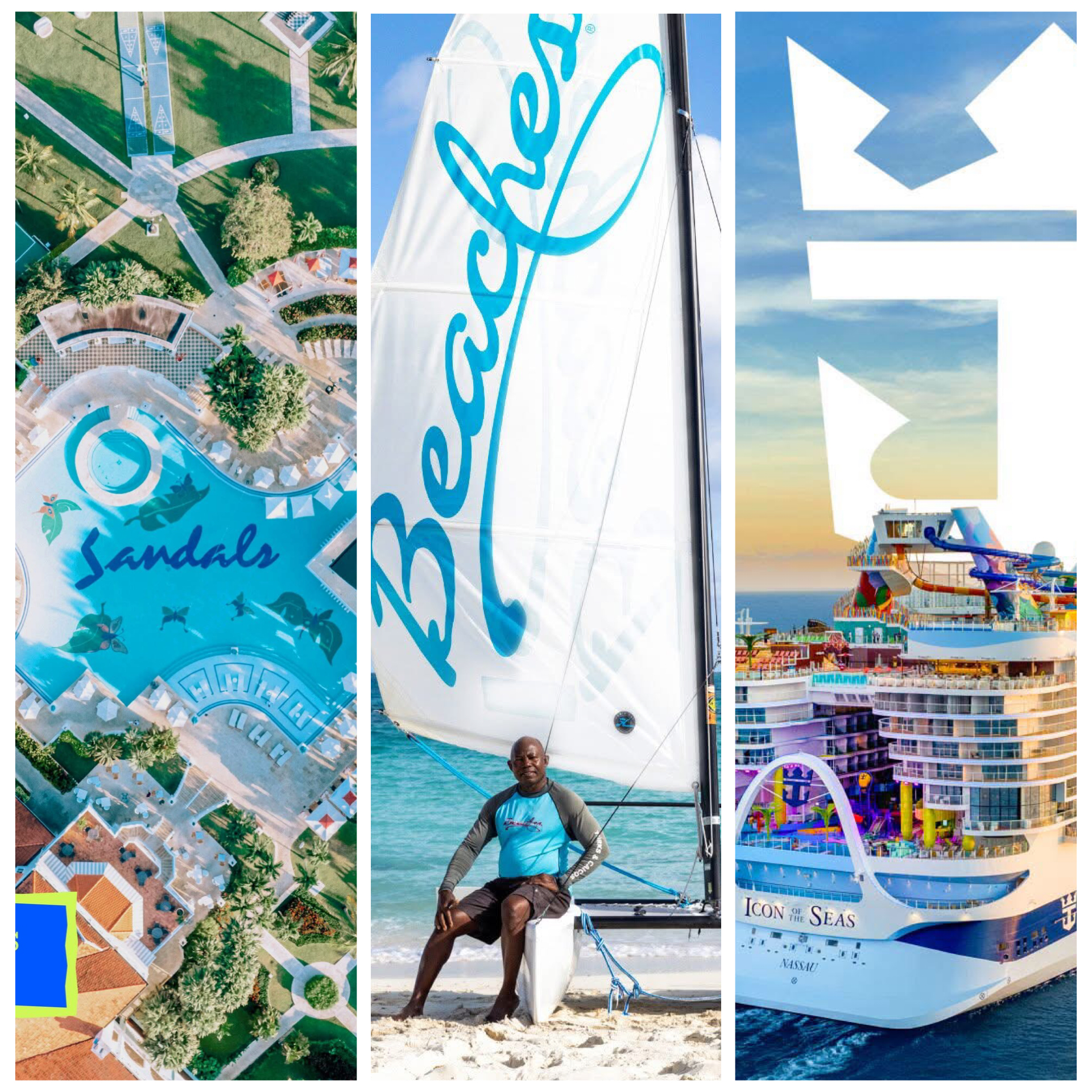
The Caribbean tourism deal first reported as a possibility on Tuesday is now a signed agreement. Royal Caribbean Group plans to pay approximately US$3 billion for a 50% stake in Sandals and Beaches Resorts, putting the value of the business at about US$6 billion. The purchase is expected to close in early 2027, subject to approvals.
Founded in Jamaica by the late Gordon “Butch” Stewart in 1981, the resort business has a presence across nine Caribbean destinations, including Jamaica, The Bahamas and Turks and Caicos. Sandals has described its workforce as nearly 20,000 people, most of them Caribbean nationals.
“My father, Gordon ‘Butch’ Stewart, founded Sandals Resorts with the belief that a company built in the Caribbean could stand on the world stage alongside the most respected names in hospitality,” said Adam Stewart in the announcement carried by PR Newswire. He will remain executive chairman, while the Stewart family retains a stake. The companies say existing reservations and resort operations will continue as usual.





-
 Independent writer1 week ago
Born Here, Raised Here, but Still Unable to Vote: Is this a Conundrum for TCI Electorate?
-
 Bahamas News4 days ago
Rosewood Exuma: A precedent-setting case for environmental law and future development in The Bahamas
-

 Bahamas News1 week ago
Monument Supports Hands for Hunger With Paradise Plates Debut
-
 News3 days ago
Invest TCI Strengthens Regional Investment Connections at Caribbean Investment Forum 2026 in Barbados
-

 Bahamas News1 week ago
Schweppes ‘the Art of Mixology’ Dazzles at Paradise Plates with Nemiroff Vodka
-
 Bahamas News3 days ago
Energy Minister Delivers Electrifying Keynote Opening Address at CAREC 2026
-

 News22 hours ago
Crown Land Unit Leads Multi-Agency Enforcement Exercise in Five Cays