
TCI News
Bariatric patients get spotlight in TCI House of Assembly; cry continues for severe obesity surgery


#Grand Turk, Turks and Caicos – October 18, 2020 — Individuals who struggle with being overweight in the Turks and Caicos got the kind of vocal support in the House of Assembly, which makes those in our bariatric community feel a lot lighter.
It is reported that there have to be policy changes in order for bariatric patients to have their severe obesity re-considered.
It is not cosmetic. It is a serious medical condition which could be the difference between life and death.

“It is nothing that is cosmetic. It is something that is life threatening and it is would appear as if their voices are not being heard loud enough. Those persons live lives in a way that they don’t know if they are going to go to sleep tonight and wake up tomorrow, that’s how bad it is,” said Hon Dwayne Taylor, Speaker of the TCI House of Assembly.
It was agreement with a presentation by the member for Grand Turk North, Hon George Lightbourne who is calling for efforts to amend the laws to be accelerated.
“I’ve gotten reports from persons who are concerned. Persons who find themselves in need of – I believe the correct term would be: bariatric surgery – life threatening surgery and I’ve been asked to address it. The relevant minister, I’m not sure how far you’ve gotten in terms of amending policies and doing whatever you have to do but it’s a real issue,” said Lightbourne during House of Assembly on October 13.
In a Letter to the Editor in June 2020, it was said: “Some of us have been told over two years ago that they are amending the policy to include this procedure under the NHIP Scheme, and to date, nothing yet. Some of us have been given month to month promises for the last three years that hopefully we would be out of here in a few weeks’ time to a month to undergo surgery, and to date, nothing yet.”

The TCI Bariatric Group is a community now; in solidarity as they advocate to be acknowledged and approved for the life-saving procedure. In the June letter to Magnetic Media, the Group talked about steps taken and disappointments experienced.
“For those of you who do not understand the term Bariatric, it is simply means the medical treatment of obesity which is being seriously overweight and a number of us have been deemed medically morbidly obese,” it was added, “We were told that if we got referrals from the doctors, that our issues would be place before the cabinet and that it should not be a problem for us to be given the bariatric procedure which is so badly needed to save all of our lives, so we all went and got numerous of referrals, some exceeding as much as five. We followed the necessary procedures, only to be told that are referrals were refused because the NHIP Policy does not cover this procedure and that it is deemed a cosmetic procedure.”
The Governor, the Premier and the Minister of Health are reportedly aware of the vexing battle of the Bariatric Group.
Lightbourne expressed, it is time for the mischaracterization of the condition to cease.
“Cosmetic, Mr. Speaker is something that you do for fashion and you do because you want to look better. When the issue is pertaining to something that is life threatening, we ought to take it serious and we ought to act with haste.”
The surgery, according to the Bariatric Group costs around $10,500. The members are all National Health Insurance Plan (NHIP) contributors and question the lackluster pace to make the adaptations which would all the NHIP to cover the costs of the surgery.

“We need help, we need this government to live up to the promise made to us. We were told that monies have already been budgeted for these procedures from last year budget and as of today nothing.
Persons on the outside would look and say, oh go and exercise you all too lazy, or stop eating, you all too greedy and frankly that is not the case. Many of us cannot exercise because of our knees, our backs or something else, and really food is not an issue. It is simply a metabolism issue, a genetic issue or some other kind of medical issue.
Every country we have contacted is offering this surgery free of cost to locals once persons meet the medical requirements, what is wrong with our Country?”
Hon Lightbourne offered this in conclusion: “I think that our number one interest should be to do whatever it takes to make life better, Mr. Speaker.










News
Statistics Authority Highlights Trade Data as Turks & Caicos Records $227M in Imports for Q4 2025


Turks and Caicos, March 18, 2026 – The Turks and Caicos Islands Statistics Authority is highlighting the importance of reliable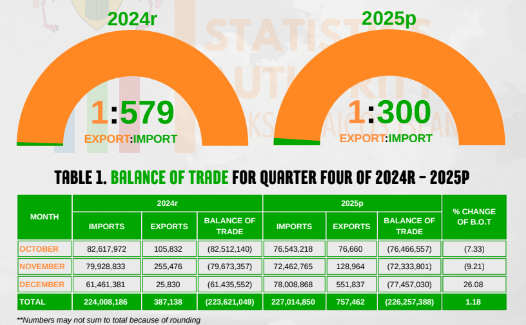 economic data following the release of its latest Trade Statistics Bulletin, which shows the country recorded approximately $227 million in imports during the fourth quarter of 2025.
The detailed report provides a clear breakdown of where goods entering the Turks and Caicos Islands are coming from, the types of products being imported, and the revenue generated from trade-related activity. The figures offer valuable insight into the level of economic activity across the country and the continued demand driven by tourism, construction, and consumer spending.
According to the bulletin, the United States remained by far the largest supplier of goods, accounting for more than $200 million in imports during the quarter. This represents the majority of all goods entering the Turks and Caicos Islands and reflects the territory’s long-standing dependence on U.S. markets for food, fuel, machinery, building materials, and consumer products.
The Dominican Republic was the second largest source of imports, supplying just over $4.1 million in goods, while The Bahamas ranked third, with approximately $1.8 million in imports recorded for the period. The report also noted increasing trade with countries such as China, Panama, Switzerland, Poland, and India, showing that businesses continue to expand their supply networks beyond traditional partners.
In terms of the types of goods being imported, the bulletin shows strong activity in categories such as food and live animals, mineral fuels, manufactured goods, machinery and transport equipment, and chemicals, all of which are essential to supporting the tourism industry, infrastructure development, and everyday life in the islands.
The report also tracks revenue collected from international trade, including fuel tax, customs processing fees, and motor vehicle licensing, providing another measure of economic performance during the quarter.
Officials say the quarterly Trade Statistics Bulletin is an important tool for government, businesses, and the public, offering accurate information presented through clear tables, charts, and graphics that make complex data easier to understand.
For a small, import-dependent economy like the Turks and Caicos Islands, access to reliable statistics remains critical. By continuing to publish detailed trade reports, the Statistics Authority helps ensure that decisions about growth, investment, and development are based on sound information.

News
Department of Tourism Regulations Achieves 90% Compliance in Accommodation Enforcement Initiative

Providenciales, Turks and Caicos Islands – Wednesday, 18 March 2026: With enforcement initiatives ongoing for 2026, the Department of Tourism Regulations is proud to report that 90% of tourism accommodation properties were registered in 2025. Using data from AirDNA, approximately 1,300 properties were identified across Turks and Caicos, with over 1,200 now accounted for in the Department’s licensing system.
The initiative was led by Quality Assurance Officer Donessia Skippings and Regulations Specialist Sasha Arthur, who coordinated the preparation and distribution of enforcement letters nationwide and managed the inspection schedule for Accommodation Controllers Kevin Lightbourne, Claudenise Jean, and Patral Handfield. The team carried out the enforcement drive while maintaining their regular responsibilities for licensing tourism accommodation properties.
The Department first notified the public of the Enforcement Letter Initiative in July 2025, as part of its mandate to uphold tourism standards and enforce a zero-tolerance approach to non-compliance with the Tourism Regulations Ordinance 2023. The initiative has resulted in a significant increase in registered properties, rising from 50% compliance the previous year to 90% in 2025.
Tourism Accommodation Inspectors and Controllers are trained to assess factors that enhance the guest experience in line with international tourism quality standards. The inspection process ensures that properties meet key safety and service criteria, helping to prevent situations where a visitor’s experience could be compromised due to missing or inadequate amenities. For example, proper pool safety signage helps reduce the risk of guest injuries. Compliance also contributes to the broader development of Turks and Caicos, as fees collected support infrastructure development and the maintenance of government assets.
By partnering with the Department of Tourism Regulations, property owners help strengthen the tourism product and reinforce the reputation of Turks and Caicos as a trusted destination, giving stakeholders confidence when welcoming visitors and assuring them that their properties meet the standards approved by the Turks and Caicos Islands Government.
Director Avi Adams, commenting on the success of the initiative, stated: “I commend the responsiveness of those who have received letters and taken the necessary steps to become licensed. Your cooperation is vital in safeguarding our tourism industry and preserving it for future generations. Enforcement continues in 2026; we encourage property owners and managers to renew their licenses promptly to avoid fines or legal action. We look forward to seeing even stronger compliance numbers in the year ahead.”
“Achieving 90% compliance in accommodation registration is a significant milestone for the Turks and Caicos Islands and is a clear indication that our enforcement efforts are working and that accountability is strengthening across the sector. We will continue to take a firm but fair approach to enforcement, as maintaining standards is essential to protecting the integrity and global reputation of the Turks and Caicos tourism industry.”

Turks and Caicos, March 18, 2026 – A recent call for applications for Ad Hoc Judges by the Judicial Service Commission of the Eastern Caribbean Supreme Court comes as the Turks and Caicos Islands Supreme Court prepares to hear a busy slate of criminal, civil and constitutional matters, according to the latest court list published for the week of March 16–20, 2026.
The vacancy notice, published March 4, invites suitably qualified attorneys to apply to be placed on a roster of Ad Hoc Judges who may be appointed to perform the duties of a Supreme Court Judge for specific cases or limited periods. The appointments are made under section 77(5) of the Turks and Caicos Islands Constitution, which allows for temporary judicial appointments when required.
While the notice does not state the reason for the recruitment, the current court schedule reflects a demanding caseload, including a multi-day criminal trial, several sentencing hearings, and a constitutional motion involving the Attorney General.
Among the matters listed for hearing this week is a trial involving three defendants, John Smith, Kenneth Abrams and Robert Koenig, scheduled to run over several days before Justice Selochan. Multi-day trials are typically reserved for complex matters involving multiple charges or extensive evidence.
The court list also includes a constitutional motion filed by Turks and Caicos Realty Limited and others against the Attorney General. The case is scheduled for a status hearing later in the week. Constitutional motions are generally used to challenge the legality of government actions or laws, although details of the claim were not disclosed in the court listing.
Additional matters before the court include several criminal sentencing hearings, civil proceedings, and the admission of a new attorney to practice before the Supreme Court.
Ad Hoc Judges are appointed when necessary to ensure the efficient functioning of the court, particularly in cases where additional judicial capacity is required, or where a judge must be recused due to a conflict of interest.
The weekly court list is subject to change, but the current schedule suggests an active period for the Supreme Court as a range of significant matters move forward.
Angle by Deandrea Hamilton. Built with ChatGPT (AI). Magnetic Media — CAPTURING LIFE.





-

 Bahamas News1 week ago
Economic and Financial Experts Assess US-China Relations; Offer Advice for The Bahamas
-

 Bahamas News1 week ago
Experts Analyze Economic Landscape; Opportunities and Challenges
-

 News1 week ago
Beaches Resorts Announces Grand Opening of Treasure Beach Village at Beaches Turks and Caicos
-

 Caribbean News1 week ago
Widow’s Testimony Recounts Night Haiti President Was Killed
-

 Government4 days ago
$6M Digital Transformation Drive to expand E-Government, National ID and Biometric Borders
-

 News1 week ago
North and Middle Caicos Students receive educational material from Sandals Foundation and Beaches Turks and Caicos resort
-

 Uncategorized3 days ago
WHERE ARE THE LOCAL ARTISTS?
-

 Health2 days ago
Gut Health Linked to Lower Colorectal Cancer Risk According to Cleveland Clinic Dietitian