TCI News
TCI Governor Statement on launch of Natl Security Strategy
Published
7 years agoon
#TurksandCaicosIslands – January 22, 2020 — “TCI now, for the first time, has a National Security Strategy. The need for TCI to have this was driven by the Premier and it became one of my first priorities, on arrival, to help her deliver it.
It sat very well with my own initial priorities, outlined in my inauguration speech, around crime, illegal immigration and hurricane preparedness.
The most important line in the strategy we launch today is the last sentence of the introduction “In terms of the leadership needed to tackle National Security challenges the Premier’s and the Governor’s Office stand together”.
When it comes to the specifics of crime and policing, because national security is much more than crime, we also bring the Commissioner into this top team.
In these three roles we combine all the powers we need: funding through taxing and spending; democratic accountability; decisions around operational deployment; executive and emergency powers if needed; and the ability to reach beyond our own borders. If we were pulling against each other, or even working in parallel rather than together, none of us could deliver in the way the country rightly demands. But that’s explicitly not the case.
All that I’m about to say would not have been possible without the Strategy we launch today – and the thinking that went onto it. The institutions that flow from it, help consolidate this ‘top team relationship’ so it’s not personality dependent, but the way Government functions in the future to look after the safety and security of its people.
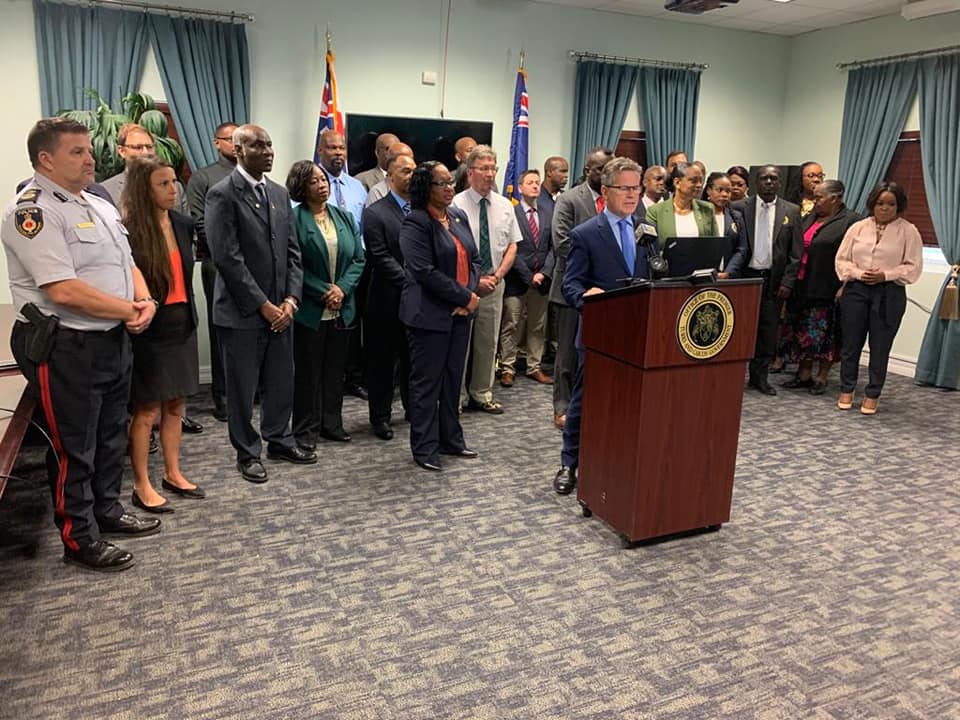
With one team at the top, we intend to create a ‘one government team’ around us to deal with these issues. The team you see with us today are among the top thirty officials in TCI Government and Policing that will execute the strategy. We are also grateful to be joined – as not disinterested observers – by the Commissioner of Montserrat, the Deputy Commissioner from Cayman and the Assistant Commissioner from Bermuda. We are strengthened by your presence Gentlemen.
All of us are presently involved in a one week training exercise run by the Royal Military Academy Sandhurst but we have taken an hour out of that course to be with you today. We are in a classroom learning – you are never too old to learn – and in learning, as much from each other – we are coming together as a team, sharing experiences, forming, storming and norming around one shared endeavour: to make this country safer.
All in this room agree that the fact this country is small should be our strength in terms of national security. Our communication and co-operation across Government should be straightforward. We should be agile. We should be efficient. But let’s be frank with each other, we are presently none of these things – so this week is important, indeed vital, in that process of change.
A public version of the strategy will be published but I suspect the public are interested today, not in what’s written on paper, but what’s happening as a result of the Strategy in the real world. That’s what I intend to focus on.
First, once you have the right strategy, you then need the right structures and the people with the right skills to implement it. So that’s where I start:
- An already established National Security Council has been reimagined that can develop national capability and work at the strategic level and tackle wicked problems. That change has now occurred we are feeling the benefits. Bringing experts into the room, as required, has helped.
- Since September a UK funded security advisor has been in place to help drive strategic change. The Premier and myself, and I suspect all who have come into contact with her, want to pay public tribute to Victoria for her detailed planning work. Much of what I’m about to describe, she has been instrumental in.
- I can announce today that a TCIG National Security Advisor (modelled on the role of the NSA in the UK) has been appointed who will work to both the Governor and Premier. This is a significant step forward in both tying together Government but also vesting more responsibility in Turks Islanders to manage national security. This will be Tito Lightbourne who will become the first Permanent Secretary National Security. This role will allow him to work across Government Departments with the authority of the Governor and Premier and he will co-ordinate to ensure proper cross-government working on National Security issues while being the focus for building long term national security capability.
- At the same time I can announce the promotion and appointment of two new Permanent Secretaries into the key Ministries involved in National Security. Mr Desmond Wilson will take over as PS Border Control and brings considerable experience with him as the former Director of Immigration. He also has a well-deserved reputation for action and delivery; qualities I admire.
- Ms Althea Been who moves from being a Deputy Secretary in Border Control, and will therefore be taking useful context about the challenges of that area of national security, will start as PS at Home Affairs on the 1st April. She also has a reputation for proactivity and delivery and that reassures us that she will be a first class member of the top team vital, for example, in redeveloping the Prison and all matters linked to that institution.
- Funding of a National Security Secretariat, working to Tito Lightbourne has been agreed. The threats outlined in the Strategy will be managed by two senior ‘Threat Leads’ in the Secretariat; crucially that includes our resilience to, and recovery from, disasters. Placing that issue in the centre of Government, rather than on the side, is an important shift of emphasis.
- When we combine this NSA and Secretariat with the strong command and control function the Police have now developed at the operational level we will have a well-drilled national command structure for use in times of crisis at the strategic, operational and tactical levels. We will be rehearsing and refining this capability during the year.
- In terms of new and significant national capability we are in close touch with the UK Ministry of Defence, as you know we intend to generate a Turks and Caicos Regiment – our own Defence Force. We expect to be asking for expressions of interest for the Regiment’s first Commanding Officer within weeks, followed by advertising for its regular Officer cadre shortly thereafter, before starting to recruit the ‘Reserve Force’ in the summer.
Looking further down into the strategy, I intend to use my remaining time today, to look at the two issues that are at the top of the public’s agenda: Illegal Immigration and separately, because it’s intellectually lazy to conflate the two, Serious Crime.
But before I do that I want to emphasise that the most pressing threat to our National Security – over a period of decades – is going to be natural disaster. The seas around us are warming. They provide the fuel for hurricanes, and we are in their path. You’ll see in the strategy it’s in the top two we must tackle – we have to move from a position where we focus on ‘recovery’ to one where much more effort is placed on ‘resilience’. Countries in the Caribbean that don’t, will go into perpetual decline, unable to recover properly between each natural disaster.
Worth also putting on record that, other than Natural Disaster, Illegal Immigration and Serious Crime, the other six issues the Strategy calls out as threats are: critical national infrastructure failure; serious public disorder; maritime sovereignty; food security and scarcity; cyber and, finally; terrorism, money laundering and financing of terrorism.
Before moving onto crime let me start with what we are doing to reverse the seriously destabilising impact illegal immigration has on our society.
- Without getting ahead of ourselves we now have the start of a good story to tell in terms of the interdiction of the traditional large sloops. I said shortly after my arrival in July that I intended to learn from failure and be accountable. We’ve studied trends, both success and failures. While ten landed in the first half of the year, from 30th August, only one large vessel has got through – and even then a number, although not all, of its illegal passengers were arrested once they made land fall.
- The team we have on the front line protecting our maritime borders – led by Ennis Grant, Everet Warrican, Tito Forbes and Rodman Johnson are, to my mind, heroic. As a team we’ve been testing, adjusting and learning. Staffing at the radar has been increased, more efficient deployment of Maritime assets has been established and better cross-government working introduced.
- There’s much more to do and a virtual team that pulls together the Maritime Branch, Radar and Immigration Task Force has started to take root. Linking them to the US Coastguard and Bahamian Defence Force in a wider international team, a game changer. And at this point I pay great tribute to our international partners. This is essential because we cannot be complacent: as we improve so do our opponents – Darwinian like – they evolve. We have to adapt our ways of working and capabilities rapidly; we are now starting to have the team work in place to make that happen.
- But stopping the sloops is attacking the symptom not the cause. The big change the Strategy calls out is the need to go after the under-pinning business model: prosecuting those, in TCI, and overseas if we can reach them, profiting from this trade in human cargo. To that end a significant investigation into people trafficking – led by the Police and drawing on contracted UK Police Officers – has commenced. This large investigation is working in tandem with Canadian, US and UK law enforcement. The recent arrest of 29 Sri Lankans – and congratulations to all involved in that particular success – has allowed us to look through an investigative keyhole at a global people trafficking ring. With international partners we intend to exploit that opportunity.
- With this ambition in mind – going after those profiting from the trade rather than just those trafficked – our intention is to build a secure and vetted capability on the Islands that can better collect, assess and then take action on intelligence we generate – or which is generated by our partners. Like the Defence Force, the UK are looking to support us in this and this will have strategic impact on all aspects of national security and serious crime.
- Significant funding from Government to upgrade the radar has also been secured. Our intention is to make detection so likely we disincentivise travel across dangerous waters. As it is, 15 Haitians lost their lives in the waters off West Caicos last year, we assume many more in open seas. We mourn their and their family’s loss while equally holding those who trafficked them, exploited them and profited from them, with contempt. They are now the targets of our criminal justice system.
- Very significantly – because great efficiency and effectiveness can be delivered if we get this right – programmatic work has begun to establish a Border Force probably with different combined land and combined sea elements. The Premier has been keen on this type of reorganisation from the beginning and she was right to be so.
- Funds have been secured to retrofit a seized fast vessel to strengthen the Maritime Branch that will be deployed on Grand Turk (seriously extending range).
- Work has also begun with the US Coast Guard and the Bahamian Defence Force to significantly strengthen tri-lateral and bi-lateral co-operation. Lawyers are now involved in drafting future agreements. There has anyway been an immediate uptick in co-operation – some of that has been already described in the media – and we have been clear with all international parties that they shouldn’t underestimate TCI’s ambition. Our aim is to be a serious partner and player in the region.
- In terms of energy we have initially focussed on stemming the maritime threat, so we are excited by the appointment of Desmond Wilson who, drawing on guidance from his Minister (who of course is part of the NSC) can use the convening power provided by the PS National Security and deliver a proportionate whole of Government approach, to tackling Illegal Immigration through arresting those who overstay, or who entered illegally. There’s a critical balance we must get right here in not alienating those who have every right to be here.
And now to crime:
- Crime is rightly the hot topic so I will dwell on what, as Governor, Premier and Commissioner, we are doing to make a change. It’s important though to recognise that while the Police take the burden of public scrutiny, Policing on its own isn’t the answer. If you will indulge me to be clear, to the point of bluntness – the answer to the problem we are trying to solve won’t be reached until future public co-operation is in line with present public outrage.
- Policing by consent, which is our Policing model, can’t succeed without public trust and public engagement. Policing can do far better on this – and recognising this fact is an important first step – so we now have a structured approach to delivering that change. But the public must meet us half way and if they don’t, the investments we are making will fail. It’s that important. In some ways it’s that fragile.
- An increase in overall Police numbers by 20% has begun, recruits have started training and the overall uplift will be complete by March 2021. The Commissioner tells us this increase will be a game changer; we can reinforce the very capable Tactical Unit, the Maritime Unit and crucially bring in proper Community Policing where the community gets to know their local officer through regular engagement.
- We already have 8 officers training in Barbados. The recruitment of a further 20 – also recruited from inside TCI – has been completed on schedule and they will train in the Bahamas. Recruiting the next tranche of 20 is due to begin which will include bringing in experienced overseas officers who can immediately reinforce our Tactical and Maritime Unit. Further recruitment can be fine-tuned dependent on need.
- As well as recruiting we must train existing staff – not least in terms of building a relationship with the public; our officers have been underinvested in for years. Funds for a significant uplift in Police Training have been agreed.
- A gun crime unit has been established and this has started to yield results. More guns were recovered in the two months before Christmas than in the previous two years.
- The use of a UK police officer, on island as part of the SIPT trial, but hugely experienced in murder investigations, has now been commissioned to review all murder cases. UK Police will review professional standards of conduct and performance in our Police force and separately review the structures and organisation of the Police’s approach to homicide and will then remain in country to mentor. The Commissioner has other initiatives he is working on drawing on UK policing experience that we are not yet in a positon to announce, but which will make an impact to the long term strength and health of the Force.
- Outside of the National Security Strategy, but crucial to its success, the last Chief Justice, independently, pulled together the Justice sector (Judges, Chief Magistrate, AG, DPP, Commissioner, Prison Superintendent, Social Welfare, UK Justice Advisor) into a committee that could drive positive change in the overall Justice system. Cabinet has now been presented with a plan as to how Government can support much needed change in all aspects of justice other than Policing. This includes the like of Prison reform, parole, rehabilitation, the efficiency of the system in delivering justice and the physical environment in which justice is delivered.
- You will note from what I haven’t said – and this is explicit in the Strategy – that we stay top level and we deliberately do not seek to drop down into operational policing decisions around the deployment of officers and the like. It’s important that these decisions are the Commissioners, with his excellent Force Executive, so he can maintain operational independence. What the strategy seeks to do is give him the resources, connectivity to both other parts of Government and overseas, and the context in which the Force can succeed.
Conclusion:
I have spent previous press conferences expressing my heartfelt thoughts about the impact of crime. We rightly focus on murder but the truth is all crime corrodes our society and damages our people. Even new to these Islands I’d met the young man who had been simply introduced to me as ‘Spooky’, the DJ at the basketball games I attend.
And I’d met a previous victim of murder, Jeffrey, and thought what a convivial and engaging bar tender he was and what a great young father he must be. This is a small society where murder feels close because it is close. Not only do families grieve, but with each murder the country grieves.
The most important thing I can do to honour their short lives, the most important thing we can do in this room is recognise we all have personal agency in this endeavour.
If you judge we are serious, the greatest thing you can do to honour those who have become victims is become equally serious yourself in playing your part. Many I know already feel this way. We need people actively building an ever healthier society, in whatever way they can, using whatever talent is at their disposal.
I’m not going to appeal for information (others better placed than me can do that, although I’d note it’s the greatest contribution some could make) but I am – unapologetically – going to ask for national solidarity, for national unity, when it comes to national security.
I’ve been particularly grateful to the Leader of the Opposition for his thoughtful, measured and constructive advice, to me personally and in a more formal consultation, as we have developed this. As a national leader, but also as an ex-Police Officer, his instincts have not only been important but genuinely valuable. To the rest of you I say, given we can find so many ways to divide ourselves, this isn’t one of the issues on which we need to seek division and we achieve great collective strength if we don’t.
So I end with one of my favourite quotes, not biblical in this instance, but from Sun Tzu – one of history’s great military philosophers: “Strategy without tactics” he wrote “is the slowest route to victory”. “Tactics without strategy is the noise before defeat.”
TCI now has a strategy. Within it, I’ve just described some of the tactics we are already employing and capability we are building. I, the Premier, the Commissioner and all those in this room, representing every branch of Government involved in this shared enterprise, are committed to delivering a safe environment. I hope you can, in your own way, feel part of this because in truth you – the public – are without doubt our greatest national security asset. Extrapolating slightly from the Sun Tzu quote: national unity, around national security, would be the fastest route to success.
And with that, may God Bless these Turks and Caicos Islands.”
Full Statement on January 22, 2020 by HE Governor Nigel Dakin
Magnetic Media is a Telly Award winning multi-media company specializing in creating compelling and socially uplifting TV and Radio broadcast programming as a means for advertising and public relations exposure for its clients.
You may like
Education
Department of Education Concludes Four-Day TCI National Standards Secondary School Curriculum Implementation Training
Published
9 hours agoon
September 12, 2026
Providenciales, Turks and Caicos Islands: The Department of Education, through its Curriculum Development Unit, successfully concluded a four-day TCI National Standards Secondary School Curriculum Implementation
Training, bringing together secondary school teachers, curriculum officers, education officials, facilitators and key stakeholders in preparation for the piloting of the Turks and Caicos Islands’ draft national secondary curricula.
The training focused on Social Studies, Mathematics, English Language and General Science. Teachers explored the draft curricula, learning objectives, content, instructional approaches and assessment expectations, while considering how the standards can be translated into meaningful classroom practice. The curricula are grounded in research, educational data, national priorities, comparative curriculum analysis and the distinctive context of the Turks and Caicos Islands.
The Honourable Rachel Taylor, Minister of Education, Youth, Sports and Culture, commended Mrs Cleon Astwood, Head of the Curriculum Development Unit, and her team for their dedication and the significant progress made in developing the National Standards Curricula for secondary education. She also recognised the invaluable contribution of educators across the Turks and Caicos Islands, whose professional expertise, classroom experience, and feedback are essential to ensuring that the curricula are relevant, responsive, and aligned with the evolving needs of TCI learners.
“The development of our National Standards Curricula is an important investment in the future of our children and, ultimately, in the future
of the Turks and Caicos Islands. Education must continue to evolve to meet the changing needs of our learners, our society, and our economy. Our teachers are at the heart of this process. Their knowledge, professional experience, and insight from the classroom are critical to ensuring that the curricula we develop are academically sound, relevant to our local context, and practical to implement. I commend our Curriculum Development Unit and our educators for the tremendous work being undertaken and for their continued commitment to strengthening the quality of education we provide to every child in the Turks and Caicos Islands.”
Educators were also addressed by Mr James Astwood, Permanent Secretary; Mr Mark Garland, Director of Education; and Ms Elisann Delancy, Deputy Director of Education, who emphasised embracing change, professional collaboration and continuous improvement.
A central focus of the training was the role teachers will play during the pilot phase. Teachers were encouraged to critically engage with the draft documents, paying attention to the clarity and appropriateness of objectives, sequencing and progression, instructional time, resources, gaps, omissions and areas requiring clarification or revision. Their classroom experiences and documented feedback will help strengthen the curricula before finalisation and national implementation.
The Social Studies session also emphasised Local Studies. A panel featuring Mrs Lisa Talbot of the Turks and Caicos National Museum, Dr
Carlton Mills, Mrs Joan Astwood-Sutton and Ms Cynclair Musgrove provided historical and cultural perspectives to support accurate, culturally relevant classroom instruction.
Mrs Cleon Astwood noted: “Curriculum development cannot take place in isolation from the teachers who will ultimately bring these documents to life. As they pilot these documents, we expect them to question, test, reflect and provide meaningful feedback. Constructive professional dialogue is necessary if we are to produce strong, relevant curricula that genuinely meet the needs of our students and our education system.”
With the training concluded, participating teachers will now implement and evaluate the draft curricula in authentic classroom settings, document strengths and challenges, and submit recommendations to the Curriculum Development Unit. The Department of Education extends its appreciation to all teachers, school leaders, facilitators, historians, stakeholders and Ministry and Department officials who contributed to the successful four-day exercise.
Turks and Caicos, September 11, 2026 – Fewer than 40 days may remain before InterHealth Canada’s reported 90-day handover period expires, yet the Turks and Caicos Islands Government has not publicly identified those steering the hospitals through the transition—or disclosed their mandate, deadlines and work programme.
The September 8 Speech from the Throne offered confirmation that a body exists: “A Joint Transition Committee of Government and Inter-
Health has been formed to manage the handover.”
Government acknowledged the gravity of what comes next, declaring: “The immediate duty is clear. Clinical care and facilities services must continue without interruption while successor arrangements are put in place.”
It went further, promising: “Staffing, essential works, critical supplies and interim funding will be handled so that patients are protected during the transition from one contract to the next.”
Opposition Leader Douglas Parnell said the committee was expected to include six representatives from TCIG and six from InterHealth Canada. He claimed the names had been identified, but that the committee had not held its first meeting and no transition agreement had been executed. Parnell demanded publication of its membership, appointments, first meeting date and work programme.
Those claims have not been independently confirmed, but the Throne Speech did not answer them. It declared the committee formed without naming its chair or members, explaining its authority, confirming whether it has met, or setting measurable deadlines.
The distinction is critical. The hospitals are national assets; what is in question is who will deliver and manage the clinical and facilities services now contracted through InterHealth Canada when the arrangement ends.
Health Minister Kyle Knowles has insisted patient care will continue, saying: “We are working diligently to bring closure to this matter,” and
maintaining that government can manage the process.
The Throne Speech itself framed the stakes plainly: “The people must be able to reach a hospital they can trust, at a price the country can sustain.”
Government also announced that “A Health Services Authority will be established to oversee primary, secondary and some tertiary level care,” but that authority is still to be established. The longer-term vision, according to the Speech, is “improved local capacity, prevention, transparent provider arrangements, responsible financial control and a workforce equal to the task.”
With the reported October 18 deadline approaching, assurances are no longer enough. The public needs to know who is managing the transition, what they must deliver, when each safeguard must be completed and what contingency exists if a successor arrangement is not ready.
A committee cannot inspire confidence while its composition and work remain invisible.
News
Building a Stronger Royal Turks and Caicos Islands Police Force through Change and Capacity Building
Published
1 week agoon
September 4, 2026
Turks and Caicos, September 4, 2026 – As the world continues to advance, the nature of policing continues to evolve. Criminals are becoming more sophisticated, technology is changing rapidly, and the expectations placed upon law enforcement agencies have never been greater. If we are to remain effective in protecting our communities, we must be prepared to evolve alongside these changes.
It is against this backdrop that the Royal Turks and Caicos Islands Police Force has embarked on a journey of organizational transformation
and modernization. Change is not always comfortable, nor is it easy. It requires us to challenge old ways of thinking, review longstanding practices, and sometimes make difficult decisions in pursuit of a better future.
We recognize that change often brings uncertainty and resistance. However, strong institutions cannot remain static. They must continuously adapt to changing circumstances while remaining true to their core mission and values. Our responsibility as a Police Force is to build structures, systems, policies, and capabilities that will endure long after any individual officer leaves the organization.
This transformation is not simply about responding to today’s challenges. It is about building an institution that is resilient, sustainable, and capable of serving future generations.
Central to this transformation is capacity building.
For too long, discussions about organizational effectiveness in policing have focused primarily on equipment and infrastructure. While these remain critical, true organizational strength comes from knowledge, competence, leadership, and institutional capability. Our objective is not merely to fill positions but to develop professionals who possess the expertise, confidence, and leadership skills necessary to navigate increasingly complex policing environments.
The Royal Turks ans Caicos Islands Police Force have made substantial investments in training, leadership development, specialist expertise, and knowledge transfer across the Force. ACP Dr. Terrance Bent, drawing on more than 30 years of policing experience and professional knowledge, will play a pivotal role in driving this organizational transformation. These investments are intended not only to enhance individual capability and performance, but also to strengthen the institutional resilience and effectiveness of the Force. Every officer who undertakes advanced training becomes a valuable source of expertise, mentorship, and leadership, creating a lasting ripple effect that benefits colleagues, teams, and the wider organization.
In this way, capacity building becomes far more than professional development. It becomes the foundation upon which long-term organizational success is built.
Between October 2025 and August 2026, the RTCIPF delivered 63 training courses and programmes, recording 1,289 participant attendances across a broad range of professional development initiatives.
The Junior Command Programme, our flagship leadership development initiative, continues to strengthen supervisory and leadership capacity and offers certification and accreditation for further learning opportunities. Four(4) cohorts have successfully completed the programme since its reintroduction, with the fifth cohort scheduled to conclude on 11 September 2026. To date, fifteen (15) persons from the RTCIPF and the Turks and Caicos Islands Border Force have completed the programme, while six participants are currently undergoing training. An additional 32 personnel remain engaged in ongoing professional development activities.
These investments in our people are already producing measurable results. We are building stronger leaders, enhancing operational capability, improving investigative capacity, and creating a more professional and adaptable workforce. These improvements are helping us create a police service that is better equipped to meet today’s challenges while preparing for those that lie ahead.
Encouragingly, these efforts are being reflected in our operational outcomes. Over the past year, the Royal Turks and Caicos Islands Police Force has recorded a steady decline in serious reported crime, including significant reductions in violent offences and homicides. Murders have fallen from a record high of 48 in 2024 to 27 in 2025, and to just three(3) recorded murders by the end of August 2026. This represents a reduction of 43.8% in 2025 and 93.8% in 2026 when measured against the 2024 baseline. Collectively, this equates to approximately 66 fewer homicides recorded over the period compared to what would have occurred had the 2024 murder rate continued.
Serious crime has also continued on a downward trajectory, decreasing from 551 offences in 2024 to 502 in 2025, with 210 offences
recorded by the end of August 2026. Based on current trends, serious crime is projected to end 2026 at approximately 315 offences, representing a reduction of 42.8% compared with 2024.
These achievements are a testament to the dedication of our officers, the support of our partners and the cooperation of the communities we serve. The results demonstrate the positive impact of sustained investment in our people, targeted enforcement initiatives, intelligence-led policing and strong community partnerships.
While we are encouraged by this progress, it would be disingenuous not to acknowledge the challenges that remain.
Our officers continue to operate under demanding circumstances. There are genuine concerns regarding facilities, technology, equipment, uniform supplies and other resources necessary to support effective policing. These are not mere inconveniences; they are operational realities that can affect our ability to deliver services at the standard both the public and our officers deserve.
We acknowledge these concerns and are committed to addressing them. To support this effort, the Force has engaged Mr. Rohan Richards as Chief Operations Officer. Drawing on his extensive expertise and operational experience, Mr. Richards will provide strategic guidance and oversight to identify areas for improvement, strengthen organizational efficiency, and help drive the changes necessary to enhance the effectiveness, resilience, and capability of the Force.
The acquisition of modern technology, fit-for-purpose workspaces, specialized equipment and adequate operational resources remains essential to achieving our modernization objectives. Budgetary constraints continue to present challenges, and we will continue to advocate strongly for the investments required to equip the Force for the future.
However, while we pursue the resources we need, we cannot allow the absence of resources to define who we are. Our identity is shaped not by the equipment we possess, but by the professionalism, dedication, and resilience of the people who serve.
Every success achieved by this Force has been made possible through the determination, commitment, and sacrifice of the men and women who serve this organization and by extension, the people of the Turks and Caicos Islands.
Too often, the public sees the uniform but not the person behind it. They do not always see the long hours, the missed family occasions, the difficult decisions, or the emotional burden that policing can impose. Yet every day, our officers continue to answer the call of duty with professionalism, courage, and unwavering commitment.
As an organization, we have a responsibility to support our people by investing in their development, recognizing their contributions and
creating opportunities for growth. Morale is strengthened when individuals feel valued, respected and empowered to succeed.
That is why our modernization programme places people at its heart. Every course completed, every skill acquired, every leadership opportunity created, and every improvement in working conditions is an investment in the people who make this organization successful.
While building capability and reducing crime remain essential priorities, public trust and police legitimacy are equally important.
The appointment of an Inspector General Alison Woods reinforces our commitment to ensuring that accountability is not merely an aspiration but a reality. It provides an independent mechanism through which allegations of police misconduct can be examined fairly, impartially, and transparently. This oversight role strengthens public confidence while supporting the professionalism and integrity of the overwhelming majority of officers who serve honourably each day.
At the same time, it is important to recognize the dangers that officers continue to face in the execution of their duties. Criminals remain willing to confront law enforcement, particularly during responses to firearms-related incidents.
A recent shooting involving several underage males serves as a stark reminder of this reality. Incidents such as these highlight the complex environment in which officers must operate, balancing accountability and transparency while confronting individuals who are often armed and prepared to engage in serious criminal activity.
For this reason, our focus has increasingly shifted from short-term gains to long-term sustainability. The true measure of success is not whether crime falls during my tenure as Commissioner. Rather, it is whether the systems, structures, and capabilities we are building today are strong enough to sustain that success long after my tenure has ended.
Building institutional resilience also means investing in the next generation of police officers. While developing our existing workforce remains a priority, we continue to focus on attracting talented individuals from within our own communities. Recruitment remains an important part of this effort, and we continue to encourage suitably qualified Turks and Caicos Islanders, Permanent Residency Certificate holders and British Overseas Territories citizens to consider a career in policing.
The future of this organization depends on our ability to identify, develop and retain individuals who are committed to public service, professionalism and integrity. By bringing new talent into the organization while continuing to develop those already serving, we are creating a sustainable foundation for long-term success and ensuring that the progress we achieve today can be maintained well into the future.
My goal is clear: not simply to reduce crime today, but to create the conditions that will keep crime low, communities safe, and public
confidence strong for years to come.
Change does not happen overnight. It requires patience, discipline, commitment and collective effort. It requires the support of our officers, our partners, our Government and the communities we serve.
As we prepare for the reopening of schools, the Royal Turks and Caicos Islands Police Force will maintain an increased presence on the nation’s roads to help ensure the safety of students, parents and all road users. Motorists are urged to comply with all traffic laws and exercise patience during peak travel periods. Drivers who create unnecessary congestion or are found in violation of traffic regulations may face enforcement action and prosecution where appropriate.
Together, we are building more than a modern police service. We are strengthening an institution, safeguarding our progress, creating opportunities for our young people, and laying the foundation for a safer and more secure Turks and Caicos Islands for generations to come.
The men and women of the Royal Turks and Caicos Islands Police Force are our greatest asset. They remain the driving force behind every success we achieve today and every success this organization will achieve in the future.
Stronger Together, serving the citizens, residents and visitors of these Beautiful by Nature Turks and Caicos Islands.
TRENDING
-
News1 week agoStarlink Gets 15-Year TCI Licence; Commission Reveals Fees, Future Flow and Digicel Partnerships
-
News1 week agoBuilding a Stronger Royal Turks and Caicos Islands Police Force through Change and Capacity Building
-
Independent writer1 week agoA Second Chance Through Service: Is the TCI Regiment an Untapped Tool for Rehabilitation?
-
News1 week agoFlow Strengthens Network Leadership in TCI
-
News1 week agoGOLDEN MESSAGE: REMEMBER, REPENT, RETURN
-
Education9 hours agoDepartment of Education Concludes Four-Day TCI National Standards Secondary School Curriculum Implementation Training
-
News11 hours agoUNDER 40 DAYS: COMMITTEE FORMED—BUT WHO IS ON IT?