
Caribbean News
Miss Jamaica Festival Queen initiates ‘Nourish & Flourish’ campaign

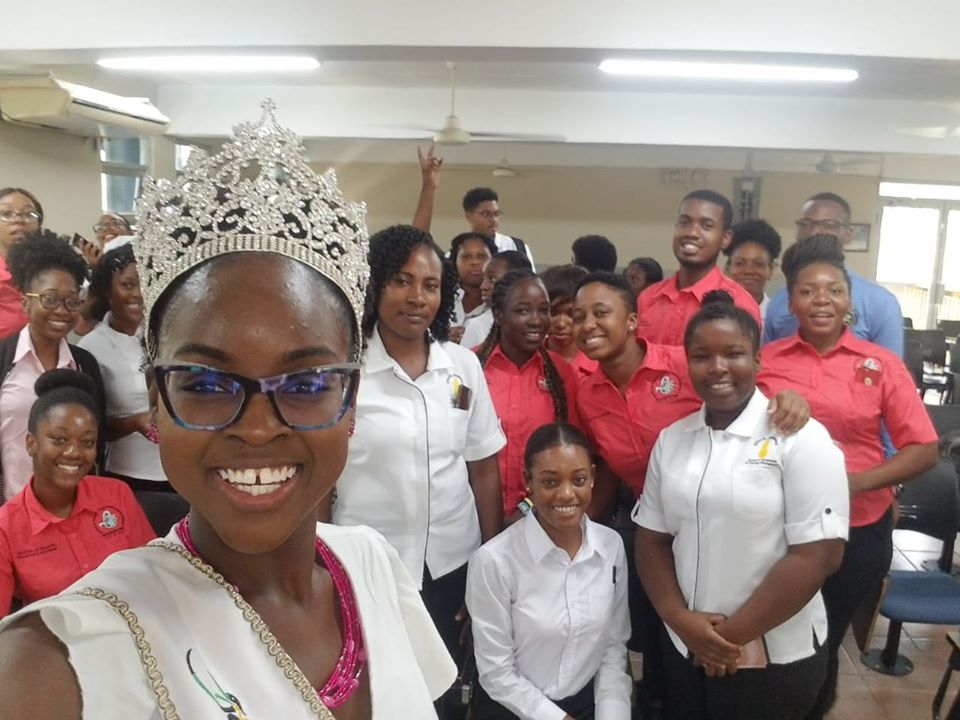
#Jamaica – January 16, 2019 — Miss Jamaica Festival Queen 2019, Khamara Wright, has embarked on a project, dubbed ‘Nourish and Flourish’, which is focused on facilitating high-school students with healthy meals.
Key among the initiative’s objectives are encouraging creative cooking lessons; fostering and heightening awareness of the need for healthy living and eating practices; and showcasing the versatility of Jamaican foods, while promoting what she describes as the “Jamaican culinary heritage”.
“What we eat impacts our performance and our well-being, hence that project is geared towards educating persons about preparing such meals, going into the schools and speaking to the relevant persons, so that we can prepare those meals for the children and they can be educated on how to prepare the meals for themselves,” Miss Wright tells JIS News.

The Festival Queen, who is a chef and an alumnus of the University of Technology (UTech), says she is passionate about Jamaican cuisine.
She notes that on countless occasions, she is asked to share her food-preparation skills with other persons, adding that this and her interest in health fuelled the birth of the healthy meals project.
Miss Wright points out that by educating individuals about food preparation and healthy eating practices, the project aims to achieve the goal of enabling Jamaicans to realise their full potential through the promotion of healthier lifestyles.
“It is geared towards health, wellness, and nutrition. I would like to see more persons empowered to eat the things that are good for us, and know how to prepare it,” she states of the project to be launched this month.
Miss Wright informs that the project also represents an effort to ensure a sustained reduction of non-communicable diseases (NCDs) and will provide an educational opportunity and hands-on approach to encourage healthier meal consumption, purchasing methods as well as an understanding of food from the seed to the plate.
“My mission, as the facilitator and chef, is to inspire, motivate and educate, so that our communities can make more informed decisions about their diets and wellness,” she points out, adding that the food and nutrition classes will be organised for participating schools islandwide.
After each session, students will be allowed to taste the prepared meals, and ask questions. Two students from each school will participate in the Nourish and Flourish Competition, to be held at the end of March, at the Chinese Benevolent Association in St. Andrew.

The Festival Queen expresses the hope that the project will help to stem the generational cycle of lifestyle choices that lead to preventable illnesses, and that nutrition awareness will be taken to a higher level.
“If these objectives are met, the holistic performance of the participants will be positively geared in the right direction,” she argues.
Miss Wright contends that the project is intended to ensure that Jamaicans are healthier, because “we have to be heathier to fulfil our potential”, as outlined in the long-term National Development Plan – Vision 2030 Jamaica.
“The project is aligned with that. So in that, I play many parts in educating persons, and ensuring that they are living their best lives,” she says.
Miss Wright, who is also the parish festival queen for St. Catherine, ended a 29-year drought for the parish, when she copped the national crown in 2019.
With a degree in Food Services Management, she is preparing to advance her career by becoming a Wellness Chef, so that she can heighten the campaign for healthier consumption.

The 23-year-old queen has, so far, been conferred with the Marcella Blake Award for Leadership, Commitment and Resilience by UTech, and nominated twice for the Omni Hotel Service Champion Award, while working at the Resort in Texas, USA.
A firm believer in serving her community, Miss Wright is a member of the Greater Portmore Joint Council, the New Kingston Rotaract Club, and the Council of Voluntary and Social Services.
She encourages well thinking, civic-minded Jamaicans to become positive role models for the nation’s youth.
Miss Wright tells JIS News that at age nine she was positively impacted by her school teacher, Tanya Ewers-Clarke, at the Kensington Primary School in St. Catherine.

“I saw her as the woman I would love to [emulate]; she embodied grace and passion,” she notes.
The young social advocate also wants to channel her energy into recycling initiatives, and educating community members about the dangers of pollution.
She says winning the Festival Queen title has served to bolster her motivation for community service.
The Miss Jamaica Festival Queen Competition, which began as the Miss Jamaica Beauty Contest in 1963, is organised by the Jamaica Cultural Development Commission (JCDC).
The need for a greater emphasis on cultural awareness prompted a shift in the competition’s focus in 1975.
The event has grown over the years to become the premier forum for intelligent, culturally aware and poised young ladies seeking a platform for their contribution to nation building.
It is one of the highlights of the Emancipation and Independence celebrations in August.
The contestants at the national coronation are the parish queens who have been crowned during the 13 parish coronations (Kingston and St. Andrew being represented by one queen), held annually across the island.
Several Miss Jamaica Festival Queens have gone on to serve as cultural ambassadors and nation builders in their respective careers and areas of endeavour.
Press Release, JIS, story by GARFIELD L. ANGUS

By Deandrea Hamilton | Editor
September 28, 2026 – Wall Street initially flinched at the $3-billion handshake. But in a matter of days, it was smoother sailing.
Perhaps the bigger Caribbean business story is not what Sandals Resorts International is getting from the deal. It is who is writing the cheque — and what that says about what Gordon “Butch” Stewart built.
As reports of Royal Caribbean Group’s Sandals deal circulated Tuesday, RCL shares plunged 6.14 percent from Monday’s $250.25 close to $234.89, on sharply elevated trading.
When the agreement became official Wednesday — approximately $3 billion for a 50 percent equity interest in Sandals and Beaches Resorts — shares slipped another 1.95 percent to $230.30 and touched $222.22 intraday. Investors were digesting both the size of the investment and committed debt financing secured through Morgan Stanley.
But by Thursday, RCL rebounded 3.77 percent, with shares continuing their recovery Friday to finish the week around $243. Analysts were also looking ahead: JPMorgan reportedly raised its RCL price target from $345 to $394, while Citi placed the company on a 90-day positive catalyst watch.
And just who is RCL?
Royal Caribbean Group is a global vacation giant, publicly traded on the New York Stock Exchange with a market value of roughly $65 billion. Its portfolio includes Royal Caribbean International, Celebrity Cruises and Silversea, alongside private destinations and an expanding vacation platform.
So when a company of that scale commits $3 billion for only half of Sandals and Beaches Resorts, the transaction puts a striking financial marker on one of the Caribbean’s greatest home-grown hospitality success stories.
The deal, expected to close in early 2027, creates a 50-50 partnership with the Stewart family and takes Royal Caribbean deeper into the all-inclusive resort business.
Butch Stewart started Sandals in Jamaica in 1981 believing a Caribbean company could compete with the world’s best.
Forty-five years later, one of the world’s biggest vacation companies is prepared to pay $3 billion just to own half of what he built.
Now that’s the handshake that does more than seal a deal — it cements a legacy.
Caribbean News
Royal Caribbean Group and Sandals Resorts Announce Landmark Partnership to Accelerate Their Leading Vacation Experiences


Royal Caribbean Group Investment to Advance Sandals and Beaches’ Growth and Broaden the Group’s Vacation Portfolio
Montego Bay, Jamaica and Miami, September 24, 2026 – Royal Caribbean Group (NYSE: RCL) and Sandals Resorts today announced the signing of an agreement to form a partnership in the all-inclusive resort space with a 50% investment from Royal Caribbean Group. Building on Sandals and Beaches Resorts’ more than four decades of leadership in Caribbean hospitality, the joint venture will create new opportunities for continued resort growth while broadening the experiences across Royal Caribbean Group’s vacation platform.
The partnership brings together two of the travel industry’s most celebrated vacation companies, pairing Sandals and Beaches’ all-inclusive resort expertise with Royal Caribbean Group’s vacation platform, including industry-leading brands – Royal Caribbean, Celebrity Cruises and Silversea – a portfolio of private destinations, new river cruising offering, and an industry-first loyalty program. United in a shared history in the Caribbean and connected by a love for their communities, the companies will offer travelers an unparalleled collection of cruise, private destination and resort experiences, serving guests across more vacation occasions and establishing their undisputed leadership in Caribbean vacations.
The joint venture expands Royal Caribbean Group into an adjacent vacation category, growing its participation in the approximately $2 trillion global vacation market, and meets the growing global demand for Sandals and Beaches Resorts by accelerating their expansion. The partnership will include Sandals and Beaches’ collection of premier all-inclusive properties across the Caribbean, and the companies will explore opportunities to broaden distribution, deepen guest engagement, and make it easier for travelers to discover vacation experiences offered across both portfolios.
“For nearly 60 years, we’ve reimagined what a vacation can be, constantly expanding the ways we inspire our guests to explore, connect and create lifelong memories,” said Jason Liberty, Chairman and CEO, Royal Caribbean Group. “We have been building a vacation platform that brings joy to millions of people around the world and creates meaningful relationships that last with our guests. Our partnership with Sandals and Beaches Resorts is an important next step on that journey – bringing together two iconic leading vacation companies to further strengthen and grow one of the most admired resort portfolios in the world. The Stewart family has created powerful and beloved brands, and we are honored to build on that legacy. Together, we see tremendous opportunity to expand the reach of Sandals and Beaches Resorts and continue turning the vacation of a lifetime into a lifetime of vacations.”
“My father, Gordon ‘Butch’ Stewart, founded Sandals Resorts with the belief that a company built in the Caribbean could stand on the world stage alongside the most respected names in hospitality. Today is proof of how far that vision can go,” said Adam Stewart, Executive Chairman of Sandals Resorts and Beaches Resorts. “This partnership is the natural next step in building on that conviction. It gives us the ability to grow faster with a partner that shares our values of exceptional hospitality, long-term investment, and the power of enduring brands. Together, we will introduce more guests to Sandals and Beaches Resorts while creating even more extraordinary experiences for those who have made our resorts part of their lives for decades.” Stewart added, “As we continue to grow, we will remain true to what has always defined us: delivering authentic vacations that exceed expectations while creating opportunities for our team members, travel advisor partners and the communities we call home. The future has never been brighter, and I know this moment would make my father incredibly proud.”
The joint venture will be governed by a board under the shared leadership of Stewart and Liberty. Stewart will maintain a leadership role in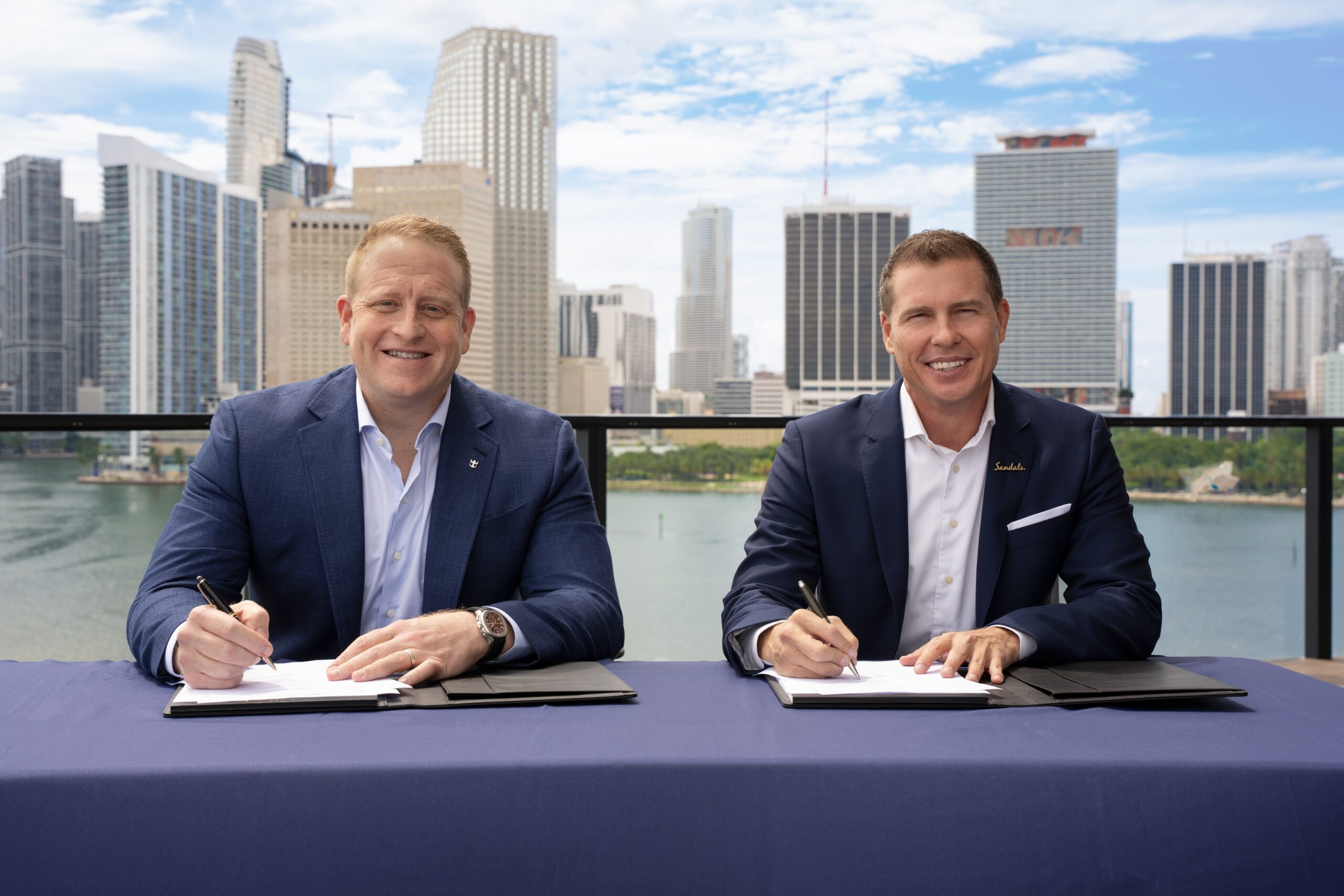 guiding the company’s long-term strategic growth as Executive Chairman of Sandals and Beaches Resorts. Existing reservations, loyalty programs, resort operations and cruise operations will continue as usual, with the partnership bringing additional resources to support future opportunities.
Under the terms of the agreement, Royal Caribbean Group will acquire a 50% equity interest in Sandals and Beaches Resorts for approximately $3 billion, representing a forward EBITDA multiple of approximately 10x. Royal Caribbean Group has secured committed debt financing from Morgan Stanley to fund the investment. The transaction is expected to close in early 2027, subject to customary approvals and closing conditions, and is expected to be accretive to earnings next year.
BofA Securities and PJT Partners acted as financial advisors, and Latham & Watkins and Jones Day acted as legal advisors to the Sandals Group. Perella Weinberg Partners and Morgan Stanley acted as financial advisors and Kirkland & Ellis LLP acted as legal advisor to Royal Caribbean Group.
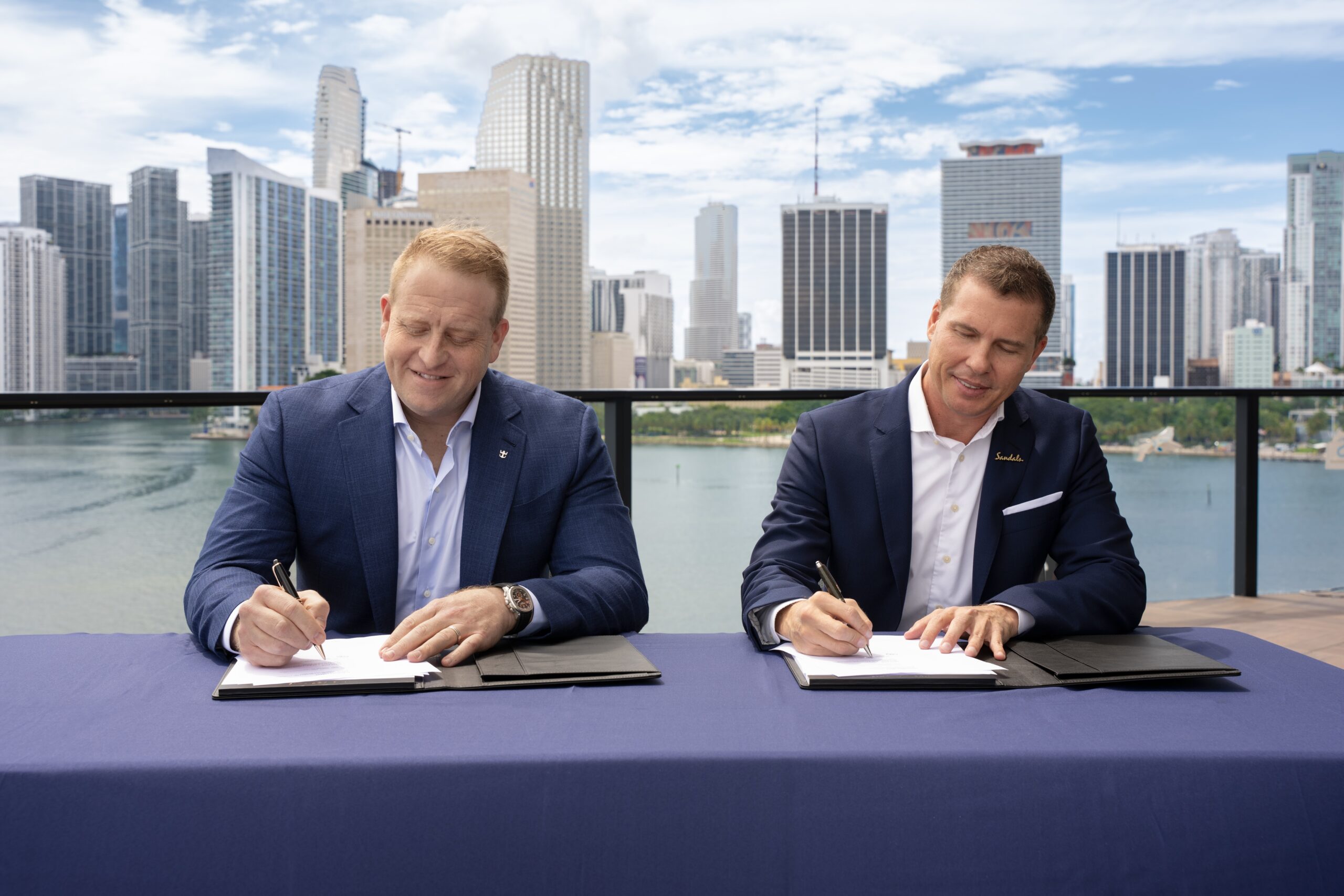
PHOTO CAPTION: Jason Liberty, Chairman and CEO of Royal Caribbean Group, and Adam Stewart, Executive Chairman of Sandals Resorts, mark the signing of an agreement to form a landmark partnership that expands Royal Caribbean Group into the all-inclusive resort space and supports the future growth of Sandals and Beaches Resorts. The signing took place at Royal Caribbean Group’s new headquarters in Miami, with the city’s skyline in the background.
The Caribbean tourism deal first reported as a possibility on Tuesday is now a signed agreement. Royal Caribbean Group plans to pay approximately US$3 billion for a 50% stake in Sandals and Beaches Resorts, putting the value of the business at about US$6 billion. The purchase is expected to close in early 2027, subject to approvals.
Founded in Jamaica by the late Gordon “Butch” Stewart in 1981, the resort business has a presence across nine Caribbean destinations, including Jamaica, The Bahamas and Turks and Caicos. Sandals has described its workforce as nearly 20,000 people, most of them Caribbean nationals.
“My father, Gordon ‘Butch’ Stewart, founded Sandals Resorts with the belief that a company built in the Caribbean could stand on the world stage alongside the most respected names in hospitality,” said Adam Stewart in the announcement carried by PR Newswire. He will remain executive chairman, while the Stewart family retains a stake. The companies say existing reservations and resort operations will continue as usual.





-

 Independent writer1 week ago
Born Here, Raised Here, but Still Unable to Vote: Is this a Conundrum for TCI Electorate?
-

 Bahamas News5 days ago
Rosewood Exuma: A precedent-setting case for environmental law and future development in The Bahamas
-

 News3 days ago
Invest TCI Strengthens Regional Investment Connections at Caribbean Investment Forum 2026 in Barbados
-

 Bahamas News1 week ago
Monument Supports Hands for Hunger With Paradise Plates Debut
-

 Bahamas News4 days ago
Energy Minister Delivers Electrifying Keynote Opening Address at CAREC 2026
-

 Bahamas News1 week ago
Schweppes ‘the Art of Mixology’ Dazzles at Paradise Plates with Nemiroff Vodka
-

 Bahamas News8 hours ago
Bahamas Issues Cybersecurity Alert Over Akira Ransomware Threat
-

 News1 day ago
Crown Land Unit Leads Multi-Agency Enforcement Exercise in Five Cays