
Bahamas News
BAHAMAS: SBDC Family Island Roll-out Begins with Exuma

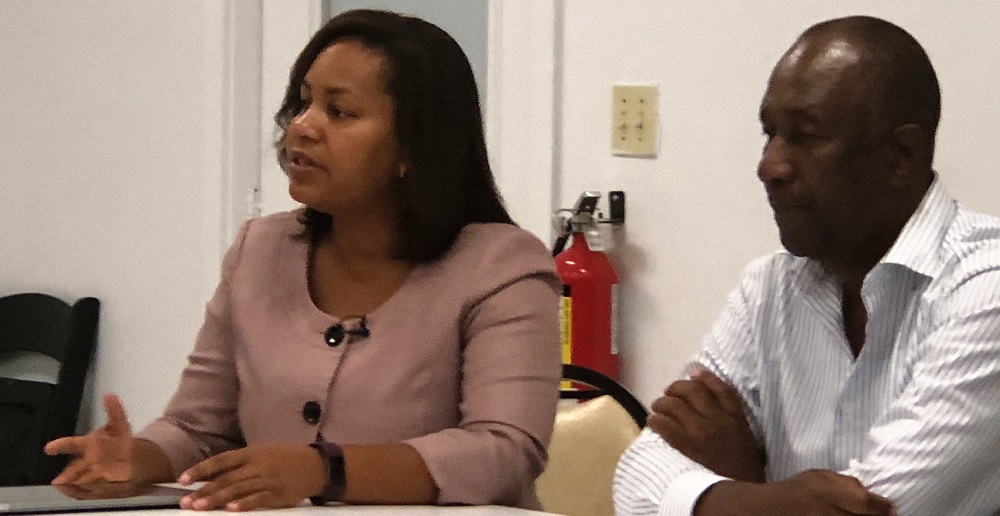
#Exuma, October 25, 2018 – Bahamas – The Access Accelerator Small Business Development Centre has kicked off its Family Island rollout on Exuma, meeting with the Exuma Chamber of Commerce and holding a town hall meeting in Georgetown, where dozens of excited entrepreneurs and would-be entrepreneurs gathered to hear about the new entity and to sign up.
Access Accelerator Executive Director Davinia Blair was a featured speaker at the Exuma Business Outlook as well. She spoke to the crowd about what the data said about Exuma’s Micro, Small and Medium-sized Enterprises (MSMEs).
Town Hall
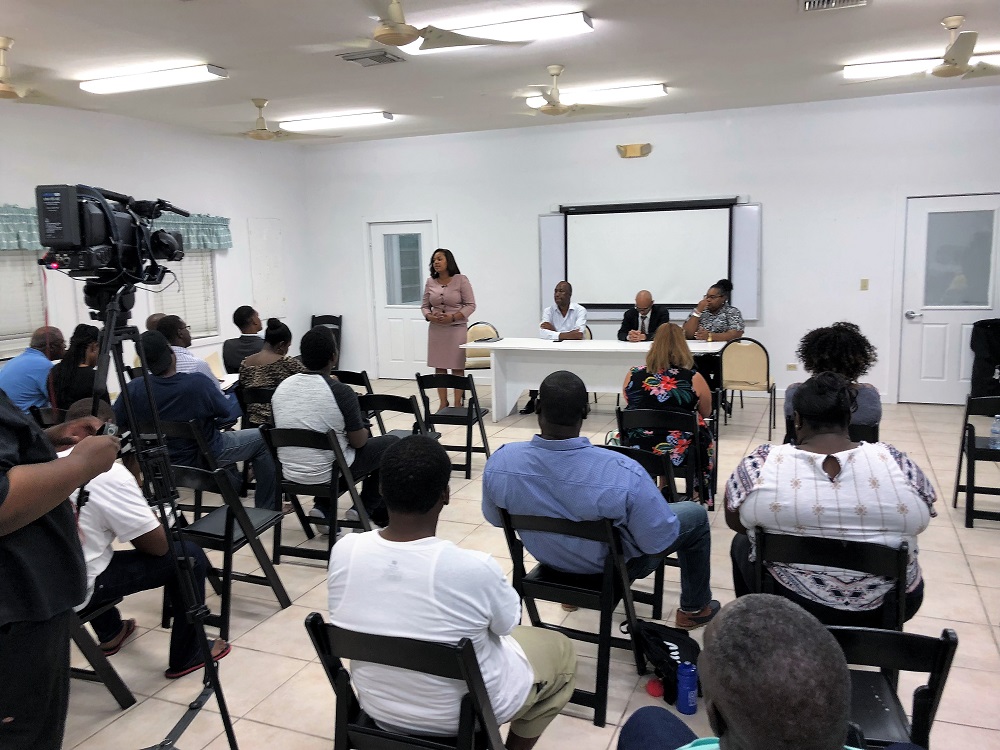 One attendee at the town hall meeting was enthusiastic about the advent of the Access Accelerator, though she lamented that such an entity took so long to come to life.
“If this had been around when I was first starting out, I’d be a millionaire,” she said.
Another attendee summed up the need for the Access Accelerator when she described her frustrations trying to get her business idea off the ground.
She said, “I couldn’t find the right people to get into contact with.”
In addition to discussing the services the Access Accelerator will begin offering Exumians today (Tuesday), Ms. Blair acknowledged what some attendees said, that MSME development did not appear to have kept pace with the development of the island overall, even though by some measures, MSMEs in Exuma are outperforming the larger businesses.
Ms. Blair reiterated that the government has committed that 20 percent of its procurements would be reserved for MSMEs. She said in addition to that commitment, there must be a commitment to include local MSMEs in the supply chain for foreign direct investment (FDI) opportunities.
“Bahamian MSMEs – and for Exuma projects, Exuma MSMEs – must be at the table as heads of agreements are being negotiated,” Ms. Blair asserted.
Rollout
Later in October, the Access Accelerator will be in Abaco, where the Access Accelerator team will meet with the Abaco Chamber and hold a town hall meeting to introduce the Access Accelerator and connect with the local entrepreneurial community.
In November, Blair is expected to speak at the Long Island Business Outlook, and other islands to which the Access Accelerator is bound before taking a break for the Christmas season include Andros and Eleuthera.
Action
With the new name and branding, the Access Accelerator Small Business Development Centre has three critical new hires which highlight the tremendous momentum generated by the official launch on September 20, and carried into the first two weeks of operations, including the graduation of the first classes of entrepreneurs from the two-week introductory course, both in New Providence and Grand Bahama.
The SBDC is the product of a tri-partite arrangement between the Government, through the Ministry of Finance, University of The Bahamas (UB) and the Bahamas Chamber of Commerce and Employer’s Confederation (BCCEC). The Centre has a three-year mandate initially to guide the development, funding, growth and evolution of Micro, Small and Medium-sized Enterprises (“MSMEs”) in The Bahamas.
Executive Director Blair announced that the SBDC had hired a Senior Business Development Specialist, an Associate Director of Operations and had contracted someone to design and build the Access Accelerator website.
Mr. Nicholas Higgs is the Centre’s new Senior Business Development Specialist, tasked with providing business development advisory services to MSMEs and assisting the Executive Director with overall operation of the program.
Mr. Higgs is responsible for providing counseling on all aspects of small business operations including but not limited to management, financing, operations, marketing and personnel. He will have a special emphasis on capital advising for small businesses. In addition, Mr. Higgs will conduct client counseling, assist in the development and implementation of training events and workshops, promote Access Accelerator services, network with community organizations involved in small business and economic development, and assist in maintenance of data in the Access Accelerator Client Activity Training System (CATS).
“I view my role as one of the most important in fostering and growing startups, small and medium companies in  the country. My role specifically is to assist companies with sharpening their financial swords to fulfill their goals of raising funds, expanding their companies or to simply become a more efficiently-run company,” said Mr. Higgs, who sees the Access Accelerator, and by extension himself, as something of a Jedi master for Bahamian startups.
Ms. Bianca Lee is the new Associate Director of Operations, tasked with oversight, supervision and administration of the SBDC’s business operations.
“I am very excited, because we will be able to focus on a section of the market that I believe has been untouched. Entrepreneurship is a big thing, especially among young people – even in passing you can hear people talking about their entrepreneurial dreams. Being able to provide support and guidance to those persons will be amazing, especially to assist that process from start to finish,” she said.
Meanwhile, the SBDC has selected Travis Miller of Thought & Method to develop the SBDC website, which is expected to be launched for public use in mid-December 2018.
Said Miller, “I’m excited about the SBDC because the initiative will allow entrepreneurs more opportunities to get their ideas out there and develop or refine their businesses and likely get access to funding to help make their dreams a reality. I believe what SBDC will provide will impact the landscape for entrepreneurs for years to come.”
The new hires come after the appointment of the SBDC Board of Directors, chaired by Geoffrey Andrews and Deputy Chair Dr. Olivia Saunders, two weeks ago. The new board includes Merrit Storr, Ellison Delva, Clifford Johnson, Hank Ferguson, Tyrina Neely, Gina McKenzie, Remelda Moxey, Kristie Powell, Christopher Sawyer and Pedro Rolle.
Press Release: Small Business Development Centre
Photo Captions:
Header: Executive Director of the Access Accelerator Ms. Davinia Blair discusses the new entity with entrepreneurs in Exuma at a town hall-style meeting, where she advocated for Exuma businesses to be included in discussions about FDI projects planned for Exuma.
Insert: Executive Director of the Access Accelerator Ms. Davinia Blair discusses the new entity with entrepreneurs in Exuma at a town hall-style meeting, where she led a panel including Exuma Chamber of Commerce President Pedro Rolle and Department of Inland Revenue


The Bahamas, March 30, 2026 – The voice of a proud mother captured the spirit of a nation Monday night, as Bendra Rolle shared heartfelt reflections on the overwhelming Bahamian support for her son, VJ Edgecombe, during the Philadelphia 76ers matchup against the Miami Heat in Miami.
“The patriotic support and scenery at my son, VJ Edgecombe’s NBA game… was overwhelming,” Rolle said in a statement issued following the game. “The arena in Miami was lit. Bimini and the Bahamas showed up and showed out.”
Her words come amid what has already been widely described as a remarkable showing of national pride, with Bahamians traveling in large numbers to South Florida to witness the young guard’s continued rise. For Rolle, however, the moment extended far beyond basketball.
“Beyond VJ’s basketball talents, I’m so moved by his magnetic personality and personal journey to inspire and excite an entire nation—our beloved Bahamas,” she said. “I thank God for VJ’s humility and for his hunger for greatness. He never forgets how far God has brought us.”
While the Sixers did not secure the win on the night, Edgecombe delivered a solid individual performance, finishing with 13 points and five assists. He made an early impact on the game, showing confidence and poise before foul trouble disrupted his rhythm, but still managed to leave his mark in meaningful minutes.
The game itself evolved into a cultural showcase, with Bahamian flags waving throughout the arena and chants ringing out in support of Edgecombe. Much of that presence was bolstered by a coordinated travel push from Bahamasair, which helped facilitate fan travel and added to the electric atmosphere in Miami.
Rolle said the emotional weight of the moment was deeply felt by her family, as they witnessed firsthand the unity and pride of the Bahamian people.
“Thanks and love for the tears and overwhelming joy on Monday, Bahamas,” she expressed. “The Bahamian flags were love, loud, and proud. On my own behalf, VJ, and the entire family, I am ever grateful for the indescribable experience.”
Her closing words underscored what many have described as the true victory of the night—not the final score, but the powerful display of national pride and support surrounding one of The Bahamas’ rising stars.

PHOTO BY SIXERS NATION
Bahamian pride is already on full display in South Florida, with fans arriving in strong numbers ahead of tonight’s highly anticipated NBA matchup featuring VJ Edgecombe and the Philadelphia 76ers.
Helping to power that movement was Bahamasair, which rolled out a strategic promotion to facilitate travel, turning the game into a full-scale national showing.
And the celebration started early.
A “Bahamas Invades Florida” pre-party over the weekend set the tone, with Bahamian fans, DJs and supporters converging in Fort Lauderdale to build momentum ahead of the game. The event, marketed as a major cultural gathering, has spilled into Miami, where a strong Bahamian presence is expected inside the arena tonight.
This is no ordinary road game.
The Sixers enter the matchup healthy and are favoured to win, adding to the anticipation surrounding what many expect to be a standout performance by the Biminite guard.
Edgecombe, the third overall pick in the 2025 NBA Draft, has been electric in his rookie season — delivering high-scoring performances and quickly establishing himself as one of the league’s most exciting young talents.
But beyond the stats, it’s the moment that matters.
With South Florida just a short flight away, Bahamians have seized the opportunity to show up in force — flags, energy and all — transforming the game into something far bigger than basketball.
A national turnout.
A rising star.
And a night where the Bahamas is expected to be felt — from tip-off to final buzzer.
Angle by Deandrea Hamilton. Built with ChatGPT (AI). Magnetic Media — CAPTURING LIFE.

The Bahamas, March 18, 2026 – Twenty days into the latest Middle East escalation, the United Nations is warning the conflict is spreading beyond its original battlefield, as the death toll rises and governments around the world issue urgent travel advisories — including The Bahamas.
In a March 17 statement, the UN Secretary-General’s office said the war must stop and called for all Security Council resolutions to be respected, noting with concern that countries in the Gulf continue to be targeted, raising fears of a wider regional confrontation.
The current round of fighting began February 28 with strikes involving the United States, Israel and Iranian-linked forces, followed by missile and drone attacks across Iraq, Lebanon and parts of the Gulf.
International monitors report more than 1,300 people killed in Iran alone, with additional casualties reported in Lebanon, Israel and Gulf states. U.S. officials confirm at least 13 American service members have died since the escalation began, while reports indicate additional senior Iranian military leaders were killed in recent strikes.
Despite the growing violence, several NATO countries including the United Kingdom, France and Germany have not joined offensive operations, instead calling for diplomacy to prevent the conflict from widening.
The Bahamas Ministry of Foreign Affairs has also issued a travel advisory, warning Bahamian nationals to avoid travel to Israel, Palestine, Iran and Lebanon and to reconsider travel across much of the Gulf region due to the risk of sudden escalation, flight disruptions and security threats.
Officials say Bahamians already in the region should remain vigilant and be prepared for rapidly changing conditions.
Angle by Deandrea Hamilton. Built with ChatGPT (AI). Magnetic Media — CAPTURING LIFE.





-

 News1 week ago
Password to Paradise Radio Remotes at Beaches Turks & Caicos continue to highlight the TCI as the preferred Caribbean destination
-

 News1 week ago
Beaches Turks & Caicos adds four new PADI Dive Instructors to the cadre of professionals in the watersports department
-
 News1 week ago
Beaches Turks & Caicos shares fine dining experiences to high school students in Providenciales
-

 Bahamas News7 days ago
Bahamasair Backs Surge as Bahamians Flood South Florida for V.J. Edgecombe Showdown
-

 News7 days ago
50 Years of Ministerial Government: Cabinet Moves to Mark Milestone Rooted in 1976 Constitution
-

 News7 days ago
Fuel Costs Rise Again as Pelican Energy Warns of Global Pressures
-
 News7 days ago
Government Moves to Amend Destination Management Fee Law
-

 News7 days ago
Flow TCI Empowers Local Communities with ‘Project EmpowerHER’