Bahamas News
Nearly 1,500 UK Parliamentarians to Weigh In on Bahamas–Turks and Caicos Maritime Boundary Treaty

By Deandrea Hamilton | Editor
A historic maritime boundary treaty between The Bahamas and the Turks and Caicos Islands is heading for scrutiny by 650 elected members of the United Kingdom’s House of Commons and approximately 796 members of the House of Lords before it can become legally binding.
The agreement was signed in Nassau on Monday, November 16, 2026, by Bahamian Foreign Affairs and Immigration Minister Frederick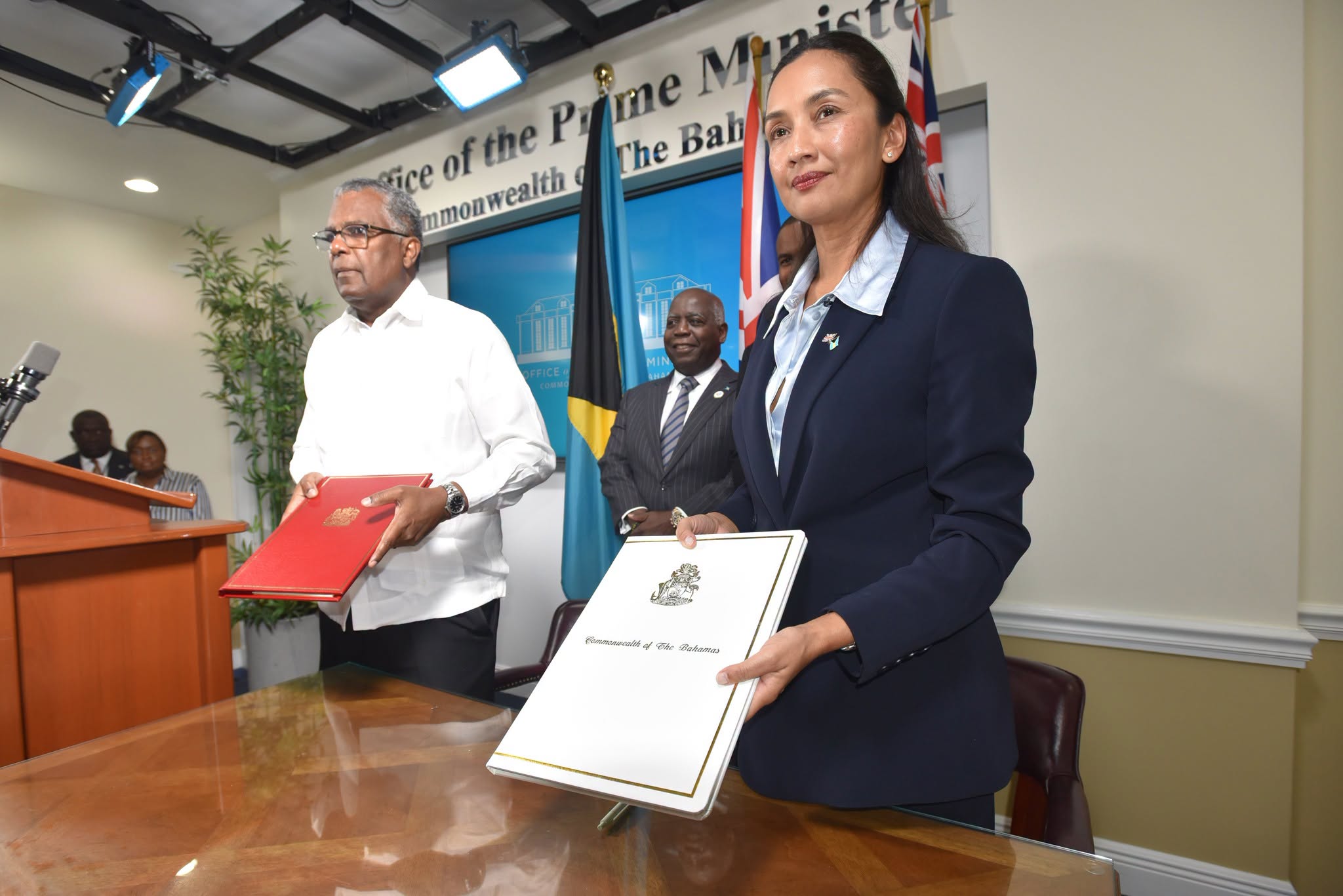
Although the treaty draws a delimitation line across the Atlantic Ocean, that line runs much deeper than the surface.
It establishes a boundary through the water column, across the seabed and into the subsoil beneath it, defining maritime rights and jurisdiction involving fisheries, underwater resources and security operations.
The boundary separates maritime areas between Mayaguana and Inagua in The Bahamas and the Caicos Islands.
But the signatures do not make the treaty immediately enforceable.
Under British parliamentary procedures, the agreement must be presented to both Houses for 21 sitting days, allowing parliamentarians to scrutinize its provisions and potentially object to ratification.
A parliamentary vote is not automatically required. However, the House of Commons can formally delay ratification, while the House of Lords may register objections.
The process reflects the Turks and Caicos Islands’ constitutional relationship with Britain, which retains responsibility for its international treaty arrangements.
Deputy Premier Jamel Robinson emphasized the territory’s involvement in the negotiations.
“Our Government has been actively engaged in the negotiations, ensuring that the interests of our people and our maritime communities
He added that the agreement strengthens the foundation for maritime security, responsible fisheries management and cooperation between the neighboring jurisdictions.
Negotiations began in 1992, with a technical agreement reached in 1996 that was never ratified. Talks resumed in 2023, following changes to The Bahamas’ archipelagic baselines in 2008.
Prime Minister Philip Davis welcomed the conclusion of negotiations spanning more than three decades.
“It gives fishermen and law enforcement officers on both sides an agreed line, and it will strengthen the close cooperation between our security services.”
Davis also acknowledged the longstanding friendship between the two island communities.
“Our peoples have been friends for generations, and today’s Agreement builds on that friendship.”
Once both governments complete their domestic procedures, the treaty will enter into force on the 30th day following the final notification.
For two Caribbean neighbors, the agreement settles a 34-year-old boundary question, but its final legal journey now passes through Westminster.