
Caribbean News
Haiti: Over 500 Prisoners Escape and nearly 6 Million People near starving


Deandrea Hamilton
Editor
April 4, 2025 – Thirteen months since armed gangs stormed the Toussaint Louverture International Airport in protest of the then Prime Minister and the situation has spawned a dangerous set of crises for Haiti. Today, the World Food Programme says it is facing a funding gap of $54 Million in the mission to stem the escalating level of food insecurity; a challenge compounded by gang insurgencies into new communities outside of Port-au-Prince.
In the latest wave of violence, 500 inmates were set free from a prison in the Centre Department of Haiti, an area which flanks the country’s border with the Dominican Republic. An attack in Mirebalais was blamed for the prisoner escape and is the painful result of failures to contain the gang-fuelled violence. The UN reports that in the first three months of this year, the number of displaced people has rocketed by 15,000. “…this weekend’s attack in Mirebalais in Haiti, which reportedly resulted in the escape of more than 500 detainees from a local prison, has also led to – according to OCHA – widespread looting and the burning of homes, schools, and churches.
This incident highlights how gang activity is expanding beyond the Ouest Department, where Port-au-Prince is located.”
The attack was condemned by the Secretary General, who also called on Haitian authorities, stakeholders and the international community to redouble efforts in the Republic.
“Displacement there has steadily increased since January from 170,000 people to 185,000 people at the end of March, according to the IOM. Thousands of displaced people are now sheltering in makeshift sites, including schools and public buildings.
We and our partners continue to monitor the situation, assess the needs and support humanitarian response when security permits.”
But it seems a futile fight. The World Food Programme says it is running out of money and running out of time, as victims caught in the web of the gangs are trapped without anyway to access they help they are offering.
“…in Port-au-Prince, the insecurity, the protests and the roadblocks have all impeded movement and disrupted the delivery of food assistance, but WFP is continuing to push forward on operations to provide assistance to 25,000 people facing emergency levels of food insecurity. These people, who live in areas controlled by armed groups, are largely cut off from the rest of the country.”
The updates were furnished to media this week by the United Nations, with horrifying figures and circumstances for more than half the 11.6 million people who call Haiti their home. So much appears to be hinged on restoring democratically elected leadership in the Republic, but there are far more pressing concerns and the more immediate attention has shifted again to the Haitian National Police (HNP). A need to ensure the HNP is equipped through the Multinational Security Support with the resources, logistical data and personnel to, as Andrew Holness, Jamaican Prime Minister put it, “take down the gangs.”
“Yesterday, WFP was able to provide hot meals to 2,000 of the 6,000 people displaced. Today, WFP is telling us they are expanding that assistance. This operation is part of the country-wide efforts, which have seen WFP and partners provide more than 100,000 hot meals to 15,000 newly displaced people in the past week alone.
Typically, newly displaced people are initially offered hot meals and then transitioned to cash assistance, pending available funding.”
Half of Haitians do not have enough food to eat.
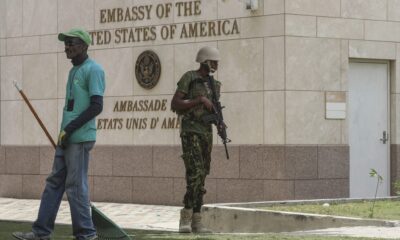
It was March 4, 2024 that the gangs highjacked authority in Haiti; it is estimated that 5,600 have been murdered including two members of the Kenyan Police Force.





CARIBBEAN — Jamaica has become the 13th CARICOM member state to accede to the African Export-Import Bank Establishment Agreement, further strengthening economic ties between Africa and the Caribbean.
The development was confirmed during the 50th CARICOM Heads of Government Meeting, where an Afreximbank delegation led by George Elombi and Kanayo Awani met with Jamaica’s Prime Minister Andrew Holness to advance cooperation.
Prime Minister Holness thanked the bank for its support following Jamaica’s recent hurricane, noting that Afreximbank financing helped restore critical infrastructure including water, electricity, sewage systems and roads, while also assisting reconstruction efforts aimed at building stronger resilience to future disasters.
The meeting also focused on broader development opportunities tied to Jamaica’s membership in the agreement. Discussions included rebuilding and modernising infrastructure such as railways, hospitals and other public facilities, while strengthening regional transportation and trade networks to improve the movement of people and goods across the Caribbean.
Afreximbank has been expanding its presence in the Caribbean as part of its strategy to connect Africa with the region often referred to as “Global Africa.” The bank has already committed billions of dollars in financing and trade support to Caribbean economies in recent years, including funding for infrastructure, trade facilitation and private sector investment.
By joining the agreement, Jamaica gains expanded access to Afreximbank’s financial instruments, technical support and trade networks designed to promote commerce between Africa and CARICOM states.
Regional leaders say the growing partnership could unlock new opportunities in areas such as trade, logistics, tourism, manufacturing and cultural exchange, strengthening economic cooperation between the two regions with deep historical and diaspora ties.
Angle by Deandrea Hamilton. Built with ChatGPT (AI). Magnetic Media — CAPTURING LIFE.
Caribbean News
Liberty Caribbean Supports Regional Forum on AI, Cyber Resilience and Digital Inclusion

Port of Spain, TRINIDAD & TOBAGO (February 24, 2026) — Liberty Caribbean, the operators of Flow, Liberty Business and BTC, recently served as Gold-Level Partner of the two-day Trinidad and Tobago Internet Governance Forum (TTIGF), themed “The Innovation Paradox – Balancing Progress with Responsibility and Resilience”.
The Digital Divide is of particular interest to Liberty Caribbean and is being addressed through its Charitable Foundation across the region. Low broadband penetration in the Caribbean contributes to diminished opportunities for individuals, communities, and local economies, but with the support of funding partners, this gap can be addressed through a comprehensive programme – JUMP – that focuses on providing access, devices, and digital skills.
“Liberty Caribbean was proud to serve as Gold-Level Partner of the TTIGF because the conversations taking place here shape key digital policies for multiple stakeholders,” said Simone Martin-Sulgan, Vice President and General Manager, Flow Trinidad.
“As technology accelerates at an unprecedented pace, we must ensure that innovation strengthens our societies rather than fragments them. The theme, ‘The Innovation Paradox – Balancing Progress with Responsibility and Resilience,’ speaks directly to the work we do every day: building networks that are not only fast and reliable, but secure, inclusive and future-ready.”
Across the Caribbean, the digital divide remains one of the most pressing barriers to equitable growth. Low broadband penetration limits access to education, entrepreneurship and essential services, and that is why we are deeply committed to closing this gap.
Through the Liberty Caribbean Charitable Foundation and initiatives like the JUMP Programme, the company is expanding access to technology, affordable connectivity and digital skills training so that individuals and communities are empowered to participate fully in the digital economy.
Martin-Sulgan further stated “at Liberty Caribbean, we believe progress and responsibility must move in lock step. By investing in resilient networks, inclusive programmes and trusted partnerships, we are helping to build a Caribbean that is innovative, secure and prepared for the opportunities ahead.”
Topics covered during the Forum, with over 140 participants, included “Securing Critical Infrastructure”, Integrating AI into Digital Transformation”, “The Digital Divide”, The Human Cost of Innovation – Mental Health and Well-being in the Digital Age’, and AI, Cyber Resilience and Regional Innovation”.
Focused on the underlying mandate of the Conference theme thought leaders, innovators, policymakers, technologists, researchers, and community stakeholders were invited to explore how countries can evolve boldly without compromising values or long-term stability.
Photo Caption:
TTIGF – l-r Darren Campo, Regulatory & Compliance Officer; Yolande Agard-Simmons, Senior Manager Communications; and Kevon Swift, Senior Manager Government and Regulatory Affairs of Flow Trinidad in attendance at the Post Event Mixer at Caribbean Telecommunications Union’s Head Office in St Clair, Port of Spain
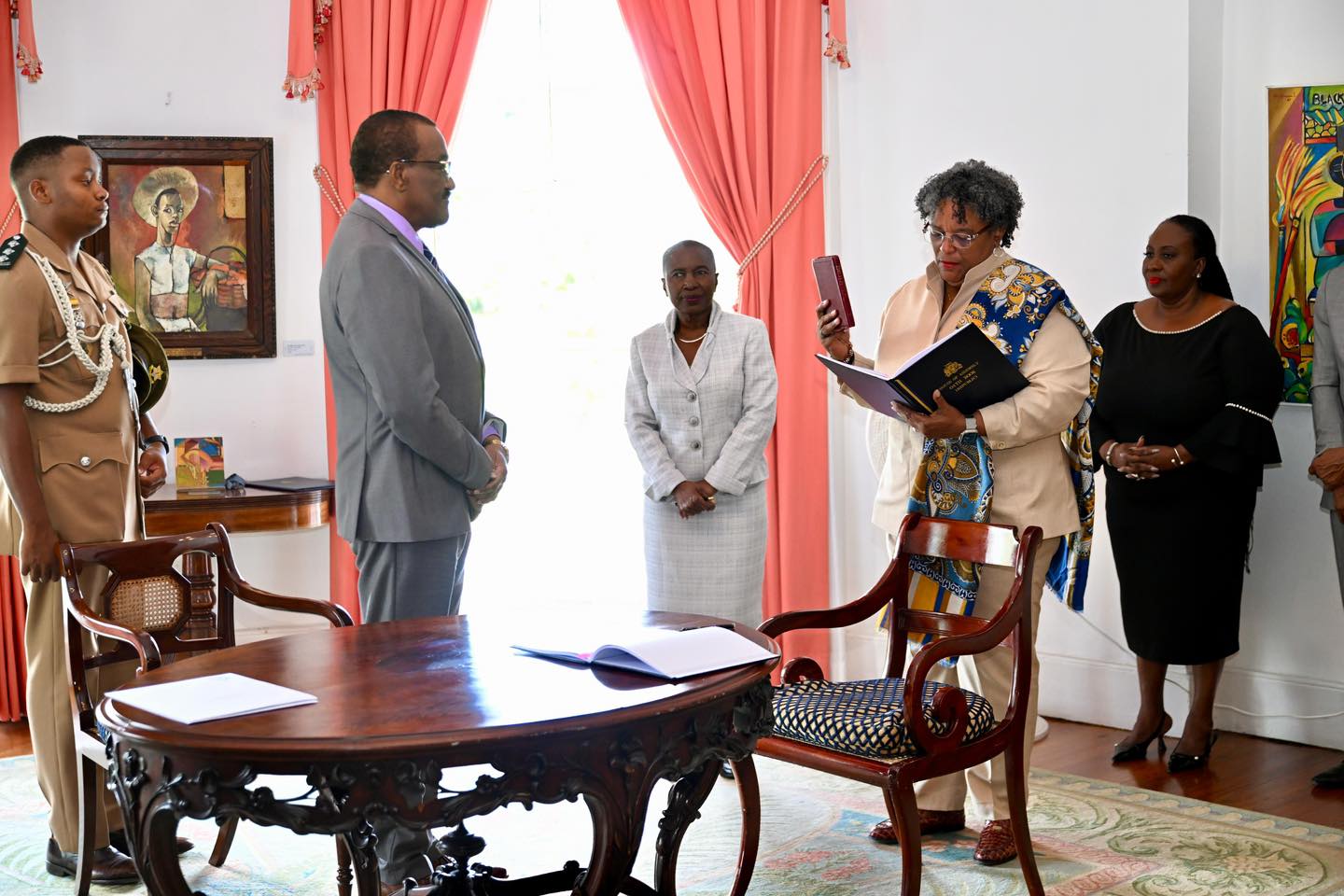
Barbados, February 12, 2026 – Prime Minister Mia Amor Mottley was this afternoon officially sworn in for a third consecutive term, hours after delivering one of the most emphatic election victories in Caribbean political history — another complete capture of all 30 seats in Barbados’ House of Assembly.
The ceremony, conducted by President His Excellency Lt. Col. The Most Honourable Jeffrey Bostic, marked the formal start of a new administration following the February 11, 2026 general election, which returned the Barbados Labour Party (BLP) to power with a renewed and overwhelming mandate.
In a statement after taking the oath, Mottley said she accepted the responsibility “with humility and resolve,” thanking the people of Barbados for placing their trust in her leadership once again and urging national unity as her government begins its new term. Attorney Wilfred Abrahams was also sworn in as Attorney General.
The result is historic not only for its scale but for its consistency. This is the third straight general election in which the BLP has won every constituency, reinforcing Mottley’s dominance in national politics and extending an unmatched era of one-party control in the modern democratic period.
Voting day unfolded under the watch of a CARICOM Election Observation Mission, led by Antigua and Barbuda’s Supervisor of Elections Ian Hughes and supported by senior electoral officials from Belize and Jamaica. The team engaged key institutions ahead of the poll and monitored the process across the island.
Regional leaders were swift in their congratulations.
Guyana’s President Irfaan Ali described the outcome as “emphatic and historic,” saying the clean sweep reflected how deeply Mottley’s leadership has connected with Barbadians and expressing optimism about strengthening ties between the two countries.
Jamaica’s Prime Minister Andrew Holness also hailed the victory, noting that her re-election provides an opportunity to deepen cooperation within CARICOM and advance shared regional priorities.
The scale of the win again leaves Barbados without a parliamentary opposition, a reality that has become a defining feature of the political landscape since 2018. Supporters argue the repeated mandate reflects public confidence in Mottley’s stewardship of economic reform, climate diplomacy, the transition to a republic, and Barbados’ expanding global influence.
Now, newly sworn in and backed by another unanimous parliamentary majority, Mottley begins a third term with both extraordinary political capital and equally high expectations at home and across the region.





-

 Health1 week ago
Chile becomes the first country in the Americas to be verified by WHO for the elimination of leprosy
-

 Caribbean News4 days ago
Jamaica Joins Afreximbank Agreement, Strengthening Africa–Caribbean Partnership
-

 Bahamas News1 week ago
Dredging Is Not Just About Size — It Is About What Is Being Destroyed, Warns Save Exuma Alliance Regarding Yntegra’s Proposed Rosewood Resort
-

 News1 week ago
Police Commissioner Honoured with Distinguished Civic Service Award at TCHTA Star Awards
-

 News1 week ago
Flow TCI powers Inter-High Track and Field Championships
-

 Education1 week ago
Message from Hon. Rachel M. Taylor, Minister of Education, Youth, Sports & Culture
-

 News5 days ago
Treasure Beach Village Opens at Beaches; Tourism Leaders Expect Surge in Bookings
-

 News3 days ago
Rights Without Justice: How Weak Enforcement Fails Women and Girls