
TCI Court
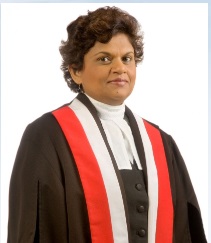
New President for Court of Appeal, Justice Alice Yorke-Soo Hon



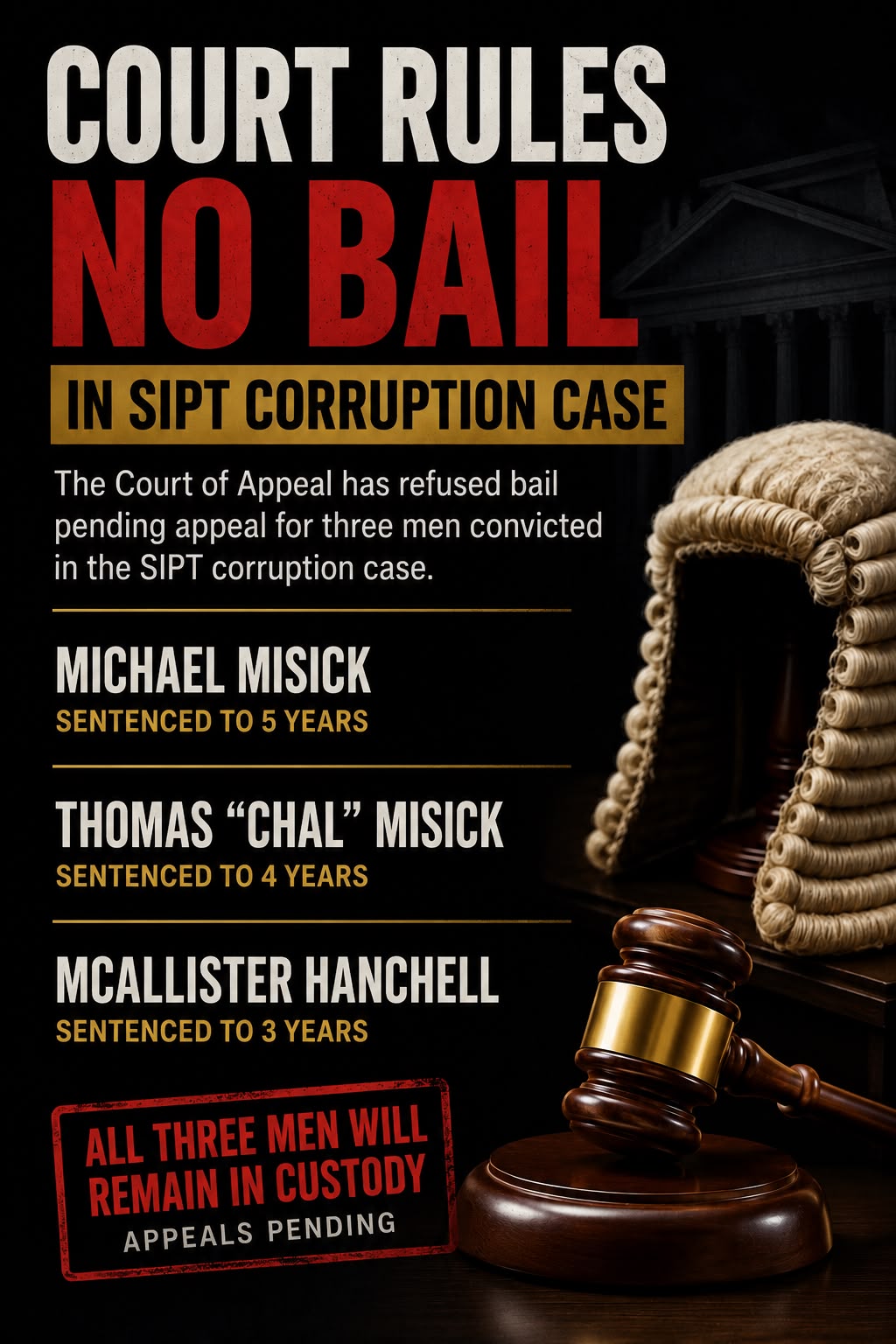
Turks and Caicos, July 6, 2026 – Former Turks and Caicos Premier Michael Misick will remain in prison as he appeals his conviction in the Special Investigation and Prosecution Team (SIPT) corruption case after the Court of Appeal refused his application for bail pending appeal.
The Court also denied bail to former Cabinet Minister McAllister Hanchell and attorney Thomas “Chal” Misick, meaning all three men will continue serving their custodial sentences at His Majesty’s Prison while the appeals process moves forward.
The ruling is a significant development in one of the territory’s most consequential criminal prosecutions. It means the convictions remain in effect, and the men will stay incarcerated unless the Court of Appeal later overturns their convictions or otherwise orders their release.
The Court found the applicants had not established the exceptional circumstances required for bail pending appeal. It also determined there was insufficient basis to conclude that the appeals were likely to succeed or that the men would complete most or all of their prison terms before their appeals are heard.
Michael Misick was sentenced in May to four years and 26 days after being convicted on three bribery counts. Hanchell received a three-year sentence for bribery, while Thomas “Chal” Misick was sentenced to four years following his conviction for money laundering.
The convictions followed years of investigations and court proceedings arising from the SIPT inquiry into allegations of corruption involving former public officials and government transactions.
While the appeals remain before the courts, Monday’s decision confirms that the three appellants will continue serving their prison sentences. Their legal challenge now shifts to the substantive appeal, where the Court of Appeal will determine whether the convictions or sentences should be upheld, varied or overturned.
Judge Cites Kofi Annan, But Finds No Evidence Defendants Caused the Wider Harm Described by the Former UN Chief
By Deandrea Hamilton
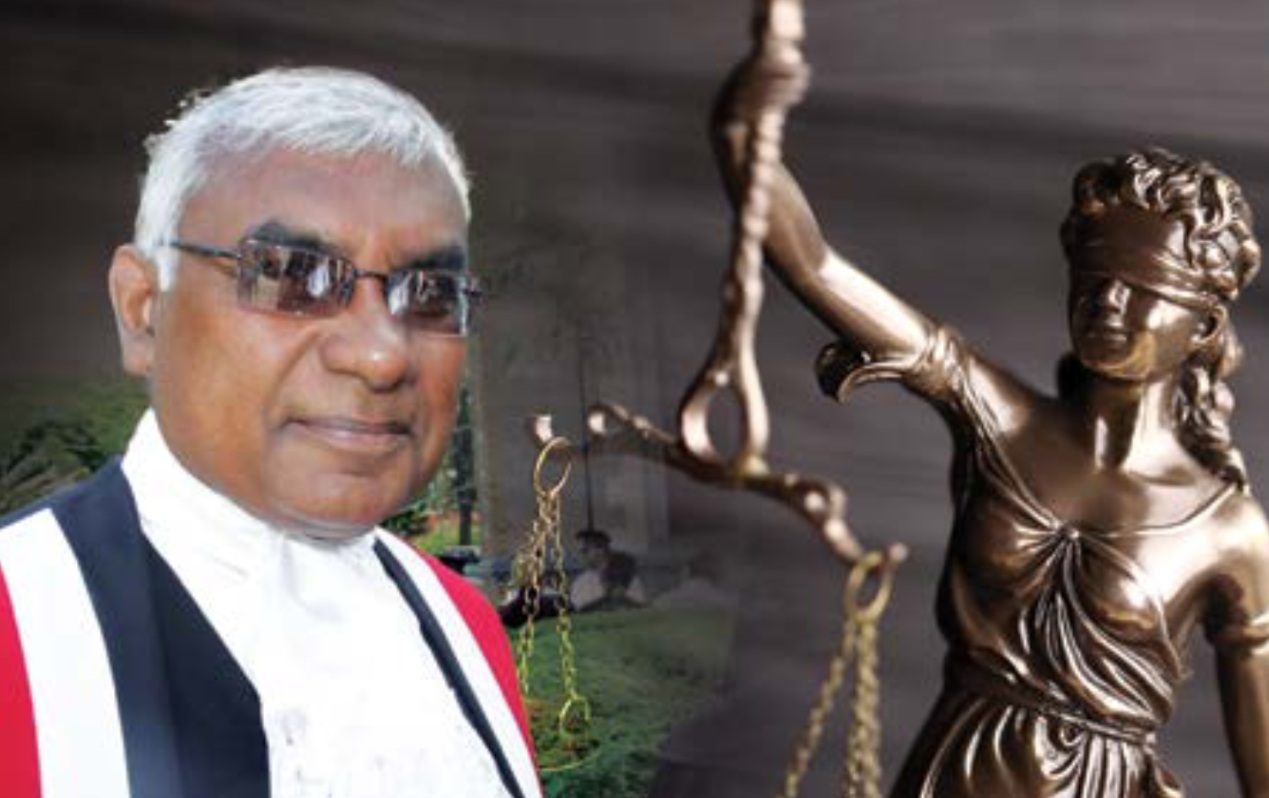
Turks and Caicos, June 9, 2026 – One week after former Premier Michael Misick, former Cabinet minister McAllister Hanchell and attorney Thomas “Chal” Misick began serving prison sentences in the Turks and Caicos Islands’ landmark corruption case, attention is turning to a significant distinction made by Justice Rajendra Narine during sentencing.
In imposing prison terms on May 29, the judge agreed that corruption is a serious offence capable of causing profound societal harm. Yet he also found that there was no evidence the three convicted men caused the sweeping consequences described in one of the world’s most famous condemnations of corruption.
The quotation came from former United Nations Secretary-General Kofi Annan, who famously wrote:
“Corruption is an insidious plague that has a wide range of corrosive effects on societies. It undermines democracy and the rule of law, leads to violations of human rights, distorts markets, erodes the quality of life and allows organized crime, terrorism and other threats to human security to flourish.”
Annan further observed:
“This evil phenomenon is found in all countries — big and small, rich and poor — but it is in the developing world that its effects are most destructive.”
Justice Narine acknowledged the quotation but drew an important distinction between the broad consequences of corruption described by Annan and the evidence presented during the trial.
“The court agrees that there is no evidence in this case that the offending parties actually caused or contributed to any of the harmful consequences described in the quotation,” Narine said.
The finding did not spare the defendants from prison.
The judge made clear that the offences remained serious enough to warrant immediate custodial sentences.
“This case was about an abuse of public trust for the sake of personal gain,” Narine stated.
“The conduct of the defendants caused a constitutional crisis and reputational harm to the territory.”
He added that the public interest demanded punishment and deterrence.
“The public interest requires that the sentence must reflect society’s abhorrence of the criminal conduct and the sentence should be such that like-minded potential offenders would be deterred from similar conduct.”
Narine also rejected suggestions that the absence of direct victims diminished the seriousness of the offences, noting that corruption often harms institutions and public confidence rather than identifiable individuals.
At the same time, the court accepted several mitigating factors advanced by the defence.
“The court is aware of the age, middle age of the offenders, that the immediate custodial sentences would have a traumatic effect on the families, understanding the emotional distress involved,” Narine said.
He also agreed that rehabilitation was not a major concern.
“The court agrees with the defence counsel that there is a low risk of reoffending and that the objective of rehabilitation is not a significant factor in this case.”
Those considerations, combined with the extraordinary delay in bringing the matter to conclusion and the defendants’ previous good character, contributed to substantial reductions from the starting points the judge initially considered.
Michael Misick ultimately received an effective sentence of four years and 26 days on three bribery convictions. Hanchell was sentenced to three years on two bribery counts, while Chal Misick received four years on four money laundering convictions.
The legal saga, however, is far from over.
All three men remain in custody while awaiting a June 17 hearing on applications for bail pending appeal. In addition, confiscation proceedings — which could determine what assets or funds may be recoverable by the Crown — are still to come.
For now, the court’s message appears clear: while the conduct warranted prison and public condemnation, Justice Narine was not prepared to conclude that the defendants’ actions produced the full range of societal devastation described in Annan’s warning about corruption.
Angle by Deandrea Hamilton. Built with ChatGPT (AI). Magnetic Media — CAPTURING LIFE.

Turks and Caicos, June 1, 2026 – No one thought that a premier who had been so fiercely defended by supporters and so widely celebrated across the Caribbean for helping to transform the Turks and Caicos Islands would one day be looking out at the country he once led from behind prison walls.
Yet that is the reality confronting former Premier Michael Misick following Friday’s sentencing in the long-running corruption prosecution that has shaped political discourse in the Turks and Caicos Islands for nearly two decades.
Before the transactions, decisions and conduct that ultimately led to convictions, Michael Misick was widely regarded as one of the most influential political figures in modern Turks and Caicos history. During his tenure as leader of the Progressive National Party government, the country experienced unprecedented levels of investment, development and international attention. To supporters, he was a visionary and relentless leader. To critics, he became the face of a government whose actions ultimately triggered allegations of corruption, abuse of power and failures of accountability that reverberated throughout the territory.
On Friday, those competing narratives collided in dramatic fashion.
As Justice Rajendra Narine handed down prison sentences, the atmosphere inside the courtroom reportedly shifted from anticipation to shock. Supporters stood silently. Some wept. Others struggled to absorb a reality that had long seemed possible in theory but distant in practice.
The reality of the ruling became apparent almost immediately.
Armed police officers remained inside the courtroom as arrangements were made to take the convicted men into custody. Rather than exiting through the front of the Supreme Court, Michael Misick, attorney Thomas “Chal” Misick and former Cabinet Minister McAllister Hanchell were escorted from the building through a rear exit, avoiding what could have become a highly charged public scene outside the courthouse.
By Friday evening, the three men were behind bars.
For many residents, that was the moment the significance of the ruling truly settled in. Convictions had been handed down. Appeals had been argued. Court appearances had stretched across years. But imprisonment was different. It transformed a legal saga into an immediate and undeniable reality.
The sentence imposed on Michael Misick was also shaped by factors extending far beyond the offences themselves.
Justice Narine revealed that he began with a starting point of eight years’ imprisonment for each of the bribery convictions before weighing aggravating and mitigating factors. The court ultimately reduced that starting point by five years after considering a range of circumstances, including the extraordinary delay in the proceedings, a finding that Misick’s constitutional right to be tried within a reasonable time had been breached, the 339 days he spent in custody in Brazil during extradition proceedings, his lack of previous convictions, years of public service, family circumstances and medical evidence presented by the defence.
After those reductions were applied, the court imposed sentences of three years on Counts One and Three and five years on Count Two. The additional credit for the 339 days spent in Brazilian custody further reduced the effective sentence to two years and 16 days on Counts One and Three and four years and 26 days on Count Two.
The judge’s reasoning was nevertheless clear. Despite the mitigating factors, the seriousness of the offences, the abuse of public trust and the need to uphold standards of good governance required custodial sentences. In essence, the court concluded that penalties short of imprisonment would fail to adequately reflect the gravity of the conduct.
The outcome is unprecedented in modern Turks and Caicos history. Never before has a former premier of the territory been ordered to serve a custodial prison sentence.
The political and family dimensions make the development even more extraordinary.
Michael Misick and Chal Misick are brothers of Premier Charles Washington Misick. All three convicted men were prominent figures associated with the Progressive National Party administration at the centre of the corruption allegations. While Premier Charles Washington Misick has consistently remained separate from the proceedings and has never been implicated in the case, Friday’s events nevertheless placed him in the unusual position of leading the country while two brothers begin serving prison terms.
Yet even as three years long prison sentences await the men, we learn the legal battle is not over.
Sources indicate appeals could be filed as early as Monday, with requests for bail expected to accompany those efforts. It remains unclear whether the challenges will focus on the convictions, the sentences imposed, or both.
What is clear is that after nearly two decades of investigations, hearings, trials, judgments and appeals, the story is still being written.





-

 News6 days ago
Beaches Turks & Caicos strengthens year-round commitment with local craft vendors and transport operators
-

 Health1 week ago
Cleveland Clinic First in Ohio to Perform Robotic Nipple-Sparing Mastectomy
-

 News4 days ago
Beaches Turks & Caicos gives Enid Capron Primary a pre-term facelift
-

 Independent writer18 hours ago
Born Here, Raised Here, but Still Unable to Vote: Is this a Conundrum for TCI Electorate?
-

 Bahamas News7 days ago
Two Months On, The Bahamas Academy of Sciences Turns Fifty Years of Research into Action
-
 News5 days ago
Stakeholders Strengthen Collaboration on Housing and Informal Settlements at World Habitat Day Roundtable
-

 Education4 days ago
TCICC Earns International Recognition at Ignition Community Conference 2026