
Caribbean News
CARIBBEAN EMPLOYERS CHALLENGED TO END VIOLENCE AGAINST WOMEN IN THE WORKPLACE

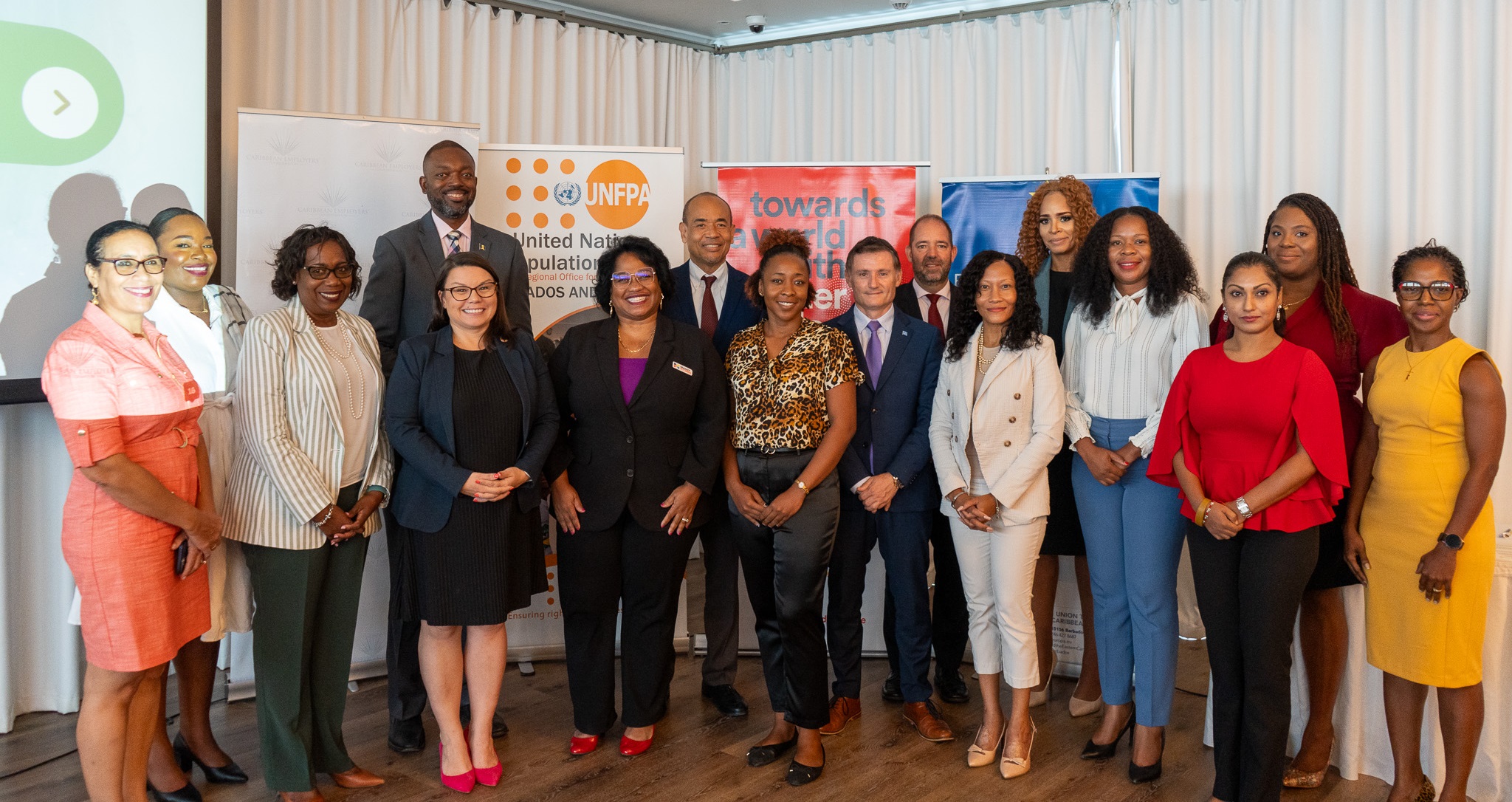
CEC Launches Workplace Policy to Promote Eliminating Gender-based Violence
BRIDGETOWN, BARBADOS. SEPTEMBER 18, 2023 – The workplace must become another line of defense against Gender-based Violence (GBV) and Caribbean businesses must establish policies to ensure that this is the case.
This call came recently from President of the Caribbean Employers Confederation (CEC), Wayne Chen, as he delivered the opening remarks at the launch of a Gender-based Violence (GBV) Workplace Policy, which is part of the Caribbean Regional Programme of European Union-United Nations Spotlight Initiative, designed to empower employers to play their part in the work to end violence against women and girls (VAWG).
Under the theme “From Awareness to Action: Transforming the Caribbean Workplace to End Violence Against Women”, the launch of United Nations Population Fund (UNFPA)-led initiative, featured a range of speakers representing the interests of labour, as well as the regional diplomatic corps. A total of eight businesses from Barbados, Antigua and Barbuda, and Trinidad and Tobago, formally demonstrated their commitment to implementing policies to end gender-based violence in the workplace, during a signing ceremony of the official policy.
In addressing the gathering, President Chen noted that the milestones from Phase I of the project included the creation of a gender-based violence workplace toolkit, communications materials and training programmes. Phase II, he added, would see support being provided to Caribbean employers to apply these tools to their respective industries and business places. This aspect will be completed in four phases with emphasis on areas as broad as gender equality, victim-centered support, recruitment, reporting and self-defense training.
The CEC President also noted that the COVID-19 Pandemic had exacerbated the issue of VAWG, making the need for initiatives that can create lasting change even more urgent.
David Mogollon, Head of Cooperation, Delegation of the European Union, also addressed the forum describing GBV in the workplace as “simply unacceptable.” He emphasized that interventions in the workplace must be culturally appropriate and embedded within the organisation, to ensure that there is a “zero tolerance approach” at various levels of its structure, to bring about meaningful change.
Jenny Karlsen, Deputy Director, United Nations Population Fund (UNFPA) Sub-Regional Office, Caribbean noted: “It is our collective duty which necessitates the support of everyone, from leadership to individuals to foster a safe working environment for everyone because every person, regardless of gender, deserves to work in an environment free from fear, intimidation, or violence. Together, we can make a difference that touches the lives of every individual, particularly women and girls in the Caribbean.”
UN Resident Coordinator, Didier Trebucq, described the proceedings as “an important moment in our journey towards a safer, more equitable workplace for all.” He noted that with the 2023 global Sustainable Development Goals (SDG) Summit less than a week away in New York, “this is welcome progress on our work to end Gender-based Violence in the region and achieving the SDGs for people everywhere.” Commending the eight companies from three CARICOM Member States who participated in developing the GBV Workplace Policy, the UN Head assured that the UN System will continue to support work undertaken in Barbados and the Eastern Caribbean “to eliminate GBV in all its forms in the workplace and wherever it shows up.”
Commending employers for their part in this critical policy, Barbados’ Minister of Labour, Social Security and the Third Sector, the Hon. Colin Jordan in delivering the Feature Address underlined that “violence and harassment at work, and in the world of work, causes harm to individuals, families, businesses and societies. It affects people’s lives, dignity, health and wellbeing. It also worsens inequality in societies and undermines business productivity. There should be no place for and no tolerance of violence and harassment,” he concluded.
Persons attending the launch were also treated to poignant cultural performances by Barbadian Spoken Word artist Cindy Celeste and singer Rhesa Garnes who both reminded of the importance of women to society.
The resources developed will be available to organizers and HR practitioners across the region, in the hope that in the future more organisations will come on board to implement workplace policies that protect the rights and well-being of their employees.

Caribbean News
Liberty Caribbean Supports Regional Forum on AI, Cyber Resilience and Digital Inclusion
Port of Spain, TRINIDAD & TOBAGO (February 24, 2026) — Liberty Caribbean, the operators of Flow, Liberty Business and BTC, recently served as Gold-Level Partner of the two-day Trinidad and Tobago Internet Governance Forum (TTIGF), themed “The Innovation Paradox – Balancing Progress with Responsibility and Resilience”.
The Digital Divide is of particular interest to Liberty Caribbean and is being addressed through its Charitable Foundation across the region. Low broadband penetration in the Caribbean contributes to diminished opportunities for individuals, communities, and local economies, but with the support of funding partners, this gap can be addressed through a comprehensive programme – JUMP – that focuses on providing access, devices, and digital skills.
“Liberty Caribbean was proud to serve as Gold-Level Partner of the TTIGF because the conversations taking place here shape key digital policies for multiple stakeholders,” said Simone Martin-Sulgan, Vice President and General Manager, Flow Trinidad.
“As technology accelerates at an unprecedented pace, we must ensure that innovation strengthens our societies rather than fragments them. The theme, ‘The Innovation Paradox – Balancing Progress with Responsibility and Resilience,’ speaks directly to the work we do every day: building networks that are not only fast and reliable, but secure, inclusive and future-ready.”
Across the Caribbean, the digital divide remains one of the most pressing barriers to equitable growth. Low broadband penetration limits access to education, entrepreneurship and essential services, and that is why we are deeply committed to closing this gap.
Through the Liberty Caribbean Charitable Foundation and initiatives like the JUMP Programme, the company is expanding access to technology, affordable connectivity and digital skills training so that individuals and communities are empowered to participate fully in the digital economy.
Martin-Sulgan further stated “at Liberty Caribbean, we believe progress and responsibility must move in lock step. By investing in resilient networks, inclusive programmes and trusted partnerships, we are helping to build a Caribbean that is innovative, secure and prepared for the opportunities ahead.”
Topics covered during the Forum, with over 140 participants, included “Securing Critical Infrastructure”, Integrating AI into Digital Transformation”, “The Digital Divide”, The Human Cost of Innovation – Mental Health and Well-being in the Digital Age’, and AI, Cyber Resilience and Regional Innovation”.
Focused on the underlying mandate of the Conference theme thought leaders, innovators, policymakers, technologists, researchers, and community stakeholders were invited to explore how countries can evolve boldly without compromising values or long-term stability.
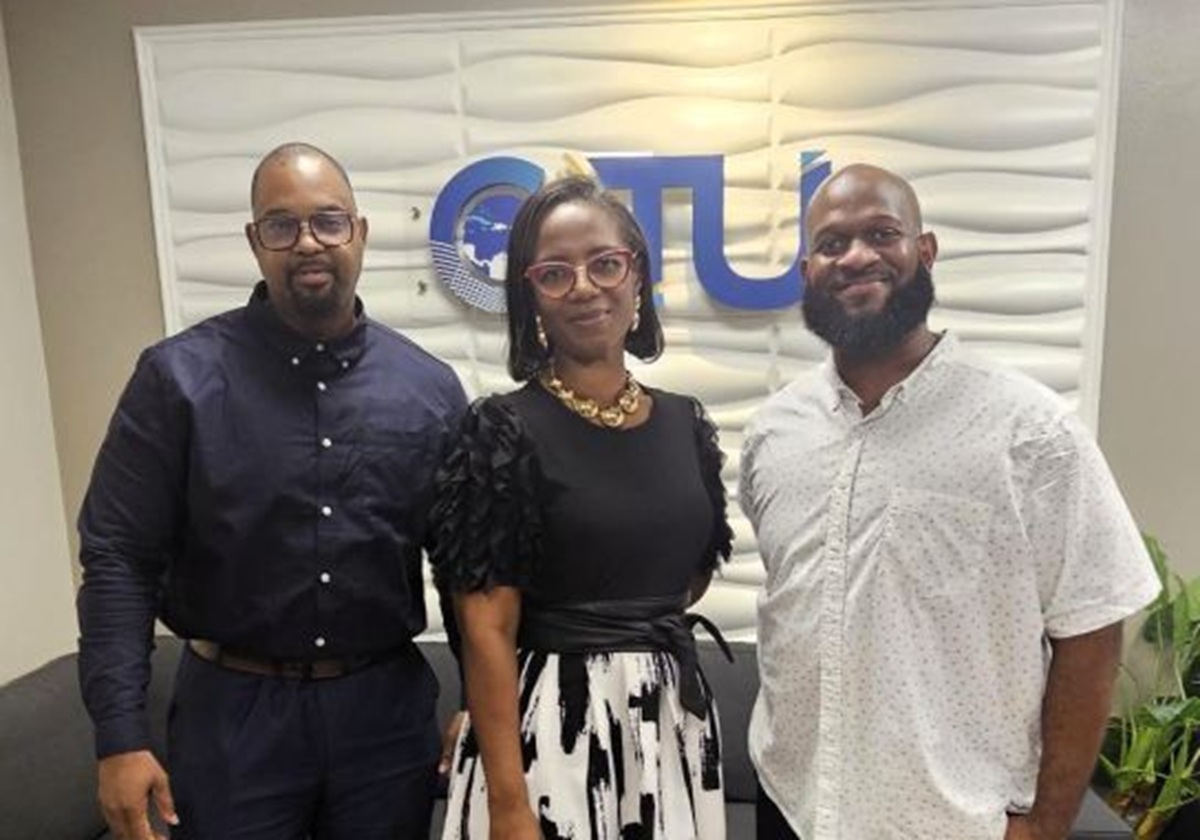
Photo Caption:
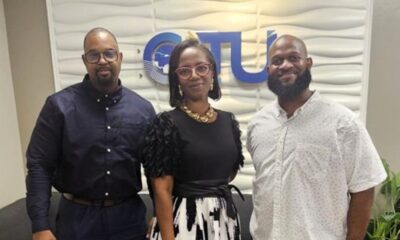
TTIGF – l-r Darren Campo, Regulatory & Compliance Officer; Yolande Agard-Simmons, Senior Manager Communications; and Kevon Swift, Senior Manager Government and Regulatory Affairs of Flow Trinidad in attendance at the Post Event Mixer at Caribbean Telecommunications Union’s Head Office in St Clair, Port of Spain
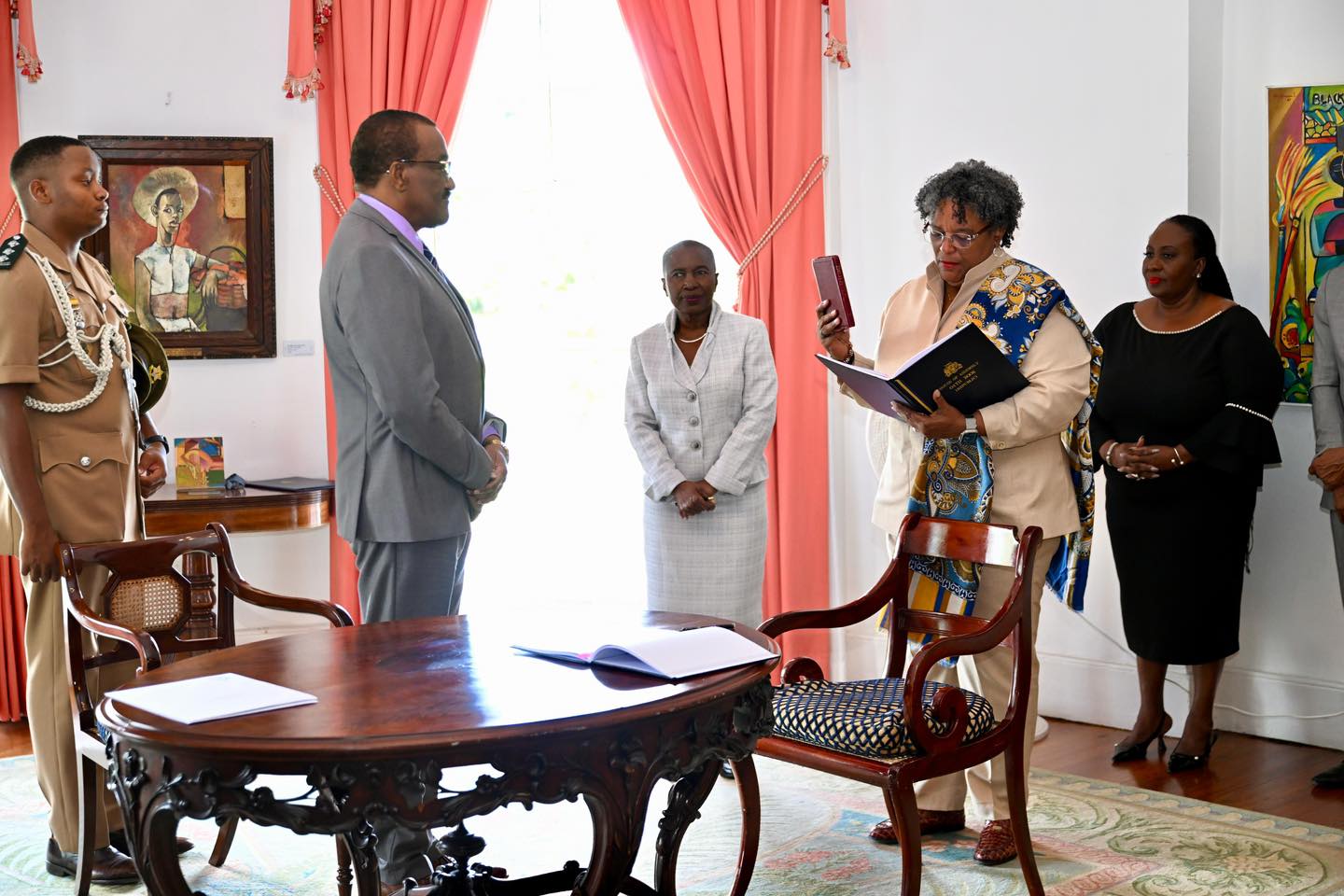
Barbados, February 12, 2026 – Prime Minister Mia Amor Mottley was this afternoon officially sworn in for a third consecutive term, hours after delivering one of the most emphatic election victories in Caribbean political history — another complete capture of all 30 seats in Barbados’ House of Assembly.
The ceremony, conducted by President His Excellency Lt. Col. The Most Honourable Jeffrey Bostic, marked the formal start of a new administration following the February 11, 2026 general election, which returned the Barbados Labour Party (BLP) to power with a renewed and overwhelming mandate.
In a statement after taking the oath, Mottley said she accepted the responsibility “with humility and resolve,” thanking the people of Barbados for placing their trust in her leadership once again and urging national unity as her government begins its new term. Attorney Wilfred Abrahams was also sworn in as Attorney General.
The result is historic not only for its scale but for its consistency. This is the third straight general election in which the BLP has won every constituency, reinforcing Mottley’s dominance in national politics and extending an unmatched era of one-party control in the modern democratic period.
Voting day unfolded under the watch of a CARICOM Election Observation Mission, led by Antigua and Barbuda’s Supervisor of Elections Ian Hughes and supported by senior electoral officials from Belize and Jamaica. The team engaged key institutions ahead of the poll and monitored the process across the island.
Regional leaders were swift in their congratulations.
Guyana’s President Irfaan Ali described the outcome as “emphatic and historic,” saying the clean sweep reflected how deeply Mottley’s leadership has connected with Barbadians and expressing optimism about strengthening ties between the two countries.
Jamaica’s Prime Minister Andrew Holness also hailed the victory, noting that her re-election provides an opportunity to deepen cooperation within CARICOM and advance shared regional priorities.
The scale of the win again leaves Barbados without a parliamentary opposition, a reality that has become a defining feature of the political landscape since 2018. Supporters argue the repeated mandate reflects public confidence in Mottley’s stewardship of economic reform, climate diplomacy, the transition to a republic, and Barbados’ expanding global influence.
Now, newly sworn in and backed by another unanimous parliamentary majority, Mottley begins a third term with both extraordinary political capital and equally high expectations at home and across the region.

Liberty Caribbean is Diamond Sponsor of CANTO Connect 2026 and 42nd AGM
Port of Spain, TRININDAD & TOBAGO (February 1, 2026) — Liberty Caribbean, the operators of Flow. Liberty Business and BTC, has reaffirmed its commitment to turning regional connectivity into measurable economic and social outcomes as Diamond Sponsor of CANTO Connect 2026 and its 42nd Annual General Meeting.
CANTO is the leading regional body that brings together telecommunications operators, ICT providers, regulators, governments, and industry partners to support the development of the Caribbean’s digital and communications landscape.
Simone Martin-Sulgan, Vice President and General Manager, Flow Trinidad & Tobago delivered the sponsor’s address on behalf of Liberty Caribbean.
“The work of laying fibre and lighting towers is done; connectivity is now our foundation,” she said.
“The real task before us is to translate that foundation into innovation, productivity and prosperity for our people. Intelligent connectivity, such as networks designed for 5G, AI and IoT, will be the platform for smarter public services, more resilient systems and scaled opportunities for Caribbean entrepreneurs.”
Martin-Sulgan emphasised that infrastructure alone will not deliver sustainable progress.
“Digital progress must become digital prosperity. That means creating career pathways for young people, helping local businesses scale and ensuring citizens across our communities can fully participate in the digital economy. A connected Caribbean should also be a confident, creative and globally competitive Caribbean,” she said.
Liberty Caribbean is represented by a senior delegation at CANTO Connect to support the conference objectives of aligning policy, investment and execution across the region under this year’s theme ‘Elevate the Caribbean – From Connectivity to Global Competitiveness’.
Liberty Caribbean’s delegation includes Inge Smidts, Chief Executive Officer; Desron Bynoe, VP and General Manager, Flow Barbados; Susanna O’Sullivan, VP and General Manager, North Caribbean; Marilyn Sealy, Senior Director, Head of Communications; Dominic Boon, VP, People; Daniel Neiva, Chief Commercial Officer, B2B; Bradley Ramcharan, Director, B2B, Trinidad & Tobago; Yolande Headley, Country Manager, Dutch East Caribbean; and Jade Reymond, Country Manager, Flow Anguilla.
Martin-Sulgan thanked CANTO’s local secretariat for convening the forum and urged delegates to convert conversation into action.
“If we align policy, capital and capability, the Caribbean can move from connectivity to competitiveness. Liberty Caribbean will continue to invest in resilient networks, nurture homegrown talent and partner to deliver measurable social and economic value across our markets,” she said.





-
 News7 days ago
DDME Staff Strengthen Disaster Management Capacity Through Professional Development Workshop
-
 Caribbean News1 week ago
Liberty Caribbean Supports Regional Forum on AI, Cyber Resilience and Digital Inclusion
-
 News7 days ago
The Turks and Caicos Islands Set Positive Start to 2026 with Increase in January Stayover Arrivals