
Caribbean News
Veteran Journalist, Lloyd B. Smith, Conferred with Order of Distinction

BY: SERENA GRANT
JIS
#MontegoBay, Jamaica, November 14, 2022 – The name Lloyd Barnes Smith is synonymous with the city of Montego Bay, St. James as is the popular and much sought-after community newspaper, The Western Mirror, which he has helmed for over 30 years.
Widely referred to as ‘The Governor’, Mr. Smith is renowned for journalistic prowess, sharp business acumen and unwavering generosity to his beloved city.
For these traits, he has, this year, unsurprisingly been conferred with the Order of Distinction in the rank of Officer (OD) for service in the field of Business, Media and Community Service.
The award was presented by Governor-General, His Excellency the Most Hon. Sir Patrick Allen, during the National Honours and Awards Ceremony at King’s House on Monday (October 17), which was celebrated as National Heroes Day.
Born and bred in Mount Salem, Montego Bay, Mr. Smith tells JIS News that he always loved to write.
The proud Cornwall College alumnus discloses that it was during his time in school that he discovered his love for writing after winning a national essay competition.
“I knew I had this innate ability to write and, interestingly, when I was at Cornwall, the boarders would seek to engage young ladies from [neighboring] Mount Alvernia High School for Girls and Montego Bay High School for Girls; in those days you had to write love letters. The letters sometimes took the form of poetry or quotes or just a play on words, and I ended up making quite a little fortune writing the letters for them,” Mr. Smith recounts with a chuckle.
After graduating from Cornwall College, instead of hurdling head-on into the writing career for which he was destined, Mr. Smith went the more traditional route of teaching.
He tells JIS News that he was among the first batch of students to attend the Church Teachers’ College in Manchester, “because the college had just opened and a few of us were selected. I think it was 75 of us in all, to start; later, I graduated with credit from the college.”
Among the schools at which Mr. Smith taught were Holmwood Technical High School and Craig Head Primary School in Manchester, and St. Georges College and Kingston College in Kingston.
He also served as Principal of Oxford Preparatory School. However, during his tenure there, he saw an opportunity to finally segue into his dream career.
“I saw an advertisement in the paper where this particular publishing firm was looking for an editor, and I was always keen on getting back fulltime into publishing and ultimately journalism. It was McGraw Hill, a very well-established publisher internationally, and Kingston Publishers was the local agent for them. So, I got the job and became the editor at Kingston Publishers. I was there for quite a while, editing a few books,” Mr. Smith informs
The journalist established himself as a literary exponent when he edited the first two books ever published about National Hero, the Right Excellent Sir Alexander Bustamante.
The first was entitled ‘Alexander Bustamante and Modern Jamaica’ by Professor George Eaton, which was published in 1975, while the second, ‘Bustamante and His Letters’ by Frank Hill, released the following year.
After making his mark at Kingston Publishers, Mr. Smith joined Jamaica Publishing House, a subsidiary of Teachers’ Book Store, in a sales and marketing position, based in Kingston. He was, however, promoted to the entity’s Western Regional Manager, which saw him returning to Montego Bay.
Now back home, Mr. Smith once again gave in to his urge to write. Always still in pursuit of his journalism dreams, he approached the editor of a small community newspaper based in Montego Bay, called The Beacon, to write a column.
“I started to write a column under the pseudonym ‘The Republican’. It turned out to be a very controversial column because I was hitting left right and centre, upsetting the status quo, making life miserable for those in authority,” the newsman says with a twinkle in his eye.
The stir created by Mr. Smith’s column reflected in paper sales, and the rest is history. Soon, destiny landed him a full time job at The Beacon, where he became the editor. However, when he started in his new job, he realised that the publication’s operations were collapsing.
The owner and director of the paper, who had welcomed Mr. Smith with open arms, unceremoniously left the entity.
The entity also suffered the misfortune of its printing press being seized by the bank funding its operations through a loan, for which the equipment was used as collateral, after the firm defaulted.
This made the newspaper heavily dependent on a popular printery in Montego Bay, a move which drained its then meagre funds. These misfortunes left a shocked Mr. Smith to pick up the pieces.
“The paper was crumbling, no ads; [for] many weeks, [the] staff didn’t get paid. I even went home for several weeks [with] no salary and the workers started to rebel; there was unrest,” he recounts.
“One day, one of the workers said, ‘Mr. Smith, you look like our only hope here; what can you do for us? We want you to take over the business’. I said ‘I couldn’t do that. If I were to move in such a position, you all would have to write a letter that clearly [states this]’; so they did the letter,” he says.
Thereafter, the editor formed a management team and got to work, and in 1980, out of the ashes of The Beacon, The Western Mirror was born, published by its own publishing arm, Western Publishers Limited.
It was not an easy undertaking, as rebuilding the company took grit, determination and, most of all, heart.
Mr. Smith recounts how the company finally acquired another printing press but, unfortunately, they could not afford to charter a vehicle to bring it the paper’s location. He emotionally recalls how dedicated staff members pushed the press on a cart across town to the Western Mirror’s location at the time.
Even with his running of the newly formed company, Mr. Smith was awarded a media fellowship by the then United States Information Service (USIS) to study mass media at the Newhouse School of Communication at Syracuse University, New York, USA, in 1985.
With over 45 years in media and contributions to several other fields, Mr. Smith’s accolades and professional accomplishments read like the making of a well-rounded man of excellence.
In addition to being Managing Director and Editor-in-Chief of the Western Mirror, Mr. Smith holds the distinction of being the longest serving columnist of the Jamaica Observer, writing for the publication since its inception in 1993. He also copped the Pegasus News Chief Award and the Advertising Agencies Association of Jamaica (AAAJ) Media Personality of the Year and lifetime achievement Award, in 2008.
The veteran also received the Sam Sharpe Award for Journalism from the St. James Municipal Corporation and Montego Bay Chamber of Commerce and Industry Award for notable contribution in the field of Journalism.
Under Mr. Smith’s leadership, the Western Mirror has received numerous awards and citations, including the Press Association of Jamaica’s Best Small Publication Award on six occasions, the Marcus Garvey First Memorial Achievement Award, Print Media and the St. James Parish Council Trailblazer Award in recognition of Montego Bay’s 35th Anniversary of its attainment of city status.
In addition to his media career, Mr. Smith is a former Member of Parliament and was Deputy Speaker of the House of the House of Representatives in 2011.
In the area of philanthropy, Mr. Smith was the chief sponsor and organiser of the Lloyd B. Smith Community Football League in St. James from 1979 to 2019. He is also an honorary director of the Committee for the Upliftment of the Mentally Ill (CUMI), and a Justice of the Peace (JP).
He is an accomplished theatre actor and was first from western Jamaica to cop the local Actor Boy Award for Best Actor in a Leading Role.
Mr. Smith is married and the proud father of two children.
While his list of accolades keeps growing, the veteran newsman remains the undisputed ‘Governor’ of Montego Bay.
Contact: Serena Grant
Release: JIS
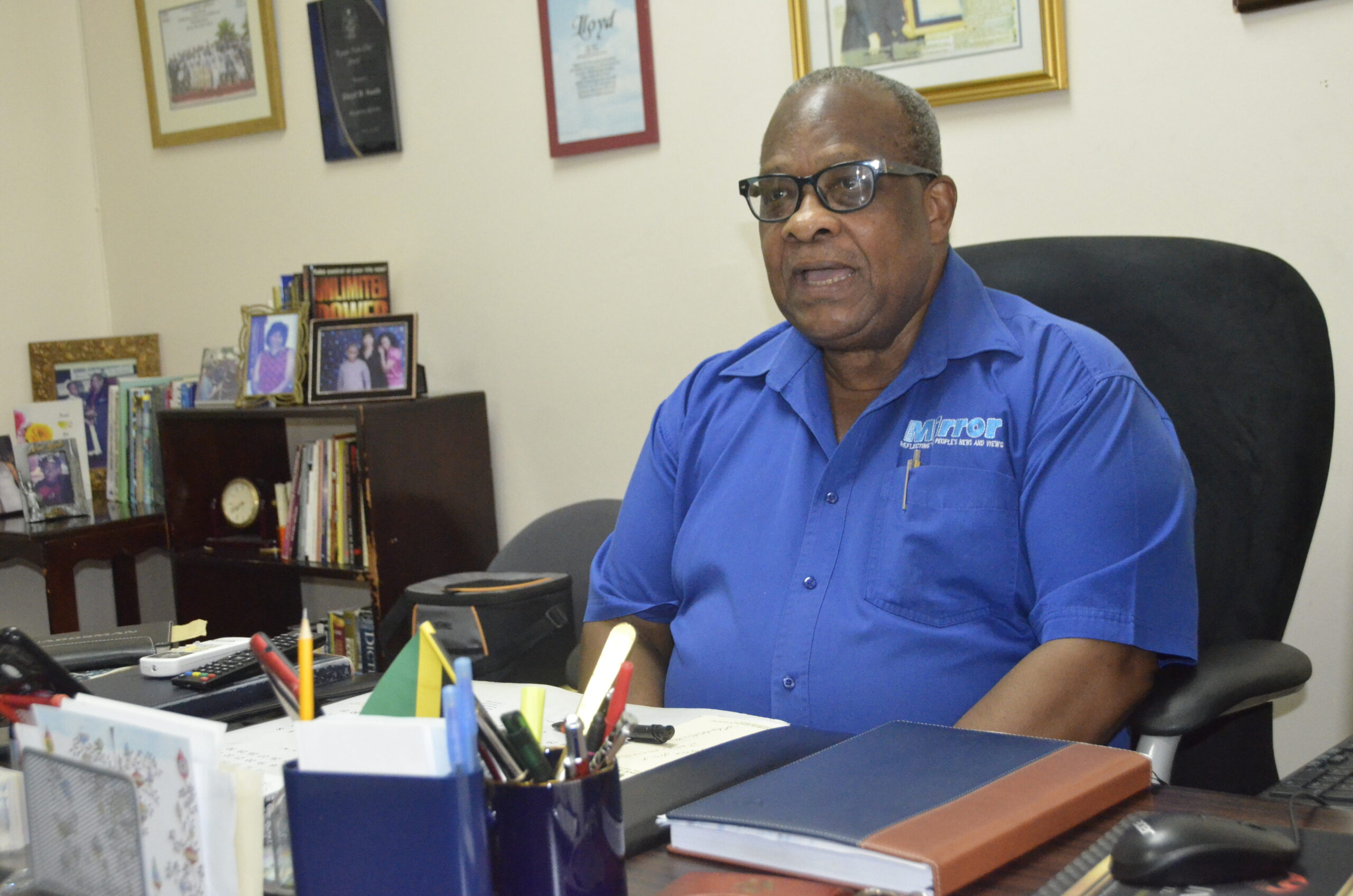
Photo Caption: Managing Director and Editor-in-Chief of the Western Mirror, Lloyd B. Smith.
Serena Grant Photo

By Deandrea Hamilton | Editor
September 28, 2026 – Wall Street initially flinched at the $3-billion handshake. But in a matter of days, it was smoother sailing.
Perhaps the bigger Caribbean business story is not what Sandals Resorts International is getting from the deal. It is who is writing the cheque — and what that says about what Gordon “Butch” Stewart built.
As reports of Royal Caribbean Group’s Sandals deal circulated Tuesday, RCL shares plunged 6.14 percent from Monday’s $250.25 close to $234.89, on sharply elevated trading.
When the agreement became official Wednesday — approximately $3 billion for a 50 percent equity interest in Sandals and Beaches Resorts — shares slipped another 1.95 percent to $230.30 and touched $222.22 intraday. Investors were digesting both the size of the investment and committed debt financing secured through Morgan Stanley.
But by Thursday, RCL rebounded 3.77 percent, with shares continuing their recovery Friday to finish the week around $243. Analysts were also looking ahead: JPMorgan reportedly raised its RCL price target from $345 to $394, while Citi placed the company on a 90-day positive catalyst watch.
And just who is RCL?
Royal Caribbean Group is a global vacation giant, publicly traded on the New York Stock Exchange with a market value of roughly $65 billion. Its portfolio includes Royal Caribbean International, Celebrity Cruises and Silversea, alongside private destinations and an expanding vacation platform.
So when a company of that scale commits $3 billion for only half of Sandals and Beaches Resorts, the transaction puts a striking financial marker on one of the Caribbean’s greatest home-grown hospitality success stories.
The deal, expected to close in early 2027, creates a 50-50 partnership with the Stewart family and takes Royal Caribbean deeper into the all-inclusive resort business.
Butch Stewart started Sandals in Jamaica in 1981 believing a Caribbean company could compete with the world’s best.
Forty-five years later, one of the world’s biggest vacation companies is prepared to pay $3 billion just to own half of what he built.
Now that’s the handshake that does more than seal a deal — it cements a legacy.
Caribbean News
Royal Caribbean Group and Sandals Resorts Announce Landmark Partnership to Accelerate Their Leading Vacation Experiences
Royal Caribbean Group Investment to Advance Sandals and Beaches’ Growth and Broaden the Group’s Vacation Portfolio
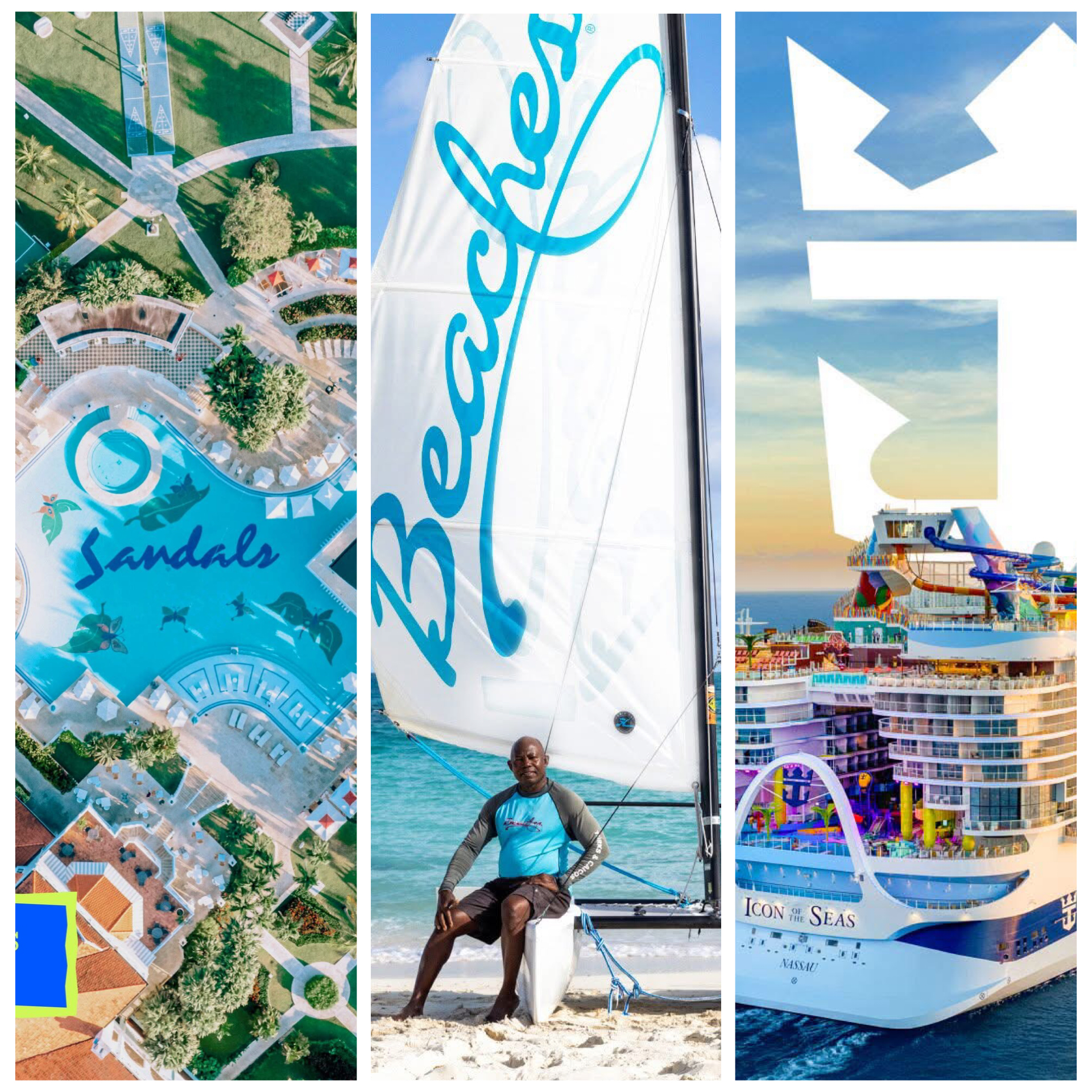
Montego Bay, Jamaica and Miami, September 24, 2026 – Royal Caribbean Group (NYSE: RCL) and Sandals Resorts today announced the signing of an agreement to form a partnership in the all-inclusive resort space with a 50% investment from Royal Caribbean Group. Building on Sandals and Beaches Resorts’ more than four decades of leadership in Caribbean hospitality, the joint venture will create new opportunities for continued resort growth while broadening the experiences across Royal Caribbean Group’s vacation platform.
The partnership brings together two of the travel industry’s most celebrated vacation companies, pairing Sandals and Beaches’ all-inclusive resort expertise with Royal Caribbean Group’s vacation platform, including industry-leading brands – Royal Caribbean, Celebrity Cruises and Silversea – a portfolio of private destinations, new river cruising offering, and an industry-first loyalty program. United in a shared history in the Caribbean and connected by a love for their communities, the companies will offer travelers an unparalleled collection of cruise, private destination and resort experiences, serving guests across more vacation occasions and establishing their undisputed leadership in Caribbean vacations.
The joint venture expands Royal Caribbean Group into an adjacent vacation category, growing its participation in the approximately $2 trillion global vacation market, and meets the growing global demand for Sandals and Beaches Resorts by accelerating their expansion. The partnership will include Sandals and Beaches’ collection of premier all-inclusive properties across the Caribbean, and the companies will explore opportunities to broaden distribution, deepen guest engagement, and make it easier for travelers to discover vacation experiences offered across both portfolios.
“For nearly 60 years, we’ve reimagined what a vacation can be, constantly expanding the ways we inspire our guests to explore, connect and create lifelong memories,” said Jason Liberty, Chairman and CEO, Royal Caribbean Group. “We have been building a vacation platform that brings joy to millions of people around the world and creates meaningful relationships that last with our guests. Our partnership with Sandals and Beaches Resorts is an important next step on that journey – bringing together two iconic leading vacation companies to further strengthen and grow one of the most admired resort portfolios in the world. The Stewart family has created powerful and beloved brands, and we are honored to build on that legacy. Together, we see tremendous opportunity to expand the reach of Sandals and Beaches Resorts and continue turning the vacation of a lifetime into a lifetime of vacations.”
“My father, Gordon ‘Butch’ Stewart, founded Sandals Resorts with the belief that a company built in the Caribbean could stand on the world stage alongside the most respected names in hospitality. Today is proof of how far that vision can go,” said Adam Stewart, Executive Chairman of Sandals Resorts and Beaches Resorts. “This partnership is the natural next step in building on that conviction. It gives us the ability to grow faster with a partner that shares our values of exceptional hospitality, long-term investment, and the power of enduring brands. Together, we will introduce more guests to Sandals and Beaches Resorts while creating even more extraordinary experiences for those who have made our resorts part of their lives for decades.” Stewart added, “As we continue to grow, we will remain true to what has always defined us: delivering authentic vacations that exceed expectations while creating opportunities for our team members, travel advisor partners and the communities we call home. The future has never been brighter, and I know this moment would make my father incredibly proud.”
The joint venture will be governed by a board under the shared leadership of Stewart and Liberty. Stewart will maintain a leadership role in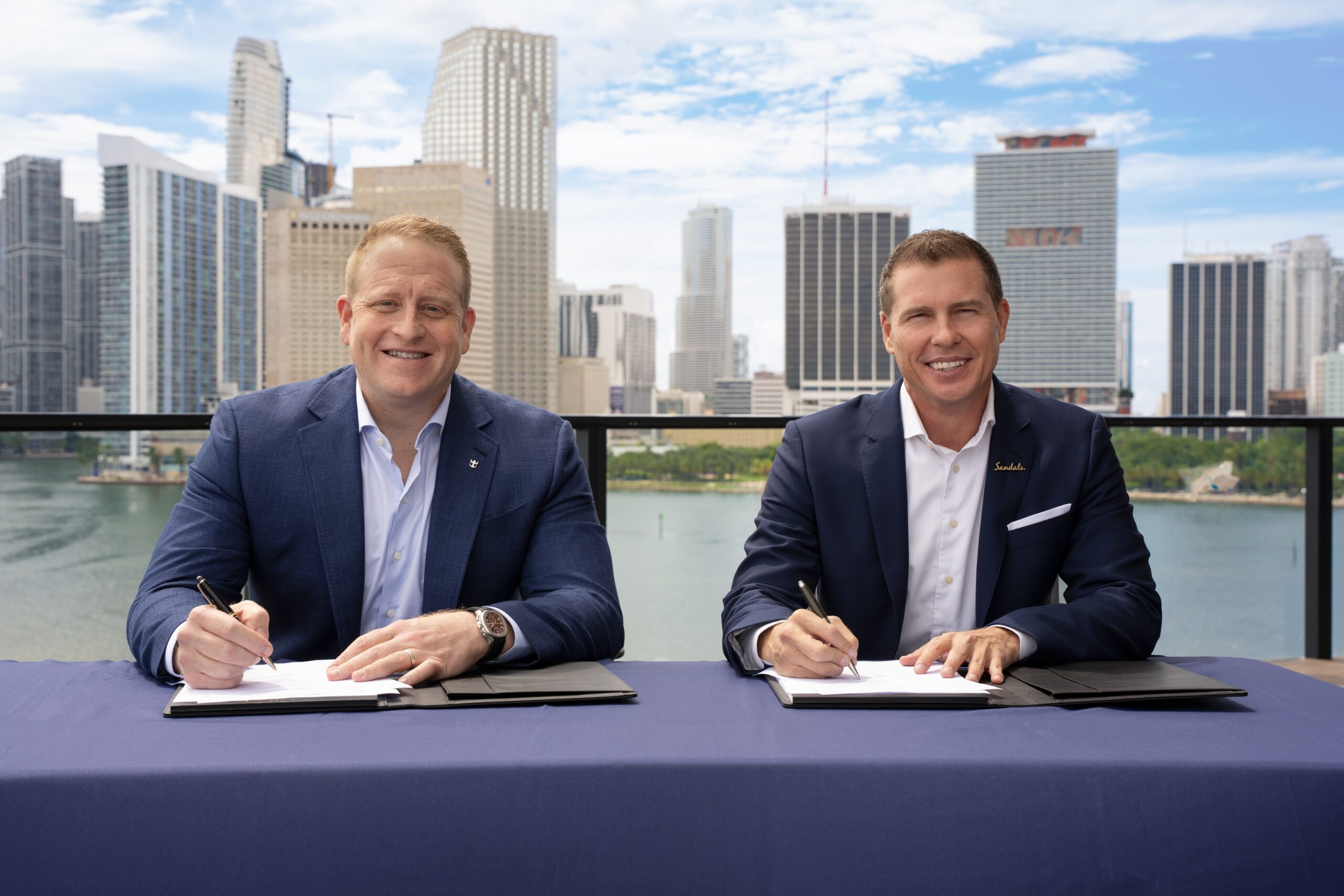 guiding the company’s long-term strategic growth as Executive Chairman of Sandals and Beaches Resorts. Existing reservations, loyalty programs, resort operations and cruise operations will continue as usual, with the partnership bringing additional resources to support future opportunities.
Under the terms of the agreement, Royal Caribbean Group will acquire a 50% equity interest in Sandals and Beaches Resorts for approximately $3 billion, representing a forward EBITDA multiple of approximately 10x. Royal Caribbean Group has secured committed debt financing from Morgan Stanley to fund the investment. The transaction is expected to close in early 2027, subject to customary approvals and closing conditions, and is expected to be accretive to earnings next year.
BofA Securities and PJT Partners acted as financial advisors, and Latham & Watkins and Jones Day acted as legal advisors to the Sandals Group. Perella Weinberg Partners and Morgan Stanley acted as financial advisors and Kirkland & Ellis LLP acted as legal advisor to Royal Caribbean Group.
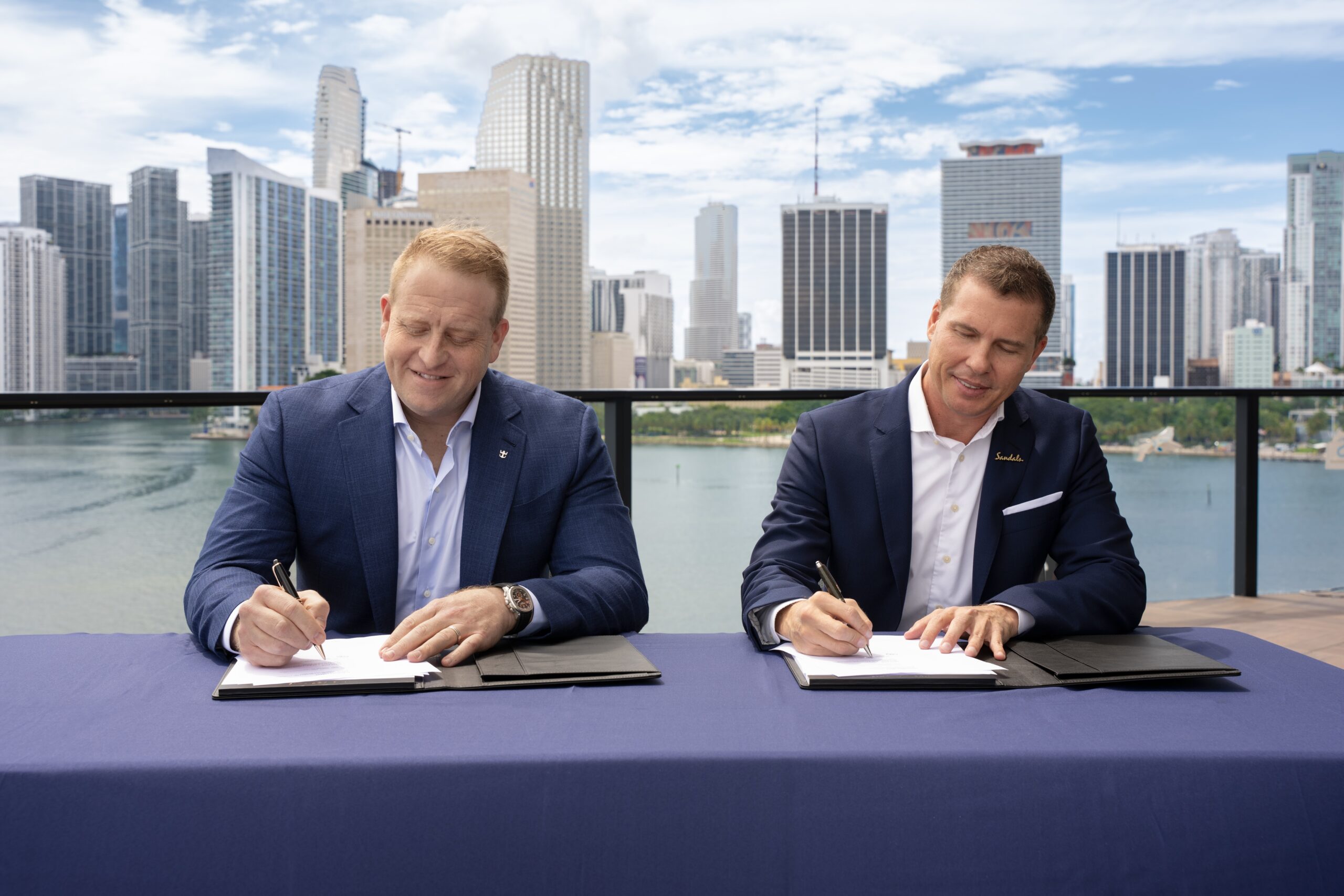
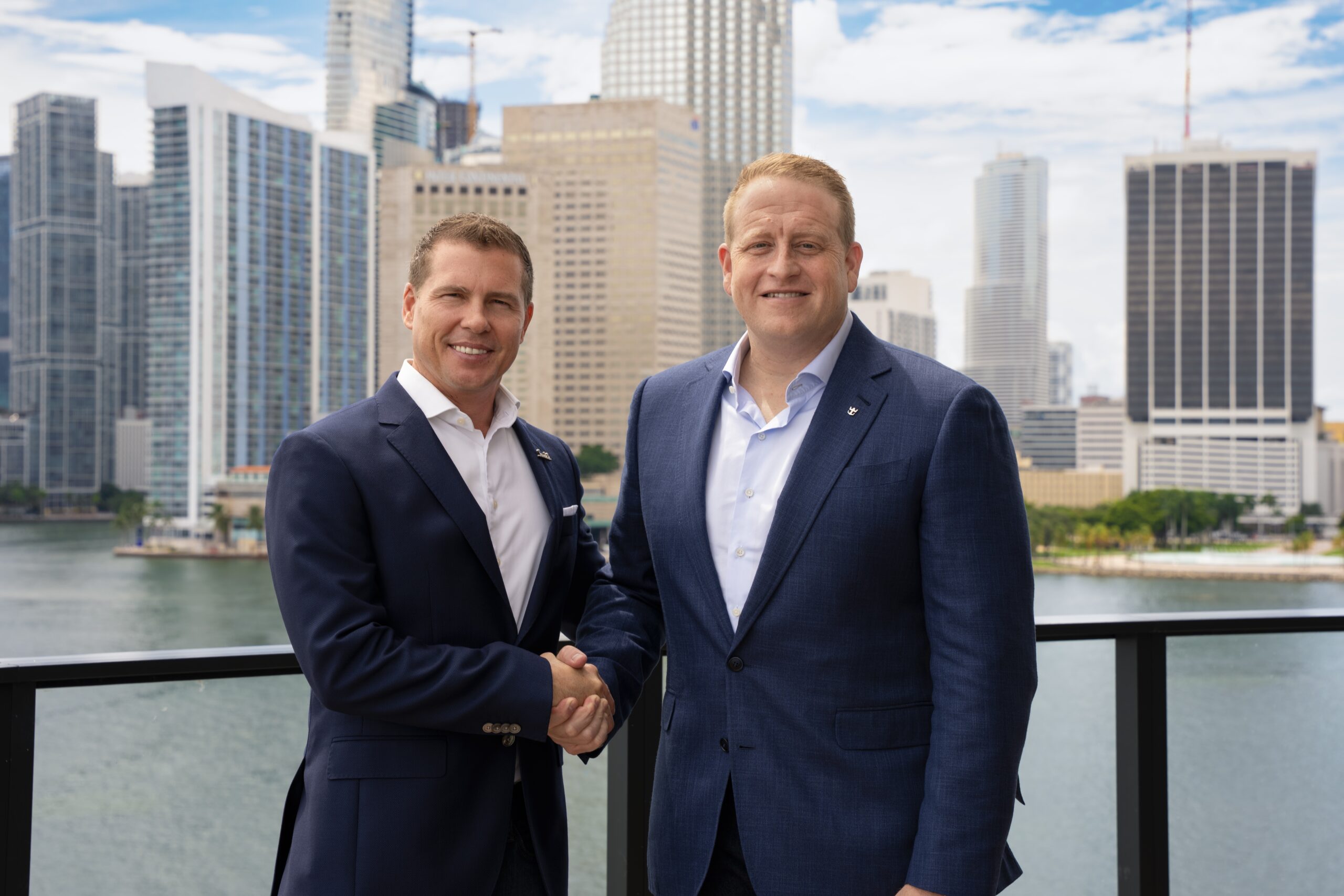
PHOTO CAPTION: Jason Liberty, Chairman and CEO of Royal Caribbean Group, and Adam Stewart, Executive Chairman of Sandals Resorts, mark the signing of an agreement to form a landmark partnership that expands Royal Caribbean Group into the all-inclusive resort space and supports the future growth of Sandals and Beaches Resorts. The signing took place at Royal Caribbean Group’s new headquarters in Miami, with the city’s skyline in the background.
The Caribbean tourism deal first reported as a possibility on Tuesday is now a signed agreement. Royal Caribbean Group plans to pay approximately US$3 billion for a 50% stake in Sandals and Beaches Resorts, putting the value of the business at about US$6 billion. The purchase is expected to close in early 2027, subject to approvals.
Founded in Jamaica by the late Gordon “Butch” Stewart in 1981, the resort business has a presence across nine Caribbean destinations, including Jamaica, The Bahamas and Turks and Caicos. Sandals has described its workforce as nearly 20,000 people, most of them Caribbean nationals.
“My father, Gordon ‘Butch’ Stewart, founded Sandals Resorts with the belief that a company built in the Caribbean could stand on the world stage alongside the most respected names in hospitality,” said Adam Stewart in the announcement carried by PR Newswire. He will remain executive chairman, while the Stewart family retains a stake. The companies say existing reservations and resort operations will continue as usual.





-

 Health1 week ago
Cleveland Clinic First in Ohio to Perform Robotic Nipple-Sparing Mastectomy
-
 News5 days ago
Beaches Turks & Caicos strengthens year-round commitment with local craft vendors and transport operators
-

 News3 days ago
Beaches Turks & Caicos gives Enid Capron Primary a pre-term facelift
-

 Bahamas News6 days ago
Two Months On, The Bahamas Academy of Sciences Turns Fifty Years of Research into Action