
Bahamas News
Government, fulfilling commitment to provide housing for Bahamians

By: Kathryn Campbell
Bahamas Information Services
#TheBahamas, May 18, 2022 – The Hon. Philip Davis, Prime Minister and Minister of Finance, has underscored the government’s commitment to “strengthening” and “deepening” its “unmatched” legacy of providing access to decent, affordable housing to Bahamians.
“My government is acutely aware of the current housing shortage in The Bahamas and the backlog of housing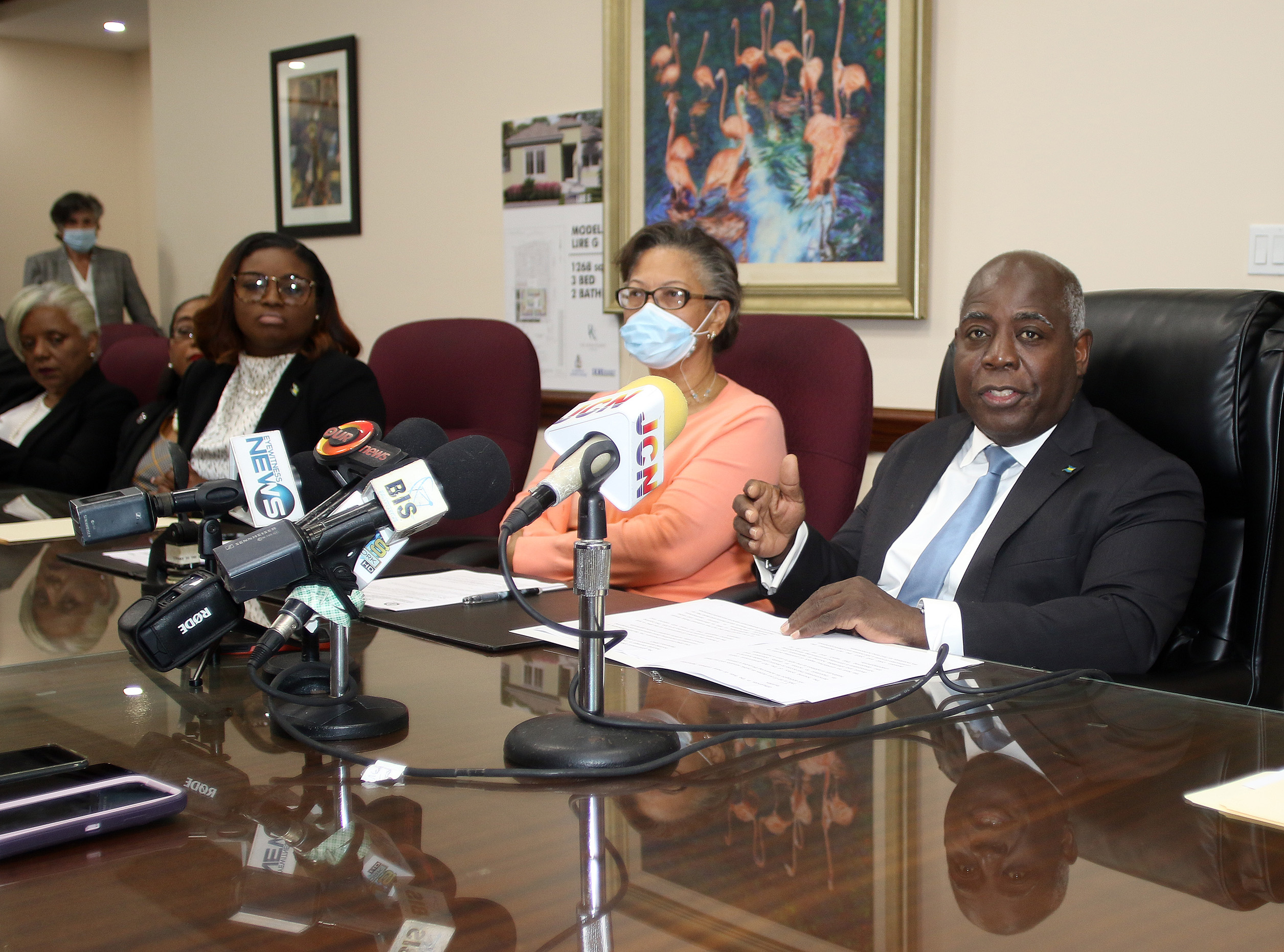 applications at the Mortgage Corporation of The Bahamas (BMC),” said Prime Minister Davis.
“Our BMC Executive Chair, Barbara Cartwright, is committed to expediting those applications and assigning without delay, suitably qualified housing applicants.
“I believe the number of applications at BMC in just the last eight months is in excess of 3,500. This housing demand suggests that we move with urgency and dispatch.”
In this vein, the government, Monday, along with stakeholders, unveiled The Renaissance at Carmichael, a housing sub-division on 70 acres of crown land off Carmichael Road in Western New Providence.
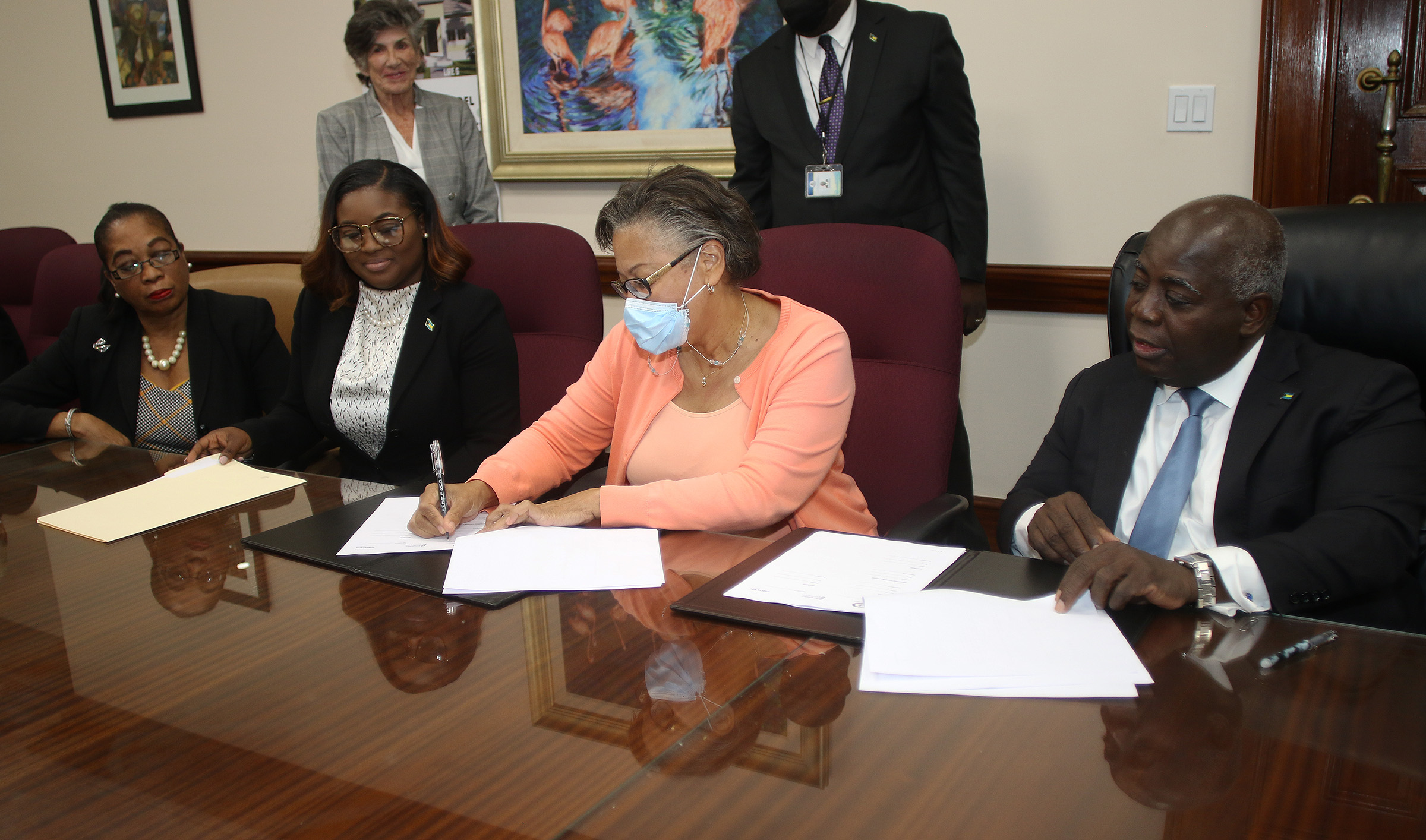
Executives of the government and public-private partnerships (PPP) participated in a ceremonial signing of a Memorandum of Understanding, May 16, 2022 at the Office of the Prime Minister, which will allow Bahamian families the ability to open the doors to 200 new homes.
The subdivision is being funded by a PPP arrangement between the Government, a $20 million backing from PROVEN Wealth Ltd. through Simplified Lending, the Mortgage Corporation of the Bahamas and financiers.
Dignitaries in attendance: the Hon. Jobeth Coleby-Davis, Minister of Transport and Housing; the Hon. Vaughn Miller, Minister of the Environment and Natural Resources; the Hon. Pia Glover-Rolle, Minister of State for the Public Service; Leroy Major, Executive Chairman, Bahamas Agricultural and Industrial Corporation; Nicole Campbell, Secretary to the Cabinet; David Davis and Antoinette Thompson, Permanent Secretaries; Barbara Cartwright, Chairman, Bahamas Mortgage Corporation; Oral Lafleur, Acting Chief Housing Officer; and Thomas Ferguson, Acting Director of Housing. Representatives of private sector partners: Robert Pantry, Founder and CEO, Simplified Lending; Johann Heaven, President and CEO, PROVEN Wealth Limited.
Prime Minister Davis assured that as the economy fully opens and grows, the government expects to expand PPPs in other areas of national economy including public infrastructure providing investments, ownership and job opportunities for Bahamians.
Minister Coleby-Davis said the initiative will set a new standard in affordable housing by which other housing developments will be measured.
She described today’s signing is an “historic” milestone which can be attributed to the commitment of the government to bring to fruition a concept from an idea to reality.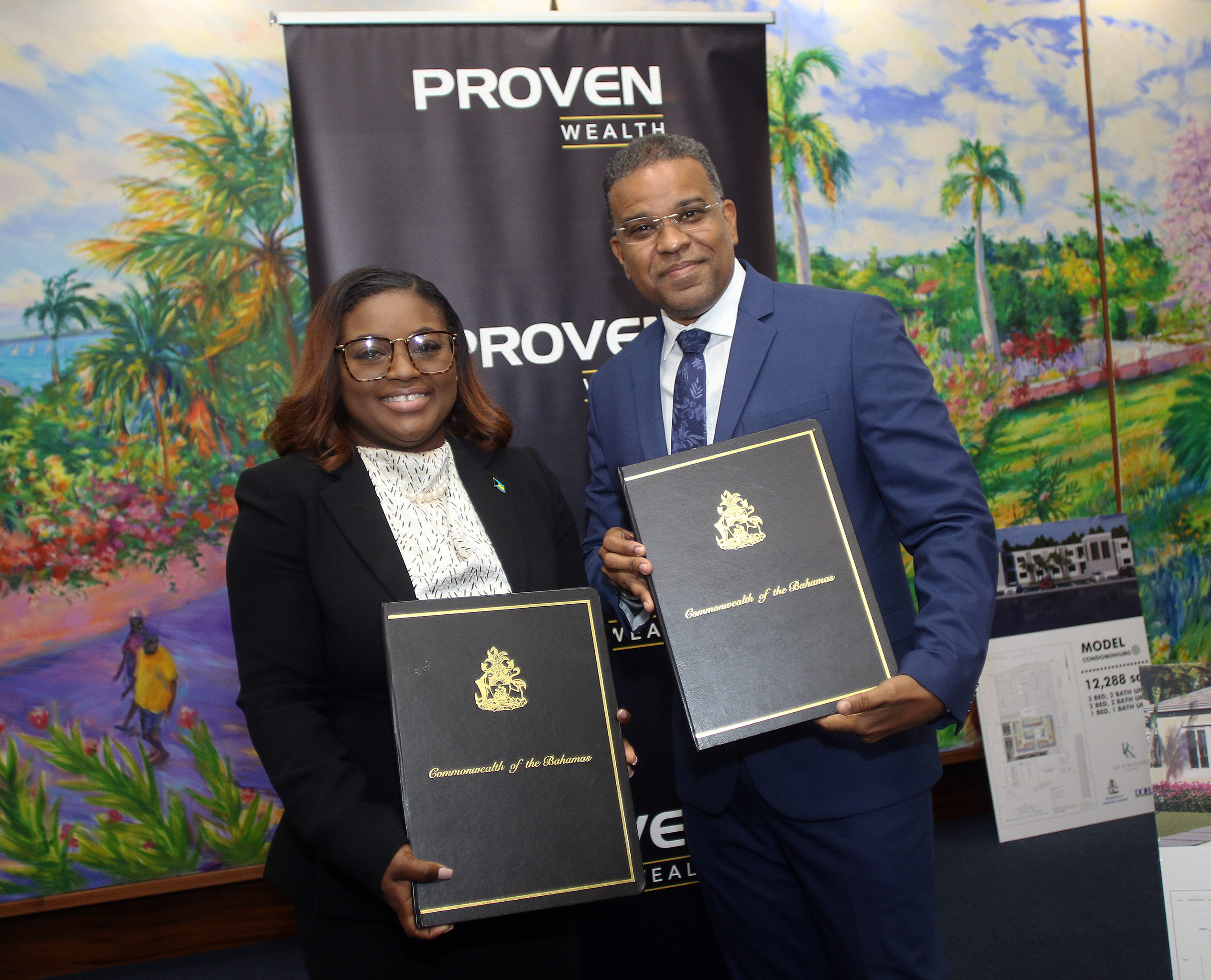
“With this project we intend to create an estate where a sense of community thrives. There will be lit streets, sidewalks; a park where children can play safely and family gatherings can take place. Neighbors will be able to come together and interact as our families were able to do many years ago.
Formerly known as Carmichael Village Sub-division, the community will comprise 104 single family, two and three-bedroom residences, and eight two-storey condominium buildings with 12 units each.
In a video presentation Minister Coleby-Davis said, “Thanks to Simplified Lending, a Bahamian company which secured funding through a leading regional finance company called PROVEN. Many who only dreamed of home ownership will be able to walk through the front door to their new lives in less than one year.”
She informed that homes will be built to the highest quality with steel frame construction, storm-rated windows and doors, attractive facades and strong concrete foundations raised three feet above road level.
“Thanks to careful design, planning and exemptions on certain building supplies, every home will remain in the affordable price range opening doors to home ownership starting at $130,000,” she said.
Mr. Heaven said, “This transaction today will be primarily funded through the Bahamian portion of our Heritage education fund which is a regional education savings plan that is over 30 years old and is a household name for saving for your children’s tertiary education.”
The government broke ground for Pinecrest Sub-Division, a 43-lot community in Southern New Providence in January of this year.
Release: BIS
BIS Photos/Patrick Hanna
Header: From left: Antoinette Thompson, Permanent Secretary; the Hon. Jobeth Coleby-Davis, Minister of Transport and Housing; Nicole Campbell, Secretary to the Cabinet and the Hon. Philip Davis, Prime Minister and Minister of Finance.
1st insert: The Hon. Philip Davis, Prime Minister and Minister of Finance, is pictured speaking at the signing of Memorandum of Understanding for The Renaissance at Carmichael, a new sub-division in western New Providence.
2nd insert: The Hon. Jobeth Coleby-Davis, Minister of Transport and Housing and Johann Heaven, President and CEO, PROVEN Wealth Ltd., after ceremonial signing of the Memorandum of Understanding.

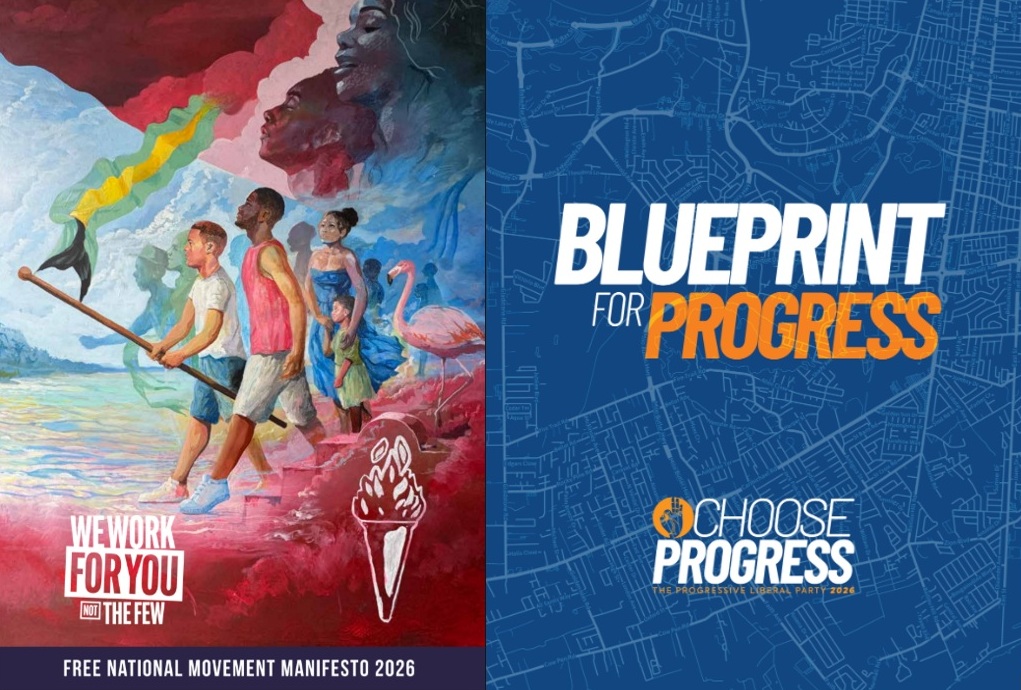
The Bahamas, April 14, 2026 – With the 2026 Bahamian general election set for May 12, the country’s major political parties have now formally placed their plans before the electorate, offering competing visions for governance, growth and relief.
The governing Progressive Liberal Party (PLP), led by Philip Davis, launched its “Blueprint for Progress 2026” on April 8, 2026, outlining a 46-page plan focused on long-term development and systems reform. The document places heavy emphasis on energy transition, digital government, workforce training and food security, positioning the party as one seeking continuity following its first term. The full plan is publicly available online through official PLP platforms for voters to review.
Just days later, on Sunday, April 12, the opposition Free National Movement (FNM), under Michael Pintard, unveiled its 2026 Manifesto at a major event in Nassau. Spanning 54 pages, the document centers on cost-of-living relief, tax reform, healthcare expansion and housing, offering what the party describes as a more immediate response to economic pressures facing Bahamian families. The FNM has also made its manifesto accessible online.
Beyond the two major parties, the Coalition of Independents (COI) had already entered the policy space earlier, formally unveiling its long-range Vision 2030 framework on Saturday, March 1, 2025, at the Fusion Superplex in Nassau during a packed national launch led by party leader Lincoln Bain. That framework has since been complemented by a 100-day action plan released in late March/early April 2026, adding a short-term policy layer to its long-range proposals.
These policy rollouts come as the country prepares for a pivotal vote, with the Parliamentary Registration Department confirming a voters’ register of approximately 203,000 eligible voters, one of the largest in the nation’s history. Key dates are now set, with Nomination Day on April 16, followed by advance polls on April 30, ahead of General Election Day on May 12.
With platforms now in the public domain and the timeline locked in, the focus shifts squarely to the electorate—who must now weigh the promises, examine the plans and decide the country’s direction at the polls.
Angle by Deandrea Hamilton. Built with ChatGPT (AI). Magnetic Media — CAPTURING LIFE.

The Bahamas, April 14, 2026 – At its core, the $65 million water security project is designed to strengthen the reliability, safety and resilience of the water supply across The Bahamas.
If implemented as planned, the investment is expected to improve water quality, reduce contamination risks and support public health, while increasing supply reliability and limiting service disruptions during droughts or system failures. The project also aims to expand and upgrade infrastructure, including wellfields, pumping stations and storage capacity, and to protect freshwater resources from saltwater intrusion—an increasing threat for low-lying islands. In practical terms, that could mean cleaner, more consistent and more dependable access to water for residents across the country.
The project was first conceptualised in 2019 under the previous administration, when a proposal was submitted to the Green Climate Fund to strengthen the resilience of the country’s water systems. That early work came just months before Hurricane Dorian exposed the vulnerability of national infrastructure, including critical water and sanitation systems, particularly in the northern Bahamas.
The initial phase focused on developing the concept, identifying priority areas and engaging regional and international partners, including the Caribbean Development Bank, to support the design and preparation of a full funding proposal.
Following the change in government in 2021, the project advanced into its most technical and demanding stages. The current administration oversaw the completion of key requirements, including feasibility studies, environmental and social assessments, and detailed financing negotiations with international partners—steps necessary to move the proposal from concept to approval.
That multi-year process has now culminated in approval of a $65 million financing package, combining grant funding with concessional loans to support long-term upgrades to the country’s water infrastructure.
While the project brings significant international support, it is not entirely free money. The package is structured as a blended financing arrangement, combining grant funding with concessional loans—meaning a portion of the funding will ultimately need to be repaid. Based on information released by the Caribbean Development Bank, approximately $25 million of the total package is tied to loan financing, with the remaining portion provided as grant support.
Concessional loans typically carry more favourable terms than commercial borrowing, including lower interest rates and longer repayment periods. However, they still represent debt obligations that will be borne over time.
Notably, detailed terms of the loan components—including interest rates, repayment schedules and any associated conditions—were not disclosed in the initial announcement issued by the Office of the Prime Minister (Bahamas). Those details are expected to be outlined in formal financing agreements, but have not yet been made public.
For Bahamians, the project represents both investment and obligation. While the grant funding provides a significant boost to infrastructure development, the loan component adds to the country’s long-term financial commitments—making transparency around terms and implementation timelines especially important.
While the approval marks a significant milestone, the timeline for delivery remains a critical factor. Based on information available from project partners, implementation is not expected to begin immediately. The initiative is anticipated to move into its execution phase later in 2026, following finalisation of financing agreements and completion of preparatory requirements.
From there, the project is projected to unfold over several years, with estimates suggesting a multi-year implementation period of up to seven years to fully deliver the planned upgrades to water infrastructure across The Bahamas.
This means that while the funding has now been approved, the benefits will be realised gradually rather than all at once. A definitive completion date has not been publicly outlined, and detailed timelines tied to specific islands or phases of work have yet to be disclosed.
For Bahamians, the question now shifts from approval to execution—when funds are drawn down, when construction begins, and how consistently the project moves from plan to delivery.
Angle by Deandrea Hamilton. Built with ChatGPT (AI). Magnetic Media — CAPTURING LIFE.

NASSAU, Bahamas — What should be a simple five-minute drive is fast becoming an expensive, hour-long ordeal, as rising fuel prices collide with worsening traffic congestion across New Providence.
As of early April 2026, gasoline prices across The Bahamas have climbed sharply, with motorists now paying an estimated $5.50 to over $6.50 per gallon, depending on the station and grade. The increases, seen at major retailers including Esso, Rubis and Shell, reflect a volatile global oil market driven by escalating geopolitical tensions.
The latest spike — in some cases jumping more than 50 cents per gallon within days — is being driven by uncertainty surrounding escalating tensions involving Iran. U.S. President Donald Trump has issued a direct ultimatum, warning that the United States could launch aggressive strikes on Iranian infrastructure, including power plants and key facilities, if demands are not met. While he has also expressed hope for a swift resolution, the threat of rapid escalation is already rattling global oil markets — and The Bahamas, heavily dependent on imported fuel, is feeling the impact almost immediately.
At the pumps, the frustration is real.
Drivers are now paying significantly more just to sit in traffic. Commutes that once took minutes are stretching into hour-long crawls, burning fuel with little movement and compounding the financial strain. For many residents, the issue isn’t just the price per gallon — it’s how quickly that gallon disappears.
Industry players are also bracing for impact. Higher diesel prices are expected to ripple across key sectors, including trucking, construction, and shipping — all of which ultimately feed into the cost of goods and services. In short, this is not just a fuel story; it’s an inflation story in the making.
Despite the surge, the Bahamas Petroleum Retailers Association has moved to calm fears, confirming that there is no fuel shortage. Supply remains stable, but consumers are being urged to adjust behavior — from maintaining proper tyre pressure to considering carpooling — small measures that could stretch every dollar a bit further.
Retailers, however, are not offering much comfort on price relief. While fluctuations are expected, insiders say the days of sudden price drops are unlikely in the immediate term. The “shock” increases may level off, but a meaningful decline hinges on global stability — something that currently feels out of reach.
For Bahamians, the reality is tightening: higher fuel costs, longer commutes, and a growing sense that relief isn’t coming anytime soon.
Angle by Deandrea Hamilton. Built with ChatGPT (AI). Magnetic Media — CAPTURING LIFE.





-

 News5 days ago
Community Emergency Response Training – Blue Hills & Wheeland
-
 News5 days ago
HAITIANS FLEE HOME AS PUSH FACTORS MOUNT; LANDINGS SURGE IN TCI, AGAIN
-
 News5 days ago
TCI Selected from 59 Countries for World Bank AI Programme as Officials Attend Washington Meetings
-

 Caribbean News4 days ago
Team Trinidad & Tobago Makes Waves with Historic CARIFTA Aquatics Performance
-

 News5 days ago
What Planning Board Meeting Exposes about Housing Development in Providenciales
-
 News5 days ago
Multi-Agency Enforcement Action Conducted at Caicos Lodge
-

 Caribbean News4 days ago
Mottley Celebrates CARIFTA Champions After Stunning Relay Upset
-

 Bahamas News4 days ago
New Manifestos Released as Bahamas Heads to Historic May 12 Vote