
Bahamas News
PM: “All the talk about where Grand Bahama can go is over for me. It’s time for action”

By Andrew Coakley
#TheBahamas, February 7, 2022 – Prime Minister of the Bahamas and Minister of Finance, the Hon. Philip Davis says all of the talk about what Grand Bahama can become and where it can go are over for him.
It’s time now, he said for action.
“I know Grand Bahama, having lived here myself in the early seventies, so the time has come for Grand Bahama to really live up to its true potential,” said Prime Minister Davis. “It’s not going to happen with people just talking about it. It has to happen with someone who really wants to do something about it.”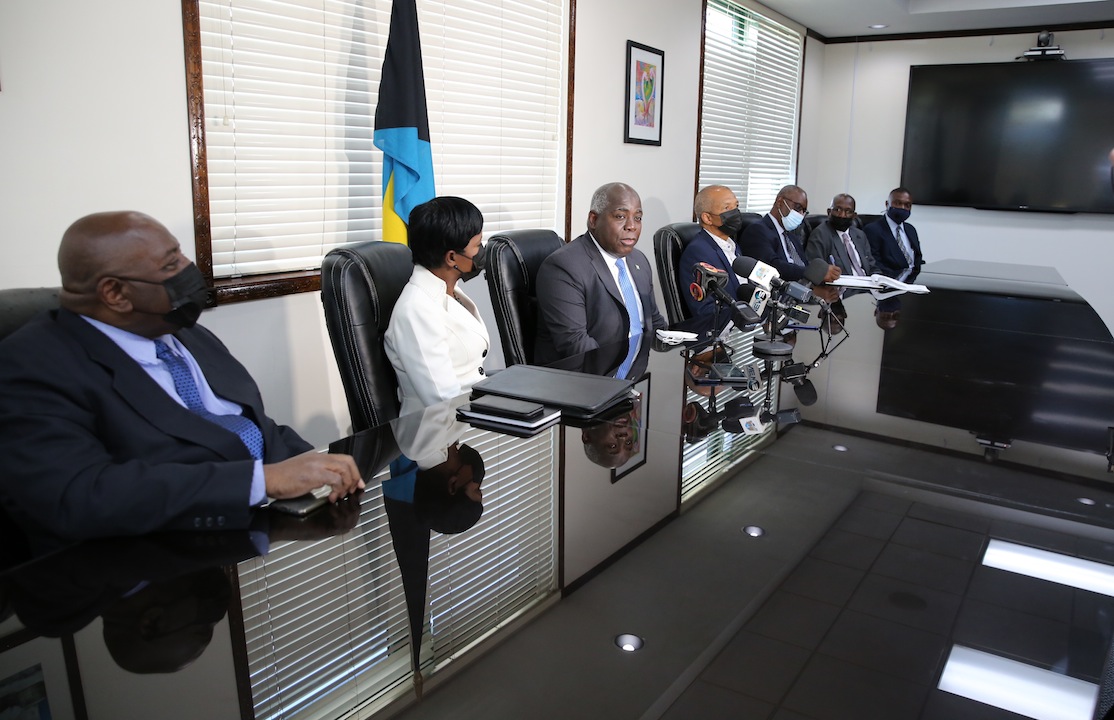
The Prime Minister’s remarks came during a visit to Grand Bahama on Monday, January 31, 2022, at a press conference in the Office of the Prime Minister (GB). Prime Minister Davis was frank in his answers about Grand Bahama and about what it needs in order to be restored.
As far as investor confidence is concerned, Prime Minister Davis says that investor confidence in The Bahamas as a whole is on the rise, but he admitted that when it comes to Grand Bahama, it seems as if that confidence by investors in the island has waned over the years.
“We have been, in our movements, seeking to restore that confidence,” said Mr. Davis. “For Grand Bahama, when it comes to investors, there has always been a question mark. Why is that? Investors are willing to invest in The Bahamas, but when it comes to Grand Bahama, there is always some reluctance on their part.
“For example, I had a conversation in Dubai with someone who had come to Grand Bahama and looked at projects, but their desire to invest just withered because there was no connection. I’ve been talking with them and hopefully we may find that something that will cause them to reconnect and revisit their vision and desire to invest here.
“But we are working on how we can fully restore the confidence for people to invest in Grand Bahama.”
Asked about any updates on the sale of the Grand Lucayan Resort, Prime Minister Davis pointed out that there have been a number of expressions of interests, which are under consideration by the Minister of Tourism and Investments.
However, he said for him personally, the real issue isn’t just trying to sell the Grand Lucayan Resort. “There’s no sense in us putting it in the hands of someone and then the other components for a successful community are not there,” said the Prime Minister.
“For example, for us to have a successful project at the Grand Lucayan, airlift is important, So, we have to look at the airport to see how we can get that back on stream in a way to complement and to ensure that it feeds into the Grand Lucayan Hotel. In addition to the airlift, we have to ensure that there are other attractions available for persons coming into Grand Bahama. There has to be a complete visionary plan, if we’re going to continue to promote Grand Bahama as a tourist destination, which will include us having not just the hotel, but any other projects on that level.
“We also have to decide what kind of tourists we want to attract to Grand Bahama; whether it’s a golf destination, casino driven or technology driven. There are a number of factors we’re looking at now to determine the direction in which we would like to see Grand Bahama go. We want to have partners in Grand Bahama who have a vision; a vision where they’re prepared to put their money where their mouth is to ensure it becomes a reality.”
Prime Minister Davis assured Grand Bahamians that his government’s plans for a new hospital to be constructed in Grand Bahama is still on the drawing board. He said that he, along with the Minister for Health, have been in deep discussions and negotiations with any number of entities to ensure that the government is to at least be able to break ground for the new hospital before the end of the year.
“For my part, I indicated to the Minister that I want us to start by June,” said the Prime Minister.
During his visit to Grand Bahama, the prime Minister got an opportunity to view one of the new initiatives launched by the Ministry of Grand Bahama that would help to clean up certain properties in preparation for the construction of some half-way homes.
PHOTO CAPTIONS
BIS Photos/Lisa Davis
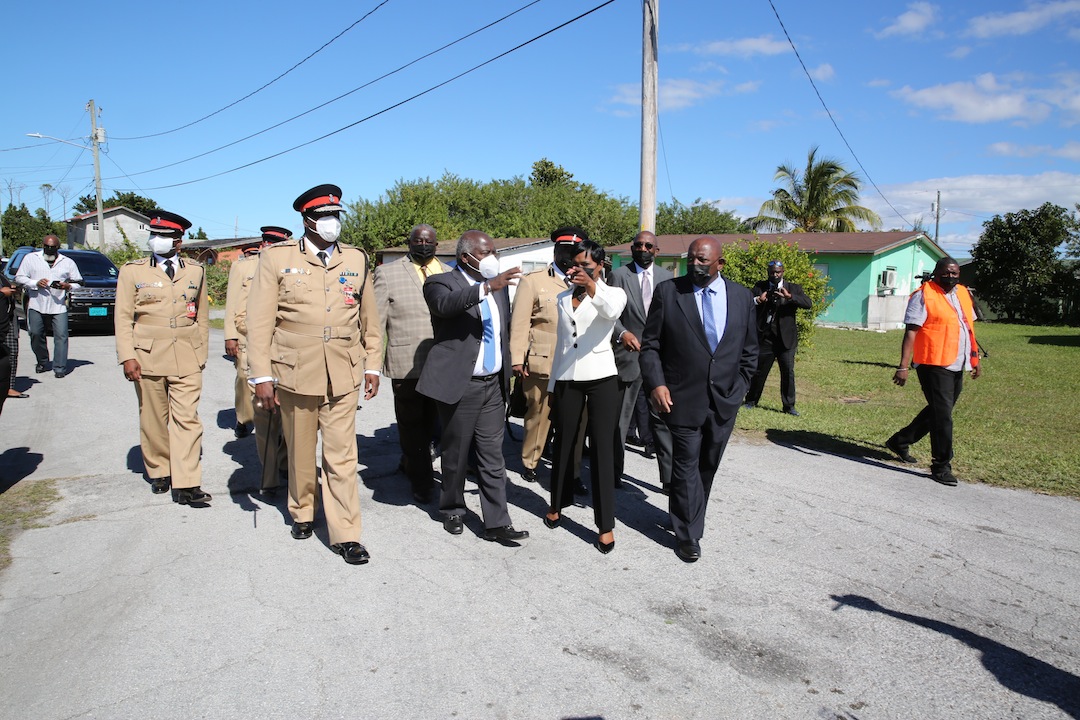
Header: Prime Minister Davis and his delegation walked the entire community of Tripp Circle to view the full scope of cleanup work there. Accompanying the Prime Minister to Grand Bahama were Hon. Myles LaRoda, Minister of State in the Office of the Prime Minister; David Davis, Permanent Secretary (OPM); Leon Lundy, Parliamentary Secretary (OPM); Jerome Fitzgerald, Senior Policy Advisor; Latrae Rahming, Director of Communications (OPM) and Kevin Simmons, OPM.
Insert: Prime Minister Philip Davis (center) addressing the media in the conference room of the Office of the Prime Minister (GB) on Monday, January 31, 2022. Seated left of the Prime Minister is Minister for Grand Bahama, Hon. Ginger Moxey. At the right of the Prime Minister is Minister of State in the Office of the Prime Minister, Hon. Myles LaRoda.

The Bahamas, April 14, 2026 – With the 2026 Bahamian general election set for May 12, the country’s major political parties have now formally placed their plans before the electorate, offering competing visions for governance, growth and relief.
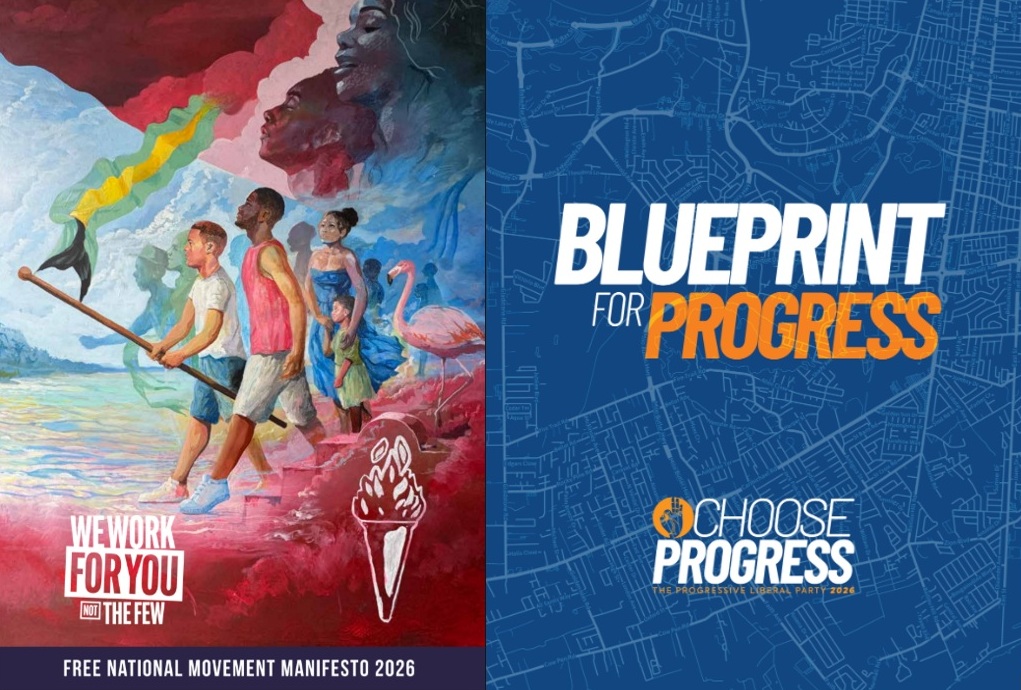
The governing Progressive Liberal Party (PLP), led by Philip Davis, launched its “Blueprint for Progress 2026” on April 8, 2026, outlining a 46-page plan focused on long-term development and systems reform. The document places heavy emphasis on energy transition, digital government, workforce training and food security, positioning the party as one seeking continuity following its first term. The full plan is publicly available online through official PLP platforms for voters to review.
Just days later, on Sunday, April 12, the opposition Free National Movement (FNM), under Michael Pintard, unveiled its 2026 Manifesto at a major event in Nassau. Spanning 54 pages, the document centers on cost-of-living relief, tax reform, healthcare expansion and housing, offering what the party describes as a more immediate response to economic pressures facing Bahamian families. The FNM has also made its manifesto accessible online.
Beyond the two major parties, the Coalition of Independents (COI) had already entered the policy space earlier, formally unveiling its long-range Vision 2030 framework on Saturday, March 1, 2025, at the Fusion Superplex in Nassau during a packed national launch led by party leader Lincoln Bain. That framework has since been complemented by a 100-day action plan released in late March/early April 2026, adding a short-term policy layer to its long-range proposals.
These policy rollouts come as the country prepares for a pivotal vote, with the Parliamentary Registration Department confirming a voters’ register of approximately 203,000 eligible voters, one of the largest in the nation’s history. Key dates are now set, with Nomination Day on April 16, followed by advance polls on April 30, ahead of General Election Day on May 12.
With platforms now in the public domain and the timeline locked in, the focus shifts squarely to the electorate—who must now weigh the promises, examine the plans and decide the country’s direction at the polls.
Angle by Deandrea Hamilton. Built with ChatGPT (AI). Magnetic Media — CAPTURING LIFE.

The Bahamas, April 14, 2026 – At its core, the $65 million water security project is designed to strengthen the reliability, safety and resilience of the water supply across The Bahamas.
If implemented as planned, the investment is expected to improve water quality, reduce contamination risks and support public health, while increasing supply reliability and limiting service disruptions during droughts or system failures. The project also aims to expand and upgrade infrastructure, including wellfields, pumping stations and storage capacity, and to protect freshwater resources from saltwater intrusion—an increasing threat for low-lying islands. In practical terms, that could mean cleaner, more consistent and more dependable access to water for residents across the country.
The project was first conceptualised in 2019 under the previous administration, when a proposal was submitted to the Green Climate Fund to strengthen the resilience of the country’s water systems. That early work came just months before Hurricane Dorian exposed the vulnerability of national infrastructure, including critical water and sanitation systems, particularly in the northern Bahamas.
The initial phase focused on developing the concept, identifying priority areas and engaging regional and international partners, including the Caribbean Development Bank, to support the design and preparation of a full funding proposal.
Following the change in government in 2021, the project advanced into its most technical and demanding stages. The current administration oversaw the completion of key requirements, including feasibility studies, environmental and social assessments, and detailed financing negotiations with international partners—steps necessary to move the proposal from concept to approval.
That multi-year process has now culminated in approval of a $65 million financing package, combining grant funding with concessional loans to support long-term upgrades to the country’s water infrastructure.
While the project brings significant international support, it is not entirely free money. The package is structured as a blended financing arrangement, combining grant funding with concessional loans—meaning a portion of the funding will ultimately need to be repaid. Based on information released by the Caribbean Development Bank, approximately $25 million of the total package is tied to loan financing, with the remaining portion provided as grant support.
Concessional loans typically carry more favourable terms than commercial borrowing, including lower interest rates and longer repayment periods. However, they still represent debt obligations that will be borne over time.
Notably, detailed terms of the loan components—including interest rates, repayment schedules and any associated conditions—were not disclosed in the initial announcement issued by the Office of the Prime Minister (Bahamas). Those details are expected to be outlined in formal financing agreements, but have not yet been made public.
For Bahamians, the project represents both investment and obligation. While the grant funding provides a significant boost to infrastructure development, the loan component adds to the country’s long-term financial commitments—making transparency around terms and implementation timelines especially important.
While the approval marks a significant milestone, the timeline for delivery remains a critical factor. Based on information available from project partners, implementation is not expected to begin immediately. The initiative is anticipated to move into its execution phase later in 2026, following finalisation of financing agreements and completion of preparatory requirements.
From there, the project is projected to unfold over several years, with estimates suggesting a multi-year implementation period of up to seven years to fully deliver the planned upgrades to water infrastructure across The Bahamas.
This means that while the funding has now been approved, the benefits will be realised gradually rather than all at once. A definitive completion date has not been publicly outlined, and detailed timelines tied to specific islands or phases of work have yet to be disclosed.
For Bahamians, the question now shifts from approval to execution—when funds are drawn down, when construction begins, and how consistently the project moves from plan to delivery.
Angle by Deandrea Hamilton. Built with ChatGPT (AI). Magnetic Media — CAPTURING LIFE.
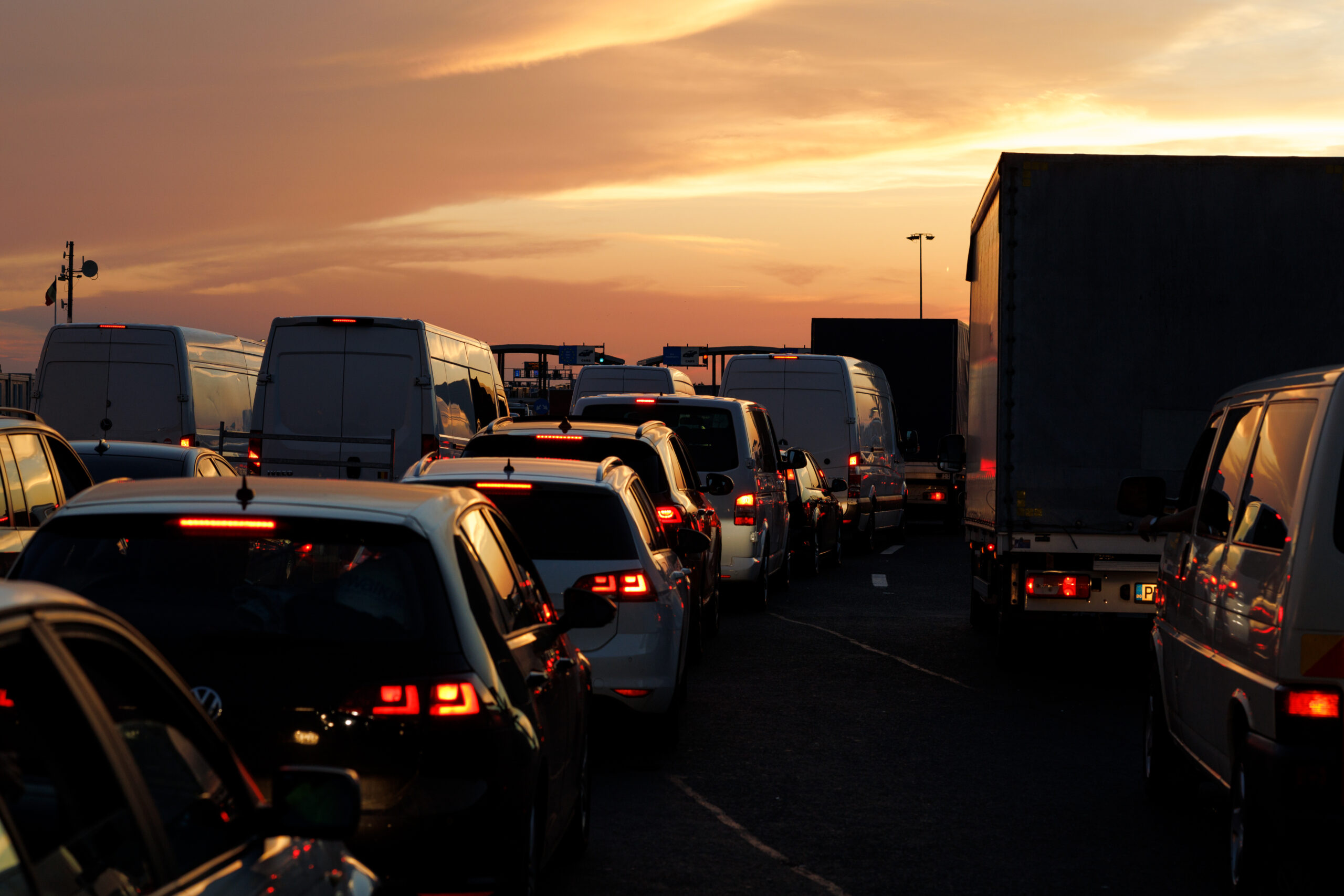
NASSAU, Bahamas — What should be a simple five-minute drive is fast becoming an expensive, hour-long ordeal, as rising fuel prices collide with worsening traffic congestion across New Providence.
As of early April 2026, gasoline prices across The Bahamas have climbed sharply, with motorists now paying an estimated $5.50 to over $6.50 per gallon, depending on the station and grade. The increases, seen at major retailers including Esso, Rubis and Shell, reflect a volatile global oil market driven by escalating geopolitical tensions.
The latest spike — in some cases jumping more than 50 cents per gallon within days — is being driven by uncertainty surrounding escalating tensions involving Iran. U.S. President Donald Trump has issued a direct ultimatum, warning that the United States could launch aggressive strikes on Iranian infrastructure, including power plants and key facilities, if demands are not met. While he has also expressed hope for a swift resolution, the threat of rapid escalation is already rattling global oil markets — and The Bahamas, heavily dependent on imported fuel, is feeling the impact almost immediately.
At the pumps, the frustration is real.
Drivers are now paying significantly more just to sit in traffic. Commutes that once took minutes are stretching into hour-long crawls, burning fuel with little movement and compounding the financial strain. For many residents, the issue isn’t just the price per gallon — it’s how quickly that gallon disappears.
Industry players are also bracing for impact. Higher diesel prices are expected to ripple across key sectors, including trucking, construction, and shipping — all of which ultimately feed into the cost of goods and services. In short, this is not just a fuel story; it’s an inflation story in the making.
Despite the surge, the Bahamas Petroleum Retailers Association has moved to calm fears, confirming that there is no fuel shortage. Supply remains stable, but consumers are being urged to adjust behavior — from maintaining proper tyre pressure to considering carpooling — small measures that could stretch every dollar a bit further.
Retailers, however, are not offering much comfort on price relief. While fluctuations are expected, insiders say the days of sudden price drops are unlikely in the immediate term. The “shock” increases may level off, but a meaningful decline hinges on global stability — something that currently feels out of reach.
For Bahamians, the reality is tightening: higher fuel costs, longer commutes, and a growing sense that relief isn’t coming anytime soon.
Angle by Deandrea Hamilton. Built with ChatGPT (AI). Magnetic Media — CAPTURING LIFE.





-

 News6 days ago
Community Emergency Response Training – Blue Hills & Wheeland
-
 News5 days ago
HAITIANS FLEE HOME AS PUSH FACTORS MOUNT; LANDINGS SURGE IN TCI, AGAIN
-
 News5 days ago
TCI Selected from 59 Countries for World Bank AI Programme as Officials Attend Washington Meetings
-

 Caribbean News4 days ago
Team Trinidad & Tobago Makes Waves with Historic CARIFTA Aquatics Performance
-

 News5 days ago
What Planning Board Meeting Exposes about Housing Development in Providenciales
-
 News5 days ago
Multi-Agency Enforcement Action Conducted at Caicos Lodge
-

 Caribbean News5 days ago
Mottley Celebrates CARIFTA Champions After Stunning Relay Upset
-

 Bahamas News4 days ago
New Manifestos Released as Bahamas Heads to Historic May 12 Vote