
TCI News
TCI: Educators and Education Officers now better equipped to protect vulnerable children


#Providenciales, July 27, 2019 – Turks and Caicos – The Ministry of Education, Youth, Culture, Library and Social Services with the support from the European Union is working to ensure Education Officers and school Principals are better equipped to identify and cope with children who may be exposed to or suffering from violence and abuse.

Ms. Heidy Williams is the Education Officer with responsibility for Early Childhood Education and she explained that a recent training session successfully demonstrated to participants their key roles and responsibilities when it comes to safeguarding children, “Child protection and safe-guarding refers to the protection and safe-guarding of all children against violence.
It ensures that systems are in place to prevent, identify and stop violence that are already happening. Violence against children can be in the form of poor nutrition, poor health care, lack of affection, unresponsive care, child maltreatment, neglect, corporal punishment, exposure to violence and abuse (physical, emotional, sexual).”
Hurting children can now be much better served due to the techniques and strategies learned during the training session. Ms. Williams said a component of the program called, Courageous Conversation, had a major impact on the educators.
“Holding Courageous Conversations is the process of having the confidence to be bold and direct in order to show awareness and bring about change to a situation, recognizing that the implications can be difficult but the outcomes are generally positive.”
Admittedly, when these situations arise, they can be disconcerting and downright uncomfortable.
Ms. Williams notes that “these components are extremely important to the Ministry because children are most vulnerable to violence and these adverse experiences early in life can impair the brain architecture. Early stress due to violence elevates the stress hormone cortisol and this can disrupt brain development altering academic performance and causing harmful mental and physical consequences that can last into adulthood.”
Ms. Williams further expressed that even one incident where a child is impacted by negative events or environments are viewed as too much.
“With the challenges of sporadic incidences of violence against children, the Ministry of Education recognizes the need to be proactive in guaranteeing the safety and well-being of children into adulthood,” said Ms. Williams who added that, “the training even helped Education Officers and Principals to understand how to begin Courageous Conversations. The method we are using is known as the ‘OARS Approach’. It is an acronym for O- open ended questions; A- Affirmation; R- Reflective listening and S for Summarizing. Emphasis was placed on how to interview, noting the importance of preparation, opening comments, body language, how to respond, listening and tone of voice.”

Public and private school principals and Education Officers were equipped with the skills of active listening without interrupting, how to interview, how to analyze a situation and the risk involved, how to stay neutral, methods of getting one’s attention, words to avoid when interviewing parents, helping them to find solutions to problems and methods of communicating to children in an age appropriate manner.
The training was facilitated by Barnardo’s, a British charity dedicated to protecting vulnerable children and organised for the Turks and Caicos from May 4-6, 2019 by the UK Foreign & Commonwealth Office.
“Improving the Education System in the TCI…..Together we can do it”
#magneticmedianews
#protectingvulnerablechildren
#improvingeducationinthetci






Almost two million visitors recorded in 2025
PROVIDENCIALES, TURKS AND CAICOS ISLANDS – The Turks and Caicos Islands saw an increase in stayover arrivals in December, seven percent higher than the corresponding period in 2024.
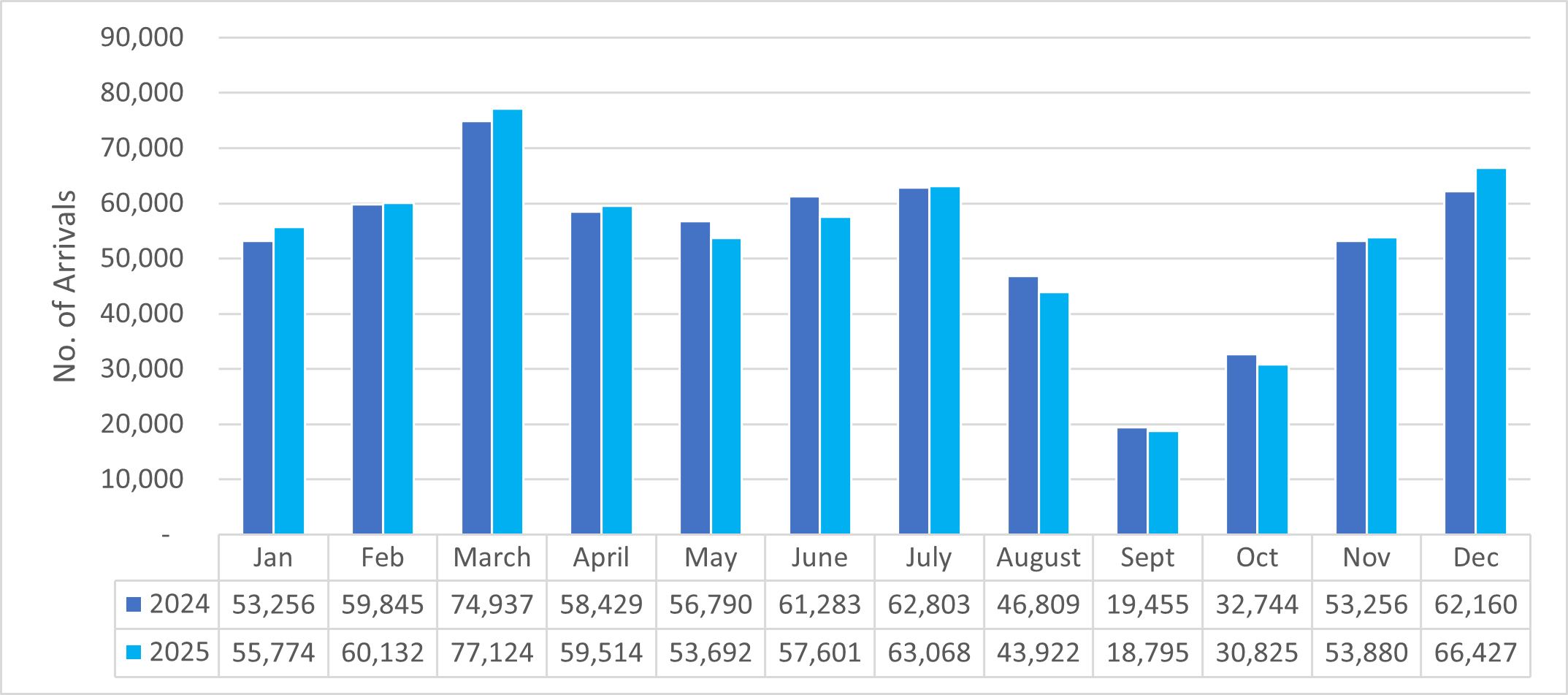
Preliminary data suggests that stay over arrivals by air for the month of December was 66,427 in comparison to 62,610 in December 2024.
From January to December 2025, preliminary visitor arrival numbers totalled 640,754; on par with the number recorded for the same period of 2024.
Stay Over Arrivals YTD December 2024/2025
The first quarter of the calendar year attracted the largest number of arrivals with visitor arrivals three percent higher than the first quarter of 2024. Reduced airlift from the United Kingdom and the United States, most notably the Virgin Atlantic and JetBlue services, was however felt from the second quarter (April to June). As a result, visitor arrivals dropped three percent in the second quarter.
By the third quarter of this year (July to September), geopolitical and economic conditions in the key source markets, namely the United States, led to further contraction of arrivals. In the last quarter of 2025, arrivals were impacted in October due to the passage of Hurricane Melissa but additional airlift from the USA and Canada resulted in an increase in arrivals in November and December.
Mr. Paul Pennicook, Interim CEO Consultant of Experience Turks and Caicos, said December’s increase in stayover arrivals is an encouraging indicator of the sustained interest in the Turks and Caicos Islands as a premier destination.
“While we note and continue to monitor geopolitical shifts that affect us, Experience Turks and Caicos is focused on increasing marketing initiatives in our primary source markets. We have spent the last two years investing in groundwork such as crucial travel advisor training to assist them in selling the destination more effectively. In the next fiscal, we will be building on those initiatives with co-op activities with partners as well as out of home advertising to increase visitation to our destination,” he said.
In Cruise, the preliminary count of passenger arrivals for the month of December 2025 was 129,346, a 22 percent increase over last December. This growth follows the berthing of 11 additional ships in Grand Turk this month.
From January to December, the cruise sector continued to outperform the same period last year, as the 1.3 million total cruise passengers recorded, marks a five percent Year-on-Year increase. 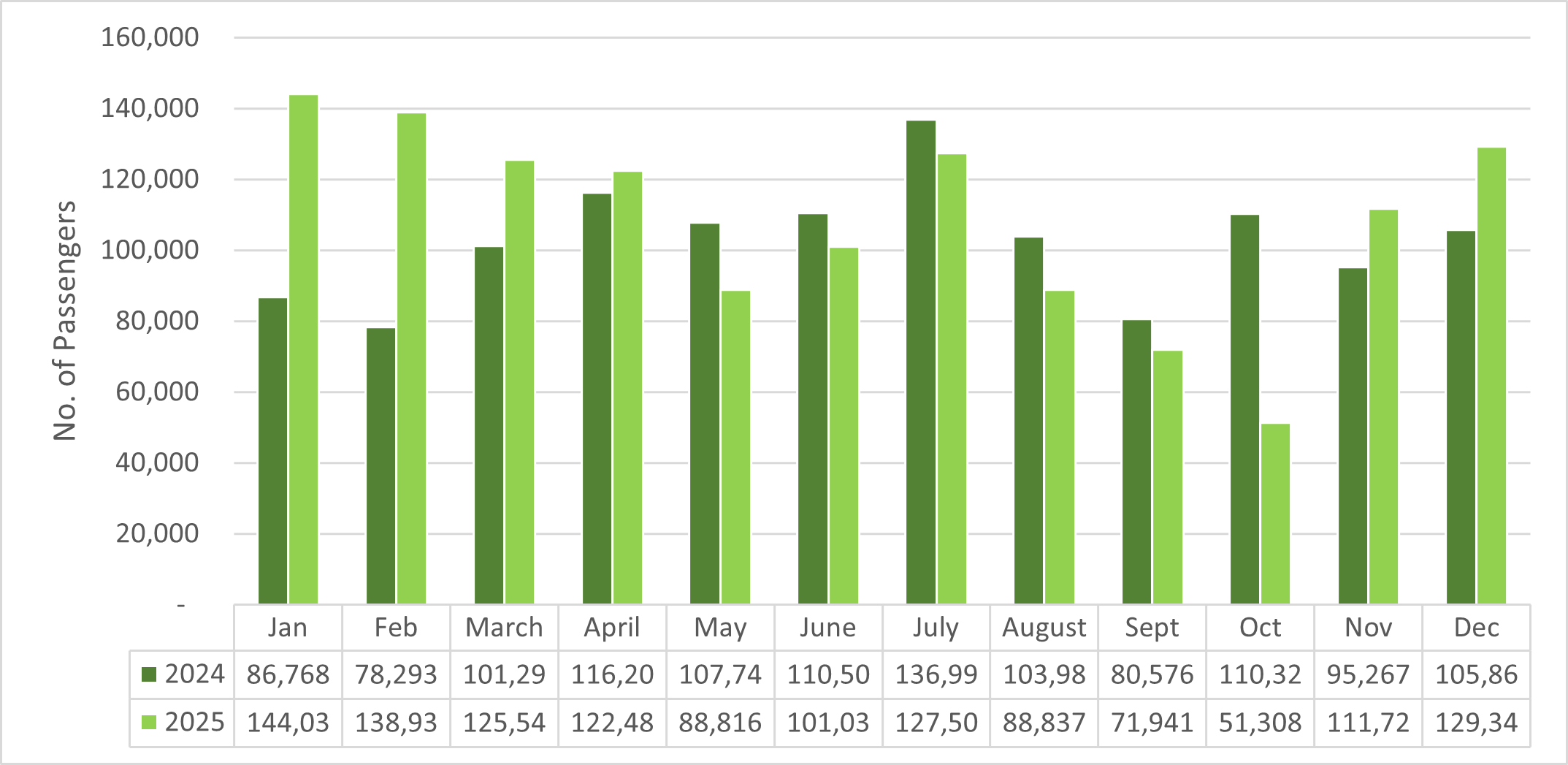
The cruise sector experienced significant growth in the first quarter of 2025, with passenger arrivals surpassing last quarter by 53 percent. In the second and third quarter however, several cruise lines adjusted their itineraries as vessels were pulled from the fleet or from the Caribbean region, which resulted in fewer passengers.
Arrivals dropped seven percent and 10 percent in the second and third quarters, respectively. Double digit growth was recorded in the last two months of Quarter 4. This growth however, was not sufficient to outweigh the drop in arrivals experienced in October, following the cancellation of cruise calls due to the passage of Hurricane Melissa. Despite the late-quarter rebound, arrivals for the final quarter of 2025 closed six percent below the same period in 2024.

News
The Department of Trade, Industry & Fair Competition to Host Export Readiness Workshop Under the theme “Empowering TCI Businesses for Local Growth and Global Markets.”
Providenciales, Turks and Caicos Islands – Wednesday, 11 February 2026: The Informal Settlements Unit (ISU) coordinated a multi-agency enforcement operation on Thursday, 29 January 2026, led by the Planning Department, with support from the Crown Land Unit, the Turks and Caicos Islands Border Force, and security provided by the Royal Turks and Caicos Islands Police Force. The operation, carried out at three different locations in Providenciales, formed part of ongoing government efforts to address unauthorised development and illegal occupation of land in accordance with governing legislation.
The operation commenced in Blue Hills, where five Section 58 Enforcement Notices were issued on unauthorised structures identified on Block and Parcel 60502/48.
Enforcement activity then moved to a second location off the Leeward Highway near Caicos Lodge, where six Section 58 Enforcement Notices were issued on additional unauthorised structures on Block and Parcel 60802/66.
The final phase of the operation took place in The Bight, where three unauthorised structures were removed, with all debris cleared from the site in keeping with established safety and environmental protocols.
The Informal Settlements Unit remains committed to working alongside its partner agencies to support lawful development, protect public and private land, and ensure that planning regulations are enforced in a coordinated and transparent manner across the Turks and Caicos Islands. Similar joint operations will continue as part of the Government’s wider strategy to address unauthorised development and informal settlement activity.





-
 News4 days ago
The Department of Trade, Industry & Fair Competition to Host Export Readiness Workshop Under the theme “Empowering TCI Businesses for Local Growth and Global Markets.”
-

 TCI News6 days ago
Experience Turks and Caicos and Aquila Host Product Development Workshops to Strengthen Sister Islands Tourism
-

 Bahamas News1 day ago
Tens of Millions Announced – Where is the Development?
-

 News3 days ago
Strong December Performance Signals Continued Demand for the Turks and Caicos Islands
-

 News5 days ago
Multi-Agency Planning Enforcement Operation Conducted at multiple locations in Providenciales
-

 Bahamas News7 hours ago
Groundbreaking for Grand Bahama Aquatic Centre
-
 Caribbean News4 days ago
Mottley Sworn in After Historic Clean Sweep in Barbados Election
-

 Health7 hours ago
What to Look for with Self-Checks at Home