
TCI News
TCI: Deputy Speech at Signing of MOU – Advance Passenger Information System (APIS)


#Providenciales, November 20, 2018 – Turks and Caicos – H.E the Governor, Madam Premier, Ministerial and Cabinet Colleagues, Officials of the Ministry of Border Control and Employment, Staff of the Immigration Department and the Press, good morning and welcome to this ceremony.
Ladies and gentlemen, on May 24, 2017, I commenced this initiative by signing the initial MOU between the USA and TCI making the Turks & Caicos Islands the first CARICOM associate member country amongst the six British Overseas Territories to sign on to the Advanced Passenger Information System, commonly referred to as APIS.
 At the 2017 signing ceremony I remarked that that the signing marked an historic occasion as the Turks and Caicos Islands embarked on a path of modernizing our border security regime through the cooperation agreement between the United States of America and the Caribbean counterparts.”
The US ambassador also explained that by adopting APIS, countries would be better able to secure their airports and ports which leads them to enhancing regional security.
The signing today of this Memorandum of Understanding between the Government of the United Kingdom and the Turks and Caicos Islands signifies the culmination of the path to officially joining our regional counterparts in the introduction of the Advanced Passenger Information System (APIS). With the signing of this MOU, the United Kingdom Government formally grants consent to the TCI for the sharing of intelligence among Member States of the Caribbean Community.
This morning, I am proud again to state that the signing of this memorandum is a significant and important step to achieving and realizing the full implementation in the APIS in the Turks and Caicos Islands and by extension improved security for our region.
For the benefit of persons present today and the media, APIS is an automated system established for aviation and maritime operators. It has the capability of enhancing border security over the region by supplying law enforcement officers with data on passengers and crew members prior to arrival and departure from CARICOM member states, United Kingdom, United States and Canada. This system was established by the US Customs Border Protection agency (CBP) in May 2009.
I am sure the most common question would be, what TCI will derive from APIS.
The main contribution of APIS to our border management are:
- Prior to departure, law enforcement officials can know in advance whether potential or known offenders or inadmissible persons are travelling.
This not only provides us and our partners with adequate time to utilize our resources more efficiently, but also helps to reduce workload through the use of technology and automated means.
- The TCI capabilities for transmission of passenger details to the point of destination well in advance of the passengers’ arrival is a very positive step towards achieving both facilitation and compliance goals.
- Advance Passenger Information System, will involve capturing a passenger’s biographic data and other flight details by the carrier prior to departure and the transmission of the details by electronic means to the Border Agencies in the destination country.
- The TCI hopes to use APIS as a decision-making tool that Immigration and Customs primarily can employ before a passenger is permitted to board an aircraft. Once passengers are cleared for boarding, details are then sent to the Agencies for screening against additional databases and can identify passengers and crew of interest.
Ladies and gentlemen, APIS has the potential to considerably reduce inconvenience and delays experienced by passengers as a result of border processing. It will contribute to more efficient passenger facilitation by allowing border control officers, (Police, Immigration, Security and Customs Officers) to focus on high-risk individuals, thereby allowing for a faster throughput of low risk travellers when undergoing arrival formalities. This would add value to processing of our tourist and allow us to maximize use of staff at the airport in particular and improve guests experience.
As part of preparation to get to this stage today several key actions have taken place. Legislations has been enacted in 2017, training and consultation was undertaken in February 2018 with internal and external partners and stakeholders. The training/workshops included the Police, Immigration Department, Airports Authority, Computer Department, Customs, Maritime and Ports Authority. External partners that have been consulted and participated in training include Marina operators, Cruise lines, Airlines, shipping companies (air and sea), freight forwarders etc.
The workshops which were facilitated by the Joint Regional Communications Centre (JRCC) made use of the international best practices and standards highlighted above, as well as the Passenger Data Toolkit of the International Air Transport Association. JRCC are the regional managers of APIS, based on Barbados.
The ultimate goal of these national workshops was to design a Road Map indicating the main steps to follow to move towards an API-enabled environment. In addition, the workshops provided participants with a thorough understanding of the functions and benefits of APIS and brought together all relevant national stakeholders in the field of aviation security in order to promote cooperation and synergies as they implement an API system.
Increase in tourism over the past decade has impacted the manner in which passengers travelling on international flights are processed. What is even more challenging is that in the TCI we anticipate even greater growth with the demand for larger aircraft and associated demand on inspection processes during peak arrival and departure times.
You are probably also aware of increases in international terrorism, drug smuggling and serious crimes and associated security and the threat posed. These threats are not only akin to the Royal Turks and Caicos Islands Police and Immigration, but also by the carriers and airport operators. Drug smuggling by passengers is a substantial part of the problem even in the region. Additional security checks/risk assessments on passengers prior to departure have added considerably to the time required for the check-in process as we are all acquainted with the long lines, and thorough checks by TSA prior to departure from Miami. These are often adjusted due to changing risks factors. You see, threats from terrorism is real and no country is immune. The increased compliance risk posed by passengers has meant that border protection agencies have had to be more vigilant and more intensive in our processing of this type of traffic.
There are a variety of Border Control Agencies in place at the Providenciales International Airport. These include Customs, Immigration, Police, Health and Safety, Agriculture etc. The level of cooperation between these Agencies varies from place to place. Different agencies frequently operate their own automated systems for passenger processing without any sharing of information. The strict division of responsibilities between the agencies means that passenger processing is often unnecessarily prolonged. APIS will bridge and consolidate critical information that can be shared between agencies.
In terms of Border Control Agency response, it has become obvious that the routine examination of all passengers and their possessions is no longer a suitable way of processing the ever-increasing passenger numbers. Emphasis has shifted from a high percentage of passenger examinations, to a more selective approach based on risk assessment, intelligence, behavioural patterns, etc., as well as randomly applied inspection processes e.g Red/Green Line in Customs. It is now well recognized that such an approach yields significantly better results, proportionate to the manpower employed, than purely random or intensive examination. Again, APIS would complement this process.
APIS can easily facilitate pre-clearance of flights treating some flight as domestic flights thereby alleviating some of the pressure at the arrival airport, and enable more prudent use of critical staff elsewhere.
Although the level of co-operation between the various Border Agencies has improved in recent years in the TCI, more can be done to rationalize procedures, save on manpower and other resources, and facilitate passengers.
 Such cooperation will result in the clearance process for passengers being reduced in complexity to the level where a lesser number of Immigration or Customs will be able to process the vast majority of arriving passengers. It is envisage that the Officers, representing the various interested agencies, would be tasked with conducting a primary inspection of each arriving passenger, and referring those requiring additional examination to the appropriate service. In addition, with increasing inter-agency co-operation, the case for the development of single interagency automated systems, serving the needs of two or more agencies is possible in the short run.
APISs introduction will monitor persons for flight and assist border agencies to identify potential or likely offenders.
The Ministry, Immigration department, Computer Department and others will continue to work with the JRCC in the physical introduction of APIS within the new year.
In short this is a great initiative and we look forward to updating the public on its advancement.
I would like to take this opportunity to thanks the Government, Cabinet and my colleagues, Ministry and Department Staff, regional bodies including IMPAC, JRCC and United Kingdom Government for the assistance and support in advancing this significant project.
Thank you.


“PNP Healthcare Ministers Carrying on Tradition”
By Randy Ewing
There are several areas that are critical to the everyday quality of life and standard of living in any civilized country: healthcare, economic development, adequate infrastructure, public safety, and education. Yet, as Sabrina Green highlighted in her recent article, there remains a troubling reality in the Turks and Caicos Islands: too often, our own people—particularly qualified Turks and Caicos Islanders—are marginalized when decisions are being made about the future of our country.
I want to focus specifically on healthcare.
Under the current PNP administration, several ministers have held responsibility for the healthcare portfolio, including Hon. Jay Saunders, Hon. Shawn Malcolm, and now Hon. Kyle Knowles, who is also my cousin.
I am not writing this because I expect anything to be handed to me. I am writing as a Turks and Caicos Islander and as a healthcare professional who has spent more than 26 years working in the healthcare industry.
My efforts to offer my expertise to the government were never motivated by money, political ambition, or the expectation of special treatment. They were motivated by something much simpler: giving back to the country that produced me.
I am from the soil.
I am from Blue Hills, Providenciales. I know our people. I know our culture. I understand our eating habits, the history and circumstances behind those habits, the foods that are locally available, and the realities that many families face when healthier food choices are more expensive or less accessible.
Professionally, I bring more than two decades of healthcare leadership and consulting experience. I hold an MBA with a concentration in Health Administration. I am a Lean Six Sigma Black Belt with a healthcare concentration and a change-management specialist with healthcare experience. Over the course of my career, I have held leadership positions and worked with organizations including Memorial Hospital, Aetna Health, and Blue Cross Blue Shield, as well as within the U.S. federal government. I have also provided consulting services to healthcare organizations, municipalities, cities, states, and organizations throughout the Caribbean.
I share this not to boast about my credentials, but to make a simple point:
There are Turks and Caicos Islanders who have spent decades acquiring knowledge and expertise that could be valuable to the development of our country.
Why aren’t we listening to them?
I understand that the government has engaged outside consultants to provide advice and expertise. There is certainly a place for specialized external expertise. But I believe we must also ask an equally important question: What measurable improvements have these investments produced for the people of the Turks and Caicos Islands?
Our healthcare challenges remain.
Our people continue to face serious health issues. People still have to travel overseas to obtain medical treatment. Families continue to worry about whether the healthcare system will be there when they need it. And many residents remain concerned about whether they are receiving the quality, accessibility, and affordability of healthcare they deserve.
So I ask our leaders: Where are the measurable outcomes?
Where is the long-term strategy?
What is the plan for developing sustainable healthcare capacity within the Turks and Caicos Islands?
And, perhaps most importantly, why aren’t more qualified Turks and Caicos Islanders being brought to the table?
This is not an argument against outside expertise. It is an argument for including our own people alongside it.
We know our communities in ways that an outside consultant cannot immediately know. We understand our history. We understand our culture. We understand the socioeconomic realities that influence health. We understand what people eat, what they can afford, what resources are available locally, and the barriers that prevent people from living healthier lives.
That knowledge matters.
Healthcare policy cannot exist only on paper. It has to work for the people who actually live here.
As the Turks and Caicos Islands continue to grow and prosper economically, we must also ask whether that prosperity is translating into better health outcomes and a better quality of life for our people.
Economic growth means little if our people cannot access adequate healthcare.
Infrastructure means little if our healthcare infrastructure cannot meet the needs of our population.
And progress means little if our people continue to believe that they must leave their own country to receive the care they need.
Minister Knowles, I respectfully ask you—and every minister and policymaker responsible for healthcare—to listen to the Turks and Caicos Islanders who have spent decades developing expertise in healthcare.
Listen to the professionals who have returned home with knowledge.
Listen to the people who understand our communities.
Listen to those who are offering their expertise not because they want something from the country, but because they want to give something back to it.
I have made that offer.
My experience, my education, and my professional knowledge are not simply credentials on a résumé. They represent more than 26 years of learning, leading, solving problems, and working to improve healthcare systems.
And I believe that expertise should have a place in the conversation about the future of healthcare in my homeland.
The Turks and Caicos Islands belong to all of us.
Our healthcare system belongs to all of us.
And our people deserve a healthcare system designed around their needs, informed by evidence, strengthened by expertise, and built with meaningful participation from the very people who call these islands home.
It is time to stop asking whether our people are qualified enough to contribute.
It is time to start asking what we are losing by not listening to them.
Our people deserve better.
And those of us who have the knowledge, experience, and willingness to help should not stop offering it.
Marvin Martin, MBA, LBBH, CMS
(STOCK PHOTO)

enabling digital transformation across key sectors and supporting enterprise customers
Providenciales, Turks and Caicos Islands (September 17, 2026) – Liberty Business has officially launched in the Turks and Caicos Islands, signalling the company’s continued transformation and strengthening its commitment to helping businesses navigate digital change, drive growth and build greater resilience.
The announcement was made during a special stakeholder event attended by government representatives, business leaders, industry partners, customers and members of the media, marking the next chapter in the company’s long-standing relationship with the Turks and Caicos Islands.
“Today represents far more than the introduction of a new name. It reflects our continued evolution as a business and our commitment to being a trusted technology partner for organisations navigating an increasingly digital economy,” said Susanna O’Sullivan, Vice President General Manager, Flow North Caribbean, Liberty Caribbean.
“Through Liberty Business, we are bringing together the strength and capabilities of Liberty Caribbean with local expertise to help businesses across the Turks and Caicos Islands connect, protect, innovate and grow. We want to be a partner that understands the ambitions of our customers and works alongside them to create meaningful business value.”
Liberty Caribbean is the operator of Flow, Liberty Business and BTC, serving customers across more than twenty markets in the region.
The launch of Liberty Business builds on the company’s long-standing presence in the Turks and Caicos Islands and its continued investment in communications infrastructure, technology and digital capabilities across the Caribbean.
Today, Liberty Caribbean operates one of the region’s most extensive communications networks, supported by approximately 50,000 kilometres of subsea and terrestrial fibre infrastructure, helping enable resilient, secure and high-performance connectivity across the region.
For businesses, the evolution comes at a time when technology is playing an increasingly important role in productivity, customer experience, cybersecurity, business continuity and growth.
“Businesses today need more than connectivity. They need technology solutions that can help them operate efficiently, protect their information, support their people and respond to change. We are excited to begin this next chapter with businesses in the Turks and Caicos Islands and to work together to build a smarter, stronger, more resilient and more connected digital future,” said O’Sullivan.
Liberty Business brings together an integrated portfolio of enterprise solutions, including advanced connectivity, cybersecurity, cloud services, data centre solutions, managed services, enterprise mobility and unified communications under a single brand dedicated to supporting the evolving needs of business customers.
Also speaking at the launch, Joanne Missick, Country Manager, Flow Turks and Caicos Islands, said the introduction of Liberty Business demonstrates the company’s commitment to evolving alongside the local business community.
“The Turks and Caicos Islands is a dynamic market with tremendous potential, and our businesses are increasingly embracing technology as an enabler of growth,” said Missick.
“From tourism and hospitality to financial services, real estate, construction, professional services and entrepreneurship, organisations are looking for ways to become more efficient, secure and resilient. Liberty Business gives us the opportunity to engage our customers differently – understanding their individual needs and helping them identify technology solutions that can support their ambitions.”
Missick added that the company’s approach is centred on building lasting relationships with businesses and providing solutions that address real-world challenges.

Providenciales, Turks and Caicos Islands – Thursday, 17 September 2026: The Ministry of Education, Youth, Sports and Culture has partnered with the Turks and Caicos Islands Elections Department to bring an exciting national election experience directly to high school students across the country with the launch of the 2026 National Student Council (NSC) Election.
Held under the theme “Your Voice. Your Country. Your Future.”, the initiative will give students from all 14 public and private high schools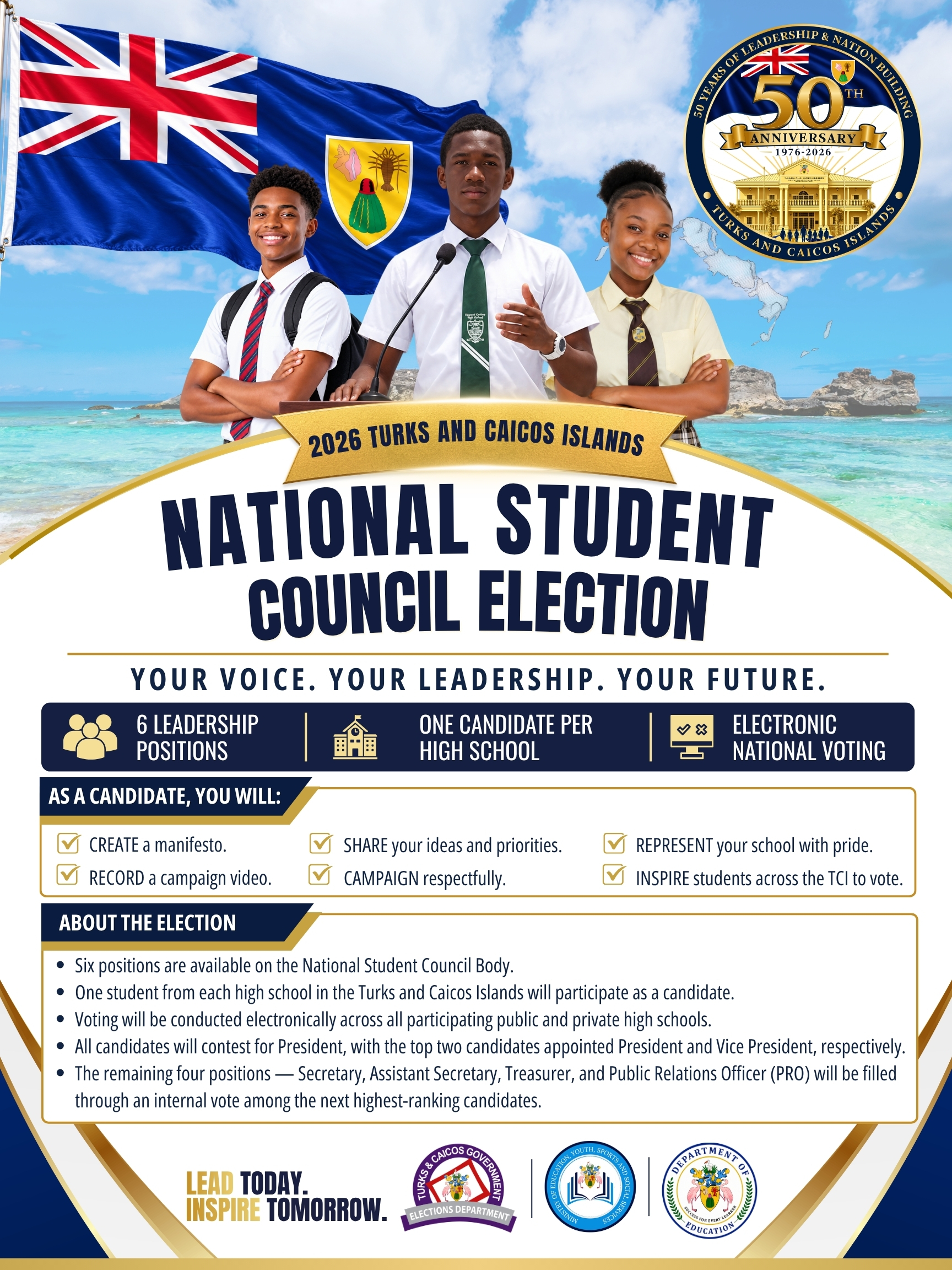 the chance to campaign, vote and compete for national student leadership positions, while gaining first-hand experience of the electoral process.
Minister of Education, Hon. Rachel Taylor, said the initiative gives young people a national platform to share their ideas and develop their leadership skills.
“Our young people have ideas, opinions and perspectives that deserve to be heard, and this election gives them a national platform to use their voices in a meaningful way. We want our students to step forward with confidence, share the issues that matter to them and experience what it means to lead and represent others.” She continued, “I am particularly excited to see students from schools across the Turks and Caicos Islands getting involved, supporting their candidates and participating in the voting process. I encourage every school to embrace this opportunity and help us create an experience that our students will learn from and enjoy.”
Each high school will nominate one student candidate to represent their school at the national level. Candidates will campaign for the positions of President and Vice President, sharing their ideas, priorities and plans with student voters across the Turks and Caicos Islands. Both positions will be decided by electronic vote among high school students across the country.
The remaining four positions on the six-member National Student Council: Secretary, Assistant Secretary, Treasurer and Public Relations Officer. will be determined through an internal vote among the top candidates following the national election.
The election will mirror several elements of the Turks and Caicos Islands’ electoral process. Candidates will choose a party name, colour and symbol, develop a manifesto and campaign slogan, and make their case to student voters. Their names, party information and symbols will appear on an electronic ballot, giving students the opportunity to experience the process as both candidates and voters.
Acting Elections Supervisor Willette Pratt stated that the timing of the initiative is particularly significant as the country continues its focus on civic awareness and youth participation.
“Coming on the heels of Constitution Day and as we prepare to celebrate National Youth Week this September, this is a timely opportunity to put civic education into practice. We want young people to understand that democracy is not only about casting a vote; it is about being informed, participating and understanding that their voice matters. We are excited to see our schools and students embrace the experience.”
Once students are selected and endorsed by their school, candidates must submit a completed Candidate Information Form, a Student Manifesto of no more than 250 words, and a 45- to 60-second Campaign Video PSA introducing themselves and outlining the issues and priorities they hope to champion.
Candidates are expected to campaign fairly and respectfully, focusing on ideas, student issues and their plans as aspiring student leaders. Personal attacks, bullying, false or misleading information, and offering gifts or incentives in exchange for votes are prohibited. Breaches of the campaign code of conduct may result in the loss of campaign privileges or disqualification.
For candidates, it is a chance to share their ideas and test their leadership skills on a national platform. For student voters, it is an opportunity to have a say in who represents them and experience the electoral process first-hand.
With candidate selection underway, the Elections Department and Ministry of Education are looking forward to seeing students step forward, bring their ideas to the campaign and, ultimately, seeing young voters across the country make their choice at the ballot.
The 2026 National Student Council Election is an opportunity for young people to do more than learn about leadership and democracy — it gives them the chance to take part. Your Voice. Your Country. Your Future.





-

 Education1 week ago
Department of Education Concludes Four-Day TCI National Standards Secondary School Curriculum Implementation Training
-

 Independent writer1 week ago
Fifty Years of Ministerial Government: Honouring Our Past, Embracing Our Present and Preparing for Our Destiny
-

 News1 week ago
UNDER 40 DAYS: COMMITTEE FORMED—BUT WHO IS ON IT?
-

 Health6 days ago
Know the Possible Warning Signs of Prostate Cancer
-

 Independent writer1 day ago
Letter to The Editor
-

 News4 days ago
Liberty Business launches in Turks and Caicos Islands
-

 Education5 days ago
TCI Schools Invited to Participate in 2026 National Student Council Election
-

 Bahamas News15 hours ago
Lunch Bag Wins this Back-to-School