
Bahamas News
Bahamas Minister of National Security Opens Stan Patrol User Group Meeting

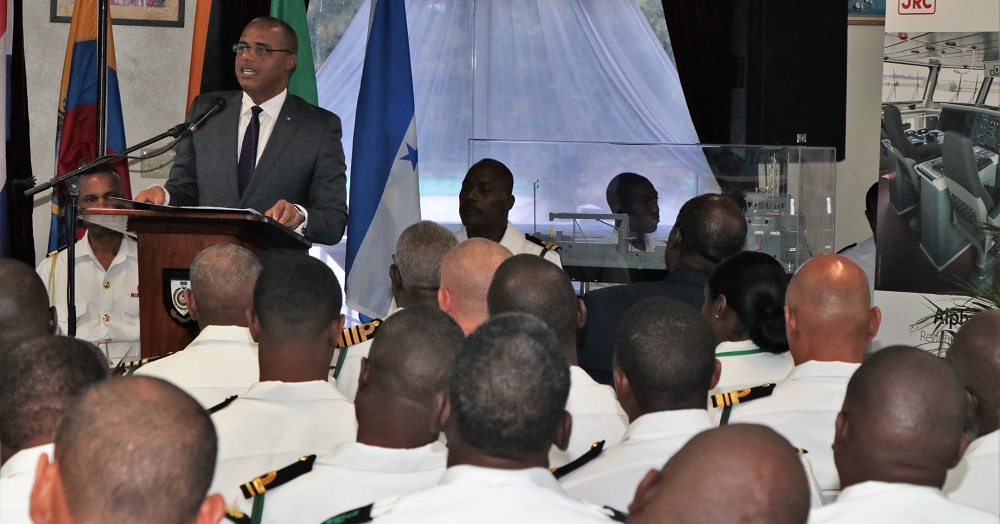
#Bahamas, November 18, 2017 – Nassau – Minister of National Security the Hon. Marvin Dames on Wednesday thanked the organizers and sponsors of the 3rd Annual Stan Patrol User Group (SPUG) Meeting, and associated events and all of the presenters and participants whom, over the following two days “will have the opportunity to discuss and share experiences in the operation and maintenance of these vessels that play a pivotal role in the execution of our individual and collective mandates, in maritime law enforcement, search and rescue of lives at sea and disaster relief and recovery, to name a few.”
“My government remains committed to safeguarding the Commonwealth of The Bahamas and this is evidenced through a number of initiatives including the procurement of more than nine patrol craft since 2014; continued development and improvement of military bases here on the island of New Providence, Matthew Town Inagua, and Gun Point, Ragged Island,” Minister Dames noted, at the Official Opening Ceremony, held at the Paul H. Farquharson Conference Centre.
Among those present for the Opening were Commander of the Royal Bahamas Defence Force (RBDF) Commodore Tellis Bethel, Director of National Emergency Management Agency (NEMA) Captain Stephen Russell, and Conference Chairperson Captain Adrian Chriswell.
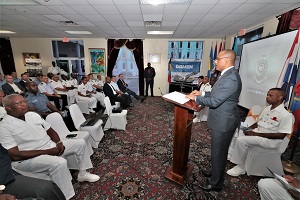 Taking part in the two-day meeting were representatives from the following: Barbados Defence Force; Belize Defence Force; Canadian Coast Guard; Dutch Caribbean Coast Guard; Ecuador’s Armada del Ecuador; Jamaica Defence Force Coast Guard; Mexico’s Secretaria de Marina; Trinidad and Tobago Coast Guard; other Officers, Warrant Officers and Senior Rates of the Royal Bahamas Defence Force; and Conference Sponsors – Damen, Pon Power Caterpillar and Alphatron Marine.
Minister Dames said that he was pleased to note the inclusion of The Bahamas National Emergency Management Agency at that edition of SPUG, as the lead agency in The Bahamas for the coordination of disaster preparation, relief and recovery.
“NEMA works closely with the Royal Bahamas Defence Force and regional and international agencies in the coordination and execution of pre-, peri- and post- disaster relief efforts,” he said.
As an archipelagic nation, Minister Dames pointed out, The Bahamas relies heavily on maritime assets to enhance the interconnectivity of the islands.
“To provide a bit of historical background, on March 31, 1980, the RBDF was created to patrol and guard over 100,000 square miles and 2,000 rocks and cays of territorial boundaries initially monitored and guarded by the Royal Navy prior before our Independence in 1973,” he said.
“Since the inception of the RBDF over 37 years ago, the Force has grown and transitioned into an inclusive sea, air and land based military with a modernised fleet of vessels,” Minister Dames added. “With a primary mission to defend the sovereignty of The Commonwealth of The Bahamas and an encompassing mission of assisting other law enforcement agencies as required, the RBDF is also mandated to perform humanitarian tasks, at home and abroad.”
With the requirement to expand the operations of the RBDF into the Family Islands, Minister Dames said, The Bahamas Government approved the capital investment for the Sandy Bottom Project in 2014 with the Dutch shipbuilding company, Damen, and the Dutch Dredging company, Van Oord. Nine of the vessels built by Damen had been delivered, he continued, eight of which have been commissioned into service; and the dredging works and quay wall construction projects by Van Oord Bahamas were nearing completion.
Minister Dames said that he was advised that the first User Conference was initiated by the Coast Guard for the Kingdom of the Netherlands in the Caribbean (KWCARIB) three years ago in Curacao, and was attended by seven countries – Jamaica, Honduras, Mexico, The Bahamas, Barbados, the USA and the KWCARIB.
“Their exchanges and shared experiences on the use of their larger patrol vessels was significant and the conference has continued to grow, with some 13 member countries, nine of which are represented today,” he said.
The objective of that initial meeting was to subsequently transfer knowledge concerning operations, maintenance, engineering, design, logistics and customer relations between Damen vessel owners to further enhance the reliability of the Stan Patrol vessels, Minister Dames said.
“Initiator KWCARIB is one of the oldest users of this type of vessel,” he noted. “Damen – design, build, Pon Power Caterpillar – engines and powerplant – and Alphatron Marine – bridge components – supported the discussions. The intention is to hold this conference annually, alternating between the national Coastguards, Defence Forces, Navies, and now, with the addition of Montserrat to the group, Police Marine Units.”
It was not fortuitous that The Bahamas had consented to co-hosting the current event for several reasons, Minister Dames noted.
“Firstly, our newly acquired fleet of vessels are all Damen built and are powered by Caterpillar and Alphatron Marine components; secondly, and unfortunately, during the past three years, The Bahamas has not been spared the wrath of disastrous Hurricanes Joaquin, Matthew and Irma, of which each individually caused extensive damage to some part of the archipelago, inclusive of New Providence in 2016 which suffered significant damage, including the RBDF Coral Harbour Base, resulting in the cancellation of this event at that juncture,” Minister Dames said. “Thus, the second iteration of this event was successfully hosted by Mexico instead, for which we were grateful.”
 Minister Dames pointed out that, in 2015, the most impactful of those storms to The Bahamas, Joaquin, propelled the Royal Bahamas Defence Force to deploy its Container City, which is a system of Containerized Equipment and Facilities designed to self-sustain troops in a disaster area whilst they effect clean-up, provide humanitarian aid and conduct needed assessments required for recovery and rebuilding.
“This equipment was initially transported utilizing multiple private chartered vessels at significant cost to Government; however, the following year, with the delivery and commissioning of a Damen-built roll-on/roll-off platform HMBS Lawrence Major, the Defence Force realized the capacity to mobilize this equipment, and regrettably had need to, following Hurricane Matthew – which caused extensive damage in the Central Bahamas,” he stated.
“This year, as we continuously forge the way ahead, the RBDF, along with local, regional and international partners, has deployed HMBS Lawrence Major – along with several components of the Container City to the Eastern Caribbean – providing needed humanitarian aid in cooperation with Jamaica and other CARICOM members to our brothers and sisters in Dominica, following the ravages of Hurricanes Irma and Maria,” Minister Dames said.
Minister Dames re-iterated that disaster relief and recovery is heavily dependent on the maritime environment to be facilitated, especially in small island nations, as, following hurricanes, airports are sometimes mostly inaccessible due to infrastructural damage and flooding, and require assessments prior to re-establishing air traffic.
“Maritime assets close this gap by allowing for bulk transport of supplies, man-power, and other required assistance, in an effort to restore normalcy in the shortest possible time,” he said. “Utilising even the smallest of these Damen platforms, the RBDF has been able to provide assistance in the form of establishing communication hubs, and the provision of potable water and food and medical supplies to residents immediately following the passage of a hurricane.”
Minister Dames said that having the ability to deploy assets simultaneously to multiple affected areas is key to responding in the aftermath of a disastrous storm. NEMA, as well, had established storage facilities in north, central and southern Bahamas, making the required emergency relief supplies available at multiple locations for ease of transshipment, regardless of which islands are affected, he added.
“Continuing to have these maritime assets Fully Mission Capable, with the ability to respond quickly to provide needed assistance, therefore, is paramount,” Minister Dames said. “This is achievable with a sustained and proactive approach to maintenance, training and operation, to increase longevity, functionality and utilization of these assets.”
“I am advised that Damen has offered The Bahamas a package which includes a controlled version of maintenance which will enable the RBDF through training to balance attrition of skilled personnel with the development of new technicians, who will ensure that these current assets achieve maximum service life, and beyond,” he added. “As this is our ultimate goal I can assure you that it will receive my government’s full attention.”
Minister Dames said that he was also advised that resulting from previous SPUG conferences were joint training opportunities that assist in lowering the cost for professional technical training for the operators and maintainers of these vessels to be conducted regionally.
“SPUG is a good example of how Defense, KWCARIB and the Dutch industry can help units in the region to deploy more efficiently and cost effectively in the joint fight against transnational threats, as well as to assist in times of disaster,” he said.
Minister Dames stated that The Government of The Bahamas acknowledged the significance in being a part of those information and experience sharing sessions as beneficial to planning when it does return to “the drawing board” to design more vessels and procure equipment for our particular needs.
“I welcome you all again to The Bahamas and look forward to hearing of your individual experiences with the Stan Patrol Craft,” he said. “I believe it is important for us to engage in such forums to identify trends and common threads of challenges that we all face, and to be enlightened on how we individually and collectively solve these issues.
“Think-tanks like these, with focus group discussions play a key role in solving global issues, or at least make them known, so that solutions can be found.”
“Finally, as you are here in The Bahamas, do not allow the seriousness of your discussions to dampen the opportunity to partake of the Bahamian hospitality, which you will undoubtedly find all around you,” he added.
By: Eric Rose (BIS)
Photo Captions
Header & 1st insert: Minister of National Security the Hon. Marvin Dames speaks during the Official Opening Ceremony of the 3rd Annual Stan Patrol User Group (SPUG) Conference, held at the Paul H. Farquharson Conference Centre, on November 16, 2017. Pictured seated behind him is Commander of the Royal Bahamas Defence Force (RBDF) Commodore Tellis Bethel. (BIS Photos/Eric Rose)
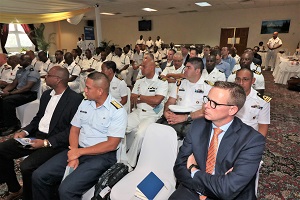
2nd insert: International representatives of marine forces and agencies (foreground) attend the Official Opening Ceremony of the 3rd Annual Stan Patrol User Group (SPUG) Conference, held at the Paul H. Farquharson Conference Centre, on November 16, 2017. (BIS Photo/Eric Rose)


The Bahamas, March 30, 2026 – The voice of a proud mother captured the spirit of a nation Monday night, as Bendra Rolle shared heartfelt reflections on the overwhelming Bahamian support for her son, VJ Edgecombe, during the Philadelphia 76ers matchup against the Miami Heat in Miami.
“The patriotic support and scenery at my son, VJ Edgecombe’s NBA game… was overwhelming,” Rolle said in a statement issued following the game. “The arena in Miami was lit. Bimini and the Bahamas showed up and showed out.”
Her words come amid what has already been widely described as a remarkable showing of national pride, with Bahamians traveling in large numbers to South Florida to witness the young guard’s continued rise. For Rolle, however, the moment extended far beyond basketball.
“Beyond VJ’s basketball talents, I’m so moved by his magnetic personality and personal journey to inspire and excite an entire nation—our beloved Bahamas,” she said. “I thank God for VJ’s humility and for his hunger for greatness. He never forgets how far God has brought us.”
While the Sixers did not secure the win on the night, Edgecombe delivered a solid individual performance, finishing with 13 points and five assists. He made an early impact on the game, showing confidence and poise before foul trouble disrupted his rhythm, but still managed to leave his mark in meaningful minutes.
The game itself evolved into a cultural showcase, with Bahamian flags waving throughout the arena and chants ringing out in support of Edgecombe. Much of that presence was bolstered by a coordinated travel push from Bahamasair, which helped facilitate fan travel and added to the electric atmosphere in Miami.
Rolle said the emotional weight of the moment was deeply felt by her family, as they witnessed firsthand the unity and pride of the Bahamian people.
“Thanks and love for the tears and overwhelming joy on Monday, Bahamas,” she expressed. “The Bahamian flags were love, loud, and proud. On my own behalf, VJ, and the entire family, I am ever grateful for the indescribable experience.”
Her closing words underscored what many have described as the true victory of the night—not the final score, but the powerful display of national pride and support surrounding one of The Bahamas’ rising stars.

PHOTO BY SIXERS NATION
Bahamian pride is already on full display in South Florida, with fans arriving in strong numbers ahead of tonight’s highly anticipated NBA matchup featuring VJ Edgecombe and the Philadelphia 76ers.
Helping to power that movement was Bahamasair, which rolled out a strategic promotion to facilitate travel, turning the game into a full-scale national showing.
And the celebration started early.
A “Bahamas Invades Florida” pre-party over the weekend set the tone, with Bahamian fans, DJs and supporters converging in Fort Lauderdale to build momentum ahead of the game. The event, marketed as a major cultural gathering, has spilled into Miami, where a strong Bahamian presence is expected inside the arena tonight.
This is no ordinary road game.
The Sixers enter the matchup healthy and are favoured to win, adding to the anticipation surrounding what many expect to be a standout performance by the Biminite guard.
Edgecombe, the third overall pick in the 2025 NBA Draft, has been electric in his rookie season — delivering high-scoring performances and quickly establishing himself as one of the league’s most exciting young talents.
But beyond the stats, it’s the moment that matters.
With South Florida just a short flight away, Bahamians have seized the opportunity to show up in force — flags, energy and all — transforming the game into something far bigger than basketball.
A national turnout.
A rising star.
And a night where the Bahamas is expected to be felt — from tip-off to final buzzer.
Angle by Deandrea Hamilton. Built with ChatGPT (AI). Magnetic Media — CAPTURING LIFE.
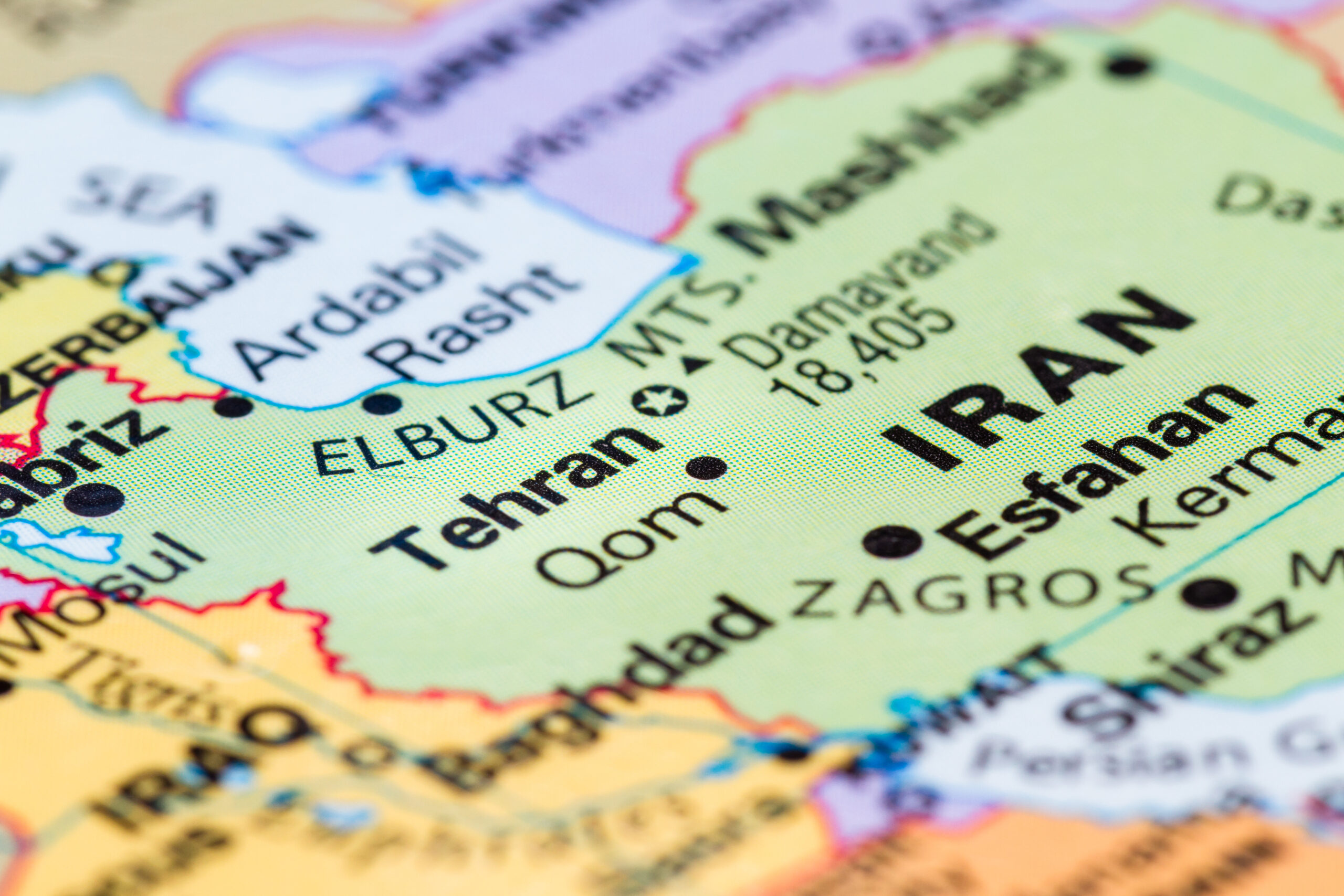
The Bahamas, March 18, 2026 – Twenty days into the latest Middle East escalation, the United Nations is warning the conflict is spreading beyond its original battlefield, as the death toll rises and governments around the world issue urgent travel advisories — including The Bahamas.
In a March 17 statement, the UN Secretary-General’s office said the war must stop and called for all Security Council resolutions to be respected, noting with concern that countries in the Gulf continue to be targeted, raising fears of a wider regional confrontation.
The current round of fighting began February 28 with strikes involving the United States, Israel and Iranian-linked forces, followed by missile and drone attacks across Iraq, Lebanon and parts of the Gulf.
International monitors report more than 1,300 people killed in Iran alone, with additional casualties reported in Lebanon, Israel and Gulf states. U.S. officials confirm at least 13 American service members have died since the escalation began, while reports indicate additional senior Iranian military leaders were killed in recent strikes.
Despite the growing violence, several NATO countries including the United Kingdom, France and Germany have not joined offensive operations, instead calling for diplomacy to prevent the conflict from widening.
The Bahamas Ministry of Foreign Affairs has also issued a travel advisory, warning Bahamian nationals to avoid travel to Israel, Palestine, Iran and Lebanon and to reconsider travel across much of the Gulf region due to the risk of sudden escalation, flight disruptions and security threats.
Officials say Bahamians already in the region should remain vigilant and be prepared for rapidly changing conditions.
Angle by Deandrea Hamilton. Built with ChatGPT (AI). Magnetic Media — CAPTURING LIFE.





-

 News4 days ago
Password to Paradise Radio Remotes at Beaches Turks & Caicos continue to highlight the TCI as the preferred Caribbean destination
-
 News5 days ago
Beaches Turks & Caicos adds four new PADI Dive Instructors to the cadre of professionals in the watersports department
-
 News5 days ago
Beaches Turks & Caicos shares fine dining experiences to high school students in Providenciales
-

 Bahamas News4 days ago
Bahamasair Backs Surge as Bahamians Flood South Florida for V.J. Edgecombe Showdown
-
 Uncategorized1 week ago
ISU Future Creators Challenge Celebrates Youth Creativity and Intellect
-

 News1 week ago
Flow TCI supports ‘Stars of Tomorrow’ at Inter-Primary Track and Field Championships
-

 News1 week ago
The Turks and Caicos Islands Featured in Top Canadian Publications
-
 News1 week ago
ISU Community Caravan Delivers Essential Services to Granny Hill North