
News
TCI: PDM Leader Astwood chimes in on 200 Imported workers at Beaches Resort

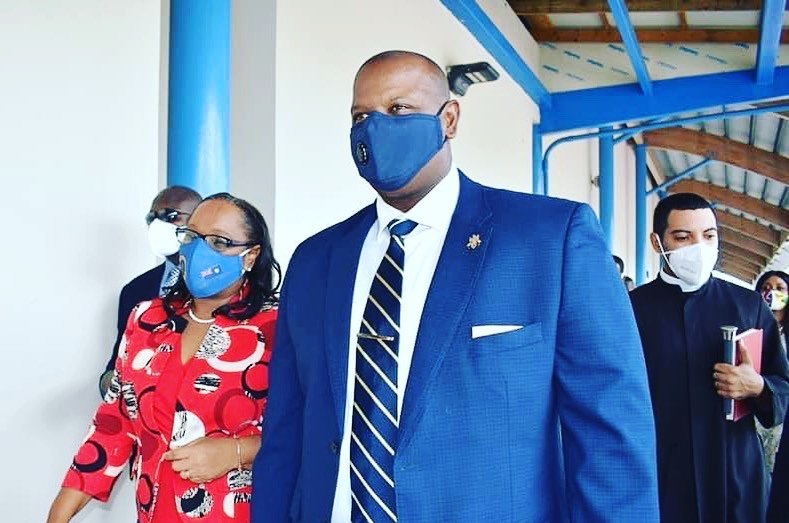
#TurksandCaicos, March 25, 2021 – “I was made aware of a WhatsApp message circulating in regards to Hon. Camillo Gonsalves, Minister of Finance, St. Vincent and the Grenadines, address in his Country’s Parliament that 200 Vincentians are to be hired for Sandals Resort in TCI and this is scheduled to occur in June/July of this year. Subsequent to Hon Musgrove’s response on this matter I have been contacted by a number of concern citizens seeking clarity of the PDM’s position on this.
When the PDM was elected in December 2016, there were no arrangements with Sandals/Beaches during our years as the Government to allow this Program; Not during my years as Minister of Border Control and Labour and not during the years the Ministry of Immigration, Citizenship, Labour and Employment was vested with the Hon. V. Delroy Williams.
On June 19, 2020 the Minister of Immigration, Citizenship, Labour and Employment placed a freeze on ALL first time work permits, which included both Senior and Lower level positions. This policy was still in place up until the PDM left office. We note the new Government has modified this policy to restrict first time work permits for mostly lower level positions.
On July 23, 2020 the Minister of Immigration, Citizenship, Labour and Employment reminded the general public that all persons whose work permits were not renewed or cancelled must leave the country. There were reminders of this over the next few months as persons were also reminded to register as unemployed in order to get first preference for jobs when they became available.
The across the board restriction on first time work permits, and the reminder for persons who were no longer work permit holders to leave the country was critical, because we as a Government were cognizant that there was significant economic fallout due to this pandemic. We recognized there were many Turks and Caicos Islanders in need of employment opportunities and they should not have to compete with work permit holders for the same opportunities.
While cross training can be beneficial, this arrangement, especially at this current time, should be reviewed closely to ensure it is beneficial to Turks and Caicos Islanders currently working in in the hospitality industry, and those TCIs who are currently seeking employment in the industry.
We believe that as the country continues to restore its economy, Turks and Caicos Islanders should be able to fully capitalize on all job openings and the 100% service charge implemented by the PDM Government.
The June/July 2021 timeline, these 200 persons are anticipated to arrive , as stated by Hon. Gonsalves, is around the same time when many of our students will be graduating from high school and university. Therefore, in addition to Turks and Caicos Islanders who are currently unemployed and underemployed, we will have recent high school and university graduates that will be seeking employment.
Where possible Beaches Resort TCI should fill those 200 available positions with Turks and Caicos Islanders.
I strongly suggest that the Government carries out a country wide employment registration drive to fully capture all Turks and Caicos Islanders who employment status has changed since the onset of this pandemic. This should also be done in tandem of reviewing the Business Staffing Plans of companies to ensure Turks and Caicos Islanders are placed in positions which allows for upward mobility.
I also note the public statements from those in official quarters stating that this arrangement was agreed by the former PDM Administration and call on the PNP Government to publicly release any and all Agreements with Beaches as it relates to Immigration matters. The public has a right to have full clarity in this matter. In addition, I call on the PNP Government to fully clarify the contradictory reports given by Beaches who stated that it was working out the details with the new government and the Hon Minister Arlington Musgrove who says he will call a Meeting. There is an urgent need for full transparency and clarification on this matter.”



Providenciales, Turks and Caicos Islands, 13th April 2026 — The Department of Disaster Management and Emergencies (DDME), in collaboration with the TCI Red Cross, facilitated a six-day Community Emergency Response Team (CERT) training for residents of the Blue Hills and Wheeland communities from March 17–20 and 23–25, 2026.
The CERT training sought to equip everyday residents with essential skills to respond effectively to minor emergencies within their communities. Key areas of focus included; Incident Command, Search and Rescue (SAR), Disaster Medical Operations, Fire Safety and Response, and Initial Damage Assessment.
A total of 17 residents from Blue Hills and Wheeland are now CERT-certified and prepared to support their communities during emergencies; providing assistance ranging from basic disaster response to critical emergency support.
Facilitators for the training included Ms. Candianne Williams, Director and Mr. Andrew Gardiner DRR Manager from the TCI Red Cross; Mr. Aubrey Felix and Mr. Roosevelt Glinton from the TCI Fire and Rescue Service and Mr. Mike Clerveaux Director of the Housing Department and CERT Instructor. Facilitators from DDME included Ms. Tamara Hylton, Training and Education Manager; Mr. Angelo Duncan, Hazard Mitigation and GIS Manager and Mrs. Patrina Pollard-Harris Training and Education Officer.
Hon. Kyle Knowles, Minister of Health and Human Services and Member of Parliament for Wheeland and Hon. Randy Howell, Member of Parliament for Blue Hills; provided invaluable support to the training and were also present to demonstrate commitment to their respective communities.
Ms. Candianne Williams, commented on the collaboration, stating: “The TCI Red Cross is pleased to have worked alongside DDME to deliver CERT training for the Blue Hills and Wheeland communities. This programme strengthens local readiness and we commend the participants for stepping forward to support their neighbourhoods.”
Praising the success of the training, Mr. Tito Lightbourne, Permanent Secretary for National Security with responsibility for DDME, stated “I would like to emphasize that this Community Emergency Response Training marks the first of many more to come over the course of the year. I look forward to supporting its expansion into additional communities across the Turks and Caicos Islands and extend my sincere thanks to the collaboration between DDME and the TCI Red Cross and to all facilitators and participants who helped to make this inaugural session a success.”
DDME and the TCI Red Cross thanks all participants for volunteering to be part of this dynamic training and for their shared commitment towards building safer, stronger communities. Through this continued collaboration, both organizations look forward to expanding CERT training programmes to more communities across the Turks and Caicos Islands.

Turks and Caicos, April 06, 2026 – Technical excellence early in their jumps became the defining factor for two Turks and Caicos athletes, as David Hall soared to gold in a nail-biting Under-20 high jump final at the 53rd CARIFTA Games in Grenada. Herwens Guerrier added to the country’s success with a 1.90 metre clearance to secure silver in the Under-17 division, finishing in a tightly contested field where all three medalists cleared the same height.
Both events were decided on countback — meaning the medals were determined not just by height cleared, but by which athlete did so with fewer failed attempts, highlighting the importance of precision and composure under pressure.
A wave of national pride followed the results, with congratulatory messages pouring in for the athletes who delivered under pressure on the regional stage. In a statement, Dileeni Daniel-Selvaratnam praised both competitors, saying their “hard work, discipline and determination have made the entire nation proud,” while encouraging the wider team to continue striving as competition unfolded at the Kirani James National Stadium in Grenada.
Team Turks and Caicos finished just outside of the top ten among 28 competing nations, and anticipation is already building for what is expected to be a spirited homecoming for the standout athletes, whose performances have ignited pride across the islands.
The 53rd staging of the CARIFTA Games, held at the Kirani James National Stadium in Grenada, unfolded under warm, at times testing conditions, with intermittent showers and shifting winds challenging athletes across disciplines.
Jamaica once again asserted its dominance, capturing its 40th consecutive CARIFTA title, continuing an unmatched run in regional athletics. Among the standout performers was Shanoya Douglas, whose electrifying run in the Under-20 200 metres earned her the prestigious Austin Sealy Award — the Games’ highest individual honour — after she shattered the long-standing record of Bahamian Shaunae Miller-Uibo, who went on to become an Olympic gold medalist in the 400 metres. Douglas clocked an impressive 22.11 seconds to rewrite the CARIFTA record books.
For Turks and Caicos, however, the spotlight remained firmly on the field, where two high jumpers delivered performances defined by discipline and growth. Hall’s gold medal-winning clearance of 2.00 metres marked a significant step forward in his development, improving on his 1.89 metre silver medal performance at the 2025 Inter-High Championships. Guerrier’s 1.90 metre effort in the Under-17 division similarly places him among the country’s top emerging talents, signalling a strong future for the event locally.
Angle by Deandrea Hamilton. Built with ChatGPT (AI). Magnetic Media — CAPTURING LIFE.

NASSAU, Bahamas — What should be a simple five-minute drive is fast becoming an expensive, hour-long ordeal, as rising fuel prices collide with worsening traffic congestion across New Providence.
As of early April 2026, gasoline prices across The Bahamas have climbed sharply, with motorists now paying an estimated $5.50 to over $6.50 per gallon, depending on the station and grade. The increases, seen at major retailers including Esso, Rubis and Shell, reflect a volatile global oil market driven by escalating geopolitical tensions.
The latest spike — in some cases jumping more than 50 cents per gallon within days — is being driven by uncertainty surrounding escalating tensions involving Iran. U.S. President Donald Trump has issued a direct ultimatum, warning that the United States could launch aggressive strikes on Iranian infrastructure, including power plants and key facilities, if demands are not met. While he has also expressed hope for a swift resolution, the threat of rapid escalation is already rattling global oil markets — and The Bahamas, heavily dependent on imported fuel, is feeling the impact almost immediately.
At the pumps, the frustration is real.
Drivers are now paying significantly more just to sit in traffic. Commutes that once took minutes are stretching into hour-long crawls, burning fuel with little movement and compounding the financial strain. For many residents, the issue isn’t just the price per gallon — it’s how quickly that gallon disappears.
Industry players are also bracing for impact. Higher diesel prices are expected to ripple across key sectors, including trucking, construction, and shipping — all of which ultimately feed into the cost of goods and services. In short, this is not just a fuel story; it’s an inflation story in the making.
Despite the surge, the Bahamas Petroleum Retailers Association has moved to calm fears, confirming that there is no fuel shortage. Supply remains stable, but consumers are being urged to adjust behavior — from maintaining proper tyre pressure to considering carpooling — small measures that could stretch every dollar a bit further.
Retailers, however, are not offering much comfort on price relief. While fluctuations are expected, insiders say the days of sudden price drops are unlikely in the immediate term. The “shock” increases may level off, but a meaningful decline hinges on global stability — something that currently feels out of reach.
For Bahamians, the reality is tightening: higher fuel costs, longer commutes, and a growing sense that relief isn’t coming anytime soon.
Angle by Deandrea Hamilton. Built with ChatGPT (AI). Magnetic Media — CAPTURING LIFE.





-

 News1 week ago
GOLD & SILVER – Hall & Guerrier Fly High for Turks and Caicos at CARIFTA 2026
-

 News1 week ago
CALL 649-338-4008 OR 649-338-2684 IF A CHILD IS AT RISK: TCI Confronts Alarming Reality During Child Abuse Prevention Month
-

 Independent writer6 days ago
The Rise of Right-Wing Populism and What It Could Mean for the Turks and Caicos Islands
-

 News1 week ago
Beaches Turks & Caicos, FIU train next generation of hospitality leaders in Providenciales
-

 Bahamas News1 week ago
FNM’S $200 CHILD SUPPORT PLAN SPARKS DEBATE AS PLP QUESTIONS FUNDING AND SCOPE
-

 Bahamas News1 week ago
Fuel Pain at The Pump: Global Tensions Drive Prices Up as Bahamians Feel the Squeeze
-

 News1 week ago
Birthright Citizenship Unchanged as U.S. Supreme Court Weighs Case, Majority of Americans Oppose Ending Policy
-

 News1 week ago
DECLARATIONS DUE: INTEGRITY COMMISSION CALLS PUBLIC OFFICIALS TO ACCOUNT